
 Back
Back








Digital product development in a highly competitive technological scenario today indeed needs to be done at a tremendous pace and agility, along with quality, to keep up with the fast-changing user expectations. DevOps bridges development and operations, this approach of DevOps has emerged as a transformative approach that enables flexible collaboration and faster deployment cycles.
Best practices of DevOps help smooth out workflows through DevOps workflow optimization, enhance product reliability, and improve overall efficiency. Hence it becomes necessary to understand the DevOps best practices that digital product teams can follow for faster and more reliable product delivery.
What is DevOps?
DevOps is a group of practices that combines software development, or Dev, with IT operations, abbreviated as Ops. It seeks to help deliver products faster and more efficiently. DevOps focuses on automation, continuous integration and delivery(CI/CD), collaboration, and monitoring throughout the product lifecycle. Breaking barriers between the teams, DevOps promotes a culture of shared responsibility and continuous improvement.
Why DevOps is Essential for Digital Product Development?
In the modern world of digital product development, with the demand for shorter release cycles, higher standards of quality, and better user experiences, it is critical to implement DevOps practices and stay updated on DevOps trends.
DORA(DevOps Research and Assessment) research reveals that high-performing DevOps teams deploy 208 times more frequently and recover from incidents 2,604 times faster than their low-performing practices. DevOps tends to emphasize automation, continuous feedback, and rapid iteration-things quite necessary for being competitive in the rapidly evolving digital economy.
7 Proven DevOps Best Practices to Accelerate Digital Product Development
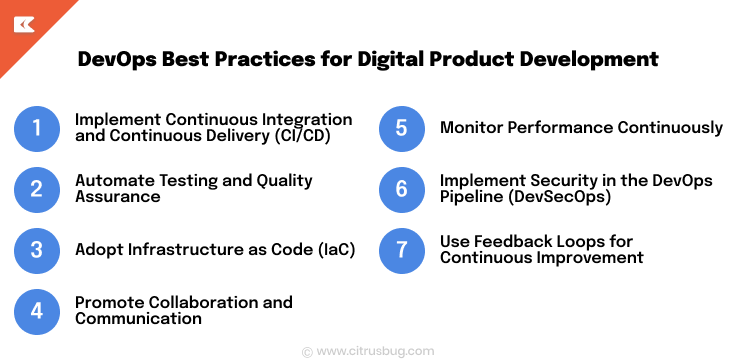
1. Implement Continuous Integration and Continuous Delivery (CI/CD)
CI/CD pipeline automation is at the core of effective workflows in DevOps, and continuous integration ensures that all codes added are automatically tested and pushed to the master branch quite frequently. Continuous delivery goes one step further, allowing teams to make automatic deployments into the production environment after clearing all tests. It shortens the feedback loops thus minimizing bugs and getting new features delivered much faster.
As observed by the State of DevOps Report from Puppet, organizations employing CI/CD perform many fewer deployments that fail, and their lead times are significantly faster than those of their peers.
2. Automate Testing and Quality Assurance
Automated testing is an integral piece of a healthy DevOps pipeline and the digital product development process. With unit, integration, and end-to-end automated tests, incoming code changes should not only be free of bugs but not break existing features.
The integrations of automation at all these stages help catch bugs early in development, which can save costs when fixing bugs and improve the quality of code. The automation of testing processes also increases the team’s capacity to innovate, as less time is spent manually fixing issues.
3. Adopt Infrastructure as Code (IaC)
Infrastructure as Code enables teams to manage and provision computing resources using code rather than doing it manually. This entails treating infrastructure configuration as code, hence versioning and automating deployments that guarantee consistent and repeatable environments all through development, staging, and production.
In cases where IaC relies on tools such as Terraform and AWS CloudFormation, managing them becomes simpler. Gartner’s study claimed that IaC can automatically shorten deployment times of infrastructure by 80%.
4. Promote Collaboration and Communication
DevOps is more about cross-functional collaboration between development and operations along with other stakeholders using DevOps collaboration tools. Regular meetings shared tools such as Slack and Jira, and a culture of shared responsibility promotes collaboration, thus encouraging teamwork toward common goals. Advanced jira reporting, enables teams to unify insights on cycle time, project timelines, and cross-team work, helping them continuously improve DevOps efficiency. Even communication diminishes friction and accelerates the resolution process, which ultimately results in the fast and effective delivery of the product. Incorporating jira checklists can help track progress, ensuring that tasks are completed on time and nothing falls through the cracks.
5. Monitor Performance Continuously
Monitoring tools give you real-time performance information as far as applications, system health, and user behaviour are concerned. Continuous monitoring, including error tracking, allows teams to detect issues early, understand usage patterns, and improve customer satisfaction.
Tools like Prometheus, Grafana, Middleware and New Relic give insights into the health of your applications. According to Deloitte, companies utilizing advanced monitoring can cut downtime by up to 90%.
6. Implement Security in the DevOps Pipeline (DevSecOps)
DevSecOps is the term when security processes are integrated into DevOps practice. When security threats keep increasing, DevSecOps becomes critical for the firm. It emphasizes security checks in the development cycle as early as possible, allows security tests to be automated, and infuses security as a collective responsibility of the teams that are involved. Adopting DevSecOps aids in finding vulnerabilities earlier, thus providing a secure product without sacrificing speed in development.
7. Use Feedback Loops for Continuous Improvement
Continuous improvement is essential in an agile DevOps culture. It would always allow teams to analyze processes and make decisions supported by data if they gather feedback from end-users and monitor performance metrics. A continuous feedback loop, therefore, forms an environment of learning and innovation that helps build better products and allows teams to react more effectively to changed market needs. To make the most of this process, collaborating with product strategy consultants can also help align improvements with your broader business goals.
Common DevOps Challenges in Digital Product Development (and How to Overcome Them)
DevOps adoption is rarely a smooth ride, even mature engineering teams hit recurring roadblocks that slow delivery and erode the gains DevOps promises. Recognizing these challenges early helps product teams build resilient pipelines and avoid costly course corrections later in the development cycle.
Here are the most common DevOps challenges digital product teams face, along with proven ways to overcome them:
- Cultural Resistance and Siloed Teams: Developers, operations, and QA often operate in silos with conflicting KPIs. Align incentives across teams, run blameless post-mortems, and embed shared on-call responsibilities to dissolve the wall between Dev and Ops.
- Toolchain Sprawl: Teams accumulate dozens of overlapping CI runners, monitoring stacks, and ticket systems, creating cognitive overhead and integration debt. Standardize on a curated toolchain and consolidate workflows through DevOps automation services that unify pipelines end-to-end.
- Skill and Talent Gaps: Engineers proficient in IaC, Kubernetes, and observability are scarce. Bridge gaps through structured upskilling, internal pair programming, or by partnering with experienced DevOps consulting companies in the USA to accelerate maturity.
- Legacy Infrastructure Bottlenecks: Monolithic applications resist automation and stall release cadence. Apply the Strangler Fig pattern, refactor modules incrementally into containerized services rather than attempting a big-bang rewrite.
- Security as an Afterthought: Shifting security left is hard when pipelines are already entrenched. Introduce SAST and DAST scanning into existing CI stages, and treat newly discovered vulnerabilities as build-breaking failures.
- Inadequate Observability: Without unified logs, metrics, and traces, incidents take hours to diagnose. Adopt OpenTelemetry as the instrumentation standard and invest in centralized dashboards from day one.
Essential DevOps Tools and Technology Stack for 2026
The DevOps tooling landscape has matured significantly, with platform engineering and AI-augmented automation now reshaping which tools deliver the highest ROI. Choosing the right stack depends on team size, cloud provider, and product complexity — but a few categories are non-negotiable for any modern DevOps pipeline.
Here’s a category-wise breakdown of the essential DevOps tools digital product teams should evaluate in 2026:
- Version Control and Source Management: GitHub, GitLab, and Bitbucket remain the foundation, with GitHub Actions and GitLab CI now offering native pipeline capabilities directly inside the repo.
- CI/CD Platforms: Jenkins, CircleCI, GitHub Actions, and ArgoCD dominate enterprise workflows, with GitOps becoming the default deployment pattern. Detailed adoption insights are available in our analysis of the DevOps automation tools market.
- Infrastructure as Code (IaC): Terraform, Pulumi, and AWS CDK lead the IaC category, with Ansible and Chef holding strong ground for configuration management at scale.
- Container Orchestration: Kubernetes is the de facto standard, supported by managed offerings like Amazon EKS, Google GKE, and Azure AKS for teams preferring reduced operational overhead.
- Monitoring and Observability: Prometheus, Grafana, Datadog, and New Relic provide full-stack visibility, while OpenTelemetry has emerged as the unifying instrumentation standard across vendors.
- Security and Compliance: Snyk, Aqua Security, and HashiCorp Vault embed shift-left scanning into pipelines, while expert cloud consulting services help integrate compliance controls without slowing delivery velocity.
- Collaboration and Workflow: Slack, Jira, PagerDuty, and Linear keep cross-functional teams synchronized through every release cycle and on-call rotation.
Key Benefits of Adopting DevOps Best Practices in 2026
Adopting these DevOps best practices would help digital product development teams obtain an immense number of benefits, including:
a) Increased Deployment Frequency: Teams can deploy fast and more frequently. This allows them to make rapid iterations, validate user needs, and get out newer features or updates more rapidly.
b) Enhanced Product Quality: Since the bugs are reduced by automated testing and CI/CD, this works to provide an even more reliable and stable product.
c) Improved Collaboration and Productivity: Reduces barriers between teams, enhances open communication, and gives birth to an agile as well as productive team.
d) Reduced Downtime: Continuous monitoring and real-time monitoring tools reduce system failures and ensure there is minimum downtime hence ensuring the experience of better quality to the users.
e) Stronger Security: By inducting security practices into the DevOps pipeline, the product becomes more secure.
The Future of DevOps: AI, MLOps, and Platform Engineering Trends
DevOps is evolving rapidly, with three forces reshaping how digital products will be built and shipped over the next few years: AI-driven automation, MLOps integration, and platform engineering as a discipline. Forward-looking teams are already restructuring their pipelines and team topologies to capitalize on these shifts.
AI-Augmented DevOps (AIOps)
Generative AI now drafts CI configurations, suggests rollback strategies during incidents, and predicts pipeline failures before they cascade. Tools like GitHub Copilot for DevOps and predictive observability platforms are significantly reducing manual toil across release cycles, freeing engineers to focus on architecture and product outcomes.
MLOps and Model Lifecycle Management
As AI models move from research labs into production, machine learning operations is becoming inseparable from traditional DevOps. Teams need versioning for data and models, automated retraining, and continuous monitoring, capabilities covered by dedicated MLOps consulting services and surveyed in our review of the leading MLOps tools and platforms.
Platform Engineering and Internal Developer Platforms (IDPs)
Rather than every team rebuilding the same pipelines, organizations are creating golden-path platforms that abstract infrastructure complexity behind self-service interfaces. This frees product developers to focus on features while platform teams maintain the underlying stack and enforce best practices.
Conclusion
Implementing DevOps best practices and utilizing DevOps services & solutions is a strategic decision that develops the competency of digital product teams in producing high-quality products with efficiency. Looking from different viewpoints of CI/CD and automation as well as security and continuous monitoring, each of these practices brings value to development in some way or the other. Organizations become agile, optimize collaboration, and produce digital products with scalable DevOps solutions that epitomize performance and reliability at high levels.
Beyond streamlining flows, DevOps establishes a basis for continuous improvement and ensures that the digital product stays competitive in this dynamic marketplace. That is to say, using DevOps best practices today is a good investment for future success regarding your digital product, establishing a basis for sustainable growth and innovation.