
 Back
Back

Today, Artificial Intelligence (AI) has become a mainstream phenomenon and has an impact on every industry ranging from retail to banking and consumer electronics. From intelligent assistants on smartphones such as Siri and Google Now to a smart speaker and device embedded virtual assistants like Alexa, we can easily say that every person interacts with some form of AI on a daily basis. This growing reliance on AI is reflected in evolving software development statistics that showcase its widespread adoption across industries.
From a business perspective, research firm Gartner estimates that nearly 37% of all organizations have implemented some form of AI in their business operations. While a good majority of these implementations have gone into consumer-facing avenues, AI is also a highly efficient tool for several businesses to spruce up their internal efficiency and productivity. A good example of one such industry is none other than the software industry.
Studies show that globally, the market for custom software development services will hit a staggering 61 Billion US Dollars by 2023 from the 47 Billion it was in 2018. And one of the key drivers of this growth will undoubtedly be autonomous software development paradigms that are facilitated by artificial intelligence. We are not talking just about coding without programmers here but a more holistic approach on building software with machine learning and big data analytics. We shall go into the details further in this blog.
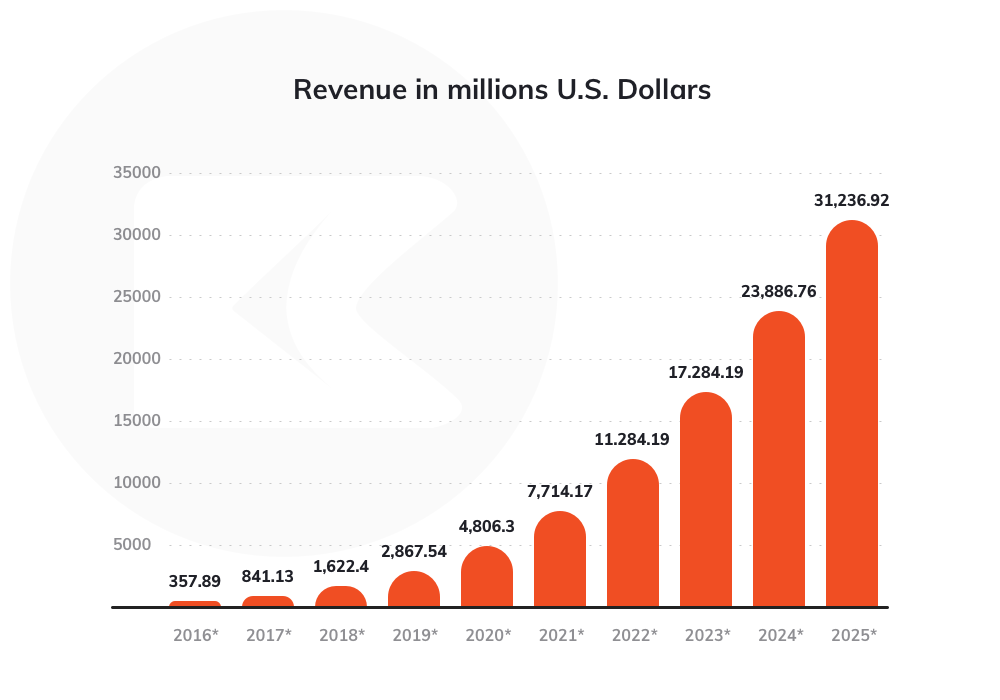
Source : Statista
Credited with building the foundation of AI in almost every business environment, the software sector has witnessed massive efforts recently to use AI in improving their own services. AI software development is a hot and trending topic among the C-Suite of today’s large as well as small technology companies.
In addition to helping companies accelerate the pace of software development traditionally, AI is giving IT companies the ability to transform and re-invent their operational models considerably. Here are 5 ways in which AI is bringing a significant change in software development today:
How AI Coding Assistants Are Changing the Way Developers Write Code
Any form of software development involves coding and for developers, the biggest impact that AI can bring in their daily routine is by helping them to code better and faster. So how can AI achieve this?
If we take a closer look at how much time each activity that a developer undertakes daily, it can be clearly seen that a good majority of this time is spent on surfing through the documentation on project specifics and debugging code that is created. Intelligent assistants that support programmers can bring a plethora of changes in this regard and make lives easier for developers.
Using high-end AI assistants, it is possible for developers to get access to real-time recommendations on code specific documents, best practices as well as examples of code that can fit particular use-cases perfectly. Kite, Codota are some well-known examples in this regard which makes work easier for developers focusing on Python and Java respectively.
In fact, startup companies in the AI-assisted programming sector have raised over 704 million USD in 2019 alone which shows the huge potential this has in reshaping the software sector in the coming years.
What Makes an AI Coding Assistant Worth Using in 2026?
Not all AI coding assistants deliver equal value. The best tools in 2026 go beyond autocomplete, they understand context across files, suggest refactors, flag security vulnerabilities in real time, and integrate directly into CI/CD pipelines. Teams evaluating tools like GitHub Copilot, Cursor, or Tabnine should assess context window depth, language model quality, and how well the tool explains its suggestions rather than just generating them.
Agentic AI: When Software Starts Building Itself
The 2026 AI landscape has moved well beyond assisted coding. Agentic AI systems, autonomous agents capable of planning, executing, and validating multi-step development tasks, are beginning to handle full feature development cycles without continuous human input. Tools like Devin, OpenHands, and similar autonomous coding agents can receive a task brief, write code, run tests, debug failures, and submit pull requests independently.
This shift does not mean developers are obsolete. It means senior engineers increasingly act as orchestrators, defining constraints, reviewing agent output, and validating alignment with broader system architecture. For software teams, the practical value is in deploying agents for well-scoped, repeatable tasks: data migrations, API scaffolding, and test suite generation. Human judgment remains essential for system design, client communication, and risk evaluation.
AI-Powered Rapid Prototyping: From Concept to MVP in Hours
One of the major reasons for delayed project kick-offs and contract signing in the IT sector is the inability of service providers to offer a demonstration of the proposed solution in time to convince clients of their potential. The prototype they build to support their claims may have delayed implementation time and can possibly lead to loss of customer interest due to excessive delays.
There needs to be a mechanism for smart and faster prototyping of solutions or in other words, a minimum viable product or solution needs to be demonstrated at the earliest.
This is an area where artificial intelligence can step in to make a considerable impact. Smart AI tools can help solution architects map business functionality into technical prototypes in a matter of minutes or hours when compared to the weeks or months it takes for a manual process. Machine learning, combined with the rise of low-code AI development platforms, enables even associates with limited technical backgrounds to generate working product demonstrations quickly.
It empowers the creation of actual visual representations of technology solutions having fully functional user interface components and output generation capabilities. This will help shorten sales cycles and also create a crucial reference element for the development team when they set out to create the actual product after the client is convinced with the prototype demonstration.
AI-Driven Bug Detection and Automated Error Management in Code
Writing code is no easy job and just as with any manual activity it is never free from erroneous circumstances as well. And everybody knows what happens when critical errors creep into blocks of code and go undetected and enter deployment. While developers do a routine job of reviewing their own code regularly, chances of them skipping errors are high.
This is where AI can be a game-changer. Large language models in software engineering can be trained to study erroneous patterns in developer behavior and infer how potential bugs are introduced into code blocks. It can then classify common errors into a pool and highly unexpected ones into another.
Once this is done, these AI bots can review and capture erroneous behavior in code blocks faster and more efficiently than human coders. AI-assisted code review bots analyze system logs, check against predefined syntax rules and code style guides, and flag issues before code advances to compilation or quality assurance stages.
Moving forward, the industry expects AI enabled error handling systems to identify, trace the root and rewrite erroneous code or code blocks without human intervention. While this can sound a bit scary it is a possible scenario and a very beneficial element for software developers to churn out risk-free code.
How AI-Enabled Software Testing Is Redefining Quality Assurance
The one area where artificial intelligence can make the biggest impact when it comes to the software development lifecycle is the testing phase or more popularly known as the Quality Assurance phase. Even today, several large enterprise application development projects utilize a plethora of test automation tools like Selenium to create automated testing environments for their developed code.
AI in testing opens a new dimension in this regard. From analyzing code for errors and bug fixes to ensuring sanity checks on all running environments, AI-enabled software testing platforms can help IT service companies leverage human resources for more important tasks rather than engaging them for routine jobs such as script creation for testing.
Autonomous software testing platforms, including agentic QA testing tools, can transform QA into a more self-sustaining pipeline within the software lifecycle, reducing manual effort while helping teams identify issues before deployment.
This helps in preventing maximum number of errors or bugs, as they are fondly called in the software development world, from creeping into the final code ready for deployment. Though making autonomous makes the entire software delivery process faster, it is advisable to have human monitoring of the activity to ensure that there aren’t any technical glitches that may lead to unscripted test scenarios from popping up.
Using AI for Predictive Project Scheduling, Cost Estimation, and Budgeting
The key reason why clients often face dissatisfying experiences with IT service providers is due to wrong budgeting and project delivery scheduling. This happens because a lot of estimations and effort calculation processes are driven by manual workflows.
There is also a lack of a definitive process where feedback from previous estimation and budgeting activities are used as lessons learned to avoid repeated mistakes. This calls for an intelligent overhaul of the budgeting and scheduling process as a whole.
Artificial Intelligence can be the key difference in this context by making the entire project scheduling and budgeting activity a well informed and autonomous process.
Reliable estimation requires clear visibility across:
- Project scope and technical complexity
- Client deliverables and acceptance criteria
- Historical team performance benchmarks
- Resource availability and capacity
- Risk factors that manual workflows routinely underestimate
By using powerful AI enabled platforms, there is a huge opportunity to predict estimates more accurately and avoid negative and dissatisfactory experiences for clients. Machine learning project estimation models can parse implementation scope from RFPs and cross-reference historical project artifacts to understand how previous user story estimates mapped to actual delivery time and cost.
These AI tools would then allow project managers to predict accurate figures for schedules and budgeting thereby creating a win-win situation for all stakeholders.
What Are the Risks of AI in Software Development Teams?
The benefits of AI in software development are real, but so are the risks that teams need to manage deliberately. Over-reliance on AI-generated code without adequate review can introduce subtle security vulnerabilities, license compliance issues, and architectural drift. There is also the challenge of skill atrophy, junior developers who primarily write code through AI prompts may miss foundational understanding that becomes critical when debugging complex, system-level failures.
The teams that gain the most from AI are those that treat it as a force-multiplier on existing skill, not a substitute for it. Establishing review protocols for AI-generated code, running regular security audits on LLM-assisted output, and continuing to invest in developer education will help organizations capture AI’s productivity gains without compounding technical debt.
The Future of AI in Software Development: What Teams Should Do Next
Artificial Intelligence is definitely turning into a focal tool for both business leaders and engineering teams to make strategic decisions on software development. From coding to testing and prototyping, the areas where AI can make contributions are widespread. The ones who invest wisely to on-board the best tools and follow best practices while utilizing the tools will gain a significant advantage over the competition. The digital transformation and AI adoption drive that businesses worldwide are pursuing demands software delivery that is both faster and inherently more reliable.
AI in software development is a key pillar that every IT organization needs to build, not as a cost-cutting measure, but as a capability that helps their customers move faster and more confidently.
AI should not be seen as a threat to the developers who build the software we all depend on. It is an intelligent enabler, one that amplifies what skilled engineers can achieve and raises the quality ceiling for every application they ship.