
 Back
Back







SaaS challenges in development have grown more complex as cloud platforms scale, customers expect zero downtime, and security regulations tighten across every market.
Building a successful product today demands more than clean code; it requires architectural foresight, strict compliance discipline, and a clear retention strategy.
This guide breaks down the most pressing technical and operational SaaS challenges teams face when developing SaaS products, and how to navigate each one.
What is SaaS Development and Why is it Uniquely Challenging?
Software-as-a-Service development differs from traditional software builds because the product, infrastructure, and customer experience all sit on the vendor’s side of the contract. Every architectural decision affects thousands of tenants simultaneously, and every release ships to live customers within hours.
Engineers must design for elasticity, multi-tenant isolation, continuous delivery, and predictable subscription economics. Partnering with an experienced SaaS development company helps teams avoid the expensive missteps that come from underestimating these compounding constraints during early planning.
Top SaaS Challenges You Face During Development
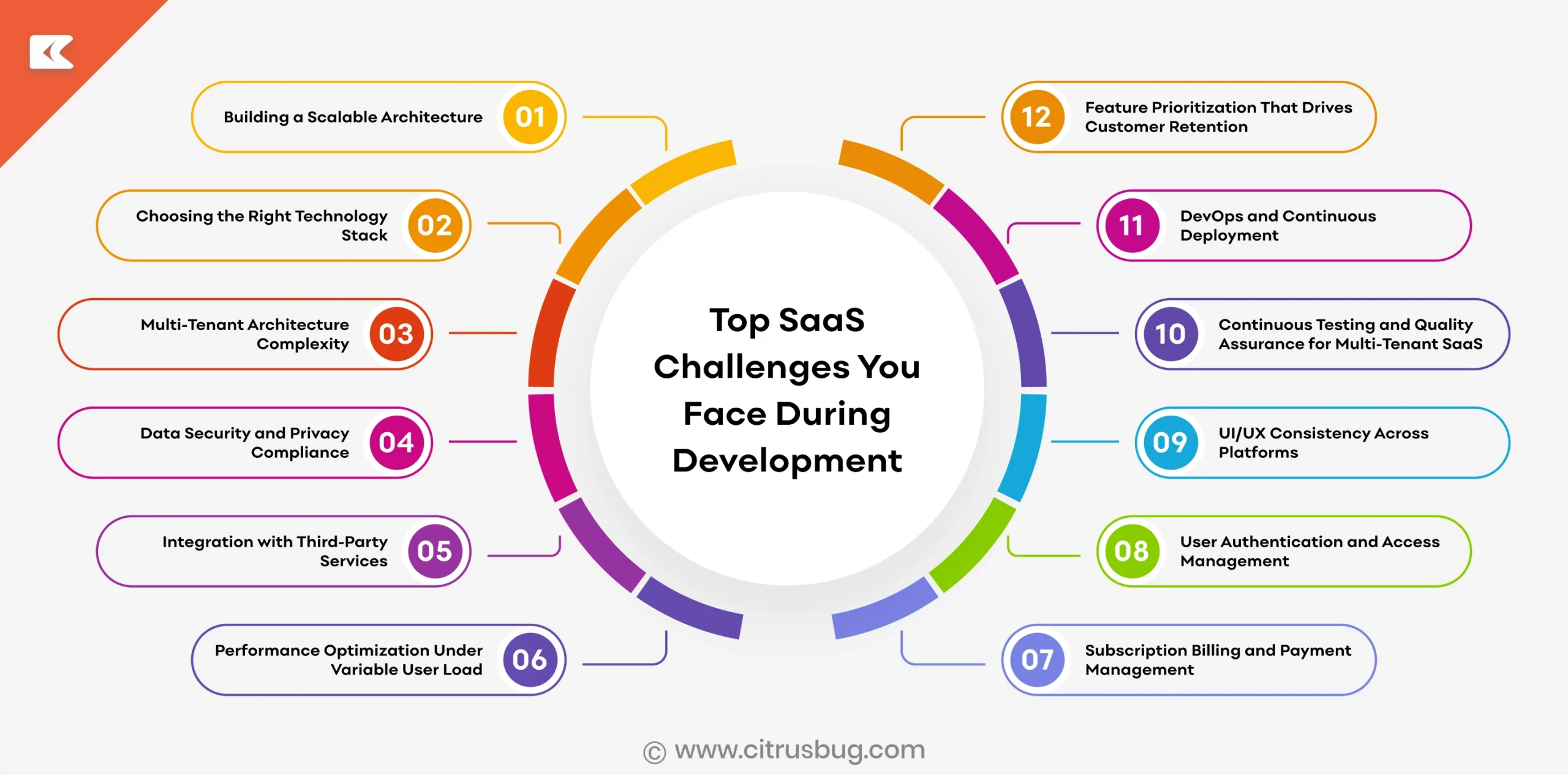
The Software-as-a-Service development challenges below appear across every stage from architecture planning to post-launch retention. Some are technical, some operational, and many compound on each other.
1. Building a Scalable Architecture
Scalability is the foundation of every SaaS platform, yet many teams underestimate how quickly traffic patterns become unpredictable. Designing horizontal scaling, load balancing, and resilient microservices early prevents costly refactors later when usage compounds.
Engaging with cloud architecture consulting experts during the design phase helps validate elasticity assumptions before user load exposes them as wrong.
Distributed caching, database sharding, and async messaging patterns belong in the conversation from day one not as emergency retrofits during a Series A scaling incident.
2. Choosing the Right Technology Stack
The wrong stack creates technical debt that compounds for years. Founders often choose default to familiar frameworks rather than evaluating fit against tenant volume, expected concurrency, and the team’s actual operational expertise.
Modern SaaS products lean toward containerized backends, polyglot persistence, and reactive frontends, but no single combination is universal.
Stack decisions should be stress-tested against the product roadmap and the realities of hiring, not just the current feature requirements that look manageable today.
3. Multi-Tenant Architecture Complexity
Another crucial SaaS challenge is multi-tenancy. It decides how customer data, configuration, and performance are isolated. Shared-database designs reduce infrastructure cost but raise security and noisy-neighbor risks, while siloed databases improve isolation at the expense of operational overhead.
The right model depends on customer size, compliance scope, customization needs, and the cost of cross-tenant data leakage if something goes wrong.
This is rarely a decision teams revisit cheaply later, which makes the upfront analysis non-negotiable for serious products.
4. Data Security and Privacy Compliance
Security in SaaS is non-negotiable for every organization. Encryption at rest and in transit, role-based access control, audit logging, and tenant data segregation form the baseline that buyers now expect by default in every procurement review.
Compliance frameworks like SOC 2, GDPR, and HIPAA add layered obligations that cannot be bolted on near launch.
Reviewing established SaaS application security practices helps teams build defensive controls before audit season arrives and threatens deal velocity.
5. Integration with Third-Party Services
Modern SaaS products rarely live in isolation. Customers expect connections to identity providers, payment gateways, CRMs, analytics tools, and webhook ecosystems that extend the platform into the rest of their stack.
Each external API introduces failure modes, version drift, and rate-limit exposure that the core product inherits. Engineering teams must design retries, idempotency, circuit breakers, and graceful degradation into every integration to prevent third-party outages from cascading into the customer’s experience.
6. Performance Optimization Under Variable User Load
SaaS workloads spike unpredictably a single enterprise tenant can dwarf thousands of smaller ones during an end-of-month reporting cycle. Caching layers, query optimization, and CDN-based asset delivery are essential, but they only solve part of the problem.
Real performance gains come from continuous profiling under production-like load. Synthetic testing alone misses the patterns that cause latency in real multi-tenant traffic, where co-tenant behavior, database connection contention, and cold cache events combine in ways no staging environment can fully reproduce.
7. Subscription Billing and Payment Management
Recurring billing introduces complexity that one-time payment systems never face. Plan upgrades, downgrades, prorated charges, dunning workflows, tax automation, and failed-payment recovery all require deliberate engineering and ongoing financial reconciliation.
Most teams underestimate the operational burden of refunds, chargebacks, currency conversion, and global tax compliance. The cost of ignoring these flows shows up as silent revenue leakage, customer disputes, and finance teams maintaining spreadsheets that should have been automated months earlier.
8. User Authentication and Access Management
Authentication needs to support single sign-on, multi-factor authentication, and granular role hierarchies that mirror enterprise org charts. SCIM provisioning, OAuth flows, and session management add layers of complexity that grow with every new tenant.
Skipping these capabilities locks startups out of mid-market and enterprise contracts where security questionnaires gate every procurement conversation, often killing deals before pricing discussions begin.
Identity is rarely a glamorous investment, but it is one of the highest-leverage ones in SaaS development.
9. UI/UX Consistency Across Platforms
Customers reach SaaS products through web, mobile, embedded widgets, and partner integrations. Maintaining consistent design language, interaction patterns, and accessibility standards across these surfaces is harder than it looks once feature velocity increases.
Design systems, shared component libraries, and platform-aware testing pipelines keep the experience coherent without forcing teams to rebuild flows for every new client.
Without this discipline, the product fragments into something that feels stitched together rather than intentionally designed.
10. Continuous Testing and Quality Assurance for Multi-Tenant SaaS
Quality assurance in SaaS extends beyond unit and integration testing. Multi-tenant regression scenarios, environment parity checks, and contract testing against external APIs are mandatory for products that ship multiple releases per week.
Continuous automated testing pipelines catch tenant-specific edge cases before they reach production.
Without this rigor, every release becomes a roll of the dice that erodes customer trust faster than any single outage because customers experience reliability as a pattern, not as isolated incidents.
11. DevOps and Continuous Deployment
Modern SaaS teams ship multiple times a day, which is impossible without mature DevOps practices. CI/CD pipelines, infrastructure as code, observability tooling, and feature flags are foundational, not optional, for any product expecting steady growth.
Many startups accelerate this maturity by partnering with a SaaS development outsourcing team that brings pre-built deployment frameworks and on-call expertise.
Building this capability internally from scratch can take a year time most products genuinely cannot afford to lose.
12. Feature Prioritization That Drives Customer Retention
Adding features without retention data is the fastest path to a bloated, unfocused product. The teams that scale tie every roadmap decision to churn signals, expansion revenue, and usage telemetry collected from real customer behavior.
Reading through proven SaaS product strategy frameworks helps founders separate noise from the signals that actually keep customers paying month after month.
Retention earned through prioritization compounds; retention chased through feature spamming creates churn that hides for two quarters before surfacing.
Hidden SaaS Development Challenges Startups Often Miss
Beyond the headline challenges, several quieter issues derail early-stage SaaS teams: under-budgeted compliance audits, weak observability that hides production bugs for weeks, technical debt accumulated during MVP shortcuts, and undefined data ownership boundaries with enterprise customers.
A disciplined MVP development process surfaces these risks early, when they are still cheap to address. Teams that skip the discovery phase and rush to ship typically pay for it twice once during the rebuild and again in customer churn driven by problems that should never have shipped.
How to Overcome SaaS Development Challenges
Overcoming these challenges requires a combination of technical discipline, operational rigor, and the right partnerships. Successful teams establish baseline practices early and revisit them as the product matures and the customer base diversifies.
- Invest in modular architecture: Build for the scale you expect eighteen months out, not just for current load.
- Treat security as a first-class feature: Integrate compliance controls during development rather than bolting them on retroactively.
- Automate aggressively: Move testing, deployment, and monitoring into pipelines that run on every commit without human intervention.
- Track the right metrics: Studying SaaS metrics to track helps prioritize fixes that move retention and revenue, not vanity numbers.
- Plan billing carefully: Choose a billing engine that handles plan changes, taxes, and dunning out of the box.
- Document tenant boundaries: Write down isolation rules before they become production incidents that erode customer trust.
- Hire or partner for gaps: A specialist SaaS development company like Citrusbug can help to resolve your critical SaaS challenges and avoid architectural debt.
Conclusion
The top 12 SaaS challenges covered above shape every product decision from architecture diagrams to renewal calls. Teams that treat them as design constraints rather than afterthoughts ship faster, retain customers longer, and avoid the rebuilds that drain runway.
Success in SaaS development comes down to anticipating these obstacles before they become outages. Start with the right foundations, and the rest of the build becomes a series of solvable problems.