Back
Back






The wealth management is changing rapidly. Clients demand tailored recommendations, live data, and smooth online experiences, whereas companies strive to enhance performance and cut expenses. Traditional systems struggle to keep up, but generative AI in wealth management is changing the game.
It is rapidly becoming adopted. 86% of corporate and private equity leaders are already utilizing generative AI and intend to increase investment in 2025. Wealth and asset management firms around the world are using AI to enhance productivity, improve customer service and generate a measurable ROI.
Generative AI is not just a trend. It is a strategic asset of smarter portfolios, enhanced client interactions, and improved operational achievements. Understanding generative AI and its use cases in wealth management helps you deliver real business value.
What Is Generative AI in Wealth Management?
Generative AI is a type of artificial intelligence that can generate new content, insights, or solutions by relying on existing data. Where traditional AI focuses on predictions or classifications, generative AI goes a step ahead. It can process complicated financial data, model market conditions and produce suggestions or reports that an advisor can put into effect instantly.
In wealth management, this means advisors and product teams can:
- Develop customized investment strategies for clients.
- Generate automated portfolio reports and performance summaries.
- Model risk scenarios and market forecasts without manual calculations.
By integrating generative AI in wealth management systems, firms can provide faster, information-based decisions, improve customer experiences, and decrease operational bottlenecks. It is not a matter of replacing human expertise, but instead multiplying it. Advisors can have access to information that would require them hours or days to assemble manually, and technology does monotonous tasks flawlessly.
Why Wealth Management Firms Are Rapidly Adopting Generative AI
Wealth management companies are under increasing pressure to provide quicker information, tailored service, and efficiency. Clients demand more than financial advice. They seek proactive solutions that align with their individual objectives. Conventional processes are not able to cope with these needs, which is why generative AI in wealth management is becoming popular.
Generative AI assists companies in processing massive data in real-time, identifying trends, and creating actionable outcomes. Advisors can create custom investment plans for high-net-worth clients and also spend less time on routine activities. Meanwhile, product and IT teams can make reporting, compliance checks and rebalancing of the portfolio automated.
The result is measurable business value:
- Increased ROI through better decision-making and efficiency
- Lower cost of operation through automation of manual processes.
- Improved client experience through personalized insights and advice in a timely manner.
80% of all asset and wealth managers around the world think AI technologies will generate revenue growth, which attests to the importance of AI as a strategic growth driver.
Businesses that implement generative AI at an earlier stage have a clear competitive advantage. Those who delay risk falling behind.
High-Impact Generative AI Use Cases Driving ROI in Wealth Management
Generative AI in wealth management is changing the way companies conduct business by converting complex financial information into actionable information. It enhances decision-making, automates time-consuming workflows, and increases advisor productivity at scale.
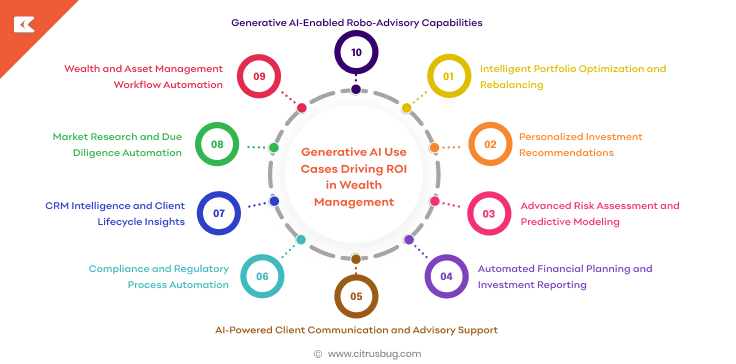
1. Intelligent Portfolio Optimization and Rebalancing
Generative AI continuously reviews market dynamics, asset correlations, liquidity, and risk levels to suggest optimal allocation of portfolios and rebalancing to take at the right time.
Benefit: Advisors can rebalance portfolios faster and more accurately.
Impact: Improved portfolio performance and less market risk.
2. Personalized Investment Recommendations
AI algorithms analyze client objectives, behaviour, portfolio history, taxes, and market variables to produce extremely customized investment advice at a large scale.
Benefit: Advisors use less time to research investment portfolios manually.
Impact: Improved client satisfaction and retention of better relationships in the long run.
3. Advanced Risk Assessment and Predictive Modeling
Generative AI uses historical data, macroeconomic indicators, and volatility to create a predictive risk model to forecast the future portfolio and market risks.
Benefit: Active risk reduction and more secure investment decisions.
Impact: Less downside exposure and increased preparedness for compliance.
4. Automated Financial Planning and Investment Reporting
Generative AI can be used in wealth management to develop detailed financial plans, portfolio overviews and performance reports that utilizes real-time information, client preferences and regulatory requirements.
Benefit: Advisors save time spent on manual records and reporting.
Impact: Rapid communication with clients and enhanced productivity of the advisor.
5. AI-Powered Client Communication and Advisory Support
Gen AI assists in interaction with clients, generating responses, explanations, and financial insights using digital channels with the help of natural language processing.
Benefit: It allows advisors to serve a larger number of clients without increasing the workload.
Impact: Better client interaction and enhanced consistency in services.
6. Compliance and Regulatory Process Automation
Generative AI analyses transactions, documents, and communications to report compliance risks and generate audit-ready records automatically.
Benefit: Compliance teams lower the manual review and operational mistakes.
Impact: Reduced regulatory risks and increased speed of auditing.
7. CRM Intelligence and Client Lifecycle Insights
AI is also used to improve CRM systems by summarizing the interactions with clients, recognizing patterns of behavior, and recommending the next-best actions to advisors.
Benefit: Advisors can have a better understanding of client needs and priorities.
Impact: Improved customer relations and growth in assets under management.
8. Market Research and Due Diligence Automation
Generative AI uses market data, research reports, and financial disclosures to produce brief insights and investment outlines.
Benefit: Research teams reduce the information and time to analyze.
Impact: More accurate research and faster investment decisions.
9. Wealth and Asset Management Workflow Automation
It automates daily business operations of onboarding, documentation, approvals and internal communications.
Benefit: Operations teams automate processes and eliminate manual dependencies.
Impact: Reduced operation expenses and quick service delivery.
10. Generative AI-Enabled Robo-Advisory Capabilities
Gen AI powers digital advisory platforms by generating personalized recommendations, portfolio explanations, and financial guidance at scale.
Benefit: Firms expand advisory services without proportional increases in staff.
Impact: Scalable revenue growth and improved accessibility for clients.
Real-World Examples of Generative AI in Wealth Management
Generative AI is no longer a concept for the future in wealth management. Major wealth management companies are already integrating it into advisory, research, and portfolio processes to enhance efficiency and customer performance.
Morgan Stanley Using Generative AI for Advisor Intelligence
Morgan Stanley applies generative AI to enable financial advisors to search, summarize, and access thousands of internal research documents and market reports.
The AI solution acts as a knowledge assistant, allowing advisors to access relevant insights quickly during client conversations.
Business Value: Faster advisor response times and improved advisory quality
ROI Impact: Higher advisor productivity and more informed client interactions
JPMorgan Applying Generative AI to Investment Research and Analysis
JPMorgan has adopted generative AI in its research processes to summarize earnings calls, financial reports, and market commentary.
This allows investment teams and advisors to digest data quickly without the need to go through a large volume of data manually.
Business Value: Reduced research turnaround time
ROI Impact: Quicker decision-making and improved investment efficiency
BlackRock Leveraging AI Within Aladdin for Portfolio Insights
BlackRock keeps improving its Aladdin system with AI-based analytics to assist asset and wealth managers in building portfolios, modelling risks, and analyzing scenarios.
Generative AI features enable converting the vast amounts of data in the market into understandable insights for investment experts.
Business Value: Improved portfolio visibility and risk transparency
ROI Impact: Better risk-adjusted returns and institutional-scale efficiency
How Generative AI Drives Measurable ROI in Wealth Management
Generative AI delivers ROI in wealth management when it is embedded into core software workflows. Not as a standalone tool, but as part of portfolio systems, advisory platforms, compliance engines, and CRM solutions. When implemented correctly, the impact is both measurable and scalable.
Higher Advisor Productivity Without Increasing Headcount
Generative AI reduces the time advisors spend on research, reporting, documentation, and routine client communication.
Advisors can focus more on strategy and relationship building. Firms support more clients using the same advisory teams.
ROI Outcome: Lower cost per advisor and improved revenue per client
Faster and More Informed Investment Decisions
By summarizing research, modeling scenarios, and highlighting market signals, generative AI accelerates decision-making across investment teams.
This speed matters during volatile market conditions where timing directly affects outcomes.
ROI Outcome: Improved portfolio responsiveness and better risk-adjusted returns
Reduced Operational and Compliance Costs
Generative AI in business automates compliance reviews, reporting workflows, and audit documentation generation.
Manual checks decrease. Errors reduce. Regulatory readiness improves across the organization.
ROI Outcome: Lower compliance overhead and reduced operational risk
Improved Client Retention and Lifetime Value
Clients receive clearer insights, timely updates, and personalised financial planning.
This improves trust and strengthens long-term relationships, especially with high-net-worth clients.
ROI Outcome: Higher retention rates and increased assets under management
Scalable Digital Advisory and Hybrid Models
Generative AI enables agencies to expand digital and hybrid advisory offerings without rebuilding platforms from scratch.
This allows firms to serve different client segments efficiently.
ROI Outcome: New revenue channels without proportional infrastructure growth
Emerging Trends in Generative AI for Wealth Management
The use of generative AI in wealth management is shifting towards experimentation to mainstream operational use. There are several AI trends that are defining how companies innovate, create client value, and achieve a competitive edge.
Rapid Adoption of AI and Generative AI Technologies
Many companies are adopting AI in primary processes.
Approximately 70% of wealth management companies have, in some form, embraced AI technologies, which means that the industry has widely embraced AI technologies.
- Many companies plan to invest further in AI tools over the coming years, underscoring confidence in their long-term strategic value.
- This trend demonstrates that generative AI is already becoming an essential component of AI in wealth management and not an experimental niche.
Growing Use of AI for Portfolio Management and Optimization
AI is increasingly important for wealth management firms in making investment decisions.
- 60% of wealth management firms use AI for portfolio management and optimization.
- AI-powered analytics is assisting companies in discovering opportunities and threats quickly than before.
This shift underscores how generative AI models can be embedded in modern software development to enhance performance and responsiveness.
Advisor Adoption of Generative AI Tools
Financial advisors are becoming more comfortable with generative AI assistance.
- 85% of financial advisors report that generative AI is beneficial to their practice, which is higher than it was in previous years.
- Around 76% reported immediate benefits from AI-enabled tools.
It means an increase in the confidence of generative AI in the performance of activities like summarizing meeting notes, automating routine work, and generating insights.
Focus on Client Experience and Personalization
Clients expect tailored experiences in wealth management, and firms are responding:
- 62% of clients prefer personalized investment advice powered by AI.
- Wealth managers are applying AI to provide personalized portfolios and responses in a more efficient manner.
This pattern strengthens the fact that gen AI is at the center of improving client interactions instead of simply optimizing back-office functions.
Challenges and Considerations When Adopting Gen AI in Wealth Management
Data security and privacy: Wealth data is confidential and needs to be highly governed and guarded.
Regulatory compliance: AI outputs should comply with financial regulations and the audit.
Explainability of AI insights: Advisors need to understand and trust AI-generated suggestions.
Integration with existing systems: AI must be compatible with CRM and portfolio systems.
Data quality and reliability: Irregular or incomplete data affects the accuracy of AI.
Advisor adoption: Human oversight remains critical for acceptance and control.
How to Get Started with Generative AI in Wealth Management
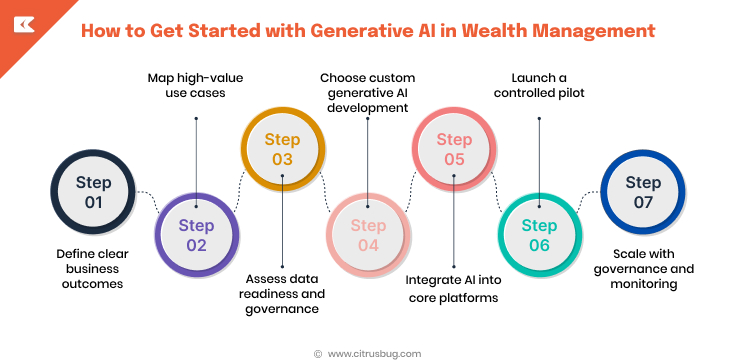
Step 1: Define clear business outcomes
Begin by determining what generative AI can do to make a difference. This might be enhancing the productivity of advisors, scaling personalization, lessening compliance costs, or speeding up the analysis of investments.
Step 2: Map high-value use cases
Assess current processes and determine where generative AI can be used more easily. The typical initial points are portfolio insights, client reporting, risk analysis, and advisory support.
Step 3: Assess data readiness and governance
Check the quality, structure and availability of client, portfolio and market data. Consider the data privacy, security controls, and regulation requirements.
Step 4: Choose custom generative AI development
Ready-to-use solutions are not always aligned with wealth management processes. Customized generative AI systems provide superior precision, clarification, and compliance alignment.
Step 5: Integrate AI into core platforms
Integrate generative AI into portfolio management systems, CRM platforms, and robo advisor dashboards to ensure a smooth adoption process among advisors and teams.
Step 6: Launch a controlled pilot
Begin with a small pilot to gauge the model performance, adoption amongst advisors, and business impact. Refine outputs and workflows with real feedback.
Step 7: Scale with governance and monitoring
Monitor AI outputs continuously, retrain models when necessary, and ensure compliance control when scaling across groups and customer segments.
Conclusion
Generative AI is transforming wealth management by enhancing productivity among advisors, improving portfolio decision-making, and offering a highly personalized experience to clients. Those companies that implement AI strategically can automate routine activities, minimize operational expenses, and offer quicker and more information-driven data.
By collaborating with a reputable wealth management software development company such as Citrusbug, you can ensure the smooth integration of generative AI in your existing processes. Our custom software development services are designed to assist companies in optimizing ROI, effectively scaling, and providing customized investment solutions to meet the changing demands of clients.