Back
Back






The healthcare systems produce vast amounts of data every second. This data is received through bedside monitors, imaging systems, wearables, and connected medical devices. However, sending everything to the cloud for processing is not always practical. Latency, connectivity gaps, and data privacy concerns often challenge them. This is where edge computing in healthcare comes in.
Edge computing transforms how medical data is processed and responded to. Instead of relying only on centralized cloud servers, it allows data to be analyzed closer to where it is created. As a result, clinicians can find insights faster, systems respond in real time, and patient care improves when seconds matter.
This shift is not just about performance. It also supports better data control, stronger security, and more reliable digital health operations. Edge computing is influencing modern healthcare system functions, including connected medical devices and intelligent diagnostics.
In this guide, we will discuss what edge computing means in the healthcare industry. We will also explore where it is used, why it matters, and how it supports clinical and operational needs in real time.
Understanding Edge Computing in Healthcare
Edge computing in healthcare is the idea of processing medical data near where it is collected. This could be inside a hospital, on a medical device, or at a local gateway. The system processes data locally instead of sending it to a remote cloud server and is used to provide immediate feedback.
Speed is critical in healthcare. Even a few seconds of delay can have an impact on patient outcomes, notably in emergency or ICU care. That is why edge computing is becoming necessary. Indeed, almost 72% of devices that are already interconnected in healthcare have already adopted edge processing to minimize latency to provide faster and more dependable responses to critical applications.
Edge computing can not only accelerate clinical decisions by processing data nearer to both patients and care teams, but it also increases reliability, enhances the level of security and enables modern digital health operations.
What Is Edge Computing?
Edge computing is a distributed computing model. Data is processed at or near the source. That source could be a patient monitor, imaging system, wearable, or diagnostic device.
In healthcare settings, edge computing allows systems to:
- Analyze patient data in real time
- Trigger alerts instantly
- Continue operating even if cloud connectivity drops
Cloud platforms still play a role. However, they are no longer the first stop for every data point. Edge handles what needs speed. Cloud handles what needs scaling and long-term storage.
How Edge Computing Works in Healthcare Systems
Healthcare environments rely on a complex network of connected devices. These devices constantly produce both clinical and operational data. Edge computing adds an intelligent layer between devices and the cloud.
The flow generally functions as follows:
- Medical devices gather data at the point of care.
- Edge nodes or gateways process that data locally.
- Only relevant insights or summarized data move to the cloud.
This architecture is especially useful in ecosystems built around IoT in medical things, where thousands of devices operate simultaneously. Edge processing prevents network overload. It also keeps sensitive patient data closer to its source.
Because of this setup, healthcare systems gain faster response times. They also gain better control over data movement. Most importantly, they maintain performance even in environments with limited or unstable connectivity.
Understanding this foundation makes it easier to see why edge computing is becoming a core part of modern healthcare technology. In the next section, we’ll look at why healthcare organizations are actively adopting it today.
Why Edge Computing Is Important in Modern Healthcare
Modern healthcare depends on speed, accuracy, and reliability. Traditional cloud-first systems, however, do not meet these needs in the clinical setting in practice. Edge computing fills this gap by bringing intelligence nearer to the point of care.
The importance of edge computing in healthcare becomes clear when you look at how care is delivered today. Data is continuous. Decisions are time-sensitive. The systems should operate even in the case of unreliable connectivity.
The Need for Real-Time Data Processing in Healthcare
Live data are crucial in healthcare decision-making. Heart rate monitors, infusion pumps, imaging systems, and wearables all produce data each second. Sending such data to the cloud and awaiting a reply is at the cost of delays.
Edge computing minimizes this latency. It processes data locally and triggers actions instantly. As a result, clinicians receive alerts faster. Automated systems respond without waiting for cloud validation. Such speed can directly influence patient outcomes, particularly in critical care units and in emergency departments.
The other benefit is reliability. The edge-based systems remain operational even when there are network failures. That is important in hospitals, ambulances, and remote care settings where uptime is a non-negotiable factor.
Challenges of Cloud-Only Healthcare Systems
Latency in time-critical care
The use of cloud-based systems adds delays since the data has to go into centralized servers. In emergency and critical care settings, even small delays can affect clinical decisions.
Dependence on stable connectivity
Healthcare settings cannot always depend on uninterrupted internet connectivity. The failure of the network can restrain the functionality of the system and interrupt the workflow of patient care.
Bandwidth limitations with growing data volumes
Connected devices, medical imaging, and continuous monitoring produce massive data streams. Sending everything to the cloud consumes bandwidth and adds to operational expenses.
Increased data privacy and security exposure
Sending patient-sensitive information through the networks raises security risks. It also complicates it in complying with healthcare data protection and compliance needs.
Limited system reliability during outages
Cloud-only architectures may fail to function during connectivity issues. This lack of resilience is risky for hospitals, remote care setups, and emergency services.
This is why most healthcare organizations are outgrowing cloud-only models. Edge computing can resolve these gaps by making healthcare systems faster, more trustworthy, and secure.
Key Use Cases of Edge Computing in Healthcare
Edge computing is offered with the highest value in terms of speed, reliability and local decision-making. This lowers the latency, enhances patient outcomes, and facilitates effective operations because data is processed nearer to the origin of the data.
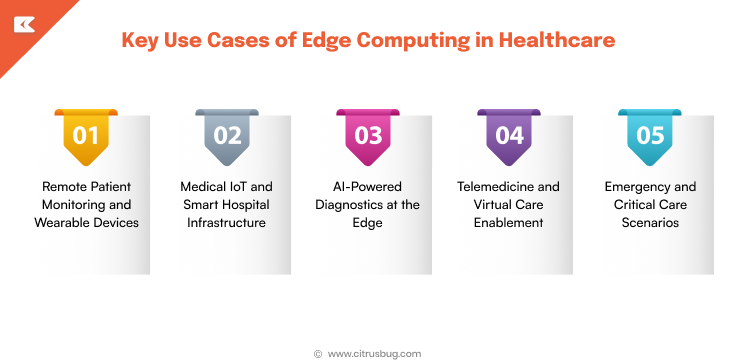
Remote Patient Monitoring and Wearable Devices
Patients with continuous monitoring generate continuous health data. Edge computing analyzes this locally, triggering instant alerts for clinicians. This real-time processing is the core of remote patient monitoring and timely interventions in spite of unstable internet.
- Continuous data collection
- Live reporting and anomaly detection
- Reduced dependency on constant cloud connectivity
Medical IoT and Smart Hospital Infrastructure
Hospitals are dependent on thousands of interconnected devices. Edge computing allows real-time tracking and predictive maintenance, enhancing efficiency and reliability. The systems demonstrate the use of IoT solutions in healthcare.
- Connected medical devices and equipment monitoring
- Asset tracking and operational efficiency
- Predictive maintenance of medical devices
AI-Powered Diagnostics at the Edge
Massive medical imaging files are slow to run on the cloud. Edge computing enables AI inference to be performed directly on devices or on nearby nodes, providing clinicians with fast insights. This minimizes the delay in data transfer and accelerates critical decisions.
- On-device AI inference for imaging and diagnostics
- Faster clinical decision support
- Reduced data transfer delays
Telemedicine and Virtual Care Enablement
Patients who join in virtual consultations are dependent on coherent video and data analysis. Edge computing guarantees low-latency communication and real-time processing of diagnostic data. Platforms leveraging telemedicine provide smoother, more reliable remote care for patients.
- Low-latency video and data transmission
- Improved patient experience in remote consultations
- Edge-enabled diagnostics for virtual care
Emergency and Critical Care Scenarios
Every second counts in the ICUs, ERs and ambulances. Edge computing processes critical data at the edge, so real-time alerts are immediately delivered to care teams. Even during network outages, life-saving decisions can be made without delay.
- Real-time monitoring in ICUs and ERs
- Edge computing in ambulances and emergency response
- Reliable performance during network disruptions
Benefits of Edge Computing in Healthcare
Edge computing brings computations nearer to the point of healthcare data production, providing more rapid decisions, enhanced reliability, and operational efficiency. Hospitals, clinics, and remote care systems benefit from real-time processing, enhanced security, and support for advanced technologies.
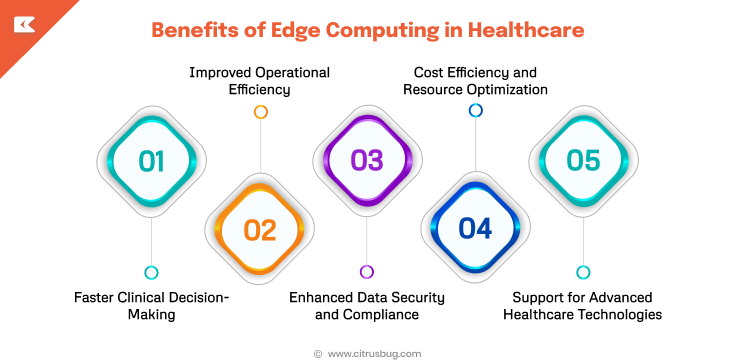
Faster Clinical Decision-Making
- Reduced latency in processing patient data
- Instant alerts for critical events
- Quicker response times in ICUs and emergency scenarios
Improved Operational Efficiency
- Real-time monitoring of medical devices
- Predictive maintenance to minimize downtime
- Streamlined workflows using RPA services for healthcare
Enhanced Data Security and Compliance
- Localized storage of sensitive patient information
- Reduced risk of cyber threats
- Easier adherence to HIPAA, GDPR, and other standards
Cost Efficiency and Resource Optimization
- Lower cloud storage and bandwidth costs
- Optimized allocation of IT and hospital resources
- Scalable infrastructure for growing healthcare data
Support for Advanced Healthcare Technologies
- Faster AI-assisted diagnostics
- Reliable Telemedicines and remote consultations
- Integration with Custom healthcare solutions for modern care delivery
Edge Computing vs Cloud Computing in Healthcare
Healthcare organizations often face the choice between edge, cloud, or hybrid computing. Understanding the differences helps decide which model fits specific clinical, operational, or remote care scenarios.
Key Differences Between Edge and Cloud Computing
| Feature / Aspect | Edge Computing | Cloud Computing |
|---|---|---|
| Data Processing | Localized processing near data source for real-time analysis | Centralized processing in remote servers, which may introduce latency |
| Latency | Very low latency with immediate response for critical care | Higher latency depending on network speed and distance |
| Reliability | Continues functioning even during network disruptions | Dependent on stable internet connectivity |
| Bandwidth Usage | Optimized usage where only processed or summarized data is sent to the cloud | High usage as all raw data is often transmitted to the cloud |
| Security & Compliance | Sensitive data stays closer to the source, reducing exposure risks | Data transmitted over networks increases potential security risks |
| Use Cases | Remote patient monitoring, ICU alerts, wearable devices, and smart hospital systems | Data storage, large-scale analytics, and population health studies |
| Cost Considerations | Lower bandwidth costs but requires investment in local infrastructure | Ongoing cloud service fees with scalable storage costs |
When to Use Edge, Cloud, or Hybrid Models in Healthcare
| Model | Best Use Cases |
|---|---|
| Edge Computing | Real-time monitoring, emergency and critical care, AI-assisted diagnostics at the bedside, and wearables |
| Cloud Computing | Long-term data storage, population-level analytics, centralized EMR systems, and AI model training |
| Hybrid (Edge + Cloud) | Combining low-latency local processing with centralized analytics for predictive care, telemedicine, and large-scale AI applications |
Challenges and Limitations of Edge Computing in Healthcare
Although edge computing is fast, reliable and contributes to improved patient care, healthcare organizations can experience some obstacles and drawbacks when adopting it. Understanding these helps in planning better solutions and avoiding potential pitfalls.
Infrastructure and Deployment Challenges
- High Initial Investment: Setting up edge nodes and IoT-enabled infrastructure requires high upfront costs.
- Hardware and Maintenance: Devices and servers require periodic updates and maintenance so that they can operate well.
- Integration with Legacy Systems: Existing healthcare IT systems might need to be customized to complete the integration with edge solutions.
Data Management and Processing Limitations
- Storage Constraints: Local edge devices do not offer as much storage capacity as cloud systems.
- Data Consistency: The process of data synchronization between edge nodes and the cloud may be complicated.
- Bandwidth for Aggregation: Although edge devices minimize cloud reliance, the transfer of aggregated data still needs bandwidth and proper planning.
Security and Compliance Considerations
- Expanded Attack Surface: Multiple edge devices increase points of potential cyber threats.
- Regulatory Challenges: It is more complex to make sure that all edge nodes meet the HIPAA, GDPR, or local healthcare regulations.
- Monitoring and Auditing: Distributed systems should be closely monitored to ensure compliance and operational stability.
Technical and Operational Constraints
- Limited Computing Power: Edge devices might not compete with large-scale AI computations as effectively as centralized cloud infrastructure.
- Dependence on Local Environment: Power disruptions or hardware failures at the edge node can disrupt services.
- Skill Requirements: Healthcare IT teams must possess knowledge of edge computing technologies, IoT, and AI integration.
Future of Edge Computing in Healthcare
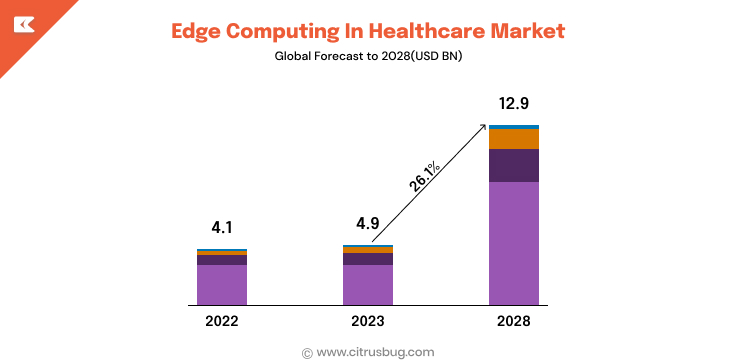
Edge computing will continue shaping healthcare as systems demand faster, localized processing. According to MarketsandMarkets, the edge computing healthcare market is expected to grow to USD 12.9 billion in 2028 due to the presence of real-time data and connected medical equipment.
AI at the edge is one of the most exciting trends in healthcare. Analytics and diagnostics can now be executed on or close to devices, reducing delays and providing clinicians with real-time information when seconds matter.
The smart hospitals are also increasing. Automation and sensors optimize workflow, anticipate device maintenance, and ensure a smooth running of operations.
Telehealth and wearable devices are growing at a very fast pace. Edge technology provides stability and low latency even in changing networks. In fact, he long-term and home care edge solution is expected to increase more than 23% annually through 2030.
Hybrid edge-cloud architectures are taking centre stage. They integrate the agility of local processing with the scalability of the cloud, building secure, efficient and future-ready tailored healthcare solutions.
Build Edge Computing Solutions for Healthcare with Citrusbug
We design and develop custom edge computing solutions that enable real-time data processing, improved system responsiveness, and secure handling of sensitive healthcare data.
Understand Your Healthcare Use Case
Every successful edge computing implementation starts with clarity. We collaborate with healthcare organizations to determine the workflows, data sources, and integration requirements that are latency-sensitive. This ensures edge computing is applied where it can provide real clinical and operational value.
Design Secure and Compliant Edge Architecture
Security and compliance are core to our approach. We develop edge architecture to meet healthcare standards like HIPAA and GDPR, and provide robust encryption, access management, and data management from the start.
Develop Custom Edge-Enabled Healthcare Solutions
Citrusbug builds custom edge computing solutions tailored to your healthcare environment. Our development team makes sure that it can integrate with existing systems, such as EHRs, IoT devices, and analytics platforms, without interfering with current operations.
Enable Scalability with Hybrid Edge-Cloud Models
We design solutions that scale. Through edge and cloud computing, we assist healthcare organizations to balance performance, storage, and analytics requirements, to enable long-term growth and changing models of care.
Ongoing Optimization and Support
Edge computing is not a single deployment. We support the ongoing optimization, performance, and feature improvement to make your healthcare systems reliable, efficient, and future-ready.
Conclusion
Edge computing is revolutionizing healthcare by providing real-time insights, enhancing clinical decision-making, and improving patient care. It enables critical applications such as remote patient monitoring, AI-driven diagnostics, and smart hospital infrastructure, and minimizes latency and cloud-only applications.
Successful adoption requires addressing security, compliance, and integration issues, and alignment of technology with clinical workflows. Hybrid edge-cloud models are flexible, scalable and efficient in the long term.
Partnering with the right team ensures your edge computing strategy delivers measurable impact. Citrusbug assists healthcare organizations in developing tailored healthcare solutions that are secure, scalable, and future-proof.