Back
Back






The healthcare automation market is undergoing rapid transformation as providers seek efficiency, accuracy, and scalability in an increasingly complex healthcare landscape.
It’s no longer just forms that are being digitized with automation it’s artificially intelligent diagnosis and other workforce automation, as well as real-time patient engagement measures.
Understanding these trends will be critical for healthcare providers positioning themselves to excel in the future and achieve a competitive advantage.
Understanding the Healthcare Automation Market
Healthcare automation is a strategic move that brings together advanced technologies to simplify not only clinical workflows but also administrative and patient engagement activities.
This market consists of various kinds of solutions, from electronic health records and automated billing systems support clinical decision-making and even AI algorithms that are very sophisticated.
The change is not just about moving to digital. Today’s healthcare automation systems are using AI, machine learning, and robotic process automation to the utmost level to cut down the redundancies, decrease human error, and let the healthcare workers focus on patient care activities.
The organizations that are using automation technologies have reported improvements in their operational metrics that are measurable. The processing times for claims have been reduced, the accuracy of diagnosis has been enhanced, the scores for patient satisfaction have improved, and the overhead of administration has decreased.
All these are tangible benefits that are pushing the market to expand in different healthcare settings all over the world.
Top Healthcare Automation Stats to Know
Market Size & Growth
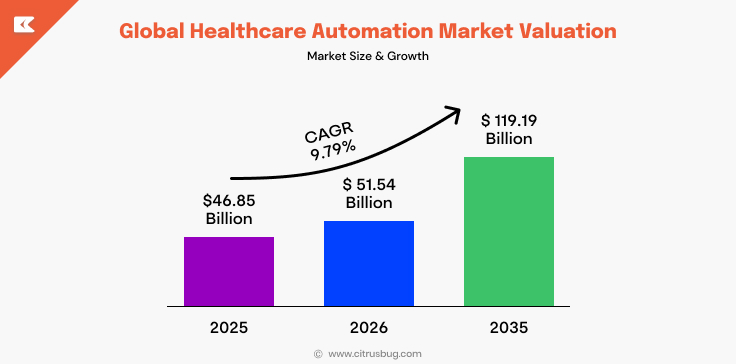
- The global healthcare automation market is estimated to be valued at $46.85 billion in 2025.
- It is forecasted to grow from $51.54 billion in 2026 to $119.19 billion by 2035, thus having a CAGR of 9.79% during the period 2026-2035.
- The market is growing at a steady high-single-digit CAGR 9% to over 12%, outperforming traditional healthcare IT growth rates.
- The healthcare automation has moved the workflow from being a futuristic dream to reality. Around 60% of the healthcare budget is spent on labor of which 24% is focused on administrative tasks.
- By integrating automation, 70% of the task can be reduced. By using automation & AI in healthcare, the problems of manual data entry, like time-consuming, operational costs, and delays in patient care are reduced.
- Clinical automation is a significant sub-segment through the valuation of traditional (non-AI) lab automation, which is $8.27 billion in 2024 and further expected to grow to USD 18.39 billion by 2033, gaining 9.3% CAGR.
- The AI-integrated clinical automation is enhancing the efficiency of clinical operations. The valuation stood at $2.78 billion in 2025 and is projected to move ahead with 31.9% CAGR.
Technology & Segment Trends
Agentic AI & Autonomous Clinical Agents
- Agentic AI in healthcare refers to autonomous artificial intelligence systems capable of making independent decisions and performing tasks without requiring human intervention. Its market has grown at a rapid pace with a CAGR of 45.56%.
- These systems automate clinical processes such as triage support, workflow optimization, and routine steps of the clinical decision-making process, and decrease the workload while also increasing consistency in patient care quality.
- Mainly used in hospital clinical settings, telehealth platform solutions, and digital patient intake systems.
Internet of Medical Things (IoMT)
- The IoMT market has been growing with a strong CAGR of 18.2%, reflecting the rapid adoption of connected medical devices and smart healthcare infrastructure across the global healthcare ecosystem.
- Quality of care is further enhanced as real-time data becomes available, patients are monitored continuously, and alerts can be automated, all of which help clinicians to make faster and more accurate decisions with less manual intervention.
- IoMT both avoids documentation errors by automating data transmission between systems and devices, and accelerates other elements of clinical workflows, as well as making care delivery proactive, as opposed to reactive.
- Application of IoMT is popular in remote patient monitoring, chronic disease management, and smart hospital systems or wearable health devices, where continuous connection and automation support are crucial to effective treatment.
Robotic Process Automation (RPA)
- The RPA healthcare market segment has evolved into a multi-billion-dollar industry and is fueled by the increasing need for automation in administrative, financial, and compliance-driven healthcare operations. The market size of it was $1.28 billion in2024 and will reach $2.04 billion by 2032, with a CAGR of 6% from 2026 to 2032.
- RPA is primarily applied in hospital administration, revenue cycle management, insurance operations, scheduling systems, and clinical documentation workflows, which require speed as well as precision.
- RPA takes over routine duties, such as claim processing, claims management scheduling, and billing, resulting in fewer human errors, less time spent on processing, and staff freed up for patient-centric tasks.
- RPA is used by large hospital systems and the insurance payers to increase operational efficiency, lower administration costs, and reduce turnaround times.
Pharmacy Automation Technologies
- Pharmacy automation has evolved into a significant revenue-generating segment within the healthcare automation market, with a valuation of $6.65 billion in 2024 and expected to reach at $10.01 billion by 2030 with 7.1% CAGR during its forecast period.
- They improve work quality as they reduce medication dispensing errors, have a more accurate dosage, and automate the redundant work of pharmacy activities that target patient safety and regulatory compliance directly.
- Automated dispensers, packagers, and inventories enhance workflow efficiency, decrease prescription turnaround time, and provide for better stock control of the entirety of pharmacy services.
- Pharmacy automation is the process of automated handling of medications in medicine and healthcare. It involves the mechanical processes of handling and distributing to ensure medication and patient safety.
Robotics and Cobots
- The medical robot market is expected to increase from $13.0 billion in 2025 to $43.7 billion in 2035, with 12.9% CAGR.
- Surgical Robots will take the largest share of the market with 42.7%, whereas laparoscopic applications will be the leader of the application segment with 33.8% share.
- It improves the quality of work by providing high accuracy, continuity, and dependability of surgical operations, diagnostics, and automated dispensing of medications, decreasing variability in the processes, and reducing human error.
- The collaborative robots market is showing fast growth with a CAGR of 18.9%. The value of the cobots market is projected to reach $3.38 billion by 2030.
- Cobots mitigate this by automating repetitive tasks like patient transfer and lab sample handling. For example, Singapore’s Changi General Hospital deployed cobots to transport pharmaceuticals, reducing nurse workload by 25% and allowing reallocation of 700+ staff hours monthly to direct patient care.
Regional Growth Insights
North America
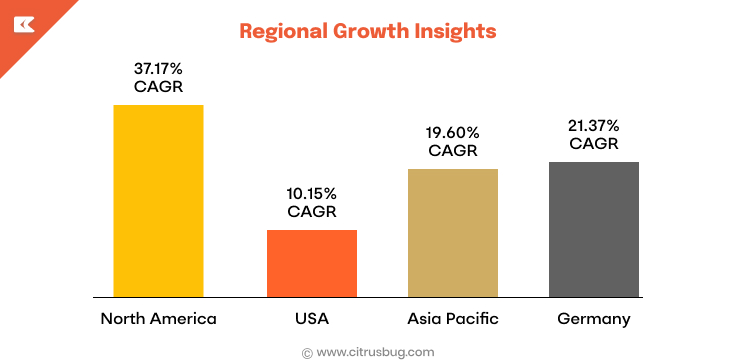
- The North American healthcare automation market registered a valuation of $14.66 billion in 2024 and is anticipated to attain a value of $250.81 billion by 2033, with a CAGR of 37.17% due to high levels of persistent adoption.
- The implementation of next-generation healthcare IT technologies, robotics, and robotic process automation in hospitals and diagnostic labs is contributing to market growth.
- With increasing emphasis on cost containment, reducing errors, and enhancing patient safety, healthcare automation is becoming an integral part of contemporary health delivery.
- In addition, the strong technology infrastructure and high levels of HC spend continued to place North America as a global leader in adopting automated healthcare solutions.
U.S.A
- Healthcare is changing by implementing automation across their workflows, revenue cycle management, diagnostics, and patient administration to improve efficiency and scalability.
- The quickness of labor shortages, clinician burnout, and rising costs will further drive the adoption of RPA, robotics, and intelligent workflow automation.
- In USA, more and more healthcare organizations are adopting automation, which enhances the overall value of the market with a CAGR of 10.15%.
- The strong presence of major healthcare technology companies and innovative start-ups positions the United States as a leader in healthcare automation innovation and commercialization.
Asia Pacific
- The Asia Pacific region is witnessing the fast-paced development of automation, which is a result of several factors emphasizing the region’s activity and prospects.
- A report indicates the healthcare automation market in Asia to be worth around $9,345.82 billion in 2024 and to grow to $22,142.44 billion by 2032 at a staggering CAGR of 19.60% for the period from 2025 to 2032.
- The growing number of patients raised the need for high-quality healthcare services. The advances in technologies such as robotic surgery systems, AI-driven diagnostics, and remote patient monitoring solutions saw the consequent investments.
- The governments in the Asia Pacific region are constantly investing in smart hospitals, digital health platforms, and connected care ecosystems.
Germany
- The German healthcare automation market is around $4,014.27 billion in 2024 and expected to reach $10,063.09 by 2032 with a CAGR of 21.37%.
- Automation supports Germany’s healthcare providers in achieving those high levels of precision, safety, and quality that are a fundamental requirement for the country’s health regulations and clinical practice.
- Automation – Smart Lab Evolution. By automating laboratory operations, diagnostics, and administrative workflows, efficiencies are increased and operational costs are lowered across hospitals.
- It aids with compliance and capturing accurate documentation, both of which are critical for healthcare outlets to meet stringent national and EU healthcare standards.
Why Healthcare Automation is Accelerating
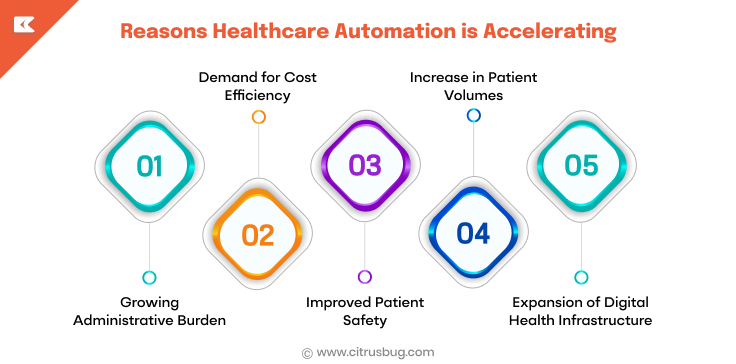
Growing Administrative Burden
Healthcare providers must manage an increasing load of administrative tasks, which include documentation requirements, billing needs, claims processing needs and regulatory compliance obligations.
The required work demands extensive time and physical effort because staff members must stop their work with patients to execute manual tasks.
Healthcare automation systems enable organizations to enhance their administrative operations by decreasing document requirements and boosting operational precision, which enables them to handle complex business activities while maintaining compliance and uninterrupted departmental connections.
Demand for Cost Efficiency
Rising operating expenses, shortage of skilled persons, and decreasing profitability are driving the healthcare industry to look for cost-effective alternatives.
Healthcare automation allows you to cut overhead through lowered manual effort, more efficient use of resources, and reduced process wastage.
Automated solutions allow providers to take on more work without the need for additional expensive personnel, thus allowing automation to be perceived as a financial investment in long-term ability and fuel economy for performance in healthcare installations.
Improved Patient Safety
Patient safety continues to be a concern in healthcare and automation ensures that errors in clinical or operational performance can be kept at a minimum.
Automated processes minimize the possibility of errors regarding drug delivery, diagnostics, and data entry.
Consistency, precision, and real-time alerts help enhance care quality, support clinical decision-making, and lead to safer patient outcomes regardless of the location of care/service.
Increase in Patient Volumes
Population growth, increasing age, and greater prevalence of chronic disease mean there are simply more patients to treat.
With both primary and specialty care, this is also allowing a way to respond to demand that’s increasing without changing the level of service or care.
Automated scheduling, diagnostics, and patient management solutions can increase efficiency in high-volume environments by minimising waiting time and improving throughput, which are both crucial to the timely delivery of care above capacity.
Expansion of Digital Health Infrastructure
The widespread adoption of electronic health records, together with cloud platforms and connected medical devices, has established a solid base that enables automation to operate effectively.
The digital health infrastructure system provides complete data integration, which enables different systems to share information while transmitting real-time data between separate components.
The system enables healthcare organizations to quickly implement automation technologies that improve their operational processes and team communication while delivering healthcare services that are efficient and expandable through data-based solutions.
Healthcare Automation Market Segmentation Insights
The healthcare automation market is segmented by product type, end user, and deployment model, enabling providers to choose solutions that fit their needs.
These segments help organizations optimize workflows, reduce errors, and improve patient outcomes while guiding strategic investment and implementation decisions.
Healthcare Automation Market by Product Type
The market is divided into software, hardware, and services. Software solutions: Such as electronic health records, AI-driven decision support, or workflow management systems , for their flexibility and scaling potential.
Hardware embraces robotics, automated dispensary, and IoMT devices for enhanced clinical accuracy. Services include implementation, integration, and customer support that stand behind every customer deployment.
Software-based solution drivers will promote the value, while hardware and services provide greater deployment throughout hospitals, labs, and pharmacies.
Healthcare Automation Market by End User
The major end users will be hospitals, clinics, diagnostic laboratories, pharmacies, and research centers. The highest market share is obtained by hospitals and surgical centers because of the large number of patients and the complicated working process.
Automation is applied to labs and research facilities to provide accurate testing and management of data. Automation applies in pharmacies to dispensing medication and inventory management to enhance patient safety.
The new segments include home healthcare and remote monitoring services, in which the increased demand for patient-centered, automated care delivery has been reflected.
Healthcare Automation Market by Deployment Model
The market is deployed via on-premise, cloud-based, and hybrid models, depending on organizational size, IT readiness, and data requirements.
On-Premise has control and compliance advantages, and cloud-based deployments are more scalable, cost-effective, and remotely accessible.
Hybrid deployments offer the best of both worlds, offering the possibility of plugging into legacy equipment and taking advantage of cloud efficiencies.
Deployment decision is driven by data security, regulatory stipulations and requirements for adaptable, future-proof health care automation.
Challenges Impacting the Healthcare Automation Market
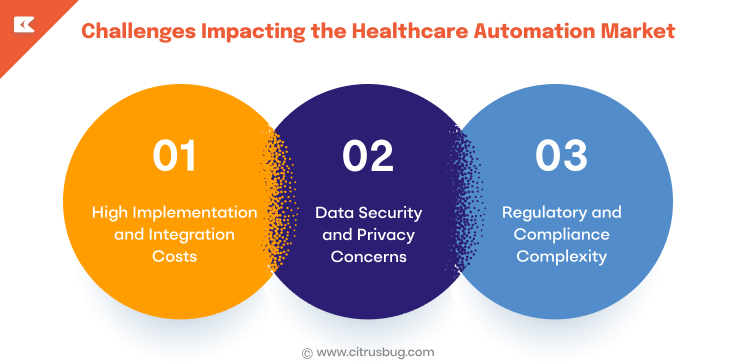
High Implementation and Integration Costs
- Healthcare automation solutions often require substantial up-front investments in software, hardware, and infrastructure upgrades.
- Integration with existing legacy systems and EHR platforms can increase deployment complexity and cost.
- The requirement of customizations for each department increases the implementation time and resource expenses required.
- Some small healthcare providers may find their budgets impaired and therefore cannot cover widespread automation.
- Continued investment in maintenance, upgrades, and support also contributes to the total cost of ownership.
Data Security and Privacy Concerns
- The healthcare automation systems process substantial amounts of confidential patient data together with clinical information, which creates higher security risks.
- The growing use of cloud-based automation systems leads to increased risks of data breaches and unauthorized system access.
- Organizations must execute ongoing monitoring together with financial investment activities to achieve compliance with data protection regulations and privacy protection requirements.
- Cybercriminals have greater opportunities to launch attacks against healthcare organizations because their systems operate through interconnected networks.
- The absence of established security protocols creates difficulties for organizations that need to implement secure automation technology systems.
Regulatory and Compliance Complexity
- The automation in healthcare should be able to meet the changing regulatory standards in regions and jurisdictions.
- Differences in national and international healthcare regulations create implementation challenges for global providers.
- Automated systems involve a lot of validation, documentation, and auditability to comply with standards.
- A constant change in the regulations puts additional pressure on the operations of healthcare organizations implementing healthcare automation solutions.
Future Outlook
Healthcare automation has a bright and promising future since digital transformation will be a strategic objective of healthcare providers across the globe.
The further development of intelligent workflows, robotics, IoMT, and AI-based systems will drive efficiency, accuracy, and patient engagement further.
There will be a rise in the use of integrated healthcare automation solution platforms by healthcare organizations to simplify the end-to-end operations and facilitate data-driven care delivery.
Scalability and flexibility will be offered by cloud-native and hybrid deployment models, and interoperability will become better, enhancing the connectivity of the system.
With an increase in value-based care models, automation will be vital in enhancing results, decreasing expenses, and creating resilient healthcare systems that are future-ready.
Conclusion
The healthcare automation market is revolutionizing healthcare by enhancing efficiency, accuracy, and patient safety in clinical and administrative processes.
As AI, robotics, IoMT, and RPA continue to evolve at breakneck speed, enterprises that implement a solid healthcare automation platform can cut costs, streamline resources, and boost care quality.
Early adopters stand to ensure their viability, the quality of care they deliver, and compete in a dynamically changing global health environment.