













Let’s Talk

Hospital Management System Development Built Around What You Already Run

Most hospital chains aren't starting from zero. You have an EHR, a billing system, and lab software that already work. Citrusbug builds the hospital management system layer that connects them, instead of asking you to rip everything out and start over.

Hospital Management System Development Built Around What You Already Run
500+
Projects Delivered
98%
Client Retention

Certified By

HIPAA Compliant HIPAA Compliant
HL7 / FHIR Compatible HL7 / FHIR Compatible
SOC 2 Type II SOC 2 Type II

Trusted by Leading Healthcare Innovators

Bosch
Deloitte
eClinicalWorks
Epic Systems
Flipkart
McKinsey
HSBC
Softbank
Allianz
Airbnb
United Health
Phelic
Sun Pharma
Target
US Foods
Advinow

Why Hospital Operations Outgrow Their Software

A hospital chain that started with one facility’s scheduling tool ends up running five disconnected systems across locations. Bed management lives in one app, lab results in another, and billing teams reconcile data manually because nothing talks to anything else.

This shows up as denied claims from mismatched patient records, nurses re-entering data that already exists in the EHR, and administrators who can’t see occupancy across locations without calling each site directly. The integration debt compounds with every new facility added.

A hospital management system isn’t meant to replace your EHR. It’s meant to sit across your operations and give every department, from admissions to the billing office, one accurate version of what’s happening right now.

Not Sure If You Need a New HMS or a Modernization Project

Most hospitals don't need a full rebuild. Get a free assessment of what to keep, replace, or connect.

Get Your Free Assessment

What a Working Hospital Management System Actually Covers

A hospital management system is only useful if its modules reflect how your departments actually operate day to day, not a generic template borrowed from a different specialty.

Patient and Admissions Management

Registration, demographics, bed assignment, and admission-discharge-transfer tracking that stays in sync across every facility in the network, not just the one a patient walked into.

Clinical Operations

OT scheduling, nursing workflows, and order management that pull directly from your EHR instead of duplicating records that already exist in a separate system.

Billing and Revenue Cycle

Claims generation, coding validation, and denial tracking built to reduce the manual reconciliation that happens when billing data doesn’t match clinical records.

Resource and Inventory Management

Pharmacy stock, equipment tracking, and staff scheduling with real-time visibility, so a shortage at one location gets caught before it becomes a patient safety issue.

What Goes Into the Integration Layer

  • Check Icon

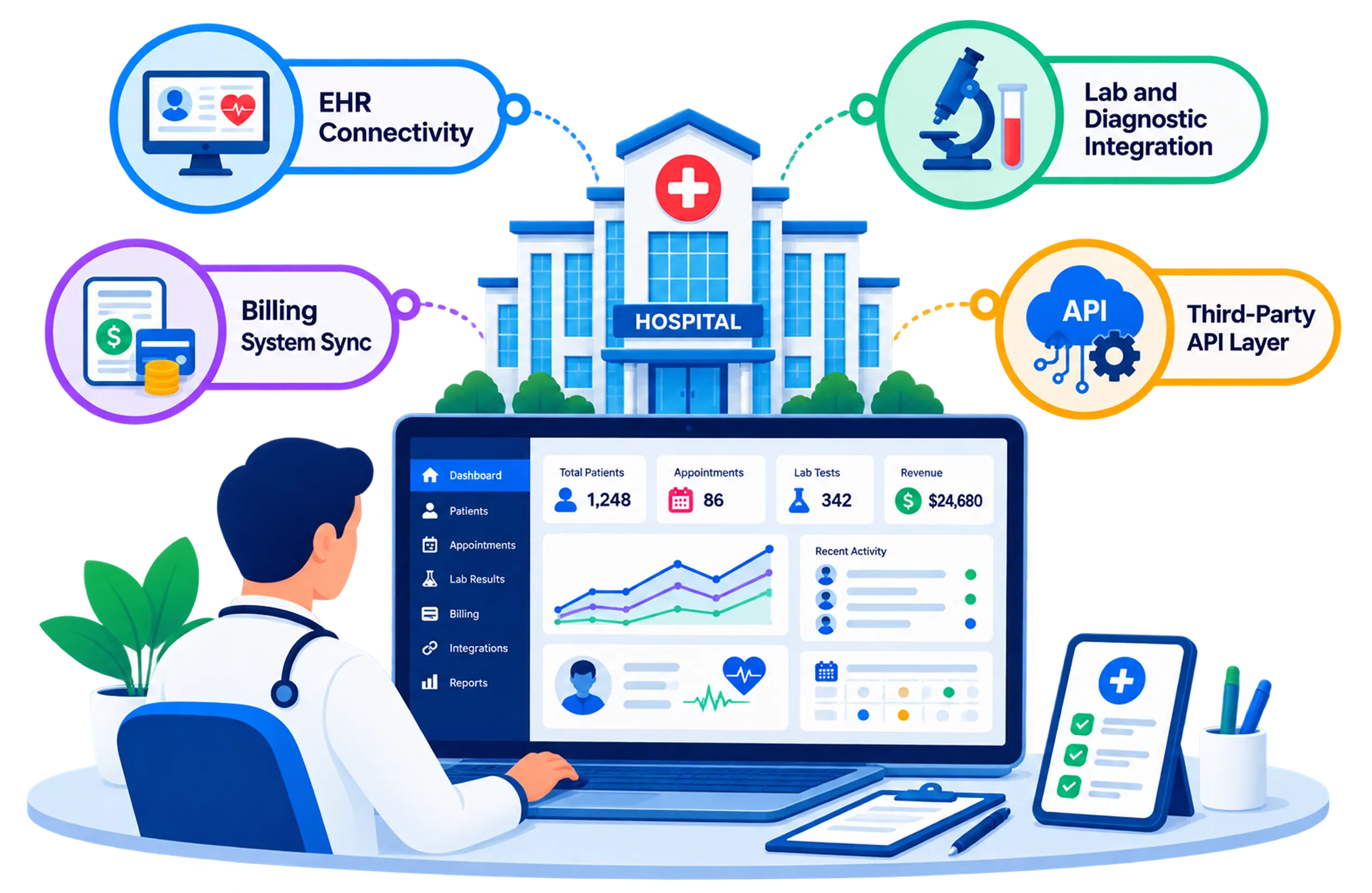
    EHR Connectivity: Patient data flows both directions using HL7 v2 ADT messaging for internal admit and discharge events, with FHIR R4 handling external-facing data exchange and patient portal access.

  • Check Icon

    Lab and Diagnostic Integration: Orders and results move automatically between the HMS and your lab information system, cutting the lag between a test being run and a clinician seeing the result.

  • Check Icon

    Billing System Sync: Charges generated during a patient encounter post directly to your revenue cycle management workflow without a separate manual entry step.

  • Check Icon

    Third-Party API Layer: A documented healthcare API integration layer handles pharmacy systems, insurance verification, and any specialty software a given department already relies on.

Enterprise-Grade Technical Capabilities

Architecture

  • Microservices, not monolith

  • Multi-location scalability

  • High-availability uptime design

  • Independent module deployment

  • Horizontal scaling by facility

Security and Compliance

  • HIPAA-aligned access controls

  • End-to-end encryption at rest and in transit

  • Full audit trail per record access

  • Role-based permissions by department

  • Breach notification workflows built in

Intelligence and Automation

  • Predictive bed occupancy modeling

  • Automated claims scrubbing

  • Real-time operational dashboards

  • AI-assisted scheduling conflicts resolution

  • Anomaly detection on billing patterns

Hospital Operations We've Built For

Multi-Location Hospital Chains

Multi-Location Hospital Chains

Centralized visibility into bed capacity, staffing, and billing across every facility under one ownership structure.
Multi-Specialty Health Systems

Multi-Specialty Health Systems

Modular configuration so cardiology, orthopedics, and oncology departments each get the workflow fields they actually need.
Behavioral Health Facilities

Behavioral Health Facilities

Stricter access segmentation and consent tracking layered on top of standard HMS modules for sensitive patient populations.
Ambulatory and Outpatient Networks

Ambulatory and Outpatient Networks

Lighter-weight admissions and scheduling flows built for high patient volume without inpatient bed management overhead.

How We Build and Migrate Your Hospital Management System

1

Discovery and Systems Audit

We map every existing system your hospital runs today, EHR, lab, billing, pharmacy, and identify what stays, what gets replaced, and what gets connected through the new HMS. This phase produces a documented integration matrix before any code is written.

2

Architecture and Compliance Design

We design the microservices architecture and define how HL7 v2 messages and FHIR R4 resources map between your existing systems and the new platform. Security and access controls get built into this design under our Secure ADLC methodology, not added after the fact during a compliance review.

3

Phased Module Development

Modules are built and tested in sequence, starting with the highest-impact workflow (often billing or bed management), so your team sees working software within weeks rather than waiting for a single big-bang release.

4

Legacy Data Migration

Patient records, billing history, and clinical data move from legacy systems with validation at every step. We run migrations in parallel with the live system so a facility never goes dark during cutover.

5

Phased Rollout and Go-Live

Each facility goes live on a staggered schedule rather than all at once, giving your staff time to adjust and giving us a controlled environment to catch issues before they hit every location simultaneously.

6

Post-Launch Support and Optimization

We monitor system performance against the baseline set during discovery, fix issues from real-world usage, and extend the platform as new facilities or departments come online.

Custom HMS vs Off-the-Shelf Platforms

Factor Custom HMS Off-the-Shelf HMS

Fits existing EHR and billing setup

Built around what you already run

Often requires replacing existing tools

Multi-location scalability

Designed for your facility count

Capped by vendor’s licensing tiers

Compliance documentation

Built in during development

Bolted on, vendor-dependent

Workflow customization


Matches your department structure

Generic templates, limited configuration

Vendor dependency

You own the source code

Locked into vendor’s roadmap and pricing

Initial cost

Higher upfront investment

Lower upfront, higher long-term cost

Compliance That Holds Up to Audit, Not Just to Launch

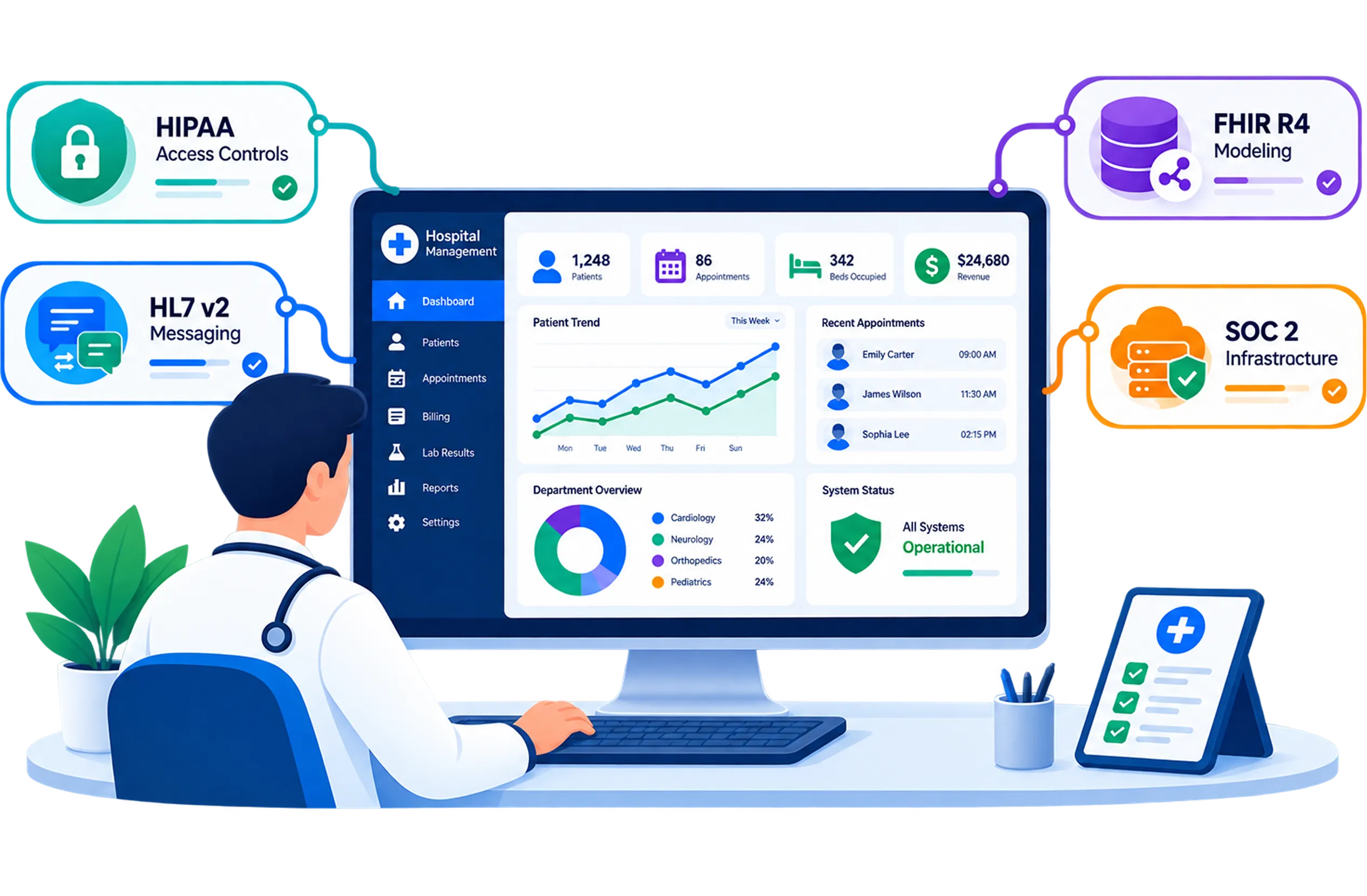
A hospital management system that passes a demo but fails a HIPAA audit six months later isn’t actually compliant, it’s just untested. We build access controls, encryption, and audit logging into every module from the start, mapped against current FHIR R4 and HL7 v2 messaging requirements rather than treated as a checklist applied after development ends.

  • Check Icon

    HIPAA-aligned access and audit controls

  • Check Icon

    FHIR R4 resource modeling for external data exchange

  • Check Icon

    HL7 v2 ADT, ORM, and ORU messaging for internal systems

  • Check Icon

    SOC 2 Type II aligned infrastructure practices

How We Engage, Based on What Your Hospital Needs

Systems Audit and Roadmap

A focused assessment of your current systems with a documented integration matrix and migration plan, before any build commitment.

  • Fixed scope, fixed timeline
  • Delivered as a standalone engagement

Phased Modernization

Build new HMS modules around your existing EHR and billing systems without a full replacement, rolled out facility by facility.

  • Module-by-module delivery
  • Lower disruption to live operations

Full Platform Build

End-to-end HMS development for hospital chains starting fresh or replacing a legacy system entirely across every facility.

  • Complete architecture and compliance design
  • Long-term platform ownership

How Much Does Hospital Management System Development Cost?

Custom HMS builds typically range from $40,000 for a phased modernization to $150,000+ for a full multi-facility platform, depending on module count and migration scope.


    Your data and info stays secure. Read our Privacy Policy.


    Why This Approach Reduces Risk

    Phased rollout means no facility goes dark during a migration, and issues surface in one location before they reach the rest of the network.

    Compliance controls built during development instead of audited in later, which avoids the rework that follows a failed readiness review.

    Integration-first design means your existing EHR and billing investment stays useful instead of being discarded.

    Source code ownership at delivery means your roadmap isn't dependent on a vendor's release schedule.

    Why Hospital Systems Teams Work With Us

    Discovery-First Builds

    Discovery-First Builds

    We document your existing systems and integration points before writing a line of code, so the architecture reflects how your hospital actually operates instead of a generic template.

    Secure ADLC Methodology

    Secure ADLC Methodology

    Security and compliance controls get embedded into each module during development, reducing the rework that typically follows a HIPAA or SOC 2 readiness review months after launch.

    Full Source Code Ownership

    Full Source Code Ownership

    You receive complete ownership of the codebase at delivery, so future changes don't require a vendor conversation or a new licensing negotiation.

    Client Testimonials (We're Rated 4.7 on Clutch)

    Healthcare Projects We’ve Built

    View All Case Studies →
    PHARMACY CarePoint

    CarePoint

    CarePoint is a comprehensive pharmacy and clinical management solution developed by Citrusbug, centralizing inventory, patient prescriptions, dispensing workflows, and compliance reporting for multi-location healthcare operations.

    Read More
    FITNESS Mediyoga

    Mediyoga

    A state-of-the-art wellness and patient engagement platform built for Mediyoga, integrating guided care programs, health tracking, and provider-patient communication into a unified digital experience.

    Read More
    HEALTHCARE Brainkey

    Brainkey

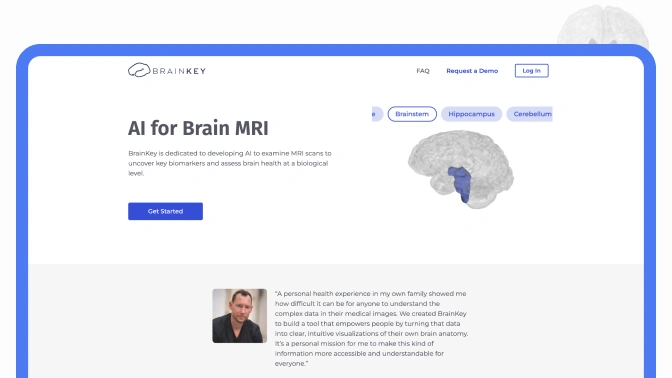
    Designed for healthcare providers and researchers, the platform enhances early detection of neurological conditions

    Read More

    Insights on Healthcare, AI & Technology

    Visit Our Blog
    Pharmacy Management System Market: Size, Growth, and Key Statistics
    Pharmacy Management System Market: Size, Growth, and Key Statistics Custom Software Development

    Pharmacy Management System Market: Size, Growth, and Key Statistics

    The way pharmacies operate has changed dramatically over the past few years. From manual record-keeping and paper prescriptions to fully digital workflows, the shift toward technology-driven pharmacy operations is accelerating…

    Read Article →
    7 Leading Hospital Management Software Development Companies You Can Trust
    7 Leading Hospital Management Software Development Companies You Can Trust Custom Software Development

    7 Leading Hospital Management Software Development Companies You Can Trust

    Hospitals that aim to increase workflow efficiency, eliminate administrative burdens, and improve overall productivity are increasingly in need of hospital management software development services. Choosing the right hospital management software…

    Read Article →
    The Role of AI in Chronic Disease Management: Use Cases, Benefits, and Impact
    The Role of AI in Chronic Disease Management: Use Cases, Benefits, and Impact Artificial Intelligence

    The Role of AI in Chronic Disease Management: Use Cases, Benefits, and Impact

    Chronic conditions such as diabetes, cardiovascular diseases, and respiratory disorders require continuous monitoring, timely interventions, and personalized care plans, something traditional healthcare models often struggle to deliver at scale. This…

    Read Article →

    FAQs About Hospital Management System Development

    Do we have to replace our existing EHR to get a new HMS?

    No. Most HMS builds connect to your existing EHR through FHIR R4 and HL7 v2 messaging rather than replacing it. Replacement is only needed if the EHR itself is the bottleneck.

    How long does a custom hospital management system take to build?

    A phased modernization typically runs four to seven months. A full platform build for a multi-facility chain runs nine to fourteen months, depending on module count and migration complexity.

    What happens to our existing patient data during migration?

    Data migrates in parallel with your live system, with validation at each step. Facilities stay operational throughout, and cutover happens on a staggered schedule rather than all at once.

    Can the system handle multiple hospital locations under one account?

    Yes. Multi-location scalability is built into the architecture from the start, with centralized visibility and independent module scaling per facility.

    What compliance documentation do we get at the end of the project?

    You receive documentation covering access control design, encryption implementation, audit logging configuration, and FHIR/HL7 mapping, ready to support a HIPAA or SOC 2 audit.

    Do you support hospitals that already tried an HMS implementation that failed?

    Yes. We regularly take over stalled or partially built systems, audit what exists, and decide what to keep versus rebuild before continuing.

    What ongoing support is included after launch?

    Post-launch support covers performance monitoring, issue resolution from real-world usage, and module extensions as new facilities or departments come online.

    Can we start with one facility before rolling out to the rest of the chain?

    Yes, this is the recommended approach. A staggered rollout lets your staff adjust and lets us catch issues in a controlled environment before scaling to every location.

    Ready to Connect Your Hospital's Systems Instead of Replacing Them?

    Get a free systems audit and find out what to keep, modernize, or build new.