Advinow
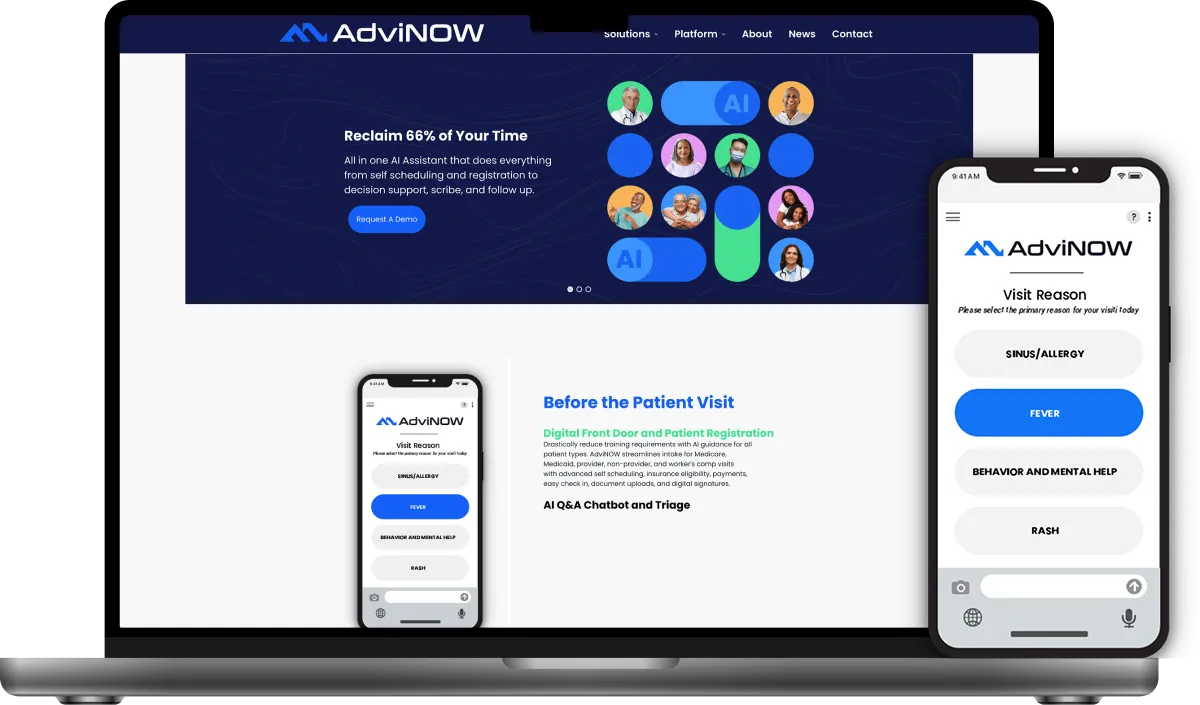
It's an AI-driven healthcare platform that automates patient engagement and consultation processes, helping healthcare providers deliver efficient, on-demand services while improving operations for urgent care.
More InfoMost claim management platforms tell you what went wrong after the payer rejects the claim. We build systems that catch payer-specific rule violations, coding gaps, and eligibility mismatches before your first 837 file leaves the system, so clean claim rates improve at the source, not in the appeals queue.
Trusted Software Development Company By
A well-built claims platform is not a billing add-on. It is the operational spine of your revenue cycle, connecting eligibility checks, coding validation, payer submission, status tracking, denial management, and remittance reconciliation into one auditable workflow.
Connect EHR, PMS, RCM, clearinghouse, and payer systems, including Epic, eClinicalWorks, Waystar, and Optum through FHIR R4 APIs and HL7 v2.x interfaces. Claims data moves from charge capture to payer acknowledgment without re-keying.
Apply payer-specific edits, ICD-10/CPT/HCPCS validation, duplicate detection, and documentation gap checks before submission. Custom rule engines catch the errors that standard clearinghouse scrubbers miss because they don't know your payer contracts.
Submit structured 837P, 837I, and 837D transactions over ANSI X12 5010. Handle 270/271 eligibility checks, 276/277 status requests, 278 prior authorization, and 835 remittance within a single integrated pipeline, with no manual hand-offs between transaction types.
Track every claim from submission acknowledgment through adjudication. Real-time dashboards show accepted, pending, denied, and aged claims by payer, giving billing and RCM teams one place to prioritize follow-up and reduce days in AR.
Automate 835 payment posting, reconcile remittance against expected reimbursement, and flag underpayments and contractual adjustment discrepancies. Teams stop chasing paper EOBs and start managing exceptions from a structured dashboard.
Track clean claim rate, first-pass acceptance, denial rate by payer and CPT code, AR days, underpayment exposure, and claim turnaround time. Custom dashboards give RCM Directors the KPIs that actually predict revenue performance, not just volume metrics.
Tell us how your current claims workflow runs and we'll show you where the revenue is slipping through.
Map My Claims WorkflowGeneric claims systems assume every payer uses the same rules. They do not. UnitedHealthcare, Humana, and Aetna each maintain proprietary adjudication logic that standard revenue cycle management software and off-the-shelf platforms were never designed to accommodate at the code level.
The result is a predictable pattern: high first-submission denial rates, manual resubmission queues that grow faster than staff can clear them, remittance reconciliation done in spreadsheets, and no clear analytics to identify whether the problem is eligibility, coding, documentation, or payer behavior.
Custom healthcare claims management software development solves this by encoding your specific payer contracts, specialty billing rules, and clearinghouse edits into the validation layer before submission, not after denial.
Each major payer publishes companion guides that override X12 5010 defaults. Handling payer-specific edits, modifier requirements, bundling logic, and NPI validation for 50+ contracted payers requires a configurable rule engine, not hardcoded conditionals.
An 837 submission triggers a chain: 999 acknowledgment, 277CA status response, potential 276 follow-up, and 835 remittance. Managing this transaction lifecycle, handling rejections at each stage, and surfacing errors to the right team member requires purpose-built orchestration logic.
CMS-0057-F mandates FHIR-based prior authorization APIs for impacted payers by January 2027. Building a claims system today that does not include a health insurance software FHIR R4 layer creates a compliance gap that will require expensive rework under regulatory pressure.
Denial recovery is expensive. The more valuable engineering investment is building denial prediction logic that identifies high-risk claims before submission by payer, CPT code, provider, and modifier pattern, and routes them to review queues automatically.
Most organizations replacing a claims platform have years of historical claim data, payer table mappings, ICD/CPT code histories, and remittance records in legacy formats. A clean migration without data loss requires structured mapping, validation testing, and parallel-run periods before cutover.
A production-grade healthcare claims management software system operates within a compliance and standards matrix that governs how data is structured, transmitted, and secured across every integration point.
How We Build Healthcare Claims Management Software
Map your existing claims workflow: charge capture, eligibility checks, coding steps, clearinghouse routing, payer submission, and remittance reconciliation. Document payer contracts, EDI requirements, denial patterns, and integration dependencies before design begins.
Define the system architecture: FHIR R4 APIs, EDI/X12 transaction pipeline, claim scrubbing rule engine, database schema, and security controls. Compliance review confirms HIPAA safeguards, audit trail requirements, and role-based access controls are built into the core not added later.
Develop EHR, PMS, and clearinghouse integrations. Build the payer-specific rule engine with configurable validation logic per contracted payer. Implement EDI transaction orchestration covering 837, 835, 270/271, 276/277, and 278 workflows.
Train denial prediction models on historical claim data. Implement NLP-based documentation extraction. Build analytics dashboards tracking clean claim rate, denial rate by payer and code, AR days, and underpayment detection.
Run functional, integration, and performance testing across all claim types and payer connections. Conduct parallel-run testing against your current system before cutover. Deploy to HIPAA-compliant cloud infrastructure and configure L1/L2/L3 SLA support.
Custom healthcare claim management software development ranges from $25,000 for a basic EDI submission platform to $200,000 or more for an enterprise system with AI denial prediction, FHIR R4 prior authorization APIs, multi-payer integrations, and legacy migration.
CMS-0057-F requires impacted payers to implement FHIR R4-based Prior Authorization, Patient Access, Provider Access, and Payer-to-Payer APIs by January 1, 2027. Operational prior authorization decision timeframes 72 hours urgent, 7 days standard took effect January 1, 2026.
Claims platforms built without FHIR R4 interoperability today will require significant architectural rework under deadline pressure. Citrusbug designs systems that support both legacy X12 278 prior authorization and FHIR-native healthcare automation solutions from day one, so compliance is a build deliverable not a retrofit.
→ FHIR R4 Prior Authorization API (Da Vinci CRD, DTR, PAS)
→ ANSI X12 5010 EDI compliance (837, 835, 278, 270/271)
→ HIPAA-compliant PHI handling and audit trails
→ CAQH CORE operating rules alignment
Custom healthcare claims management software is built for organizations with claims volume, payer complexity, or specialty billing requirements that off-the-shelf RCM tools cannot accommodate.
Review your current claims workflow, denial patterns, and integration architecture. Deliver a technical specification, payer rule inventory, and a build-ready system design.
• Claims workflow audit
• EDI/X12 gap analysis
• FHIR compliance roadmap
• Architecture blueprint
Full custom development of the claims platform including EDI pipeline, payer integrations, claim scrubbing engine, and analytics dashboards. POPULAR
• End-to-end platform build
• Payer-specific rule engine
• EHR and clearinghouse integrations
• QA, UAT, and deployment
Fixed-price or dedicated team engagement covering build, deployment, post-launch optimization, and ongoing SLA support under Citrusbug’s Secure ADLC methodology.
• Full-cycle delivery
• Post-launch L1/L2/L3 SLA support
• Free maintenance period included
• NDA + full source code ownership
Our engineers understand claims adjudication logic, not just software patterns. We build payer rule engines, denial prediction models, and EDI pipelines that perform in production RCM environments, not just in demos.
Every engagement starts with a documented requirements phase: claims workflow mapping, payer contract review, integration dependency analysis, and compliance gap assessment. Code does not start until the architecture is signed off.
We build systems fluent in both ANSI X12 5010 EDI and HL7 FHIR R4 APIs covering the full transaction lifecycle from 837 submission through 835 remittance and FHIR prior authorization workflows required by CMS-0057-F.
HIPAA safeguards, SOC 2 controls, role-based access, and audit trails are architectural requirements, not configuration options added at launch. ISO 27001 certification covers our development environment and delivery process.
You receive full source code, technical documentation, and deployment assets at delivery. There is no vendor lock-in, no ongoing license dependency, and no restriction on how you extend the platform.
Citrusbug offers L1/L2/L3 SLA support tiers after deployment, including payer table updates, regulatory change handling, and performance optimization as your claim volume and payer network grow.
It's an AI-driven healthcare platform that automates patient engagement and consultation processes, helping healthcare providers deliver efficient, on-demand services while improving operations for urgent care.
More Info
Carepoint is a solution dedicated to the pharmacy industry with a variety of tools needed to manage any pharmacy.
More Info
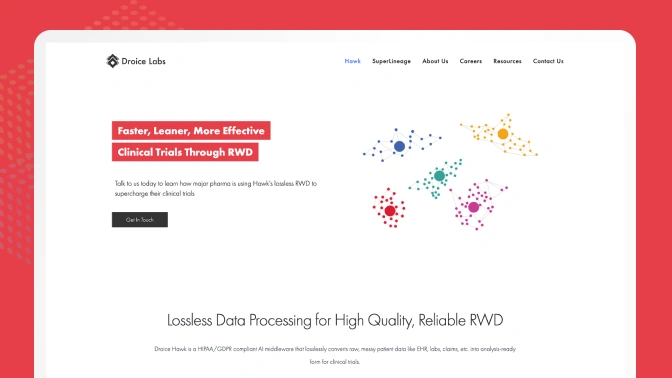
Droice Labs is a middleware designed to transform messy, unstructured patient data into clean, analysis-ready formats for clinical trials.
More Info
AI technology is revolutionizing healthcare delivery by increasing efficiency and accessibility to medical services. AI’s role in healthcare advancement has been unparalleled – from aiding in accurate diagnoses to driving…
Read Article →
Healthcare is changing fast, and conversational AI in healthcare is helping lead the way. Intelligent voice- and text-based systems support patients by simplifying the process of booking an appointment, navigating…
Read Article →
Healthcare providers face mounting pressure to process claims accurately while managing complex billing regulations and reducing denial rates. Claims management software has become an essential infrastructure for hospitals, clinics, and…
Read Article →A basic claims platform with single-payer EDI integration typically takes 3 to 5 months. Mid-level systems with multi-payer integrations, denial analytics, and EHR connectivity run 5 to 8 months. Enterprise platforms with AI denial prediction, FHIR prior auth APIs, and legacy migration take 9 to 12 months.
At minimum: 837P/I/D for claim submission, 835 for remittance, 270/271 for eligibility, and 276/277 for claim status. Most enterprise builds also include 278 for prior authorization and 999 acknowledgment handling. The specific set depends on your payer mix and clearinghouse setup.
We build configurable payer rule engines that encode each payer's companion guide requirements modifier restrictions, CPT bundling logic, NPI validation, and documentation requirements separately from the core validation layer. Payer rules can be updated without code deployments.
Organizations subject to CMS-0057-F must implement FHIR R4 Prior Authorization, Patient Access, Provider Access, and Payer-to-Payer APIs by January 1, 2027. Faster prior authorization decision timeframes (72 hours urgent, 7 days standard) took effect January 2026. We build both X12 278 and FHIR-based prior auth workflows so you satisfy both legacy and new-standard requirements.
Yes. We build FHIR R4 and HL7 v2.x integrations with Epic, eClinicalWorks, Cerner, and other EHR platforms, and support direct connections to Waystar, Optum, and other major clearinghouses.
We build ML-based denial prediction models trained on your historical denial data, NLP engines that extract and validate coding from clinical documentation, and pre-submission claim scrubbing that applies payer-specific rules automatically. These are separate modules built to your data, not generic plug-ins.
We conduct a structured migration: payer table mapping, ICD/CPT/HCPCS code alignment, claim history transfer, remittance data migration, and validation testing before go-live. Parallel-run periods confirm data integrity before you cut over.
We offer Fixed-Price, Time and Material, and Dedicated Team engagement models. Fixed-price suits projects with clearly scoped requirements from our discovery phase. We provide a detailed specification before any model is selected.