


- AI Engineering
AI Chatbot Development CompanyAI Chatbot Development Company

A top AI chatbot development company specializing in custom chatbots that boost customer experience and automate business processes. Contact us today!
AI Software Development SolutionsAI Software Development Solutions
A reliable AI software development company providing custom solutions that enhance efficiency, streamline operations, and drive business growth.
Custom NLP DevelopmentCustom NLP Development
A trusted provider of custom NLP solutions, helping businesses unlock insights from text data, automate processes, and enhance user experiences. Contact us for tailored solutions today.
Generative AI DevelopmentGenerative AI Development
A leading generative AI development company, creating custom AI models to automate content creation, enhance creativity, and drive innovation. Contact us for tailored solutions today.
Machine Learning ConsultationMachine Learning Consultation
A reliable machine learning consultation service, helping businesses harness AI to make informed decisions and drive growth. Get in touch for personalized solutions today.
- Industries
Healthcare
We deliver customized healthcare software development solutions, improving patient care, streamlining workflows, and ensuring compliance with industry regulations through innovative technology.
FinTechWe specialize in FinTech app development, delivering secure and innovative financial solutions that enhance user experience, streamline transactions, and ensure regulatory compliance.
LogisticsWe provide tailored logistics software development solutions, optimizing supply chain efficiency, improving real-time tracking, and streamlining operations to enhance overall business performance.
eLearningWe offer eLearning software development services, creating interactive, scalable platforms that enhance online education, support personalized learning, and streamline content management for educators and learners.
E-CommerceOur E-Commerce software development services offer tailored solutions for building and enhancing online stores. These services include custom website design, payment integration, inventory management, and user-friendly interfaces.
Real EstateOur Real estate software development services provide custom solutions for property management, listings, virtual tours, and CRM integration. These tools streamline transactions, enhance customer experience, and drive sales.
- WORK
- COMPANY
BlogBlog

Explore insights on AI trends, use cases, and real-world innovations.
WhitepapersWhitepapers
Explore our Whitepaper to learn how Citrusbug builds reliable, scalable, and future-ready digital solutions that drive business growth.
CareerCareerJoin a team that’s building the future with AI-driven innovation, meaningful projects, and a culture that supports learning and growth.
About usAbout usWith a strong focus on AI and emerging technologies, we help businesses embrace digital transformation through scalable, future-ready solutions.
Our PartnersOur Partners
Our strong network of technology and business partners helps us drive excellence, enhance capabilities, and ensure impactful project outcomes.
Contact UsContact Us
Let’s connect to discuss how we can support your next big idea or challenge.
- Let's Talk
 SaaS Development
 Web Application Development
 Mobile Application Development
 Custom Software Development
 Cloud Development
 DevOps Development
 MVP Development
 Digital Product Development
 Hire AI Engineers
 Hire Generative AI Developers
 Hire Chatbot Developers
 Hire Python Developers
 Hire Django Developers
 Hire ReactJS Developers
 Hire AngularJS Developers
 Hire VueJS Developers
 Hire Full Stack Developers
 Hire Back End Developers
 Hire Front End Developers
 AI Healthcare Software Development & Consulting
 Healthcare App Development
 EHR Software Development
 Healthcare AI Chatbot Development
 Telemedicine App Development Company
 Medical Billing Software Development
 Fitness App Development
 RPM Software Development
 Medicine Delivery App Development
 Medical Device Software Development
 Patient Engagement Software Solutions
 Mental Health App Development
 Healthcare IT Consulting
 Healthcare CRM Software Development
 Healthcare IT Managed Services
 Healthcare Software Testing services
 Medical Practice Management Software
 Outsourcing Healthcare IT Services
 IoT Solutions for Healthcare
 Medical Image Analysis Software Development Services
 Lending Software Development Services
 Payment Gateway Software Development
 Accounting Software Development
 AI-Driven Banking App Development
 Insurance Software Development
 Finance Software Development
 Loan Management Software Development
 Decentralized Finance Development Services
 eWallet App Development
 Payment App Development
 Money Transfer App Development
 Mortgage Software Development
 Insurance Fraud Detection Software Development
 Wealth Management Software Development
 Cryptocurrency Exchange Platform Development
 Neobank App Development
 Stock Trading App Development
 AML software Development
 Web3 Wallet Development
 Robo-Advisor App Development
 Supply Chain Management Software Development
 Fleet Management Software Development
 Warehouse Management Software Development
 LMS Development
 Education App Development
 Inventory Management Software Development
 Property Management Software Development
 Real Estate CRM Software Development
 Real Estate Document Management Software
 Construction App Development
 Construction ERP Software Development




Accounting Software Statistics 2026: Adoption Rates, Market Growth, and Future Trends
- December 16, 2025
-
645 Views
- by Ishan Vyas
Table of Contents
- Introduction
- Why Accounting Software Matters Today?
- The Growing Importance of Accounting Software
- Accounting Software Market Size & Growth (2024–2030)
- Accounting Software Adoption Analysis Report by Organisation
- Accounting Software Market Analysis By Product
- Accounting Software Adoption Analysis Report by Region
- Accounting Software Adoption Analysis Report By Industry
- Top 5 Future Trends of Accounting Software
- Conclusion
Introduction
Now, in the modern business world, accounting software is a critical component of accuracy, productivity and strategic planning. With the rise in technology, accounting software statistics indicate a transition from manual bookkeeping to fully automated, data-based financial systems that improve compliance and real-time tracking. The worldwide market is growing quickly as a result of cloud, AI and the need for more intelligent financial tools that can handle vast amounts of data in real time.
This blog discusses adoption rates, market growth, product analysis, regional trends and where accounting software is headed for 2026 and beyond.
Why Accounting Software Matters Today?
Accounting software is important today because it automates your basic financial processes and takes out manual errors from any report. As the amount of data that businesses need to manage grows, state-of-the-art tools created with finance software development can help to optimise processes and make company finances more efficient across all aspects.
Companies get real-time dashboards on cash flow, expenses, and profitability, making it easier to act quickly. Other capabilities that are improved through the development of financial software compliance is better maintained with automatically updated tax and regulatory rules.
There’s never been more demand for cloud-based accounting tools than now, with everyone working from home. Through these platforms, team members can securely access financials from anywhere. As companies expand, scalable financial software is also necessary in order to manage more complex financial tasks.
In short, accounting software is important today because it eliminates human error, increases efficiency, ensures accuracy in financial reporting and allows businesses to function more efficiently in the digital age.
The Growing Importance of Accounting Software
Now, businesses are increasingly turning to digital tools to monitor their finances more accurately and efficiently. And within these solutions, accounting software is required because it reduces workflow and allows businesses to make smarter choices.
- Automation & Efficiency: Accounting software automates core financial tasks including invoicing, ledger maintenance, payroll, and financial reporting while accounts payable automation software further reduces manual effort, minimizes errors, and saves valuable time.
- Cloud & Remote Access: Cloud computing provides dynamic access to your financial data today, a key when many employees work remotely or require flexible work arrangements.
- Advanced Features: Today’s tools come with smart reporting, analytics, as well as forecasting. They are integrated with CRM, ERP and payment systems. Now, a lot of solutions include AI in accounting software, pattern detection, fraud alerts and more reliable financial forecasts.
- Scalability & Flexibility: Larger companies typically need more advanced features to manage their accounting as they grow. Contemporary software extends across them, from small-business bookkeeping to enterprise-grade financial management.
Many SMEs start with simple invoicing before adopting full accounting platforms. Using structured documents to generate a professional invoice template with client details, line items, taxes, and payment terms helps maintain consistency while businesses scale toward more automated accounting workflows.
These drivers were also understood to mean that complex financial operations like finance, telecom and retailers could also make use of accounting software-type applications.
Accounting Software Market Size & Growth (2024–2030)
The accounting software statistics show a strong upward trend from 2024 to 2030, driven by digital transformation, automation, and increasing global adoption of cloud-based financial tools. This period highlights continuous growth across both software and service segments.
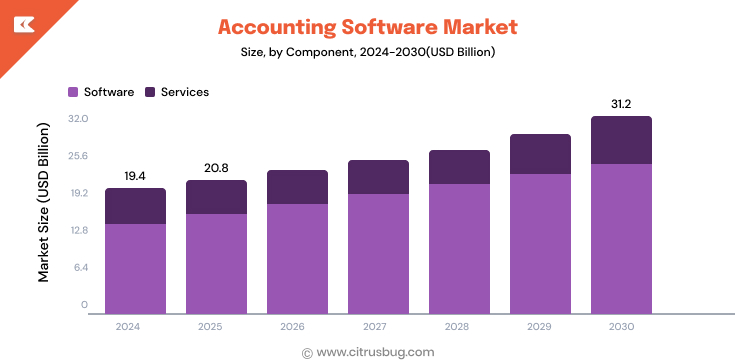
- The accounting software market was valued at USD 19.4B in 2024, with increasing adoption of cloud-based financial systems by businesses fueling steady demand. These stats are backed by account software statistics that also show growing adoption among SMEs and Large enterprises.
- The market size expands to approximately USD 20.8B in 2025 due to increased digitisation requirements and the emergence of integrated accounting ERP solutions. Businesses are turning towards automation to eliminate manual tasks, as evident in the accounting software industry statistics.
- The market reached close to USD 22–23B in 2026 and software led the industry as it has a widespread operational impact. This upward trend mirrors the accounting software statistics that consistently demonstrate a departure from traditional ways of bookkeeping.
- In 2027, the market will exceed USD 24–25B and will be in its fastest growth phase, driven by digital finance improvement. Organisations around the world are investing in next-generation financial tools that deliver market-leading accuracy, visibility and data-driven decision making.
- In 2028, the market grew to about USD 26B, fuelled by SaaS expansion, compliance requirements, and greater use of real-time analytics. Businesses are modernising workflows to meet global reporting standards and improve operational efficiency.
- The market will hit a maximum in 2030 of USD 31.2B due to robust long-term industry expansion and increased global dependence on automated finance practices. The momentum is fuelled by AI-powered tools, automation and the worldwide shift to smarter digital accounting ecosystems.
Accounting Software Adoption Analysis Report by Organisation
SME Adoption Statistics
- According to accounting software statistics, as of 2023, over 70% of SMBs and SMEs globally have adopted some form of accounting software to streamline their financial processes.
- The global SMB/SME accounting software market was valued at USD 5,858.4 million in 2024, and is projected to reach about USD 10,150.4 million by 2032, reflecting a compound annual growth rate (CAGR) of roughly 7.1%.
- By deployment type, cloud-based accounting software holds the largest share (over 50–60%) of all accounting solutions, showing how cloud accounting is a dominant trend among SMEs and enterprises alike.
- Within SMEs globally, there is a growing shift to cloud solutions; one report estimates that about 72% of SMEs have adopted cloud accounting platforms for real-time financial tracking and remote access.
- For small businesses specifically, many sellers of small-business accounting software report that around 60% of small business owners feel they lack strong accounting knowledge, which partly explains the rapid adoption when easy-to-use software becomes available.
Enterprise-Level Adoption
- High overall adoption among enterprises. According to a market report segment, about 84% of global enterprises use accounting enterprise software solutions.
- Cloud-based accounting is dominant and growing. In 2023-2024, cloud-based accounting software accounted for the majority of new deployments, and cloud adoption continues to increase as firms prioritise scalability, remote access, and real-time financial visibility.
- Enterprise organisations lead in market share. As of 2025, the “large enterprises” segment held the largest share, 64% of the global accounting software market, reflecting their greater resources and need for advanced, integrated financial systems, and the growing influence of enterprise accounting software trends.
- Growing adoption of AI, automation and analytics within ERP solutions. Over 60% of enterprises are now incorporating AI/ML features, real-time analytics, mobile access, and other advanced modules within their ERP systems, showing that automation and intelligence are core to modern enterprise accounting/ERP trends.
- According to recent accounting software statistics, the sector was valued at USD 15.23 billion in 2025 and is forecast to reach USD 29.38 billion by 2033. This growth projection underscores continuing enterprise-level adoption, driven by cloud, automation, and AI.
Accounting Software Market Analysis By Product
1) Cloud-Based Accounting Software
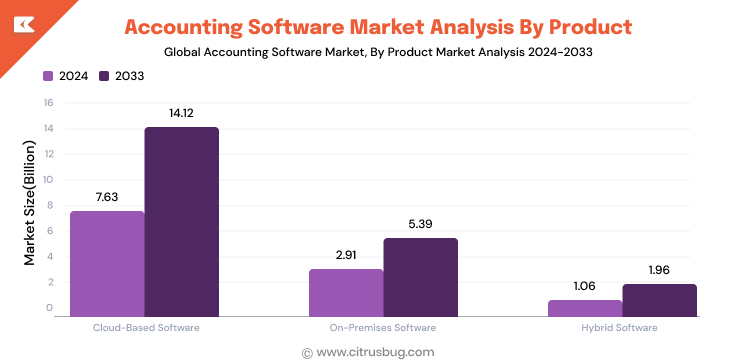
Cloud-based solutions dominate the market due to their flexibility, scalability, and lower upfront costs. They grew from $7.63 billion in 2023 to $14.12 billion in 2033, making it the leading deployment choice for modern, digital-first businesses.
This segment remains the top choice as businesses increasingly adopt digital, remote-friendly financial systems.
2) On-Premises Software
On-premises accounting software continues to serve organisations that prioritise full control over data and internal infrastructure. Its market size rises from $2.91 billion in 2023 to $5.39 billion by 2033, maintaining a stable 25.11% market share.
It remains essential for industries with strict security or compliance needs.
3) Hybrid Software
Hybrid accounting software combines the strengths of cloud accessibility with the security of local storage. It shows moderate growth from $1.06 billion in 2023 to $1.96 billion in 2033, appealing to companies transitioning gradually to cloud environments.
This segment is expanding as businesses seek balanced, flexible deployment options.
(Source)
Accounting Software Adoption Analysis Report by Region
North America
- Largest global market, led by the U.S. with USD 6.09B in 2024, driven by strong SaaS and AI-enabled bookkeeping adoption.
- Acts as the innovation hub for cloud, embedded payments, and automation, with rapid fintech–accounting ecosystem convergence.
- Growth supported by SME cloud migration and automation, sustaining mid–high single-digit CAGR in key cloud subsegments. These trends align with recent accounting software statistics showing accelerated uptake among small and mid-sized businesses.
Europe
- Market valued at USD 5.35B in 2024, expanding steadily with digital tax compliance and VAT automation requirements.
- Strong SME and enterprise adoption across UK, Nordics, and Western Europe with major players like Visma and SAP.
- Growth is moderated by fragmented tax rules and lower digitisation in parts of Southern/Eastern Europe. Despite this, regional financial software market growth continues to rise as cloud migration and automation increase across key industries.
Asia Pacific (APAC)
- Accounts for 24.1% of the global market, USD 4.6 — 4.7B, and is the fastest-growing region worldwide.
- Boosted by SME digitisation, e-invoicing mandates, and rapid cloud adoption across India, China, and Southeast Asia.
- Recent accounting software statistics indicate strong uptake of cloud-based and automated solutions in these markets. Growth potential remains high but requires robust localisation due to varied tax rules and regulatory landscapes.
South America
- Valued at USD 1.14B in 2024, with rising adoption of cloud-based accounting among SMEs in Brazil and Mexico.
- Digitisation and fintech partnerships (payments, invoicing) are key catalysts for the region’s 8.9% growth outlook.
- Challenges include economic volatility and heavy localisation requirements for tax and e-invoicing. Recent accounting software statistics indicate that SMEs adopting automated bookkeeping and reporting solutions are seeing improved efficiency and compliance.
Middle East & Africa (MEA)
- Market stands at USD 701.5M in 2024, benefiting from government-led digital tax and e-invoicing rollouts.
- Strongest demand comes from GCC (UAE, Saudi Arabia) and South Africa, driven by cloud ERP and compliance needs.
- Growth is constrained by uneven SME digital maturity and infrastructure gaps in parts of Africa, yet increasing awareness of accounting software statistics highlights a gradual uptick in automation and cloud adoption across the region.
Accounting Software Adoption Analysis Report By Industry
BFSI (Banking, Financial Services & Insurance)
- As per a 2024 accounting software statistics, BFSI held the largest share 24.78% of global accounting‑software revenue among industry verticals.
- Another 2025 source estimates BFSI’s share at 28.64%, reaffirming that BFSI remains the biggest end‑user industry group.
- BFSI requires strong financial controls, complex transaction handling, regulatory compliance and audit trails, features that accounting software (especially ERP‑integrated) provides effectively.
Manufacturing
- The manufacturing industry is identified among the key sectors adopting accounting software, especially to manage cost-accounting, supply‑chain finance, inventory valuation, and integration with operations.
- As digital transformation accelerates, accounting software trends show that manufacturing firms increasingly depend on financial automation to streamline production-linked cash flows, manage asset lifecycles, and improve forecasting accuracy.
Retail (including Retail & E-commerce)
- Retail is a significant adopter: one report estimates the “online accounting software” market size for retail at USD 4.0 billion.
- Retail firms benefit from accounting software for real‑time sales tracking, inventory management, integration with point-of-sale (POS), and streamlined reconciliation of expenses, revenues, and tax/compliance.
- The growth in e-commerce and omnichannel retail accelerates demand making retail more reliant on real‑time financial visibility.
IT & Telecom
- According to one market forecast, IT & Telecommunication is the fastest-growing industry vertical in accounting software adoption with a relatively high growth rate CAGR of 11.84%.
- For IT & Telecom companies, accounting software provides benefits like real-time financial tracking across multiple projects/locations, subscription‑based billing, payroll, and cost allocation which are critical for service-based, dynamic organisations.
Others
- These sectors adopt accounting software to manage general accounting functions — general ledger, accounts payable/receivable, payroll, budgeting & forecasting, compliance, especially as regulatory / audit requirements tighten and organisations scale.
- For smaller or non-traditional industries, cloud‑based and modular solutions are often preferred because they offer flexibility, lower up‑front investment, and scalability.
Top 5 Future Trends of Accounting Software
With the evolution of technology, accounting software is becoming more intelligent, automated and interconnected. Five key trends that show the future of financial management is faster, real-time and even more secure.
1. Artificial Intelligence (AI) and Automation
AI is becoming the core engine of modern accounting systems. In the future, software will handle tasks such as data entry, reconciliation, invoice processing, and anomaly detection automatically. This reduces manual workload, minimises human error, and frees accountants to focus on analysis and strategy.
2. Cloud-Based and Connected Ecosystems
Cloud adoption continues to accelerate. Accounting software will function as part of end-to-end digital ecosystems where it is closely linked to invoicing, payroll, banking, tax systems and ERP. Real-time collaboration, universal accessibility and increased scalability will ensure that Cloud Platforms become the new default for businesses of all sizes.
3. Advanced Data Analytics and Real-Time Reporting
Future accounting software will be able to deliver deeper insights with advanced analytics. Dashboards will feature up-to-the-minute financial metrics, forecasts of cash flow and the ability to create custom performance indicators. This move towards insight-based accounting will make better decisions and faster.
4. Blockchain and Enhanced Security
Blockchain is set to transform financial data integrity. With immutable transaction records and smart contracts, accounting processes will become more transparent, secure, and resistant to fraud. Continuous auditing and faster reconciliation will also become more achievable through distributed ledger technology.
5. Integration Through Open APIs
Accounting will get even more interconnected. Open APIs allow your organisation to integrate with any CRM, inventory, HR, e-commerce or banking system. This eliminates manual duplication of data, and ensures accuracy and continuity in a centralised financial ecosystem where information flows effortlessly.

Conclusion
The trend of adopting accounting software is growing as companies focus on automation, precision, and real-time financial visibility. Thanks to advances in AI, the cloud, analytics and greater security, these tools are transforming digital finance. Markets grow when corporates demand a scalable system to handle complex financial operations with ease and efficiency.
Custom accounting software development also allows businesses to integrate solutions that fit their individual workflow. These customised systems increase adherence, streamline procedures and help ensure the successful expansion of practices in an information-driven age.






Related Blogs
February 6, 2026
Best SaaS Development Companies in UK 2026