Exii
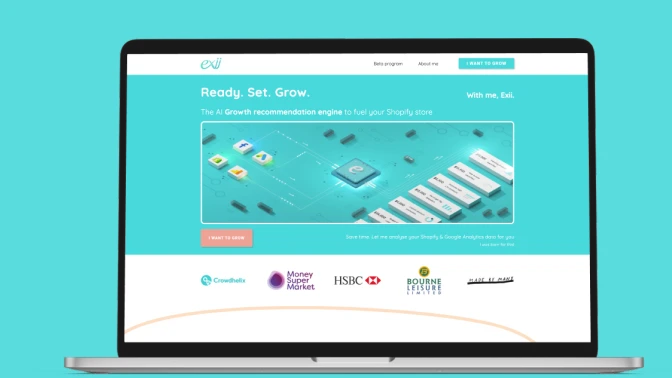
Exii.co recommendation engine personalizes online shopping experiences, enhancing customer engagement and increasing sales.
Operational Excellence
Tech Expertise
Consistent Commitment
Based on 43 Reviews
Trusted by industry leaders
An AI SaaS platform is not a regular SaaS product with a chatbot attached. Our AI SaaS development services cover every layer, from the database to the billing model, because AI's cost and behavior touch all of them. Here's what we build in from the start.
We design tenant isolation at the database, vector index, and prompt-log level, not just the application layer. Each customer’s embeddings and context stay in their own namespace, so nothing leaks across accounts as you scale.
We build retrieval-augmented generation pipelines that ground model outputs in your customers’ actual data, with generative AI integration patterns that work whether you’re using a single frontier model or routing across several.
When your product needs AI agents that take real actions, not just answer questions, we build the tool-access governance layer alongside the agent itself, so what an agent is allowed to touch is a config decision, not an afterthought.
We build the ML pipelines that turn your product’s usage data into churn prediction, demand forecasting, or pricing intelligence, feeding back into the product instead of sitting in a separate dashboard nobody opens.
Get a straight answer on your AI SaaS architecture before you spend a dollar on development.
Talk to an EngineerMost AI SaaS platforms fail quietly, not with an outage but with a cost curve that outpaces revenue. The decisions that prevent that happen at the architecture stage, before a single model call ships to production, and they're decisions most teams don't know to ask about until the bill arrives.
Building directly against one model provider’s API without an abstraction layer means every price change or deprecation is a forced migration, not a choice.
Without evaluation pipelines in place, model updates silently change your product’s behavior and nobody notices until a customer complains.
Enterprise buyers now ask for SOC 2 and EU AI Act documentation specifically for the AI features, not just the platform.
Without per-tenant token budgets, one heavy user can consume the margin on a hundred light ones.
Exii.co recommendation engine personalizes online shopping experiences, enhancing customer engagement and increasing sales.
This AI tool provides real-time, accurate renovation cost estimates for homeowners, contractors, investors, and insurance companies.
Advinow is an AI-driven healthcare platform that automates patient engagement and consultation processes, helping healthcare providers deliver efficient, on-demand services while improving operations for urgent care.
Tenants get access to AI features at signup instead of waiting for a manual provisioning step, which shortens the gap between trial and paid conversion on usage-based plans.
Per-tenant token budgets and cloud cost optimization built into the architecture keep inference spend proportional to revenue instead of growing faster than it.
Products that use a customer's own data to personalize recommendations or workflows see measurably lower churn than ones offering the same AI features to every account.
Each tenant gets a configurable spend ceiling enforced at the gateway layer, so one account's usage spike can't quietly eat into margin on every other account.
Requests route to the smallest model that can handle them, with fallback to a larger model only when the task genuinely needs it, cutting average cost per request.
Repeated or near-duplicate queries get served from cache instead of triggering a fresh model call, which matters most on high-traffic, low-variance features like search or support.
We wire model usage directly into your billing system so MLOps monitoring and customer invoicing pull from the same source of truth.
We map your data sources, tenant model, and compliance requirements before touching a model. This is where we decide the multi-tenancy pattern, token budget structure, and which model provider fits your cost and latency needs, not after the first sprint is already underway.
We build a working prototype against real data, testing whether a fine-tuned model, RAG pipeline, or a simpler ML approach actually fits the problem, since the flashiest option isn't always the cheapest or most reliable one for your use case.
We build the production platform with tenant isolation baked into the data layer and vector store from day one, integrating with your existing CRM, billing, or data warehouse rather than building a parallel system.
Beyond functional QA, we run model evaluation against edge cases and set up the audit logging and access controls your compliance team will need before enterprise buyers start asking for documentation.
We deploy with per-tenant cost dashboards live from day one, so you can see which accounts are profitable on AI usage and which need a pricing adjustment before it becomes a problem.
Most teams fall into one of these starting points. The right one depends on how much of your existing product you're willing to touch.
Add AI capabilities to a product that's already live, without disrupting the parts that work.
Build a standalone AI feature or module that plugs into your existing platform.
Build the platform from scratch with AI as a core part of the architecture, not an add-on.
Most AI SaaS development projects range from $20,000 for a focused MVP to $200,000+ for a full multi-tenant platform, depending on model complexity, integrations, and scalability requirements.
Share your details to get an accurate estimate.
We map requirements, data flows, and architecture decisions before writing code, so the build doesn't drift from what you actually need.
Security gets embedded into the development lifecycle from day one instead of getting bolted on before a compliance review.
We architect cloud spend alongside model spend, so your infrastructure bill scales with revenue instead of ahead of it.
L1, L2, and L3 support options keep the platform maintained and the models monitored after launch, not just at handoff.
AI in the modern tech-driven world is a buzzword that constantly creates new experiences for users by changing industries and products. AI in SaaS makes business smarter as improvements are…
Read Article →
The AI industry reached $184 billion in 2024 and is predicted to increase to $ 826 billion by 2030. Does this sound ridiculously high? It is not surprising at all.…
Read Article →
Introduction The healthcare industry is moving quickly to cloud-based solutions to simplify processes and enhance patient care. From streamlining workflows in hospitals to efficiently managing patient information, the healthcare SaaS…
Read Article →Most builds range from $20,000 for a focused MVP to $200,000+ for a full multi-tenant platform, depending on model complexity, integrations, and compliance requirements.
An MVP typically takes 2-3 months. A full production platform with multi-tenant architecture and compliance work usually runs 5-8 months.
Yes, in most cases. We assess your current data model first to determine whether AI features can be added incrementally or need a partial rearchitecture.
We enforce per-tenant token budgets and isolated vector namespaces at the architecture level, so usage and data stay contained per account.
Yes. Model routing, semantic caching, and per-tenant budgets are built in at launch, and we monitor cost against usage post-launch.
We build audit logging, access controls, and data governance into the architecture from the start, aligned with SOC 2 and EU AI Act risk management requirements.