

Pebblely
An AI platform designed that takes care of product photography for online businesses.
 Citrusbug Healthcare →
Custom vision models trained on your data, not stock photography, tuned to the accuracy thresholds your business actually needs, and monitored after launch instead of handed off and forgotten.
Trusted by industry leaders















Certifications and Accreditations






Deep learning models trained on your labeled data, not generic pretrained sets, tuned to the specific defects, mismatches, or objects your business needs flagged. Fine-tuning existing foundation models cuts initial data requirements when the use case allows it.
Low-latency object recognition optimized for the environment it runs in, whether that means a GPU cluster processing millions of images a day or a quantized model running on a factory-floor edge device with no reliable cloud connection.
Optical character recognition tuned for the documents you actually process, structured claim forms, handwritten notes, scanned contracts, turning image data into usable structured text instead of a flat transcript.
API-first architecture that connects vision output to the systems already running your business, ERP, CRM, EHR, or a custom internal platform, with secure data handling built in from the first integration point.
A short technical scoping call tells you whether a custom model, a fine-tuned foundation model, or an off-the-shelf API is the right fit before you commit budget.
Book a Scoping CallPretrained APIs are validated against public benchmarks, not the specific visual variance in your environment, lighting, angle, product mix, or defect type.
Third-party API updates can silently shift model behavior mid-production with no changelog you control.
Switching providers later means re-validating accuracy from zero, not a config change.
Cloud-only APIs cannot run where the images are captured, which rules out real-time use cases with connectivity constraints.


We assess what data you actually have against what the target accuracy requires, not what a generic project plan assumes. This includes checking for class imbalance, labeling quality, and whether existing data can support a fine-tuned foundation model or needs a purpose-built one, before any architecture decision gets made.
We choose between a custom-trained model, a fine-tuned vision-language foundation model, or a hybrid approach based on your accuracy target, latency budget, and available labeled data, not a default template applied to every project regardless of fit.
Models get trained against your data and validated on a held-out set that reflects real production conditions, not a curated benchmark. Our AI model training process tracks accuracy, false positive rate, and inference latency against agreed thresholds before anything ships.
Deployment targets cloud, edge, or hybrid infrastructure based on where the images are actually captured and how fast a decision needs to happen. Edge deployments get quantized and optimized specifically for the hardware they run on.
Production models drift as real-world data diverges from training data. We set up ongoing monitoring through our MLOps deployment and monitoring practice and define a retraining cadence upfront, so accuracy degradation gets caught before it becomes a business problem instead of after.
An AI platform designed that takes care of product photography for online businesses.
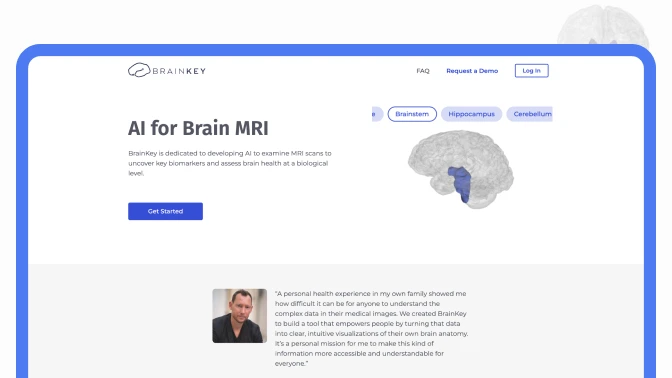
Platform leverages AI to analyze brain imaging data, providing insights into brain health.

The Huddle is an all-in-one AI-driven e-learning platform designed to revolutionize online education.
Their agile way of working, competence, and friendliness are impressive.December 7, 2024
Citrusbug Technolabs handles a data extraction project for an education company. They're also responsible for managing an AI generation project for the client.
Citrusbug Technolabs has laid out and followed a clear project outline and consistently met deadlines. The team communicates well and demonstrates a strong understanding of the client's vision and goals. Their agile approach, high level of competence, and personable approach stand out.
 Read More
Their communication and ability to capture exactly what I was asking for were impressive.November 14, 2024
Citrusbug Technolabs built an automated system for a veteran medical company. The system needed to collect and store user data, generate customized letters based on surveys, and use AI to summarize reviews.
Citrusbug Technolabs delivered a functional automated system that successfully organized the client's records and auto-generated statements. The team was quick to respond, addressed all roadblocks, and communicated effectively. Overall, their ability to understand the client's needs stood out.
Read More
They were very calm and talented, and they did bring some of their own ideas.January 28, 2025
Citrusbug Technolabs has developed an MVP for a freight and capacity marketplace. The team has created three different interfaces for three market segments.
Citrusbug Technolabs has successfully developed an effective MVP. The team has delivered the project on time and almost within budget. Moreover, their responses have been timely. Overall, the team has been calm, talented, and innovative. This has led to the client's satisfaction.
Read More
What stood out most about them was their personalized approach and sense of ownership in every aspect of the project."February 27, 2024
Citrusbug Technolabs built a Flutter cross-platform mobile app for an education company. They also developed two web apps and an admin panel and provided DevOps support for the client's infrastructure.
Citrusbug Technolabs' support successfully boosted the client's user engagement by 8x, resulting in an 85% retention rate. The reliable team demonstrated a dedication to delivering on time and promptly responding to concerns and adjustments. Their personalized, client-centric approach stood out.
Read More
They didn't like the phrase "impossible to do", which made them very solution-oriented.February 19, 2024
A healthcare company hired Citrusbug Technolabs to design and develop a user-friendly application. The team provided tailored assistance to meet the client's requirements.
Citrusbug Technolabs successfully delivered an application that was ready for market. The team was highly professional and well-organized; they stayed focused throughout the engagement and were receptive to changes. Overall, they stood out for their trustworthiness and commitment to excellence.
Read More
They're 100% on time and transparent throughout each stage of the project.February 24, 2024
A financial technology company has hired Citrusbug Technolabs to build a custom web application. The team handles the development and design of the app.
The project is ongoing, but the client has been satisfied with Citrusbug Technolabs' services. The team is very professional — they always respect timelines and provide regular updates to ensure everyone's on the same page. Also, their transparent approach makes them a trustworthy partner.
Read More
"I do believe they are exceptional at where they stand."
Citrusbug Technolabs took on a mobile app development project for a Singapore-based development house. They were provided with UX designs to execute. Currently, they're finalizing and fine-tuning the product.
Citrusbug Technolabs contributed to the successful launch of the product, which has garnered over 10,000 users in just three months. The product has also received support from investors. They consistently followed-up with their progress and delivered at a speedy rate. The team is truly stellar.
Read More
High-risk obligations under the EU AI Act’s Article 6 and Annex III become enforceable on August 2, 2026, and biometric identification and categorization systems fall squarely inside that scope.

Bias and accuracy audit documentation prepared alongside the model, not reconstructed after a regulator asks
GDPR-aligned biometric data handling built into the pipeline from the first data collection step
SOC 2 Type II infrastructure for any system processing identifiable visual data
Clear separation between biometric verification (lower obligation) and biometric identification (high-risk) built into the system design from day one
Every engagement includes the full path from data to a deployed, monitored model, not just the model itself.
We assess what you have, identify gaps, and define a labeling approach that gets you to a usable training set without over-collecting data you don’t need.
Custom or fine-tuned model development matched to your accuracy target, latency budget, and deployment environment.
A secure, documented API layer connecting model output to your existing systems, including intelligent document processing pipelines where OCR and structured data extraction are part of the workflow.
A defined cadence for tracking accuracy drift and retraining, agreed before launch, not negotiated after accuracy drops.
Feasibility validation
Test model accuracy against a real, representative slice of your data before committing to a full build.
• Small labeled dataset
• Single use case
• Go/no-go accuracy report
• 4-6 week timeline
Full model and integration
End-to-end development from architecture through deployment, integrated into your existing systems.
• Full dataset labeling
• Custom or fine-tuned model
• API integration
• Deployment support
• Post-launch handover
Ongoing monitoring and retraining
Continuous accuracy monitoring, drift detection, and scheduled retraining once the system is live.
• Drift monitoring
• Scheduled retraining
• Performance reporting
• SLA-backed support
Custom image recognition projects typically range from $20,000 for a scoped proof of concept to $150,000 or more for a production system with edge deployment and ongoing monitoring, depending on data readiness and integration scope.

Not a generic API fine-tuned at the margins. We train and validate against your actual images, environment, and edge cases from the first sprint, not a benchmark dataset that looks nothing like production.

Most vendors hand over a model and move to the next project. We build monitoring and a retraining cadence into every engagement, so accuracy drift gets caught before it costs you.

We validate feasibility against real data before you commit to a full production build, so the accuracy question gets answered early, not after budget is already spent.
Accuracy depends on data quality, model architecture, and training volume. Enterprise deployments with well-labeled domain-specific data typically outperform generic APIs on the exact cases that matter to your business.
A proof of concept runs 4-6 weeks. Full production builds with integration and edge deployment typically run 10-20 weeks depending on data readiness.
If your system does biometric identification or categorization, yes, high-risk obligations apply from August 2026. Biometric verification-only use cases are generally exempt, but the distinction is easy to misclassify.
Yes. Our API-first architecture integrates with ERP, CRM, EHR, and custom internal platforms through secure, documented endpoints.
We define a monitoring and retraining cadence upfront as part of Managed Vision Ops, so drift gets flagged and addressed on a schedule, not discovered by accident.
Both, depending on your use case. We assess whether a fine-tuned foundation model meets your accuracy target or whether a purpose-built model is the better fit before recommending either.
Yes, models can be quantized and optimized for edge hardware when real-time processing without reliable connectivity is a requirement.
Cost depends on data readiness, model complexity, and deployment environment, not a flat per-project rate. A scoping call gives you a realistic range before you commit.
Stop relying on a generic API's accuracy claims. Build a vision system trained on your data, validated against your accuracy bar, and monitored after it ships.

