

Getdandy
It’s an AI-driven reputation management platform that automates online review collection, sentiment analysis, and response strategies to help businesses enhance their digital credibility.
 Citrusbug Healthcare →
 HIPAA
HIPAA
 SOC 2
SOC 2
 ISO 27001
 GDPR
GDPR
Trusted by industry leaders















Certifications and Accreditations




Invoice matching, three-way PO reconciliation, and exception routing that still runs through spreadsheets and email.
New-hire data entry across payroll, benefits, and access systems that rarely stay in sync.
Ticket triage, order status lookups, and refund processing take up agent time before a human decision is even needed.
Purchase order creation, stock reconciliation, and vendor data updates spread across ERP and spreadsheet workarounds.
We build bots that run independently around the clock and bots that sit alongside employees for judgment-heavy steps, often combining both inside a single workflow.
Where APIs don’t exist or cost too much to open up, our bots work at the UI layer exactly the way a person would, without touching the underlying application.
OCR and NLP extract, classify, and validate invoices, claims forms, and contracts- the same intelligent document automation work we deliver standalone when documents are the whole bottleneck.
Every bot ships with defined escalation paths, so unexpected data doesn’t silently fail. It routes to a human with the context needed to resolve it fast.
Encryption, role-based access, and audit logging are built in from day one, aligned to SOC 2 Type II, HIPAA, and GDPR depending on your industry.
A control layer tracks every bot’s performance and flags drift before it causes downstream errors, giving your team visibility without checking each process manually.
Get a process-by-process automation audit scoped to your systems, not a generic template.
Map Your Automation RoadmapFinance teams see the fastest return. Invoice processing, expense reconciliation, and journal entries are high-volume, rule-based, and painful for staff. HR gets close behind; onboarding data entry across payroll, benefits, and access systems is repetitive and error-prone by design.
Customer service teams use RPA to pull order history and process routine refunds before a human ever opens the ticket, cutting first-response time without adding headcount. Supply chain and procurement teams automate purchase order creation and vendor data reconciliation across ERP and spreadsheet workarounds that never quite matched. The pattern across all four: the work is structured enough to automate, but no single owner has the bandwidth to fix it manually.
We sit with the people actually running the process, not just the manager who describes it from memory. Every branch, exception, and manual workaround gets documented, including the ones nobody mentions until week two. This is where most automation projects quietly fail, so we spend real time here before writing a line of bot logic.
We score every candidate process against transaction volume, rule stability, and the real cost of current errors, then build a business case around the two or three processes with the fastest payback. This keeps the first bot from being the easiest one to build instead of the one that actually moves a number.
Bots get built against the platform that fits your existing stack, UiPath, Automation Anywhere, or Power Automate, with modular selectors so a UI update doesn't break the whole workflow. Exception handling and escalation logic are designed in from the start, not bolted on after the first failure in production.
The bot runs in parallel with the existing manual process for a defined window, so we can compare outputs line by line before anyone's job depends on it. Edge cases surface here, and we fix them before scaling, rather than discovering them after the bot owns the process.
Once validated, the bot moves to production with monitoring, versioned logic, and a documented handover package your team can act on without calling us for every rule change. We stay involved for tuning and for AI agent development when the next process needs judgment instead of just rules.
It’s an AI-driven reputation management platform that automates online review collection, sentiment analysis, and response strategies to help businesses enhance their digital credibility.

Bevel is a health intelligence platform that unifies wearable and lifestyle data to generate personalized metabolic and wellness insights.
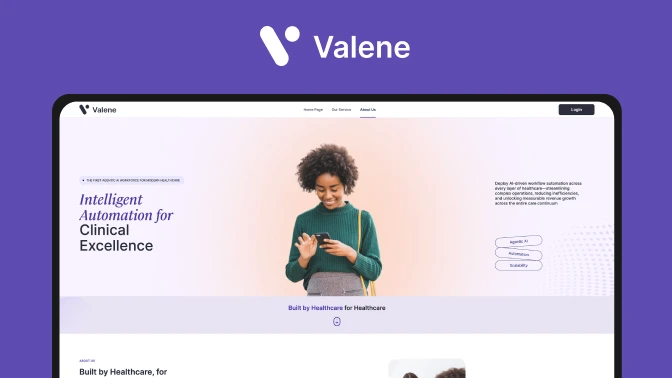
Valene Health is a pioneering telepsychiatry platform that leverages AI to enhance mental healthcare delivery.
Their agile way of working, competence, and friendliness are impressive.December 7, 2024
Citrusbug Technolabs handles a data extraction project for an education company. They're also responsible for managing an AI generation project for the client.
Citrusbug Technolabs has laid out and followed a clear project outline and consistently met deadlines. The team communicates well and demonstrates a strong understanding of the client's vision and goals. Their agile approach, high level of competence, and personable approach stand out.
 Read More
Their communication and ability to capture exactly what I was asking for were impressive.November 14, 2024
Citrusbug Technolabs built an automated system for a veteran medical company. The system needed to collect and store user data, generate customized letters based on surveys, and use AI to summarize reviews.
Citrusbug Technolabs delivered a functional automated system that successfully organized the client's records and auto-generated statements. The team was quick to respond, addressed all roadblocks, and communicated effectively. Overall, their ability to understand the client's needs stood out.
Read More
They were very calm and talented, and they did bring some of their own ideas.January 28, 2025
Citrusbug Technolabs has developed an MVP for a freight and capacity marketplace. The team has created three different interfaces for three market segments.
Citrusbug Technolabs has successfully developed an effective MVP. The team has delivered the project on time and almost within budget. Moreover, their responses have been timely. Overall, the team has been calm, talented, and innovative. This has led to the client's satisfaction.
Read More
What stood out most about them was their personalized approach and sense of ownership in every aspect of the project."February 27, 2024
Citrusbug Technolabs built a Flutter cross-platform mobile app for an education company. They also developed two web apps and an admin panel and provided DevOps support for the client's infrastructure.
Citrusbug Technolabs' support successfully boosted the client's user engagement by 8x, resulting in an 85% retention rate. The reliable team demonstrated a dedication to delivering on time and promptly responding to concerns and adjustments. Their personalized, client-centric approach stood out.
Read More
They didn't like the phrase "impossible to do", which made them very solution-oriented.February 19, 2024
A healthcare company hired Citrusbug Technolabs to design and develop a user-friendly application. The team provided tailored assistance to meet the client's requirements.
Citrusbug Technolabs successfully delivered an application that was ready for market. The team was highly professional and well-organized; they stayed focused throughout the engagement and were receptive to changes. Overall, they stood out for their trustworthiness and commitment to excellence.
Read More
They're 100% on time and transparent throughout each stage of the project.February 24, 2024
A financial technology company has hired Citrusbug Technolabs to build a custom web application. The team handles the development and design of the app.
The project is ongoing, but the client has been satisfied with Citrusbug Technolabs' services. The team is very professional — they always respect timelines and provide regular updates to ensure everyone's on the same page. Also, their transparent approach makes them a trustworthy partner.
Read More
"I do believe they are exceptional at where they stand."
Citrusbug Technolabs took on a mobile app development project for a Singapore-based development house. They were provided with UX designs to execute. Currently, they're finalizing and fine-tuning the product.
Citrusbug Technolabs contributed to the successful launch of the product, which has garnered over 10,000 users in just three months. The product has also received support from investors. They consistently followed-up with their progress and delivered at a speedy rate. The team is truly stellar.
Read More
Rule-based bots stall the moment a document doesn't match the expected template.
Most automation programs guess at which process to build next.
Rule-based bots break the moment a process needs a judgment call.
Sometimes a bot is a bridge, not the destination.
Cost depends on how many systems a bot touches and how much exception logic it needs, not just how many steps are in the process. Here's a realistic range based on typical enterprise builds, and it shifts higher when the process has heavy data integration and ETL needs.
| Bot Type | Complexity | Estimated Cost | Typical Timeline |
|---|---|---|---|
|
Single-process task bot (one system, structured data) |
Low |
$15,000–$35,000 |
3–6 weeks |
|
Multi-step process bot (multiple systems, exception handling) |
Medium |
$35,000–$70,000 |
8–14 weeks |
|
Enterprise automation program (multi-department, orchestration, governance) |
High |
$70,000–$250,000+ |
4–9 months |















One high-impact process, built and validated before you commit further.

Several related processes automated in sequence, with shared infrastructure.

A governed automation function your team can run and extend.
Most single-process bots run $15,000 to $35,000. Enterprise automation programs typically land between $70,000 and $250,000+, depending on system count and exception complexity. Tell us about your process and we'll scope a realistic number.


 Artificial Intelligence
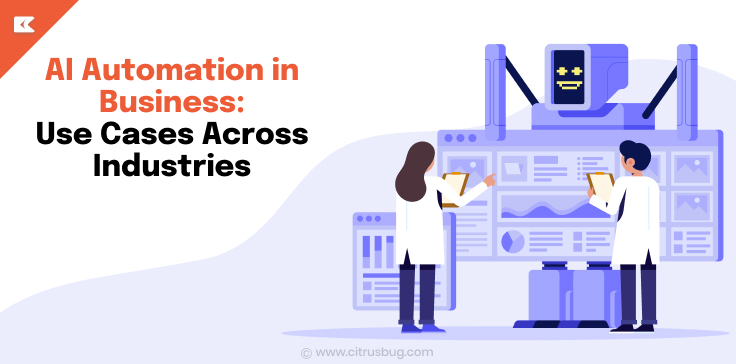
What if your workflows ran themselves? Yes, AI is making it possible. From analyzing large datasets and adapting to new market trends to predicting future outcomes, AI has revolutionized how…
Read Article →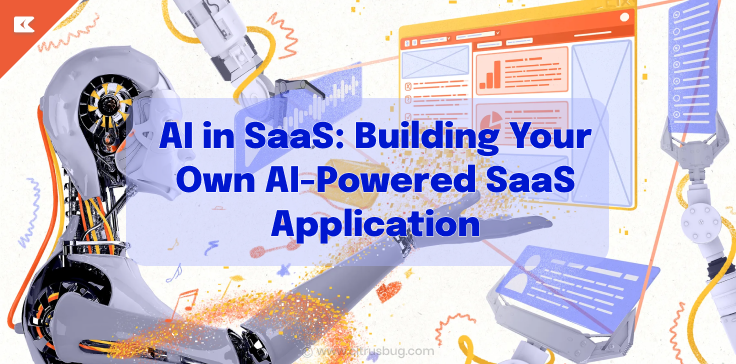 Artificial Intelligence
AI in the modern tech-driven world is a buzzword that constantly creates new experiences for users by changing industries and products. AI in SaaS makes business smarter as improvements are…
Read Article →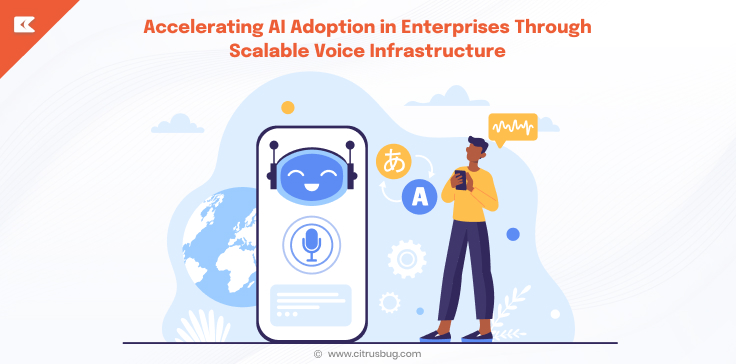 Artificial Intelligence
Introduction If you look at how enterprises operate today, almost everything is being touched by AI in one way or another. Companies are using AI for forecasting, customer support, analytics,…
Read Article →RPA automates existing UI-based steps. Workflow automation redesigns the process itself. AI agents add judgment where rules run out. Most enterprise builds combine two or three of these, not just one.
Yes. Bots operate at the UI layer, interacting with screens exactly as a person would. That makes RPA the practical option where opening an API isn't feasible or cost-effective.
It escalates to a defined human workflow instead of failing silently. We build escalation logic into every bot from day one, so exceptions get logged and routed, not lost.
We offer ongoing monitoring and tuning, or hand over a documented package your internal team can run independently. Maintenance cost depends on which model you choose and how many bots are live.
No. RPA development services are built to work with what you already have. System redesign only becomes relevant if you're planning a broader modernization, which we can also help sequence.
