Back
Back






Introduction
2026 is the year when most healthcare organizations and providers realize HIPAA Compliance is critical and mandatory to implement now more than ever. The report by the U.S. Department of Health and Human Services Office for Civil Rights reveals that around 503 breaches of unsecured protected health information were reported in 2025, affecting over 40 million individuals.
As Patient Health Information (PHI) is at a growing risk due to increasing breaches and violations, organizations must shift their approach from “checking boxes” to implementing dynamic, proactive HIPAA compliance strategies for data protection. To help you stay on track and simplify the process, we have crafted a step-by-step, complete HIPAA compliance checklist healthcare organizations can follow to secure PHI and stay compliant in 2026. Follow this checklist to ensure your business meets all the essential compliance requirements.
HIPAA Compliance Checklist – A Quick Snapshot
Most healthcare providers and business associates who are unfamiliar with the process might believe that achieving HIPAA compliance is very complicated. However, if you follow a strategic and proper HIPAA compliance audit checklist, you can certainly ensure data security and safeguard sensitive patient data. Have a look at our HIPAA Compliance Checklist table below that outlines the key actions needed to achieve and maintain compliance goals in 2026.
| Sr. No | Steps To Become HIPAA-Compliant | Key Action(s) to Take | Outcome |
|---|---|---|---|
| 1. | Assess Your Current Compliance Status | Review existing policies, systems, and data handling practices to identify gaps against HIPAA requirements | A clear understanding of where your organization stands and what needs improvement |
| 2. | Conduct a Risk Assessment | Identify potential risks to ePHI, evaluate vulnerabilities, and document threats across systems and workflows | Reduced exposure to data breaches and regulatory penalties |
| 3. | Understand the Four HIPAA Rules | Educate teams on the Privacy, Security, Breach Notification, and Enforcement Rules | Improved clarity, reduced confusion, and consistent compliance efforts |
| 4. | Appoint a HIPAA Compliance Officer | Assign a qualified individual to oversee compliance, training, and documentation | Clear accountability and centralized compliance management |
| 5. | Develop Security Policies & Standards | Create written policies for access control, data storage, transmission, and incident handling | Standardized processes and stronger governance |
| 6. | Implement Required Safeguards | Apply administrative, physical, and technical safeguards such as encryption and access controls | Enhanced protection of patient data and system integrity |
| 7. | Sign Business Associate Agreements (BAAs) | Execute BAAs with vendors and third parties handling PHI | Shared compliance responsibility and reduced third-party risk |
| 8. | Establish an Incident Response Plan | Define procedures for detecting, reporting, and responding to data breaches | Faster incident response and minimized impact of security events |
| 9. | Conduct Regular HIPAA Audits | Perform internal audits and compliance checks to ensure ongoing adherence | Early detection of gaps and audit-ready operations |
| 10. | Continuously Monitor & Update Policies | Regularly review and update policies based on regulatory changes and business growth | Long-term compliance and adaptability to evolving HIPAA requirements |
HIPAA Compliance and Its Importance
HIPAA stands for the Health Insurance Portability and Accountability Act. HIPAA compliance is basically the process of adhering to a specific set of standards aimed to protect patient health information, also known as PHI. All the information that is related to a patient’s health, healthcare, medical history, treatments, test results, and personal identifiers can be referred to as PHI.
HIPAA compliance ensures that healthcare providers, insurance companies, and business associates securely handle medical data, prevent unauthorized access, and maintain patient privacy.
Here’s why HIPAA compliance is a must-follow standard for every healthcare organization storing patients’ data.
- Protects patients’ sensitive health information from unauthorized access
- Builds trust and credibility between patients and healthcare organizations
- Helps prevent data breaches, identity theft, and misuse of medical records
- Ensures organizations follow legal and federal privacy regulations
- Avoids costly fines, legal penalties, and reputational damage
- Improves data security practices within healthcare systems
- Supports ethical handling of patient information
- Ensures secure sharing and communication of medical data across systems
Why Should Your Organization Follow The HIPAA Compliance Checklist?
A HIPAA compliance checklist is basically a complete requirements list that an organization should follow to protect patient information and comply with HIPAA, one of the most popular and mandatory U.S. federal laws.
Think of the checklist for HIPAA compliance as the blueprint for data integrity, which helps your organization maintain a secure system, prevent unwanted visitors to access patient data, and ensure every piece of patient information is managed with accuracy, consistency, and care.
Following a structured checklist matters for any organization storing and handling patient data. Let’s take a closer look at why it is crucial to follow the HIPAA compliance audit checklist.
It Builds Trust – The Currency of Care: Compliance with HIPAA regulations assures patients that their sensitive health data is handled securely, which becomes the foundation of long-term trust and loyalty.
The Way to Avoid Financial Heartburn: By following the checklist, organizations reduce the risk of fines and penalties for non-compliance, saving substantial amounts of money in potential lawsuits or audits.
Prevents Reputational Damage: The best thing about ensuring HIPAA compliance is that you can protect your organization’s reputation, which showcases your brand image as a reliable and trustworthy entity in the healthcare industry.
Acts as a Shield to Prevent Data Breaches and Cyber Threats: With a structured checklist, organizations can implement powerful security measures that guard against cyberattacks and prevent data breaches that could compromise patient information.
A Culture of Data Integrity and Accountability: By following the checklist, it would be much easier to promote a culture of data integrity and accountability. This would also ensure that all employees take the necessary steps to protect PHI.
Key to Streamlined Operations: By adhering to HIPAA requirements, organizations create a smoother, more efficient workflow that minimizes errors and ensures patient data is properly managed at all times.
Who Must Follow A HIPAA Compliance Checklist?
Majorly, there are two types of organizations that need to comply with HIPAA and should follow the HIPAA compliance checklist, as per the U.S. Department of Health and Human Services. They are covered entities and business associations.
to identify gaps, strengthen safeguards, and prepare for audits: covered entities and business associations.
Covered Entities
Covered entities are basically the organizations that are directly involved in the healthcare sector, like doctors, hospitals, clinics, health insurance companies, and certain service providers. Healthcare providers, health plans, and healthcare clearinghouses are included in covered entities.
Healthcare Providers
This category includes all the doctors, hospitals, clinics, nursing homes, pharmacies, dentists, psychologists, and specialists who provide healthcare and medical services. It’s simple, if you are providing medical care and have access to, been interacting with, and handling Patient Health Information (PHI), HIPAA applies to you.
Health Plans
Health plans are health insurance companies, HMOs, or even public health plans like Medicaid and Medicare that pay for the medical care. So, if you are managing health insurance or providing medical coverage, you have to prioritize achieving HIPAA compliance too.
Healthcare Clearinghouses
Acting as mediators in the healthcare ecosystem, healthcare clearinghouses include billing services and insurance claim processors that handle electronic patient health information. People associated with healthcare clearinghouses need to keep PHI private, and hence, have to comply with HIPAA regulations.
Business Associations
But what if your business is not actually working in the healthcare domain? Well, that’s where it gets interesting. You must know that even though you are not a healthcare service provider or a physician, you could still be affected by HIPAA as a business associate who directly or indirectly has access to PHI.
Business Associates
If you are a vendor, service provider, or even a software development company that works with a covered entity in a non-healthcare role but has access to patient data, note that HIPAA applies to you as well. These individuals and service providers are known as business associates.
Examples of business associates include data storage organizations, software providers, accounting companies, legal services, consultants, EHR platforms, third-party consultants, cloud service providers, and others who are associated with healthcare organizations and deal with PHI.
HIPAA Compliance Checklist: Step-by-Step Guide To Be Compliant-Ready
Being a HIPAA-compliant organization might feel daunting, but it can be achievable through a structured and strategic process. Follow this proven HIPAA compliance checklist that is tailored to ensure your organization stays fully compliant with HIPAA regulations and is ready to safeguard sensitive patient health information.
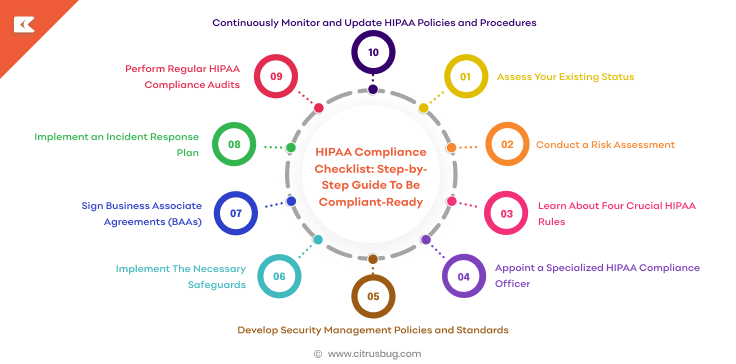
Step 1 – Assess Your Existing Status
The first step is to begin with a complete, unbiased evaluation of your existing compliance status. Get to know whether your organization belongs to the covered entities or business associates categories. It would be better to assign a dedicated team to identify the possible gaps in your current systems, policies, and practices related to handling Protected Health Information (PHI).
Outcome: The initial HIPAA compliance assessment helps you understand what changes or improvements are essential to meet HIPAA standards and achieve full compliance.
Step 2 – Conduct a Risk Assessment
When it comes to picking out weaknesses and vulnerabilities that could put PHI at risk, a HIPAA risk assessment is essential. With such compliance assessments, it would be possible to check if administrative, technical, and physical safeguards are implemented appropriately.
Check your IT systems, policies, and procedures to deduce the places or areas where sensitive patient data can be exposed. While there are no specific instructions for performing a risk assessment, it includes a variety of elements like scope, potential risks, security mechanisms, risk levels, and threat protection triage.
Outcome: This step ensures you understand your organization’s vulnerabilities and can prepare a rock-solid strategy and roadmap to take preventive actions to protect PHI.
Step 3 – Learn About Four Crucial HIPAA Rules
To avoid team burnout, confusion, and mistakes during the HIPAA compliance journey, it will be greatly helpful to know the four rules of HIPAA. When your team knows exactly what each rule means and how it applies to daily processes, it becomes much easier to move forward with confidence.
Privacy Rule: This rule regulates the use and disclosure of PHI.
- It creates a baseline for how the PHI can be used and disclosed
- The privacy rule gives patients control over their data, including the right to access, amend, and receive an accounting of disclosures
- Under this rule, healthcare providers must provide a Notice of Privacy Practices (NPP) explaining patient data usage.
Security Rule: Protects electronic PHI (ePHI) through administrative, physical, and technical safeguards.
- The HIPAA security rule sets high-level standards for safeguarding information when transmitted or stored electronically
- This rule basically involves three safeguards, Administrative, Technical, and Physical, to secure patient data and make it inaccessible to unauthorized individuals
- Encryption, access control, audit logs, and policies are essential to prevent unauthorized access or data breaches.
Omnibus Rule: Expands the scope of HIPAA compliance and liability to business associates.
- This rule further clarifies the responsibilities of business associates, strengthens patient rights, and enhances penalty structures
- Covered Entities must have to sign Business Associate Agreements (BAAs) with vendors who access and handle patient data
- Every organization that falls under covered entities will have to provide NPP to its patients.
Breach Notification Rule: Requires organizations to notify affected individuals and authorities whenever a data breach takes place.
- Incident response policy, mitigation policy, and internal notification policy must be in place
- It is required to inform HHS within 60 days, along with the affected individuals, about data breaches.
- Organizations have to maintain audit trails that can confirm or disprove PHI compromise.
Outcome: By gaining a thorough understanding of these four HIPAA compliance rules, organizations can better align and implement the regulatory requirements and avoid costly mistakes.
Step 4 – Appoint a Specialized HIPAA Compliance Officer
Designate a HIPAA compliance officer who is responsible to oversee the entire HIPAA compliance process within your organization. The specialized officer (or team, in larger organizations) will manage risk assessments, ensure security measures, implement privacy policies, conduct staff training, prepare a disaster recovery plan, and ensure that all policies are being followed to ensure compliance.
Outcome: Investing in a dedicated compliance officer or team ensures consistent oversight and effective implementation of HIPAA policies across your organization.
Step 5 – Develop Security Management Policies and Standards
Another important step in our HIPAA compliance audit checklist is about creating and implementing clear security management policies and standards. There would be a number of policies and procedures you need to follow to cover all aspects of how PHI is managed and protected within your organization. Common policies may include below:
- HIPAA release forms and Notice of Privacy Practices (NPP)
- Access management policies to ensure only authorized staff can access PHI
- Data backup and retention policies to ensure information is safely stored and retrievable
- Incident response policies to minimize damage, restore operations, and protect data.
Outcome: This step will result in your organization having a set of clear, documented policies that help standardize PHI handling procedures and ensure all employees follow the same best practices.
Step 6 – Implement The Necessary Safeguards
The HIPAA security rule outlines three types of safeguards to ensure patient health information is protected and used carefully.
Administrative Safeguards: Set internal policies and procedures that govern how PHI is handled and who has access to it. This safeguard involves:
- Training employees or staff about PHI protections
- Assign a HIPAA officer
- Conduct regular risk assessments to resolve security incidents
- Protect PHI during emergency situations
Physical Safeguards: It involves protecting physical access to PHI, whether it’s paper-based or electronic.
- Restrict physical access to servers and data centers
- Restrict facility access through authentication systems
- Implement workstation security protocols
- Ensure secure disposal of hardware and devices
Technical Safeguards: These safeguards are implemented to protect ePHI, information stored in an application or digital system.
- Encryption, firewalls, and secure authentication methods are used effectively
- Implement role-based access controls
- Encrypt data in transit and at rest
- Use strong monitoring systems and security policies
Outcome: Effective safeguards will surely minimize the risk of unauthorized access and protect patient data from breaches or theft.
Step 7 – Sign Business Associate Agreements (BAAs)
If your organization works with third-party vendors who access PHI, ensure that you have Business Associate Agreements (BAAs) in place. These legally binding agreements specify how business associates should protect PHI and what actions they should take in the event of a breach. BAAs are required under HIPAA and should be signed by all relevant third parties.
Outcome: BAAs ensure your third-party vendors understand their responsibilities and are legally obligated to maintain HIPAA compliance.
Step 8 – Implement an Incident Response Plan
It’s always better to hope for the best and prepare for the worst. Sometimes, even though you have implemented the strongest security protocols, there are still chances of being a victim of data breaches. However, having a strategic incident response plan is actually better so you can act quickly and effectively.
In case of a data breach or any suspected PHI compromise, your organization should have a well-documented process for responding to and reporting the breach. This plan should outline how to notify affected individuals, mitigate damages, and prevent future incidents.
Outcome: With a well-structured incident response plan, your healthcare organization can react quickly and minimize the impact of an unauthorized breach or cyberattack.
Step 9 – Perform Regular HIPAA Compliance Audits
Continuous compliance assessment and management are the key to ensuring a HIPAA-compliant organization. And, that can be possible with performing regular audits to make sure your HIPAA compliance efforts remain effective. You have to perform internal and external audits at a specific interval of time to review your systems, policies, and procedures. Consistent monitoring and review will help identify any vulnerabilities and ensure that PHI is protected at all times.
Outcome: Ongoing audits and monitoring provide peace of mind by identifying risks early and ensuring your organization stays compliant over time.
Step 10 – Continuously Monitor and Update HIPAA Policies and Procedures
HIPAA compliance is not something you can do once and forget about it forever. But you can consider it as a continuous process that requires an ongoing effort. Regulations are evolving day by day, and so is your organization, which is why it is crucial to regularly review and update your HIPAA procedures and data security policies. Monitor compliance continuously and develop a habit of being adaptable to whatever changes in technology, regulations, or business operations to guarantee PHI protection.
Outcome: With the help of regular reviews and updates, your healthcare organization stays ahead of changes and remains compliant as your business grows.

Secure Patient Data Confidently With Citrusbug Technolabs – Your HIPAA Compliance Partner
Just following a HIPAA compliance checklist would not be enough to ensure PHI protection; a strategic approach would be essential to achieve your compliance goals. Choose an experienced healthcare software development company like Citrusbug Technolabs, which has a team of dedicated HIPAA compliance experts ready to help your organization be secure, future-ready, and compliant.
With a structured checklist for HIPAA compliance and the right HIPAA compliance partner, you can certainly achieve compliance without complexities. Collaborate with experts who guide you through the HIPAA compliance audit checklist and implement it seamlessly if your goal is to prepare for compliance audits or build compliance standards from scratch.
FAQs
What companies specialize in HIPAA compliance audit checklists and consulting services?
There are several firms you can find to get HIPAA compliance support, but it is always better to choose a trusted partner like Citrusbug Technolabs, which specializes in HIPAA compliance audit checklists and has a dedicated team of HIPAA consulting experts. They help healthcare organizations translate HIPAA regulations into practical, audit-ready action through audit checklists, risk assessments, policy development, and ongoing consulting.
What are the essential items on a HIPAA compliance checklist for healthcare providers?
A strong HIPAA compliance checklist should include risk assessments, written privacy and security policies, administrative, physical, and technical safeguards, workforce training, incident response planning, Business Associate Agreements (BAAs), and regular audits. We recommend organizations ensure these essential compliance elements are not only documented but also actively implemented to maintain compliance and reduce risks.
What are HIPAA compliance requirements for small practices?
HIPAA compliance requirements for small practices include protecting patient health information through basic administrative, physical, and technical safeguards. This involves conducting a risk assessment, maintaining clear privacy and security policies, training staff, securing electronic records, controlling access to patient data, and other essential aspects mentioned in our checklist for HIPAA compliance.