Back
Back






Healthcare now treats intelligent conversations as a core part of digital care, not a side feature. Virtual assistants, triage bots, and voice interfaces guide patients, support staff, and assist clinicians across every stage of the care journey. As budgets shift toward intelligent automation, conversational systems sit at the center of this change, supported by evolving healthcare IT stats that highlight growing investment in digital infrastructure.
The conversational AI in healthcare market links patient experience, operational efficiency, and clinical decision support in one cohesive stream. Understanding how fast this market grows, where investments flow, and how patients and professionals respond helps leaders design technology strategies with far more confidence.
What is Conversational AI in Healthcare?
Conversational AI in healthcare refers to software that uses natural language to interact with patients, caregivers, and clinicians through chat, voice, or multimodal interfaces. It understands intent, provides answers, guides workflows, and connects to clinical and administrative systems.
These systems already guide symptom checks, schedule appointments, explain bills, and support clinical documentation. When designed well, they reduce friction for patients, cut routine work for staff, and open new ways to deliver timely, consistent care.
Market Overview of Conversational AI in Healthcare
The market for conversational AI in healthcare sits at the intersection of digital health, AI platforms, and enterprise automation. It grows alongside wider AI in healthcare spending, yet follows its own trajectory across virtual assistants, chatbots, and intelligent front door solutions.
As investments move from pilots to scaled deployments, market statistics show how strongly budgets align with conversational interfaces. The numbers also reveal how this space connects to the fast expanding healthcare chatbots segment and to broader AI adoption in clinical and administrative domains.
Global Revenue Levels in 2024 and 2025
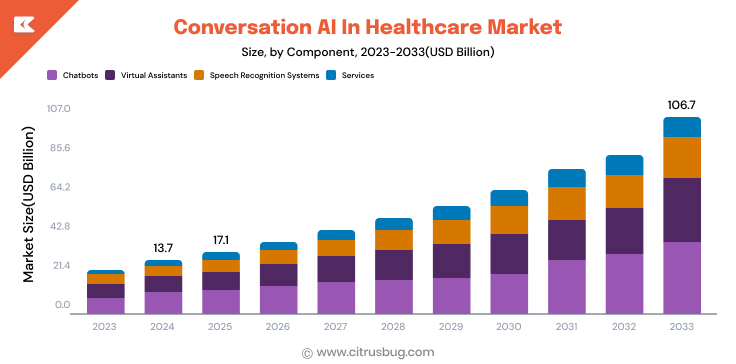
- The global conversational AI in healthcare market reached an estimated USD 13.68 billion in 2024, confirming that natural language interfaces already represent a meaningful slice of digital health spending. The figure reflects real deployments across patient engagement, care coordination, and support workflows rather than early stage experimentation.
- By 2025, the market continues climbing, with overall revenues measured at roughly USD 13.89 billion. This step up, even from an already sizable base, indicates that conversational tools move deeper into mainstream use within health systems and healthcare enterprises worldwide.
Healthcare Chatbots Within the Broader Market
- Within the broader landscape, dedicated healthcare chatbots form an important subset. One research estimate places the global healthcare chatbots market at around USD 194.85 million in 2024. This value captures focused deployments for symptom triage, basic navigation, and administrative support that sit entirely inside conversational interfaces.
- Chatbot focused solutions continue expanding as part of conversational AI in healthcare and are expected to grow in step with larger platforms. As these tools tie more tightly into clinical systems and patient records, they push the overall market toward higher value and deeper integration.
Scale of AI in Healthcare Spending by 2026
- Conversational AI does not exist in isolation. The wider AI in healthcare market reached about USD 39.34 billion in 2025, including imaging, decision support, workflow automation, and other AI powered capabilities. Conversational interfaces often act as the front layer that connects people to these underlying AI services.
- By 2026, AI in healthcare spending rises further to nearly USD 56.01 billion. This expansion gives conversational solutions a broader foundation, since many high value use cases depend on linking natural language interactions with predictive models, automation engines, and clinical algorithms.
Growth Momentum For Conversational Platforms
- Over the medium term, the conversational AI in healthcare market is projected to grow at a compound annual growth rate of about 23.91% between 2026 and 2031. A rate in this range signals persistent investment as organizations move from basic chat flows toward more advanced, integrated, and multimodal conversational systems.
This combination of strong current revenues, rising AI budgets, and sustained double digit growth positions conversational AI as a central layer in digital health strategies. As a result, developing AI chatbots for healthcare is increasingly treated as a long term infrastructure investment rather than a short term digital upgrade.
Adoption and Usage Statistics in Healthcare
Adoption statistics show how conversational AI moves from pilot projects to essential infrastructure. They reveal how many organizations rely on AI-enabled conversations, how leaders think about automation, and how clinicians and patients respond when these tools enter care pathways.
Together, these numbers highlight the human side of the market, from comfort and trust to willingness to change daily routines around AI-supported interactions.
Organizational Adoption and Clinical Readiness
- A significant majority of healthcare organizations already use AI of some kind, with adoption levels around 79%. Conversational workloads feature heavily in this mix, since they provide a visible way to apply AI to real patient and staff interactions.
- Clinician sentiment also shifts in favor of intelligent tools. Roughly 68% of physicians report that their view of generative AI in medicine has become more positive over the past year. Growing comfort among clinicians makes it easier to introduce conversational interfaces that summarize encounters, draft clinical notes, or support decision-making.
- In the United States, around 40% of physicians state that they are ready to use generative AI tools to support patient care decisions. As conversational interfaces become the primary way to access these tools, this readiness translates directly into higher usage of AI guided dialogues at the point of care.
Patient Openness to AI Guided Interactions
- Patients also show notable openness when conversational tools are designed thoughtfully. Around 67% of respondents with sensitive health issues say they would feel more comfortable scheduling appointments through an AI or online chatbot than through human staff. For many, the privacy and reduced social pressure of digital channels create a safer space to seek help.
- Perceived judgment plays a large role. Nearly 48% of patients highlight the absence of judgment or shame as a key benefit of healthcare chatbots. Effective conversational AI can therefore help surface care needs that might remain hidden in traditional interactions, because people feel more able to share candid details with a non human interface.
These adoption patterns suggest that conversational AI is no longer an experimental layer on top of healthcare operations. It is becoming part of everyday interactions for organizations, clinicians, and patients.
Regional Market Share and Growth Insights
Regional statistics show where conversational AI in healthcare scales fastest and where headroom remains highest. They reflect differences in digital maturity, regulatory readiness, and investment capacity across health systems.
Each region below captures a snapshot of share, value, or projected growth that shapes how global vendors and health organizations plan their strategies.
North America
- North America holds a leading position in conversational AI in healthcare, with an estimated 43.1% share of global revenues in 2025.
- Within that, the United States alone is expected to account for about USD 6.4 billion, while the wider AI in healthcare space in the region represents around 44.50% of global spending. This concentration gives vendors and providers in North America a strong role in shaping use case priorities and technical standards.
China
- China is forecast to expand its conversational AI in healthcare sector at 34.7% CAGR from 2025 to 2035, the highest among the major countries analyzed. This growth projection highlights intense digital transformation efforts and broad integration of AI interfaces into patient engagement and healthcare operations.
India
- India’s conversational AI in healthcare market is expected to grow at an impressive 32.1% CAGR between 2025 and 2035. Rapid adoption of telemedicine solutions, strong mobile health usage, and expanding digital health initiatives contribute to this acceleration.
Germany
- In Germany, the projected CAGR for conversational AI in healthcare from 2025 to 2035 is 29.6%. Germany’s established healthcare infrastructure and increasing investments in AI for administrative and clinical use cases support steady market expansion.
France
- France shows a projected growth rate of 27.0% CAGR over the same period. Strong public and private sector support for digital health transformation, along with structured AI integration initiatives within clinical systems, helps sustain conversational AI uptake.
United Kingdom
- The United Kingdom’s conversational AI healthcare market is expected to grow at 24.4% CAGR, reflecting its position as a mature healthcare market investing in patient experience technologies, virtual engagement platforms, and administrative automation.
United States
- In the United States, projected growth for conversational AI in healthcare is approximately 21.9% CAGR between 2025 and 2035. While growth is moderate compared to emerging markets, it stems from a large existing market base, widespread adoption of digital health technologies, and integration across clinical and back office workflows.
These regional numbers underline an important pattern. North America currently drives a large portion of deployed conversational AI capacity, while Europe records strong multi year growth that will reshape global market shares over the next decade.
Segmentation Insights for Conversational AI in Healthcare
Segmentation data clarifies where conversational AI concentrates value within healthcare, from specific product types to key customer groups. The numbers show how much revenue comes from chatbots, speech interfaces, and different categories of healthcare organizations.
Understanding this structure helps technology teams and business leaders decide which conversational capabilities to prioritize and where to expect the strongest near term returns.
Chatbots as a Core Product Category
Chatbots represent a substantial portion of conversational AI in healthcare revenues. In 2024, chatbot solutions account for about 35.66% of the overall conversational AI market in healthcare. This share reflects widespread use of scripted and AI augmented chat experiences for triage, navigation, FAQ handling, and basic patient services.
Speech Driven Interfaces and Clinical Workflows
Speech recognition and generation form another important slice of the market. Estimates indicate that speech based technologies capture around 30.8% of conversational AI revenues in healthcare in 2025. These tools support dictation, ambient listening, and real time assistance during clinical encounters.
As documentation and note taking become more automated, speech powered interfaces help clinicians interact with systems without breaking eye contact with patients. The share assigned to speech suggests strong demand for hands free, voice centric workflows that reduce administrative load.
Key End User Segments
On the demand side, hospitals and clinics command a significant portion of conversational AI spending. In 2024, these providers account for about 38.12% of end user revenues within the conversational AI in healthcare market. Their deployments span contact centers, inpatient and outpatient journeys, and internal staff facing assistants.
Dedicated chatbot platforms dedicated to healthcare also contribute to overall market growth. The healthcare chatbots segment is valued at around USD 0.4 billion in 2025, indicating that specialized vendors and solutions continue to gain traction alongside broader conversational AI platforms used across industries.
Taken together, these segmentation insights highlight a market anchored by chatbot and speech interfaces, with hospitals and clinics as major buyers and a growing ecosystem of focused healthcare chatbot providers.
Benefits and Advantages of Conversational AI in Healthcare
Beyond market size and adoption, quantitative indicators show how conversational AI contributes to return on investment and financial outcomes. These benefits shape how executives and boards view large scale programs for virtual assistants, intelligent contact centers, and AI enhanced clinical workflows.
The figures below translate abstract promises of efficiency into concrete timelines and multipliers that decision makers can use when planning roadmaps and business cases.
Faster Return On AI Investments
- Healthcare organizations report relatively short timelines to recoup AI investments when conversational and other AI solutions roll out at scale. On average, payback occurs in about 14 months. For conversational AI, which directly reduces manual work in contact centers and front office tasks, this time horizon fits well within standard capital planning cycles.
- Beyond payback periods, returns can significantly exceed the original outlay. Organizations see an average financial return of roughly USD 3.20 for every dollar invested in AI initiatives. Conversational systems that reduce avoidable calls, shorten handle times, and support clinicians can therefore deliver material savings and revenue protection that justify continued investment.
These quantitative benefits show that conversational AI in healthcare is not just a promising concept. It delivers measurable returns within one to two years, which strengthens the case for embedding these systems across both patient facing and clinical workflows.
Challenges and Barriers
Even with strong adoption and clear returns, conversational AI in healthcare faces important challenges. Statistics help keep these barriers visible so that design, governance, and oversight can adapt.
- Inaccurate or incomplete responses remain a central concern. Around 26% of patients in one survey list inaccurate responses as their top worry when using AI chatbots for healthcare. This concern reinforces the need for careful training data, robust guardrails, and clear escalation paths to human professionals.
- Concerns like this can influence how quickly organizations move from simple informational chatbots to more advanced conversational agents that support clinical decisions. Addressing accuracy, transparency, and safe handoff to human staff is essential if conversational AI in healthcare is to maintain patient trust as deployments become more ambitious.
Future Outlook and Opportunities for 2030 and Beyond
Future oriented statistics reveal how rapidly conversational AI in healthcare could scale over the next decade. They also highlight the central role of healthcare chatbots and regional AI ecosystems in shaping this trajectory.
These projections matter for long term planning, since they give technology and strategy teams a sense of the revenue pools, growth rates, and capability mixes likely to define the market through 2030 and 2032.
Global Growth Path For Conversational AI in Healthcare
- Over the second half of this decade, the global conversational AI in healthcare market is projected to expand strongly, reaching around USD 50.27 billion by 2031. At this level, conversational systems become a core layer of digital infrastructure for many health systems rather than specialized tools for limited journeys.
- Looking further ahead, the market could grow to roughly USD 80.50 billion by 2032. This trajectory aligns with an expected compound annual growth rate of about 25.02% from 2024 to 2032, suggesting sustained, long term momentum rather than a short spike.
Expansion Of Healthcare Chatbots
- Within this broader market, healthcare chatbots are set to grow into a much larger opportunity. Projections place the healthcare chatbots market at about USD 403.27 million by 2031. As these tools integrate more deeply with electronic health record systems, scheduling platforms, and remote monitoring programs, their role in the care continuum becomes more strategic.
- Over a slightly longer horizon, healthcare chatbots could reach roughly USD 943.64 million by 2032. The segment is expected to grow at a compound annual rate of around 24.15% between 2026 and 2031. These growth rates show that specialized chatbot solutions remain highly relevant even as broader conversational platforms emerge.
These future outlook figures suggest that, by early next decade, conversational AI in healthcare will sit at the center of digital care ecosystems worldwide. Chatbots and voice systems will not only answer questions but will coordinate data, automate tasks, and support clinical reasoning at a systemic level.
Conclusion
The conversational AI in healthcare market is moving from fragmented pilots toward a large, structured space with clear segments, regional patterns, and measurable benefits. Statistics from 2024 to 2032 point to strong growth, high adoption, and increasing comfort among patients and clinicians. This shift is also driving demand for specialized healthcare AI consulting for business to help organizations implement solutions responsibly and at scale.
As investments expand and returns arrive within relatively short timeframes, the conversational AI in healthcare market will continue to shape how people access, understand, and receive care. Organizations that align their strategies with this data-driven view can design patient journeys and clinical workflows that feel more intuitive while remaining safe, efficient, and sustainable.