Back
Back






Medical image analysis software is cutting-edge and transformative medical technology in the area of non-invasive health diagnostics for earlier prognosis of diseases.
Fueled by artificial intelligence and next-generation imaging techniques, this market still drives forward at impressive speeds to meet increasing healthcare requirements across the globe.
With the development of global healthcare, medical image analysis software has become an essential ingredient in modern diagnostics and treatment planning.
What Is Medical Image Analysis Software?
Medical image analysis software is a type of digital software that is developed specifically to analyze, improve, and interpret medical images such as CT scans, X-rays, MRI, PET scans, ultrasounds, etc.
It leverages advanced machine learning and AI algorithms to help healthcare workers identify abnormalities, measure disease progression , and aid clinical decision-making.
The advanced software simplifies the diagnosis-making process by automating intricate image analyses and boosting performance, ease of use, and standardization throughout medical imaging practices.
Key Functions
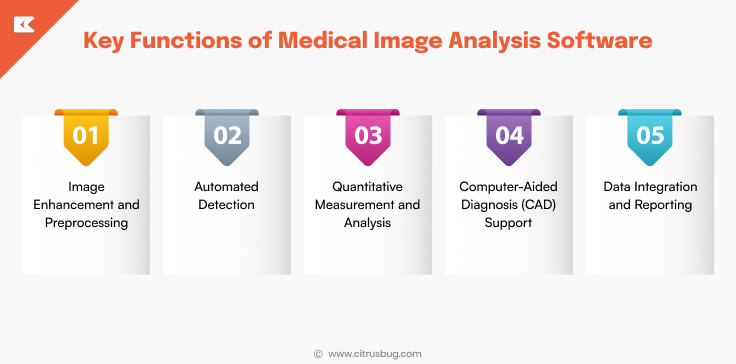
Image Enhancement and Preprocessing
- Increases contrast to improve image outlining of anatomical structures.
- Automatically adjusts brightness and clarity for the clearest view.
- Normalizes image presentation across various imaging systems.
- For advanced analysis of raw images.
Automated Detection
- Identifies organs, tissues, and lesions automatically.
- Facilitates accurate border detection for clinical applications.
- Reduces manual annotation time for radiologists.
- Improves consistency in diagnostic assessments.
Quantitative Measurement and Analysis
- Calculates the size, volume, and shape of anatomical regions.
- Allows for comparison across scans without a subjective filter.
- Supports data-driven clinical decisions.
- Improves treatment planning accuracy.
Computer-Aided Diagnosis (CAD) Support
- Points out suspicious areas to the clinician for reference.
- Reduces diagnostic errors and oversight.
- Enhances confidence in clinical decision-making.
- Complements, rather than replaces, clinician expertise.
Data Integration and Reporting
- Seamlessly integrates with PACS, EHR, and hospital systems.
- Securely archive and retrieve imaging data.
- Produce detailed customizable drill-down reports.
- Enables easy sharing of results across departments.
Medical Image Analysis Software Market Size in 2026
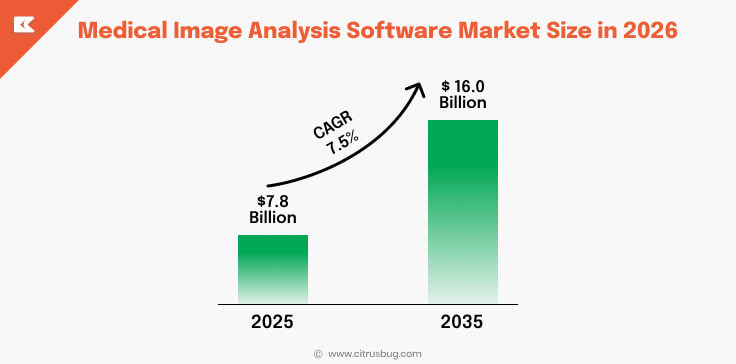
The Global Medical Image Analysis Software Market is forecasted to be worth $7.8 billion in 2025 and $16.0 billion in 2035, reflecting a compound annual growth rate (CAGR) of 7.5% during the period of projection.
5 Key Drivers Fueling Market Growth
1. Integration of AI and ML
Imaging AI implementation is the most significant driver in the imaging sector. A market research report predicts that the market will be approximately $1.65 billion in 2025 for AI in medical imaging and that it will expand at an annual rate of 31.5%, thus reaching about $6.5 billion in 2030.
AI in medical diagnosis has confirmed clinical trials showing that it can reduce the radiologists’ reporting time by nearly a quarter, and at the same time, significantly decrease false positives.
2. Technological Advancements in Imaging Modalities
Modern imaging devices now generate higher-resolution and multi-dimensional data than ever before. With imaging systems improving to collect higher-resolution, multi-parametric, and 4D images, the software to interpret the data has to keep pace with this.
One reason for the industry’s growth is that old software just can’t process the amount of data produced by a modern scanner. Spectra CT and high-field MRI build up huge and complex data sets that demand very high computation, besides their acquisition.
Advanced analysis software is needed in order to reconstruct these images into viewable formats, remove the background noise, and find the fine details that these new machines are capable of recording.
3. Growing Aging Population
Traditional demographic shifts are creating a consistent demand for diagnostics. The United Nations estimates that the number of people on the planet over 65 will double, reaching a total of 1.6 billion by 2050.
Japan has the largest proportion of elderly population, followed by Italy, Germany, France, and Denmark. This is largely because people are living much longer and healthier lives.
By 2050, nearly 40% of the populations in Hong Kong, South Korea, and Japan will be over 65.
This represents a significant jump from the percentage of those currently living in highly developed areas, where only one in five people is in this age group.
This rise brings attention towards the necessity for computer-based software that is able to handle a large number of age-specific diagnostic scans.
4. Growth of Cloud-Based and SaaS Imaging Solutions
Medical image analysis software platforms based on cloud computing technology have the traits of good scalability, low cost, and remote access.
Healthcare organizations, which are looking for flexible delivery models, are interested in these benefits. This reversal reduces the barriers to entry for such smaller operators.
SaaS solutions also simplify updates, maintenance, and integration more easily. Growth is further fueled by a broader digital health infrastructure as the market shifts more quickly to adopt the cloud.
5. Increasing Use of Computer-Aided Diagnosis (CAD)
The computer-aided detection (CAD) market is motivated by the growing incidence of chronic illnesses such as breast, lung, colorectal, and prostate cancer worldwide.
Market size of the sector is one of the most important because it estimates the ability to give insights about market demand and supply, as well as market potential.
It is valued $901.22 million in 2025, and it is estimated to reach $1439.87 million by 2033 while growing at a CAGR of 6.04% during the forecast period, which is why it is categorized as significant.
7 Major Challenges Affecting Market Growth
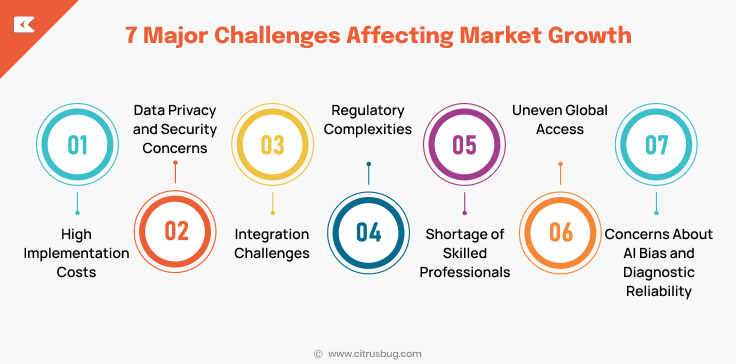
The medical image analysis software market, even though the growth statistics are very positive, still has to deal with some difficulties.
For businesses planning to get a portion of the market by 2026, it is imperative to clear these issues.
1. High Implementation Costs
High cost of implementation is the main restraint in adoption, particularly at small and mid-sized healthcare institutions.
Advanced image analysis software is very expensive in terms of infrastructure, licensing, training time, and planned obsolescence.
These ongoing costs drive up the total cost of ownership and prevent many organizations from moving on from traditional imaging workflows to more advanced AI-based analysis systems.
2. Data Privacy and Security Concerns
Medical imaging data is gradually moving to the cloud more and more, and with that, it is becoming a top target of cyberattacks.
The IBM Cost of a Data Breach Report states that the average worldwide cost of a data breach has gone up to around $4.44 million, hence making security a major concern.
The risk of losing money due to a data breach is getting bigger, and as a result, the healthcare sector has no option but to install strong protection against hacking rather than quickly introducing new software.
3. Integration Challenges
A large number of hospitals still use legacy systems that do not have the capability to interact effortlessly with the latest AI technologies.
Reports from the industry indicate that technical incompatibility is a primary obstacle, with over 50% of healthcare providers mentioning data silos as a barrier to effective care coordination.
Imaging data, which is of great value still, will continue to be stuck in isolated servers unless the integration standards, such as FHIR, are put in place.
4. Regulatory Complexities
Medical image analysis software needs to comply with stringent regulations that vary from one country to another.
Getting approvals from organizations like the FDA, EMA, or PMDA entails rigorous clinical validation, a significant investment of time and money for obtaining approval, and a lengthy process.
The hurdles set by the government make it difficult to introduce new products, restrict the access of small manufacturers to the market, and delay the pace of innovation in general.
5. Shortage of Skilled Professionals
There is a growing trend in the use of AI in healthcare, but the lack of professionals capable of using AI-based imaging tools remains a major challenge for many healthcare systems.
Radiologists, data scientists, and imaging technicians require specific training to be able to use and understand the results of advanced software.
The lack of trained personnel limits the extent to which these technologies can be used and also hinders the large-scale introduction of such software in developing areas.
6. Uneven Global Access
The market is heavily constrained by infrastructure shortfalls in emerging countries. According to the World Health Organisation (WHO), low-to middle-income countries have less than 1 CT scanner per million population compared with over 40 per million in high-income countries.
This chasm in physical hardware makes that super cool analysis software totally worthless. Enormous portions of the world have no meaningful market cap for software vendors.
7. Concerns About AI Bias and Diagnostic Reliability
AI-based image analysis systems are also faced with the potential for bias stemming from their trained dataset, raising questions of whether the diagnosis is accurate and ethical.
The discrepancy may be related to differences in the demographic, imaging, and/or clinical characteristics of study populations.
Such reliability issues affect clinician confidence and must have lifelong validation, transparency, and government oversight to be safe in the real world.
Regional Market Share and Growth Insights
North America Market Insight
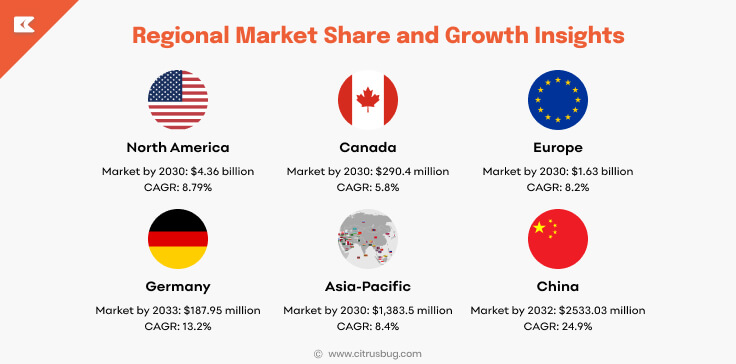
The North American medical image analysis software market valued at approximately $2.86 billion in 2025, is projected to reach $4.36 billion by 2030, expanding at a CAGR of 8.79%.
This leadership is cemented by early adoption of AI diagnostic tools, a robust reimbursement framework for digital imaging, and the presence of major software giants.
Canada Market Insight
Canada continues to grow, and this is due to government-funded digital health efforts in place. The market is anticipated to reach $290.4 million by 2030, and it will progress at a CAGR of 5.8% from 2024.
The focus is moving on towards teleradiology solutions to these remote northern populations, with substantial investment in revamping end-of-life MRI and CT stock to accommodate advanced 3D analysis software.
Europe Market Insight
The European medical image analysis software market is anticipated to reach $1.63 billion by 2030, registering a CAGR of 8.2%. This segment provides diagnoses through technology, including MRI, CT, and ultrasound analysis.
Demographic trends that see increasingly aging populations across Europe, the 65+ population increases from 18% in 2015 to 30% in 2030, also contribute to the demand for imaging solutions.
Government programs improve efficiency and device approvals, but increase health care spending to 14.6% of GDP by 2030. Cloud implementations provide instant access and scalability, the next impact of which will be provider growth.
Germany Market Insight
The German medical image analysis market is increasing at a rapid rate because of the utilization of AI and the requirement for accurate diagnostics in areas like radiology and oncology.
The global market is expected to reach $62.04 million by 2024, and is estimated to be $187.95 million by 2033, with a CAGR of 13.2%. Now this wave firmly sweeps Germany to a new horizon as a major market for advanced medical imaging systems.
Asia-Pacific Market Insight
Asia-Pacific is the fastest-growing region, fueled by massive infrastructure investments.
The market is anticipated to surge at a strong 8.4% CAGR over the forecast period, and can attain $1,383.5 million in broader imaging software value by 2030.
Market drivers include the drive towards digitization of healthcare in emerging economies, a burgeoning medical tourism industry, and the urgent requirement for automated diagnostics to handle large-scale patient numbers in densely populated regions.
China Market Insight
The Chinese medical image analysis software is estimated to be $534.2 million in 2023 and is estimated to be $2533.03 million in 2032 with a 24.9% CAGR within the forecast period of 2023-2032.
Specifically, the Chinese medical market is associated with the software deployed in the diagnosis and treatment of diseases with the help of medical image interpretation, such as X-ray, MRI, and CT scan.
This software utilizes advanced capabilities, including AI and machine learning, which enhance the quality of photos, detect defects, and help in appropriate clinical decisions.
Middle East & Africa Market Insight
The medical image analysis market of the Middle East and Africa is projected to grow with a 7.11% CAGR during the years 2024-2031.
It is growing well, driven by healthcare spending and digital adoption. Modern infrastructure has placed the Gulf Cooperation Council (GCC) countries at the lead of their region.
However, South Africa is pursuing its modernization programs and is thus gradually moving towards the top of the list.
4 Key Trends Shaping the Medical Image Analysis Software Market
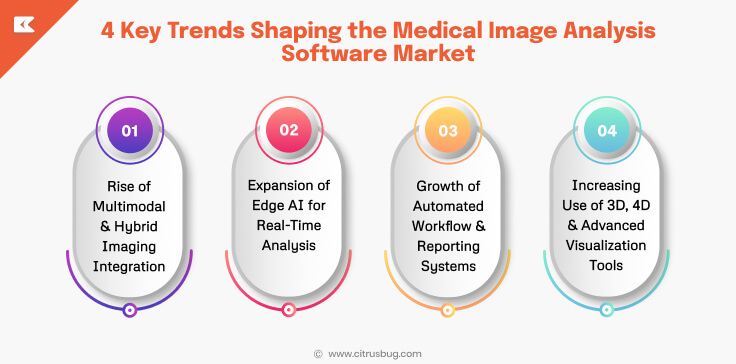
1. Rise of Multimodal & Hybrid Imaging Integration
- Aggregates MRI, CT, PET, X-ray, and ultrasound in integrated diagnostic views.
- Better for Tumors, Lesions, and Neurological Disorder Screening.
- Reduces diagnostic variation by facilitating the comparison of cross-modality quantification.
- Supports precision oncology via combined metabolic and anatomical mapping.
- Facilitates workflow integration by pooling datasets into a uniform interface.
- Enables early detection of disease by correlated imaging observations.
- Aids in more comprehensive, evidence-based decision-making by clinicians.
2. Expansion of Edge AI for Real-Time Analysis
- Allows analysis on your device or a local server, no cloud required.
- Decreases latency for emergent imaging, including stroke or trauma.
- Improves the protection of patients’ data privacy by maintaining sensitive images on-site.
- Enables real-time triage to speed time-sensitive decision workflows.
- Reduces the cost of storing and transmitting high-resolution imagery.
- Democratizes machine learning in low-bandwidth or rural health care environments.
- Enhances scalability for high-volume imaging hospitals.
3. Growth of Automated Workflow & Reporting Systems
- Automates the process of segmentation, annotation, and quantification.
- Little workload on radiologists and shorter report preparation.
- Reduces the role of human error with the help of AI-assisted measuring devices.
- Combines easily with PACS, RIS, and EHR systems.
- Provides formatted reporting required by regulatory agencies.
- Enhances the productivity of imaging centres with high case volume.
4. Increasing Use of 3D, 4D & Advanced Visualization Tools
- Enhances surgical planning with detailed 3D anatomical models.
- Allows for motion tracking and active imaging through a 4D display.
- Supplies accurate volumetric information for tumor tracking.
- Enhances the accuracy of orthopedic and musculoskeletal injury assessment.
- Works in AR/VR for training and simulation.
- Aids in assessing response to treatment with dynamic imaging for physicians.
- Enables minimally invasive treatment with more precise anatomical mapping.
Real-World Use Cases
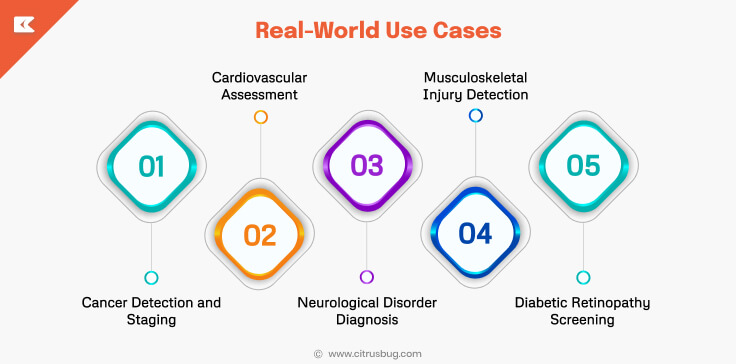
Medical image analysis software is widely used across clinical specialties. These use cases demonstrate their practical impact.
Cancer Detection and Staging
- Early detection of tumors by the identification of subtle morphological and metabolic features.
- Facilitates automated segmentation and volume measurement for accurate tumor monitoring.
- Fusion with multimodal images (e.g., CT, MRI, PET) improves staging overall accuracy.
- Helps doctors determine individualized courses of treatment for cancer.
- Minimizes diagnostic variability with the power of AI-powered interpretation.
Cardiovascular Assessment
- Offers automatic calculation of cardiac function, ejection fraction, and chamber size.
- Aids in the early identification of heart failure using advanced MRI and CT analysis.
- 3D Modeling Support for surgical planning.
- Real-time blood flow dynamic analysis with AI-powered imaging.
Neurological Disorder Diagnosis
- Helps detect abnormalities linked to Alzheimer’s, Parkinson’s, epilepsy, and stroke.
- Uses AI-enhanced MRI analysis to map brain structures and lesions.
- Enhances follow-ups of neurological therapy progress.
- Facilitates the detection of neurodegenerative evolution at the early stage via pattern discovery.
Musculoskeletal Injury Detection
- Diagnosis of fractures, ligament tears, cartilage wear, and soft tissue injuries.
- Improves orthopaedic evaluation using 3D bone and joint reconstructions.
- Automates alignment, displacements, and injury level measurements.
- Assists in sports medicine evaluations using dynamic motion imaging.
Diabetic Retinopathy Screening
- Identifies microaneurysms, hemorrhage, and other abnormalities of the retina.
- Allows a high-scale screening with automated and AI-based fundus image analysis.
- Aids in the detection of the disease at its early stages, before vision is lost due to delay.
- Lessens the workload of ophthalmologists through advanced classification of the intensities.
Future Opportunities
The prospects of the medical image analysis software market are growing at a high rate in the future due to the transition of healthcare towards accurate diagnostics and anticipatory intelligence.
Advances in multimodal imaging, edge computing, and automated workflow will open new avenues for innovation.
Companies that aim to develop AI-powered medical image analysis software can benefit from the growing need for early disease detection, more accurate personalized treatment planning, and accessibility of large-scale population health programs.
These innovations will shape a more efficient, accurate, and data-enabled medical imaging world.

Conclusion
Overall, the medical image analysis software market is changing to be more automated, clinically accurate, and adopted worldwide. The future of 2026 will be strong with good momentum due to the maturity of AI and growing diagnostic requirements.
With the continued optimization of infrastructure, improved security, and retraining of the workforce, the market will keep shifting towards smoother and fairer imaging workflows.
This consistent advancement makes the sector predisposed to the long-term effect on all the significant healthcare ecosystems.