Back
Back






The online trading platform industry has experienced substantial growth in recent years due to the rapid digitization of financial services and growing retail investor participation. Online trading platforms allow users to purchase assets such as stocks, forex, commodities, and cryptocurrencies through easy-to-use web and mobile-based interfaces, making investing more accessible than ever before.
The growth in internet and mobile usage and a surge in fintech innovation, including AI analytics, cloud platforms and stronger security, are driving the push towards digital trading. This transformation is also empowering retail investors with real-time market access, lower transaction costs, and advanced tools that were once available only to institutional traders.
In this article, we explore the online trading platform market size, including its market overview, key growth drivers, segmentation, emerging trends, major players, and future outlook, supported by the latest research and industry data.
Online Trading Platform Market Size & Growth Analysis
Current Market Size & Valuation
- The global online trading platform market size is estimated at USD 11.65 billion in 2025, driven by robust global demand for digital trading solutions as investors migrate from conventional brokers to online platforms.
- This includes income from core platform subscriptions, transactions, infrastructure services and other digital trading solutions.
Expected Growth & CAGR Forecasts
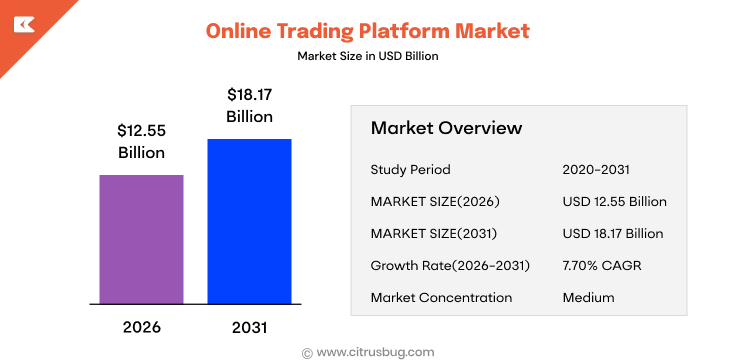
- The online trading platform market is projected to reach approximately USD 18.17 billion by 2031.
- This growth from USD 12.55 billion in 2026 to USD 18.17 billion in 2031 reflects a compound annual growth rate (CAGR) of 7.7 % over 2026–2031.
- Growth drivers include rapid adoption of mobile-first platforms, AI-assisted trading tools, cloud deployment, and expanded offerings such as crypto and fractional share trading.
Key factors driving this growth include:
1) Mobile Accessibility
One of the primary drivers of growth is the widespread adoption of digital technology.
- Online trading platforms are increasingly accessed through smartphones and tablets, making investing easier and more convenient.
- Mobile apps provide real-time market information, simplified order execution, push notifications, and portfolio tracking.
- This accessibility has replaced many traditional brokerage interactions with digital workflows.
As of 2025, approximately 75% of all retail trades are executed via mobile trading platforms, demonstrating the dominance of app-based trading over desktop usage.
2) Rise of Retail Investor Participation
The surge in individual (retail) investor participation is another major driver of the Digital trading platform market.
- Retail investors increasingly prefer digital platforms over traditional brokers due to lower costs, faster execution, and educational resources.
- Platforms now offer easy onboarding, paperless verification, and intuitive interfaces that attract first-time traders.
More than 65% of individual investors now prefer online trading platforms instead of traditional brokerage services.
3) Technological Advancements & Innovation
Technology is a powerful driver shaping the online trading landscape.
- Artificial Intelligence (AI) for predictive analytics and personalised insights
- Automated alerts that notify users of key price movements or risk events
- Algorithmic trading tools for faster trade execution
- Enhanced risk management dashboards
About 41% of active traders use AI-driven alerts, automated risk warnings, and predictive analytics to support their decision-making.
4) Multi-Asset Trading Access
Modern trading platforms are providing access to multiple asset classes in a single ecosystem, which attracts more users.
- Traders are also able to trade stocks, forex, cryptos, commodities, ETFs and derivatives from one interface.
- Multi-asset products help better promote diversification and attract a wider range of investors on platforms.
More than 57% of digital exchanges now allow for multi-asset trading across multiple asset types.
5) Financial Literacy and Education Tools
Many of these platforms combine resources, like tutorials, webinars and demo accounts to help you learn trading basics.
- Well-instructed customers usually continue to be active longer, as they trade more often.
- Learning ecosystems are providing network effects by boosting retention and engagement of users.
As of 2025, approximately 68% of new retail traders use in-app educational resources before their first trade, and platforms with integrated learning tools report up to 35% higher retention.
Online Trading Platform Market Segmentation Analysis
By Interface Type
1. Desktop
- The desktop segment is predicted to hold the largest share of the online trading market at about 48.64% in 2026.
- Desktop trading interfaces offer advanced analytical tools, multi-window charts, and customizable dashboards essential for professional and high-volume traders.
- This interface type is widely preferred by users who require comprehensive market insights and robust execution capabilities.
2. Web-based
- Web-based platforms remain a core part of the market’s interface segmentation, offering access through standard internet browsers.
- These interfaces enable real-time market monitoring, order placement, and portfolio management across devices without needing software installation.
- Web-based interfaces are popular with users seeking quick access and wide compatibility across operating systems.
3. Mobile App-based
- Mobile app-based interfaces are highlighted in the segmentation report as a key growth area for the forecast period.
- The segment benefits from increasing smartphone penetration and demand for on-the-go trading experiences.
- Features such as push alerts, simplified interfaces, and instant trade execution attract both new and retail investors.
By End-User
1. Banking & Financial Institutions Investors:
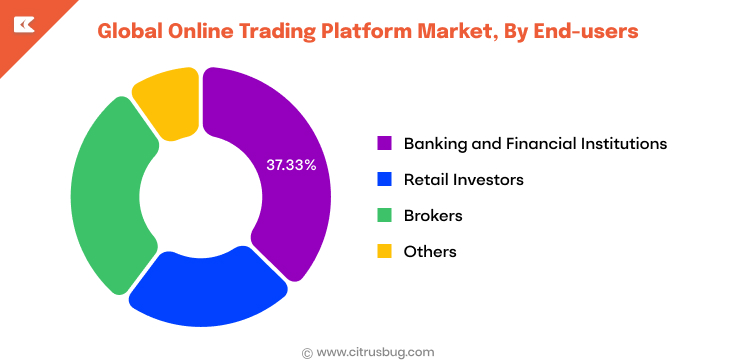
This segment is projected to dominate the trading platform market with a share of 37.33% in 2026 and is the most attractive end-user type. This segment is witnessing growth on account of surging use of customised trading software by banks and financial institutions to handle high-volume transactions, as well as diverse client requirements.
These organizations need a platform that is very scalable and secure, which can handle sophisticated trading books in addition to providing innovative solutions for trade facilitation.
2. Retail Investors:
Retail investors and day traders are also an important end-user group. They have also shifted towards digital trading platforms because of their usability, accessibility on mobile, and low fee structures.
These channels are empowering retail traders, who can manage their own portfolios, trade diverse asset classes and access financial markets without the need for conventional brokerages.
3. Brokers:
Broker firms and intermediaries are another important segment of end users. Cloud-based and big data analytics tools are increasingly being adopted, allowing them to execute more efficient trades while providing superior service for clients, driving demand for online trading platforms.
Brokers are using cloud-based technology and sophisticated analytics tools more than ever. Such solutions improve the efficiency of relevant operations, contribute to real-time decision-making and empower brokers to provide better, more personalized services to their clients.
4. Others:
This category includes specialized financial entities such as hedge funds, proprietary trading firms, and other niche participants that use online platforms for advanced strategies and professional trading needs. While smaller in share, this group contributes to market diversity and supports specialized use cases. —–
By Revenue
1. Commissions
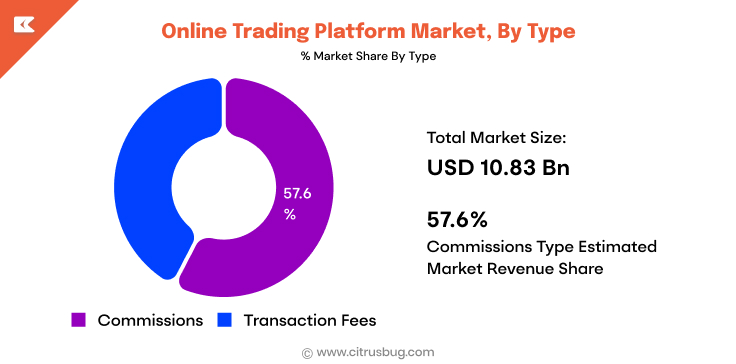
Commission-based trading remains the primary revenue model for online trading platforms. In 2025, revenue from commissions accounts for about 57.6 % of the total market share among all revenue sources.
This model earns fees every time a trade is completed, either as a percentage of the trade value or as a fixed charge per transaction.
Despite competitive pressure from zero-commission platforms, commissions still act as a dependable and stable source of income for many established brokers and trading platforms.
2. Transaction Fees
Transaction fees are the second major revenue pillar in the online trading market industry. This model includes charges for order execution, clearing, settlement, and related operational processes.
Unlike fixed commission charges, transaction fees are linked to the number and type of executed trades, helping platforms generate income even when commissions are reduced or waived.
This fee structure is particularly important as platforms expand offerings into new asset classes such as cryptocurrencies and derivatives, and higher volumes of trades.
By Region
1. North America
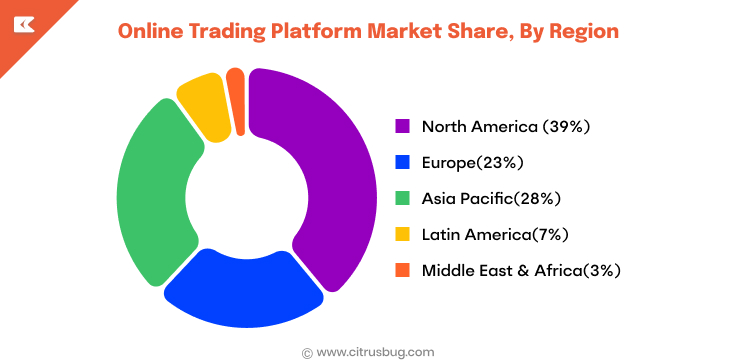
- North America is the largest regional market, accounting for approximately 39% of the global online trading platform market size in 2025.
- The region’s dominance is supported by high participation from retail investors, strong financial infrastructure, and the early adoption of advanced technologies such as AI-driven market analysis and robo-advisory tools.
- North America is projected to see continued growth, with the market size expected to rise significantly by 2035 due to ongoing digital transformation and platform innovation.
2. United States
- The U.S. alone represents a major portion of the North American market, with its trading platform market estimated at USD 6.75 billion in 2025.
- This market is forecasted to grow strongly in the next decade, reaching nearly USD 13.21 billion by 2035, supported by trends such as expanded trading hours and the integration of real-time analytics and mobile trading capabilities.
- Factors fueling U.S. growth include high smartphone penetration, widespread use of predictive analytics, and innovations like extended equities trading hours.
3. Asia Pacific
- The Asia Pacific region is expected to grow at the fastest CAGR during the forecast period, driven by the rapidly increasing adoption of online trading platforms.
- Growth factors include the rise of retail investors interested in both local and international markets, greater access to mobile trading technologies, and supportive digital payment ecosystems that make investing more accessible.
- Countries like India, China, and Singapore are at the forefront of this expansion, supported by fintech development, regulatory reforms, and growing financial literacy among new investors.
4. Other Regions
- Europe maintains a consistent market presence characterised by strong regulatory environments that promote investor protection and digital platform innovation.
- Latin America and Middle East & Africa are smaller but steadily growing markets, where improving financial market infrastructure and increasing interest in digital assets are expanding platform adoption.
- These regions demonstrate steady progress as access to financial technologies improves and regulatory frameworks evolve to support broader participation.
( Source )
Trends Shaping the Online Trading Platform Market
The online trading market trends are evolving rapidly due to technological advancements, investor behaviour, and regulatory developments. Below are the key trends shaping the industry, explained clearly and supported with reliable data sources.
1. AI and Algorithmic Trading
Predictive analytics, automated execution, portfolio optimization and risk monitoring are just some of the fields that artificial intelligence (AI) and algorithmic trading are disrupting in the online space. Sophisticated number crunching enables faster, wiser and less impulsive trading decisions.
With well over 60% of U.S. equity trading volume generated by algorithms across modern platforms, the continued advancement of algorithmic trading strategies and AI-driven automation is more evident than ever.
2. Social and Copy Trading
Social and copy trading features allow investors to follow experienced traders and replicate their strategies automatically. This collaborative approach lowers entry barriers, increases transparency, and encourages participation from beginner and younger investors worldwide.
Nearly 45% of retail investors engage in social or copy trading tools, reflecting strong demand for community-driven and experience-sharing investment platforms globally.
3. Gamification in Trading Platforms
Some trading platforms have adopted gamification features, including badges, leaderboards, progress bars, and rewards, in order to increase user engagement. These are the kind of features that make investing feel more interactive and exciting, also to millennials and first-time investors.
Around 30% of platforms now include gamified features, improving user retention, daily activity levels, and overall engagement within competitive digital trading environments.
4. Blockchain and Cryptocurrency Integration
Blockchain enables transparency, security and settlement on online trading platforms. In addition, cryptocurrency trading offerings also draw tech-savvy investors who seek a diversified portfolio and alternative assets that ride different waves to traditional financial instruments. This change has helped to increase the demand for advanced cryptocurrency exchange platform development solutions, which facilitate secure digital asset trading, wallet integration, instant transaction processing and regulatory compliance.
Around 40% of crypto-trading platforms are decentralised exchanges developed on top of blockchain, and the overall cryptocurrency value has peaked at $4 trillion in recent years.
5. Regulatory Evolution and Stronger Compliance
Regulations for online trading platforms are becoming more stringent with globalised participation. Authorities are imposing new investor protection requirements, cybersecurity guidelines, leverage limits and compliance checks to provide transparency, financial stability and sound digital trading practices.
Regulatory supervision is being tightened, while incurring operational costs for platforms and investors, which lowers systemic risks and builds a healthy market over the long-term.
Major Players in the Online Trading Platform Market
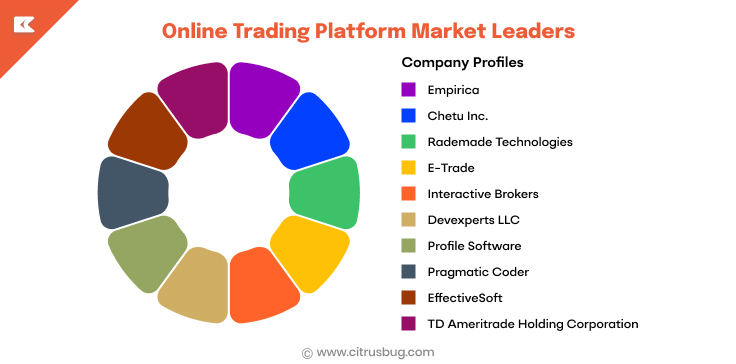
The international marketplaces for retail and professional trading groups are highly competitive, with long-standing businesses against new era fintech creators. Fueled by growing retail and institutional investor participation, these firms have grown their customer bases, revenues, and tech offerings significantly.
1) Interactive Brokers
Interactive Brokers is one of the most influential global trading platforms, known for its advanced tools, low-cost execution, and breadth of market access.
- It serves over 3.3 million brokerage customers around the world.
- It holds a leading share of global trading volume and strong institutional participation due to its international markets and API-enabled services.
- Ranked highly in multiple industry surveys and broker reviews for its trading tools, low costs, and global market access.
Interactive Brokers consistently differentiates itself with global market access, including equities, options, futures, forex, and crypto, appealing to sophisticated traders and institutions alike.
2) Charles Schwab
Charles Schwab remains one of the most established brokerages in the U.S. and the broader online trading ecosystem.
- Schwab holds an estimated 17% global platform market share due to its diversified product suite and large client base.
- It scored highly in user experience, customer service, and research tools among major broker rankings for 2025.
The firm’s broad reach from do-it-yourself trading to advanced advisory services, makes it a backbone issuer of digital brokerage.
3) Fidelity Investments
Fidelity Investments is a major U.S. broker and investment platform with a strong focus on reliability and service quality.
- It offers trading in stocks, ETFs, options, and other instruments, supported by strong research and analytic tools.
- Fidelity holds millions of active accounts, over 12 million in the U.S., according to industry data.
Fidelity’s combination of trading technology, customer education, and wealth management products positions it among the most respected full-service platforms.
4) E-TRADE and TD Ameritrade
E-TRADE and TD Ameritrade, two legacy names in U.S. brokerages, have extensive end-user bases:
- TD Ameritrade manages over 8 million active accounts, reflecting a strong retail presence.
- E-TRADE continues to deliver research tools and educational content that appeal to a mixed cohort of traders.
Following strategic integration, their combined capabilities advance Schwab’s market coverage and deepen offerings for both beginners and active traders.
5) Robinhood
Robinhood revolutionized retail investing with commission-free trading and a mobile-first user experience.
- As of late 2025, Robinhood reported 13 million monthly active users.
- Its total net revenue topped $1.28 billion (Q4 2025), driven by options and equities trading, although crypto revenue lagged.
Robinhood’s app continues to be particularly popular among younger investors and those seeking simple, low-friction access to markets.
6) eToro
eToro is a global social trading platform that blends traditional market access with community-driven “copy trading.”
- eToro had about 40 million registered users and over 3.6 million funded accounts as of 2025.
- The company completed its Nasdaq IPO in 2025, valuing the firm at around $5.6 billion and reflecting investor confidence in its model.
- In late 2025 filings, eToro reported strong growth in assets and funded accounts, with net contribution climbing 28 % year-over-year.
eToro stands out for multi-asset access and social features that appeal to both new and seasoned investors.
7) Plus500
Plus500 is a well-known online trading platform active in CFDs, shares, and derivatives.
- In 2024, Plus500 generated $768.3 million in revenue and expanded its customer base by 30 % with 118,010 new users.
- The platform has diversified beyond OTC trading and significantly increased customer deposits, which doubled to over $3 billion in 2025.
Plus500’s success demonstrates strong adoption in global markets and effective monetisation per client.
Future Outlook of the Online Trading Platform Market
The global online trading platform industry is moving into a new growth phase driven by technological innovation, rising retail investor participation, and evolving regulations. Platforms are increasingly evolving beyond basic trade execution to become integrated, technology-driven financial ecosystems.
1. Deepening Integration of AI and Automation
- The AI trading platform market is projected to grow from USD 11.05 billion in 2025 to nearly USD 64.97 billion by 2035, at a CAGR of about 19.4%.
AI-powered tools such as predictive analytics, automated execution, and real-time risk modelling are becoming core features of modern trading platforms.
- Around 55% of active traders already use AI-driven analytics tools to enhance trading strategies and improve risk management.
AI integration is expected to expand into automated portfolio optimisation and machine learning–based decision systems for greater efficiency.
2. Expansion of Social and Gamified Trading Features
- Social and copy-trading features now account for over 31% of new account openings on certain platforms, particularly among first-time retail investors.
These tools allow users to follow and replicate experienced traders, making advanced strategies more accessible.
- Many leading platforms are introducing social network-style features where users can share insights and discuss strategies.
This interactive approach increases engagement, builds investor communities, and supports long-term platform retention.
3. Growth in Cross-Border Market Participation
- Integration of real-time settlement systems with trading platforms is enabling smoother capital movement across international markets.
This reduces transaction delays and enhances efficiency in global investments.
- Improved digital onboarding and cross-jurisdictional services are lowering entry barriers for investors worldwide.
As a result, participation in global equities, forex, derivatives, and crypto markets continues to expand.
4. Potential for Regulatory Harmonisation
- Online trading platforms currently operate under more than 30 different regulatory frameworks worldwide, creating compliance complexity.
Differences in licensing, reporting standards, and investor protection rules increase operational challenges for global platforms.
- Growing international cooperation and adoption of RegTech solutions are improving cross-border compliance management.
Greater regulatory harmonisation could lower entry barriers, strengthen investor confidence, and support global market expansion.
Conclusion
The online trading platform market size is growing steadily as a result of digital innovation, internet and mobile access, and increased participation from retail investors. Meanwhile, new technologies such as AI, automation and blockchain are allowing a smarter, faster and more secure trading experience. This rapid evolution has also led to the rise of specialised service providers, including crypto trading bot development companies, that help businesses and traders automate strategies and optimise performance in increasingly competitive markets.
Regulatory demands are growing, but are also building trust and transparency. Overall, the future of the market is bright and ongoing evolution will bring ever-greater efficient, accessible technology-driven trading ecosystems to more areas of the world.