

Custom Revenue Cycle Management Software Built for Healthcare Complexity
Healthcare organizations with fragmented billing workflows don't just lose revenue. They lose time, staff capacity, and financial predictability needed for confident decisions. We build custom revenue cycle management software around your workflows, payer mix, and compliance requirements to reduce denials, accelerate reimbursements, and deliver actionable financial data.

Certifications
 HIPAA Compliant
 SOC 2 Type II
 ISO 27001
Trusted by industry leaders















Built for the Teams Responsible for Revenue Performance
This is not a SaaS platform. It is not a billing service. We are a healthcare software development company that builds the systems your billing teams, clinical staff, and finance leaders actually use every day.
We work with hospital systems, multi-specialty practices, ambulatory surgery centers, billing companies, and healthcare technology companies building RCM capabilities into their platforms. If you need a system that fits your operation rather than forcing your operation to fit a system, this is where we start.
Custom Healthcare Revenue Cycle Management Software Services
Our revenue cycle management software development covers every stage of the financial lifecycle, from patient registration to final payment. Each module is built to your workflows, your payer mix, and your compliance requirements.
Patient Registration and Eligibility Verification
Automated real-time insurance eligibility checks at the point of registration. Reduce front-desk errors and coverage mismatches before a claim is ever created, cutting denials at the source and improving intake accuracy.
AI-Powered Medical Coding Assistance
Machine learning models surface accurate ICD-10, CPT, and HCPCS codes from clinical documentation in real time, reducing undercoding, audit risk, and the manual burden on your coding team significantly.
Claims Scrubbing and Submission
Rules-based and AI-assisted claim scrubbing catches billing errors before submission reaches the payer. Direct EDI integration with major clearinghouses ensures clean claims go out fast, every time with minimal rework.
Denial Management and Appeals Automation
Automated denial classification, root cause analysis, and appeal generation reduce the time your billing team spends chasing reimbursements. Fewer denials. Faster resolution. Less manual follow-up on every rejected claim across payers.
Revenue Analytics and Reporting Dashboards
Real-time visibility into A/R aging, denial trends, payer performance, and cost-to-collect metrics. Built for CFOs and billing directors who need financial data they can act on, not just look at in static reports.
Patient Billing and Payment Portals
Transparent patient billing with digital statements, self-service payment plans, and online portals. Reduces bad debt and billing-related complaints without damaging the patient relationship your clinical team has worked hard to build.
EHR and Practice Management Integration
Bi-directional API integrations with Epic, Cerner, Athenahealth, eClinicalWorks, and other systems your teams already use. No forced migrations, no duplicate data entry, and no broken handoffs between clinical and billing workflows.
Prior Authorization Management
Automated prior auth submission, status tracking, and escalation workflows reduce care delays and administrative overhead. Integrates directly with payer portals and EHR systems so nothing falls through the cracks during approvals.
Struggling with Revenue Leakage and Delayed Payments?
Optimize billing, accelerate collections, and strengthen financial visibility with structured revenue cycle management services built for scalable enterprise performance.
Get a Revenue AssessmentHow AI Is Reshaping Revenue Cycle Management Software in 2026
The shift happening right now in healthcare billing is not incremental. Over 75% of U.S. health systems plan to expand AI-driven RCM automation, with autonomous workflows across coding, billing, and denials ranking as top priorities. The organizations moving fastest are not buying another SaaS platform. They are building AI into the financial infrastructure itself.
When we develop AI development services for healthcare revenue cycle systems, AI is not a feature added after the fact. It is designed into the architecture from day one.

ML models analyze historical claim patterns against current submissions and flag high-denial-risk claims before they leave your system. Your team fixes the issue before the payer ever sees it.
Natural language processing reads clinical notes and generates coding suggestions in real time, reducing coder workload on routine encounters and freeing your team for the complex cases that actually need expert review.
AI-assisted prior auth workflows identify which procedures require authorization, auto-populate request forms from clinical documentation, and track status without manual follow-up from your administrative staff.
Predictive models surface expected reimbursement timelines, flag payer behavior anomalies, and give your finance team forward-looking visibility instead of just historical reporting.
The most advanced RCM systems now use agentic AI to execute multi-step billing tasks autonomously with human oversight checkpoints. We build these systems for organizations that need to scale billing operations without scaling headcount.
Connected RCM Systems Built Around Your Existing Stack
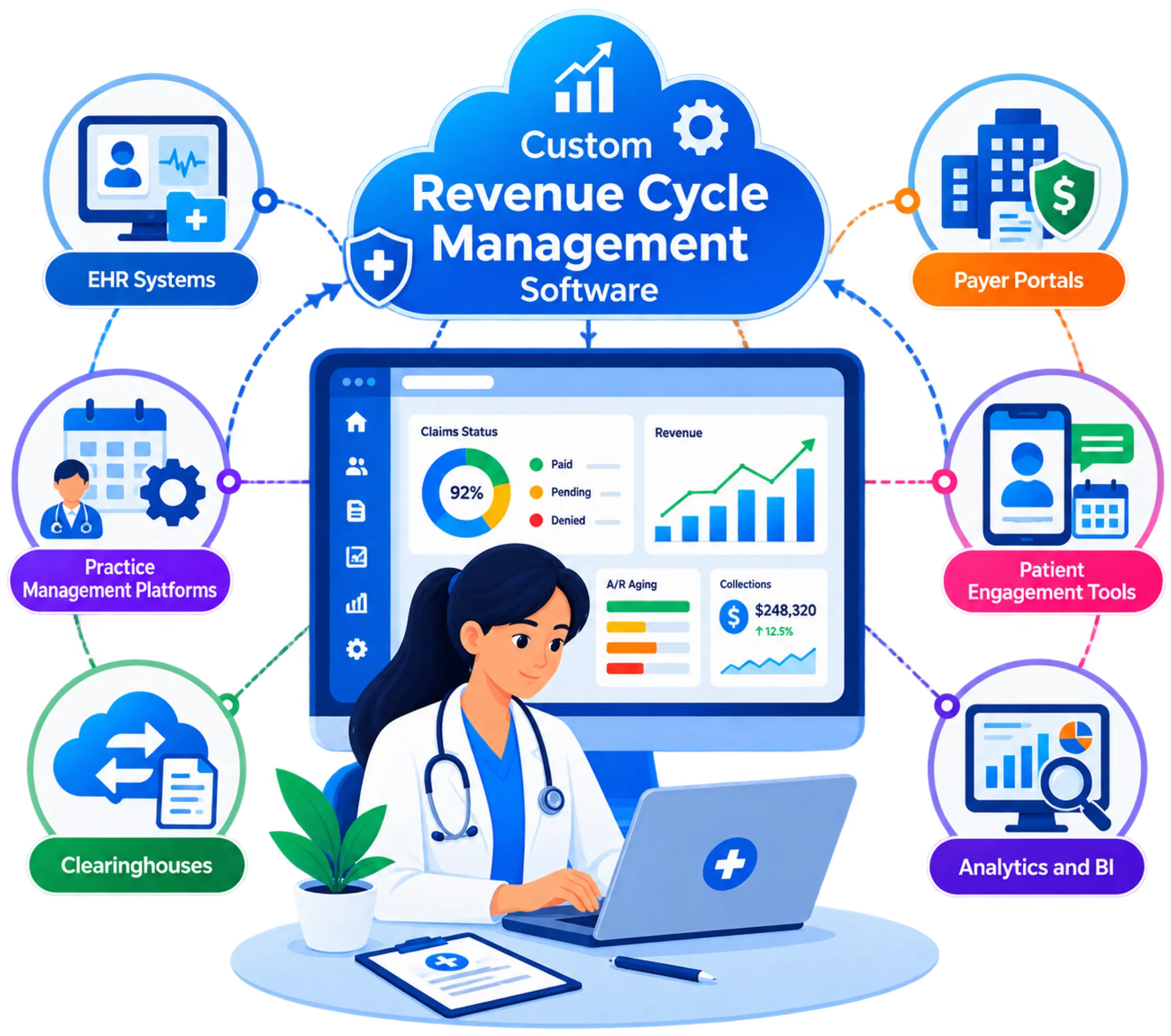
Your RCM system does not operate in isolation. We build bi-directional integrations with the platforms your clinical, administrative, and financial teams already rely on.
-

EHR Systems: Epic, Cerner, Athenahealth, eClinicalWorks, Meditech, Allscripts, DrChrono, NextGen
-
Practice Management Platforms: Kareo, AdvancedMD, ModMed, CareCloud, CollaborateMD
-
Clearinghouses: Availity, Change Healthcare, Waystar, Trizetto, Navicure
-
Payer Portals: Direct API and EDI connections with major commercial payers, Medicare, and Medicaid
-
Patient Engagement Tools: Self-service portals, patient payment gateways, digital statement delivery
-
Analytics and BI: Integration with Power BI, Tableau, and custom dashboard builds for finance and operations teams

HIPAA-Ready Architecture From the Ground Up
Revenue cycle systems handle both protected health information and sensitive financial data simultaneously. That combination demands security architecture that is deliberate, not bolted on.
Every RCM system we build includes:
- End-to-end encryption for data in transit and at rest
- Role-based access controls aligned to your organizational structure
- Comprehensive audit logging for all billing and financial actions
- Breach notification workflows and incident response documentation
- Compliance controls for HIPAA, SOC 2, and applicable regional frameworks
If your organization requires a deeper review of our security approach, our team can walk through the technical architecture directly with your compliance or legal team.
Revenue Cycle Management Delivery Framework
Discovery & Analysis
We assess current revenue workflows, billing systems, financial gaps, and compliance risks to identify improvement opportunities and measurable recovery targets.
Architecture & Design
We design streamlined revenue processes, automation frameworks, reporting structures, and control mechanisms aligned with scalability and financial transparency goals.
Development & Integration
We implement and integrate revenue management systems with ERP platforms, invoicing tools, and financial operations to ensure seamless data flow.
Compliance & Testing
We conduct validation checks, audit controls, reconciliation testing, and regulatory reviews to minimize risk and protect revenue integrity.
Deployment & Support
We deploy optimized revenue workflows with monitoring dashboards, performance tracking, and continuous advisory support to sustain financial efficiency.
Custom RCM Software vs. Off-the-Shelf Platforms: How to Choose
| Comparison Factor | Custom-Built RCM System | Off-the-Shelf SaaS RCM |
|---|---|---|
| Workflow fit | Designed around your exact processes | You adapt your processes to the platform |
| Payer and specialty customization | Full control | Limited, often requires workarounds |
| Integration depth | Bi-directional integrations with any system | Pre-built connectors only |
| AI and automation | Built to your use cases from day one | Dependent on vendor roadmap |
| Compliance controls | Configured for your regulatory environment | Standardized for general use |
| Cost model | Higher upfront, lower per-seat cost at scale | Low entry cost, high ongoing licensing |
| Right for | Mid-to-large health systems, billing companies, or organizations with complex multi-payer environments | Early-stage practices with standard billing needs |
For organizations where standard SaaS platforms have failed to address operational complexity or specialty-specific billing requirements, custom healthcare software development is frequently the more economical long-term decision.
Why Healthcare Organizations Choose Citrusbug for RCM Development

Workflow-First Approach
We start with your workflows, not assumptions. Our structured discovery maps billing processes, documents requirements, and identifies revenue leak points. You get clear documentation and wireframes upfront, preventing mid-project confusion, scope drift, and costly rework later.

Built-In Compliance
Security and compliance are integrated from day one through our Secure ADLC approach. HIPAA and data protection standards are embedded into every stage, ensuring your system is audit-ready, risk-aware, and built for real-world healthcare environments.

AI-Native Systems
AI is core to how we build RCM platforms. Features like denial prediction, coding assistance, and anomaly detection are designed into the architecture from the start, improving accuracy, efficiency, and financial performance across your revenue cycle.

Transparent Delivery
You always know where your project stands. We provide daily updates, regular demos, and direct access to the development team. No intermediaries, no communication gaps, just clear visibility into progress, decisions, and changes as they happen.
Client Testimonials (We're Rated 4.7 on Clutch)
Web & AI Development for Education Company
Their agile way of working, competence, and friendliness are impressive.December 7, 2024
Citrusbug Technolabs handles a data extraction project for an education company. They're also responsible for managing an AI generation project for the client.
Citrusbug Technolabs has laid out and followed a clear project outline and consistently met deadlines. The team communicates well and demonstrates a strong understanding of the client's vision and goals. Their agile approach, high level of competence, and personable approach stand out.
 Read More
Custom Automated System Dev for Veteran Medical Co
Their communication and ability to capture exactly what I was asking for were impressive.November 14, 2024
Citrusbug Technolabs built an automated system for a veteran medical company. The system needed to collect and store user data, generate customized letters based on surveys, and use AI to summarize reviews.
Citrusbug Technolabs delivered a functional automated system that successfully organized the client's records and auto-generated statements. The team was quick to respond, addressed all roadblocks, and communicated effectively. Overall, their ability to understand the client's needs stood out.
Read More
MVP Development for Freight & Capacity Marketplace
They were very calm and talented, and they did bring some of their own ideas.January 28, 2025
Citrusbug Technolabs has developed an MVP for a freight and capacity marketplace. The team has created three different interfaces for three market segments.
Citrusbug Technolabs has successfully developed an effective MVP. The team has delivered the project on time and almost within budget. Moreover, their responses have been timely. Overall, the team has been calm, talented, and innovative. This has led to the client's satisfaction.
Read More
Web & Mobile App Development for Education Company
What stood out most about them was their personalized approach and sense of ownership in every aspect of the project."February 27, 2024
Citrusbug Technolabs built a Flutter cross-platform mobile app for an education company. They also developed two web apps and an admin panel and provided DevOps support for the client's infrastructure.
Citrusbug Technolabs' support successfully boosted the client's user engagement by 8x, resulting in an 85% retention rate. The reliable team demonstrated a dedication to delivering on time and promptly responding to concerns and adjustments. Their personalized, client-centric approach stood out.
Read More
Mobile App Development for Healthcare Company
They didn't like the phrase "impossible to do", which made them very solution-oriented.February 19, 2024
A healthcare company hired Citrusbug Technolabs to design and develop a user-friendly application. The team provided tailored assistance to meet the client's requirements.
Citrusbug Technolabs successfully delivered an application that was ready for market. The team was highly professional and well-organized; they stayed focused throughout the engagement and were receptive to changes. Overall, they stood out for their trustworthiness and commitment to excellence.
Read More
Custom Web App Dev & Design for Financial Technology Firm
They're 100% on time and transparent throughout each stage of the project.February 24, 2024
A financial technology company has hired Citrusbug Technolabs to build a custom web application. The team handles the development and design of the app.
The project is ongoing, but the client has been satisfied with Citrusbug Technolabs' services. The team is very professional — they always respect timelines and provide regular updates to ensure everyone's on the same page. Also, their transparent approach makes them a trustworthy partner.
Read More
Staff Augmentation for Singaporean Development Company
"I do believe they are exceptional at where they stand."
Citrusbug Technolabs took on a mobile app development project for a Singapore-based development house. They were provided with UX designs to execute. Currently, they're finalizing and fine-tuning the product.
Citrusbug Technolabs contributed to the successful launch of the product, which has garnered over 10,000 users in just three months. The product has also received support from investors. They consistently followed-up with their progress and delivered at a speedy rate. The team is truly stellar.
Read More
Frequently Asked Questions About Revenue Cycle Management Software
What is revenue cycle management software in healthcare?

Revenue cycle management software handles the full financial lifecycle of a patient encounter, from eligibility verification to claims, payments, denial management, and collections. It connects clinical, administrative, and financial workflows to reduce errors and improve reimbursement outcomes.
How does medical software streamline revenue cycle management?
They optimize billing accuracy, shorten payment cycles, reduce denials, and enhance financial visibility across operations.
What is the difference between custom RCM software and off-the-shelf platforms?
An off-the-shelf platform provides a predefined set of features built for general healthcare workflows, requiring your team to adapt processes accordingly. Custom RCM software development services deliver a system tailored to your workflows, payer contracts, specialty requirements, and integration environment. The right approach depends on your operational complexity, claim volume, and how much your workflows differ from standard billing operations.
How long does it take to build a custom RCM system?
Timelines depend on scope and whether you begin with a POC or MVP. Discovery typically takes 1 to 2 weeks. An MVP for core RCM functionality can be delivered in 2 to 4 months. A full end-to-end system with multi-payer integrations, AI modules, and patient-facing components generally ranges from 5 to 10 months, depending on complexity and scale.
Is custom healthcare revenue cycle management software HIPAA compliant?
Yes, when built correctly. Custom RCM systems are designed with HIPAA-compliant architecture, including encrypted data storage and transmission, role-based access controls, detailed audit logging, and breach notification workflows. Compliance is built into the system architecture rather than added at the end.