


















Let’s Talk

Medication Management Solutions Built for Scale

Most medication errors don't happen because a drug interaction was missed. They happen because the patient's full medication list never existed in one place to check it against. We build medication management solutions that reconcile every prescription, dispense, and refill into a single source of truth, so your clinical teams catch the interaction before it reaches the patient.

Medication Management Solutions Built for Scale
500+
Projects Delivered
98%
Client Retention

Certified Excellence

HIPAA Compliant HIPAA Compliant
HL7 / FHIR Compatible HL7 / FHIR Compatible
SOC 2 Type II SOC 2 Type II
ISO 27001 ISO 27001

Trusted by Leading Healthcare Innovators

Certifications and Accreditations

What Goes Into a Medication Management Platform

Every layer of the system has to talk to the others in real time, or the safety checks are only as good as the slowest data feed.

Electronic Medication Administration Records

Electronic Medication Administration Records

We build eMAR systems that validate the right drug against the right patient at the point of administration, using barcode or RFID scanning tied directly to the active medication order.

E-Prescribing and EPCS

E-Prescribing and EPCS

Prescribing workflows built on NCPDP SCRIPT, with DEA-compliant identity proofing and digital signing for controlled substance orders routed through Surescripts.

Drug Interaction and Allergy Alerts

Drug Interaction and Allergy Alerts

Real-time cross-referencing against RxNorm and First Databank data, surfacing interactions, duplications, and contraindications before the order is signed, not after.

Medication Reconciliation

Medication Reconciliation

A single reconciled list across every prescriber, pharmacy, and care setting a patient touches, so no one is working from half the picture at admission or discharge.

Ready to Close the Gaps in Your Medication Workflow?

Get a technical audit of your current medication stack before you scope the build.

Request a Workflow Audit

Where Medication Workflows Actually Break

Fragmented Medication Histories

Fragmented Medication Histories

Patients arrive with prescriptions from three providers and no shared list, leaving gaps no single system can see.

Manual Transcription Errors

Manual Transcription Errors

Crumpled scripts and blurry photos still get typed in by hand, and that's where dosage and drug-name errors start.

EPCS Recertification Risk

EPCS Recertification Risk

Every functional change to a controlled-substance prescribing system triggers a new DEA-mandated third-party audit.

Adherence Blind Spots

Adherence Blind Spots

Once a patient leaves the visit, most systems lose visibility into whether the medication is actually being taken.

Compliance Built Into the Medication Data Layer

A medication management platform sits at the intersection of clinical workflow, pharmacy operations, and federal prescribing law, which means the data layer has to handle FHIR Medication resources, NCPDP SCRIPT transactions, and DEA audit logging without forcing a rebuild every time one standard moves. We design the architecture so each of these can evolve independently.

  • HL7 FHIR R4 Medication resources mapped
  • NCPDP SCRIPT 2023011 transaction support
  • DEA-compliant EPCS audit logging
  • RxNorm and First Databank knowledge base sync
  • SOC 2 Type II infrastructure controls

What's Included in a Full Medication Management Build

Drug Knowledge Base Integration

Direct connections to RxNorm, First Databank, or Medi-Span so interaction and contraindication checks run against current, licensed drug data rather than a static internal list.

Automated Dispensing Cabinet Connectivity

Two-way interfaces with ADC hardware so what’s pulled at the cabinet matches what’s documented in the eMAR, closing the gap between physical dispensing and digital records.

Pharmacy and EHR Interfaces

Bidirectional interfaces with EHR integration endpoints and pharmacy systems, built on FHIR and HL7 v2 depending on what the receiving system actually supports.

Patient-Facing Adherence Tools

Reminder scheduling, refill prompts, and plain-language dosage instructions delivered through the channel a patient actually checks, not just a portal they log into once.

The EPCS Requirement Most Vendors Don't Mention

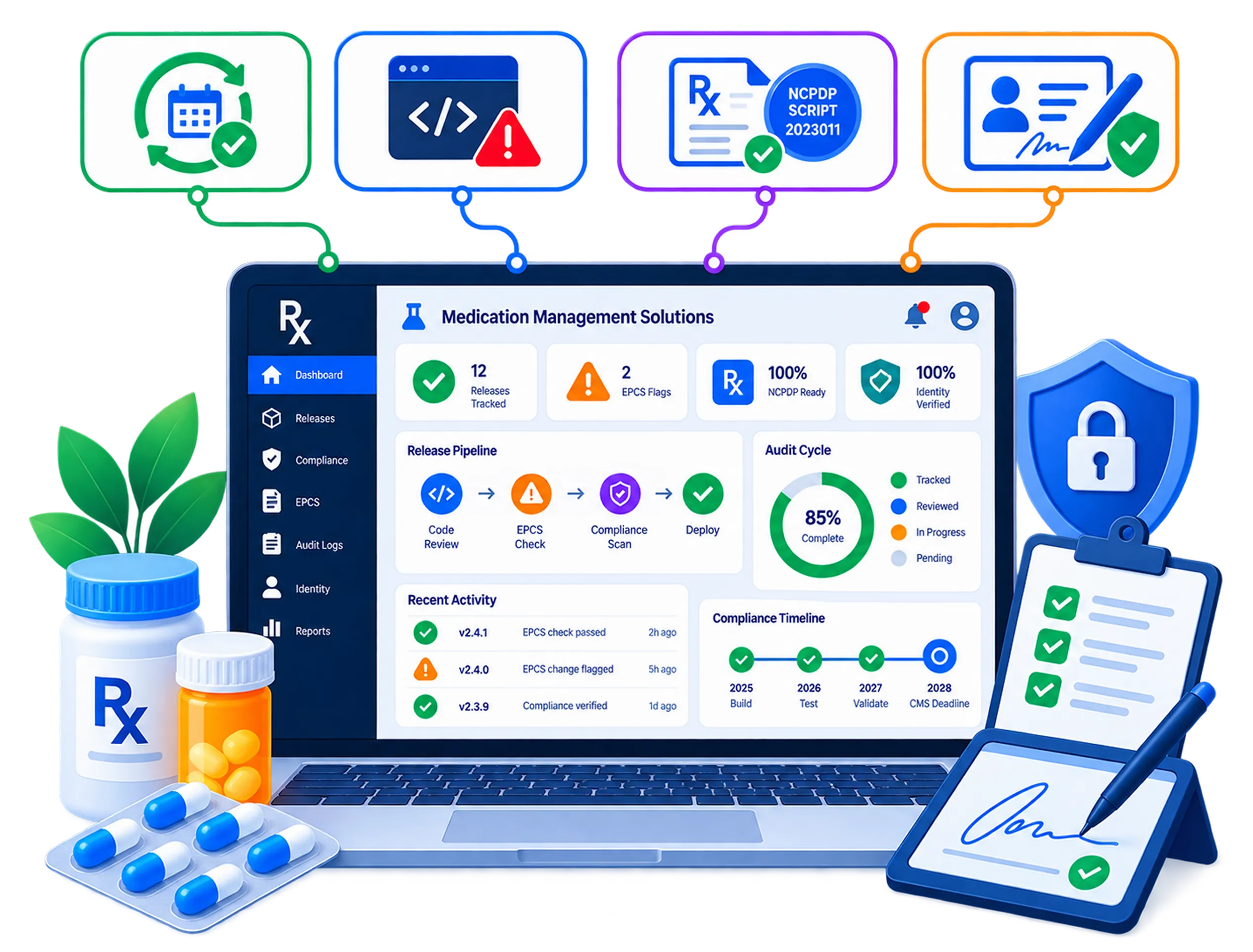
Federal law under 21 CFR §1311.300 requires any system prescribing controlled substances electronically to be re-audited by a DEA-approved third-party certifier, like Drummond, every two years or whenever a functionality tied to controlled-substance prescribing changes. Miss that window and the system can’t legally transmit a Schedule II-V prescription until it’s recertified, which stalls clinical operations, not just IT.

  • Check Icon

    Audit cycle tracking built into the release process

  • Check Icon

    EPCS-relevant code changes flagged before deployment

  • Check Icon

    NCPDP SCRIPT 2023011 readiness ahead of the 2028 CMS deadline

  • Check Icon

    Identity proofing and digital signature controls maintained continuously

Talk to a Compliance-Aware Engineer

How We Build Medication Management Systems

1

Clinical Workflow Discovery

We sit with pharmacists, nurses, and prescribers to map exactly where a medication order moves today, including the manual handoffs and workarounds that never show up in the existing system documentation. This is where most of the real requirements surface, not in a feature list.

2

Architecture and Compliance Planning

We design the data model around FHIR Medication resources and NCPDP SCRIPT transactions, then map every controlled-substance touchpoint against DEA EPCS requirements before a single line of code ships, so the audit trail isn't an afterthought.

3

Integration Layer Build

EHR, pharmacy, ADC, and drug database connections get built and tested individually before they're wired together, because debugging a failed interaction check across four systems at once costs far more time than isolating each connection first.

4

Core Workflow Development

eMAR, e-prescribing, and reconciliation modules are built in iterative sprints with weekly demos, so clinical stakeholders are reacting to working software, not a static spec they signed off on months earlier.

5

Validation and EPCS Certification Support

We run the system through DEA-aligned security and processing-integrity checks ahead of the formal third-party audit, catching the gaps that would otherwise surface during certification itself.

6

Launch and Post-Go-Live Support

Phased rollout by unit or facility, with monitoring on interaction-alert accuracy and reconciliation completeness in the first weeks, when real patient data exposes edge cases no test environment caught.

Engagement Models Scoped to Integration Depth

Single EHR Integration

Single EHR Integration

For organizations connecting one medication workflow to one existing EHR or pharmacy system.

  • Fixed-price or Time and Material
  • 2-4 month delivery window
  • One primary integration endpoint
Multi-System Rollout

Multi-System Rollout

For health systems connecting eMAR, e-prescribing, and ADC hardware across multiple departments.

  • Dedicated Team model
  • 4-7 month delivery window
  • Phased rollout by facility or unit
Enterprise-Wide Deployment

Enterprise-Wide Deployment

For multi-facility networks or payer-side programs needing reconciliation across every prescribing source.

  • Dedicated Team with embedded compliance support
  • 10+ month delivery window
  • Full EPCS audit readiness included

How Much Does It Cost to Build a Medication Management System?

Custom builds typically range from $800,000 for basic eMAR functionality to $200,000 for full enterprise systems with EPCS, e-prescribing, and multi-system integration. Get a scoped estimate for your specific workflow.


    Your data and info stays secure. Read our Privacy Policy.


    Who Needs a Custom Medication Management Build

    Hospital pharmacies replacing manual MAR processes
    Long-term care facilities managing polypharmacy across residents
    Specialty pharma programs supporting complex therapy adherence
    Payer-side teams running medication adherence initiatives

    Compliance Coverage at a Glance

    A clear view of what each standard governs and how Citrusbug's builds cover it from day one.

    Standard Scope Who Needs It Citrusbug Coverage

    NCPDP

    SCRIPT

    2023011

    E-prescribing and medication history transactions

    Any system handling Part D e-prescribing

    Built in, ahead of 2028 mandate

    HL7 FHIR R4

    Medication, MedicationRequest, MedicationStatement resources

    EHR-integrated systems

    Native data model

    DEA EPCS (21 CFR §1311.300)

    Controlled substance e-prescribing

    Hospitals, LTC, retail pharmacy

    Audit-cycle tracking built into release process

    HIPAA

    PHI handling and access controls

    All healthcare systems

    SOC 2 Type II infrastructure

    ONC USCDI v3

    Medication route and refill data interoperability

    Systems exchanging data with certified EHRs

    Mapped at the data layer

    Built by a Team That Understands Clinical Operations, Not Just the Code

    Medication safety systems fail when the people building them don't understand why a nurse scans a barcode twice or why a pharmacist double-checks a reconciliation list that the software already approved. Our healthcare engineering team has spent years inside pharmacy management and remote patient monitoring builds, which means the workflow decisions get made with the clinical stakes in view, not just the technical ones.

    Clinical Workflow Modeling

    EPCS and DEA Compliance

    Pharmacy Systems Integration

    Adherence Program Design

    Why Healthcare Teams Build Medication Systems With Citrusbug

    Secure ADLC for audit readiness
    Discovery before any code starts
    Source code ownership at delivery
    Post-launch L1/L2/L3 SLA support
    NDA by default on every engagement

    Client Testimonials (We're Rated 4.7 on Clutch)

    Real Medication Systems We've Built

    Real-world Delivery Success
    View All Case Studies →
    PHARMACY CarePoint

    CarePoint

    CarePoint is a comprehensive pharmacy and clinical management solution developed by Citrusbug, centralizing inventory, patient prescriptions, dispensing workflows, and compliance reporting for multi-location healthcare operations.

    More Info
    FITNESS Mediyoga

    Mediyoga

    A state-of-the-art wellness and patient engagement platform built for Mediyoga, integrating guided care programs, health tracking, and provider-patient communication into a unified digital experience.

    More Info
    HEALTHCARE Brainkey

    Brainkey

    Designed for healthcare providers and researchers, the platform enhances early detection of neurological conditions

    More Info

    Our Recent Blogs on Healthcare & AI

    Read Our Blogs
    The Role of AI in Chronic Disease Management: Use Cases, Benefits, and Impact
    The Role of AI in Chronic Disease Management: Use Cases, Benefits, and Impact Artificial Intelligence

    The Role of AI in Chronic Disease Management: Use Cases, Benefits, and Impact

    Chronic conditions such as diabetes, cardiovascular diseases, and respiratory disorders require continuous monitoring, timely interventions, and personalized care plans, something traditional healthcare models often struggle to deliver at scale. This…

    Read Article →
    Pharmacy Management System Market: Size, Growth, and Key Statistics
    Pharmacy Management System Market: Size, Growth, and Key Statistics Custom Software Development

    Pharmacy Management System Market: Size, Growth, and Key Statistics

    The way pharmacies operate has changed dramatically over the past few years. From manual record-keeping and paper prescriptions to fully digital workflows, the shift toward technology-driven pharmacy operations is accelerating…

    Read Article →
    Best AI Tools for Healthcare in 2026: How to Choose the Right One
    Best AI Tools for Healthcare in 2026: How to Choose the Right One Artificial Intelligence

    Best AI Tools for Healthcare in 2026: How to Choose the Right One

    The global healthcare AI market is projected to surpass $188 billion by 2030, and most healthcare organizations already know they need AI in their workflows, the harder question is where…

    Read Article →

    FAQs About Medication Management Solutions

    How long does an EHR integration usually take?

    First-time EHR integrations, including certification, typically take 4 to 8 months. Subsequent integrations with the same EHR vendor move faster once the pattern is established.

    Do you handle DEA EPCS certification for us?

    We build to DEA-aligned security and audit standards and prepare the system for third-party certification, but the formal audit is conducted by a DEA-approved certifier like Drummond.

    Can this integrate with Epic or Oracle Cerner pharmacy modules?

    Yes, through FHIR and HL7 v2 interfaces built to each vendor's certified API surface, depending on which modules your organization has licensed.

    What happens if we change a feature tied to controlled-substance prescribing post-launch?

    Under DEA rules, that change can trigger a new third-party recertification audit. We flag EPCS-relevant changes during code review so this doesn't surprise you at deployment.

    Will our system need to migrate to NCPDP SCRIPT 2023011?

    Yes, CMS requires it for Part D e-prescribing by January 1, 2028. We build new systems on this version directly to avoid a forced migration later.

    Do you build patient-facing adherence features, or only clinical-side tools?

    Both. Most engagements include reminder and refill tooling for patients alongside the clinical eMAR and prescribing modules, since adherence data feeds back into clinical decisions.

    What ongoing support is included after launch?

    Maintenance, monitoring of interaction-alert accuracy, and updates aligned with new NCPDP, FHIR, or DEA requirements as they're finalized.

    Build a Medication System Your Compliance Team Won't Have to Babysit

    Get a technical scoping call with an engineer who's shipped EPCS-certified medication systems before.