Advinow
Advinow is an AI-driven healthcare platform that automates patient engagement and consultation processes, helping healthcare providers deliver efficient, on-demand services while improving operations for urgent care.
Automate documentation, interoperability, and prior-authorization workflows across your existing EHR without a rip-and-replace project. We map the workflow, fix the data underneath it, then automate what's actually reliable to automate.
Trusted by industry leaders
Not every EHR task is worth automating in year one. These four categories are where health systems see the fastest, most defensible return, based on where manual effort concentrates and where errors are most expensive.
Ambient voice capture and NLP-based structuring turn provider-patient conversations into SOAP notes and encounter summaries, cutting the charting hours that push physicians past their scheduled shift.
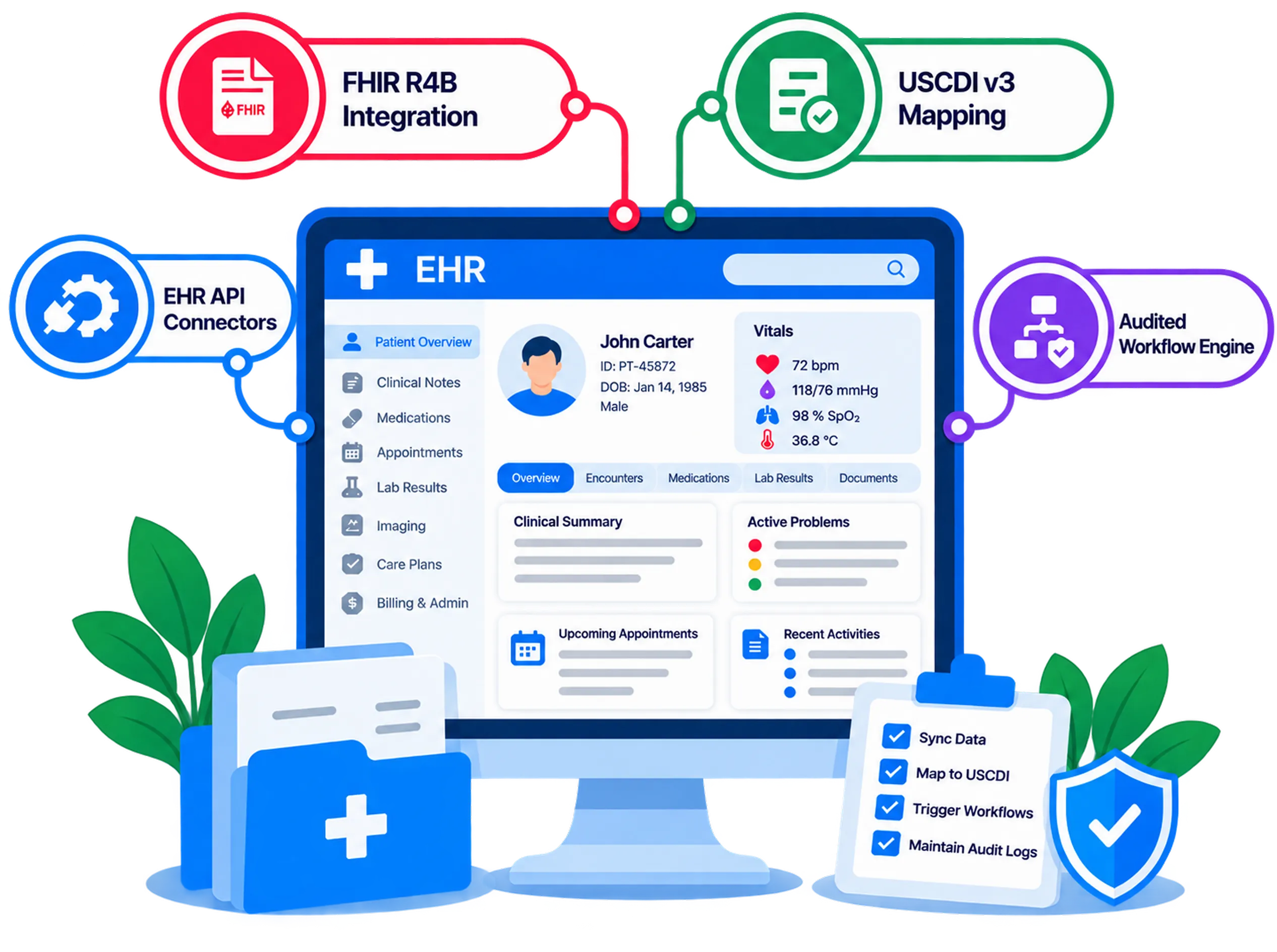
Automated data exchange between the EHR, labs, imaging systems, and pharmacies using HL7 v2 interfaces and FHIR R4B APIs, so results and orders move without a human retyping them.
Automated eligibility checks, coding suggestions, and claim status routing that shorten days in AR and reduce the denial rate tied to incomplete or mistimed submissions.
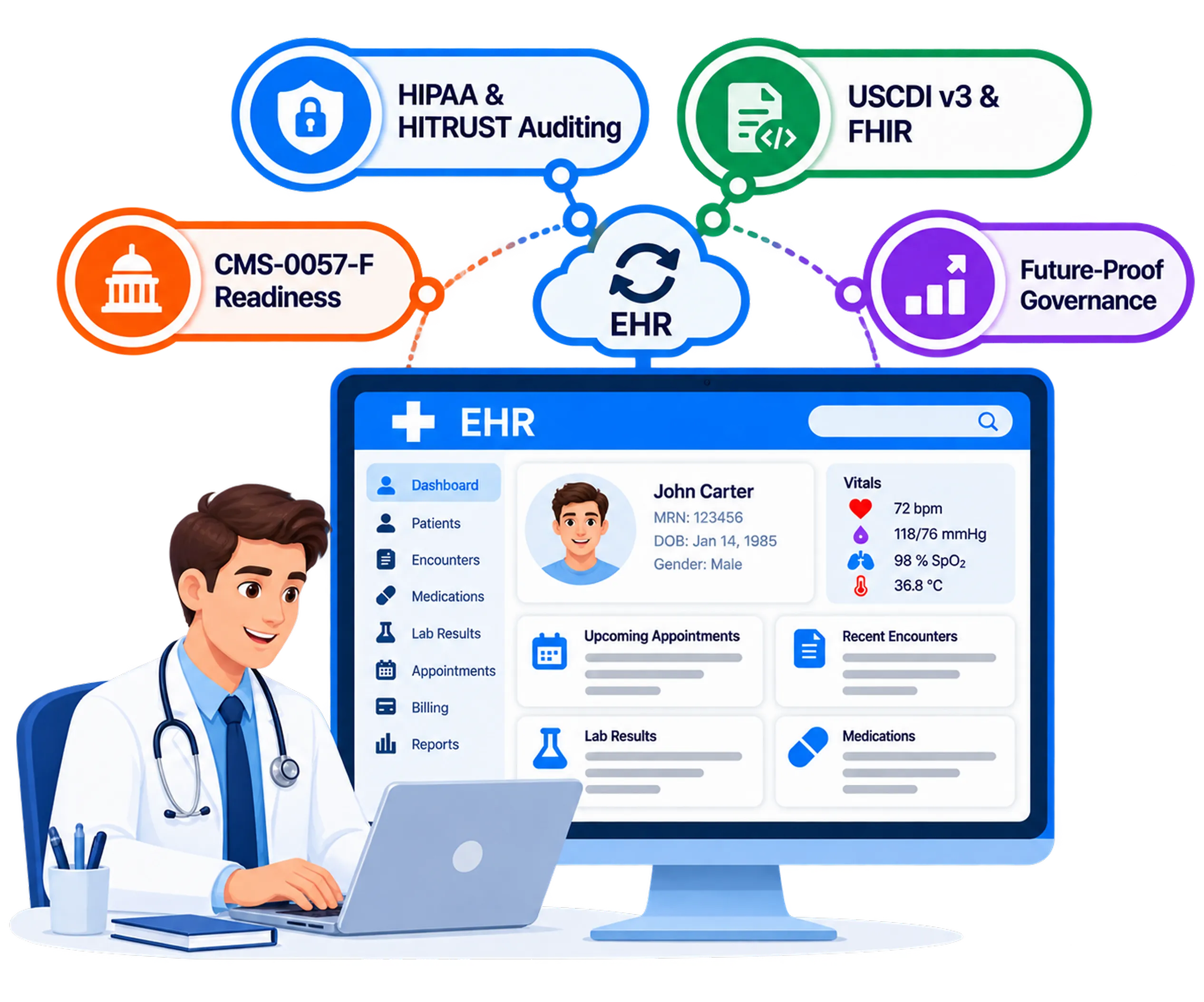
Automated access logging, audit trail generation, and retention policy enforcement that hold up under a HIPAA audit without someone assembling evidence by hand every quarter.
A short audit tells you where manual effort is costing the most and where automation will actually hold up.
Get a Free AuditPrimary care physicians now spend close to two hours in the EHR for every hour of direct patient time, with documentation eating into evenings and weekends that should be off the clock. That’s not a training problem. It’s what happens when a system built for storing records is also carrying the weight of every administrative task around it.
The instinct is to automate the visible symptom, usually documentation, and stop there. That misses where the compounding cost actually sits: clinical alerts that get overridden 49% to 96% of the time because signal-to-noise has eroded trust, and duplicate or inconsistent patient records that cause automation rules to fail silently downstream. Fixing the front-end workload without touching either of those leaves the real cost in place.
Most automation projects skip straight to building rules on top of the EHR as it exists today. That's how you end up automating a broken process faster. A layer built to actually hold up in production needs each of the following in place before the first workflow goes live.
Duplicate-record resolution and standardized terminology mapping before any automation rule touches patient data, so the rule doesn't inherit the mess underneath it.
HL7 v2 interfaces where the EHR still requires them, FHIR R4B and USCDI v3-aligned APIs where the vendor supports them, connecting to Epic App Orchard, Oracle Health Ignite, or athenahealth's API marketplace as needed.
Rule-based logic for the high-volume, low-risk tasks first, appointment reminders, eligibility checks, demographic sync, before extending automation toward clinical decision points.
A named owner for every automation rule and a review cadence that catches drift before it becomes a misfired alert or a wrong billing code.
The architecture below sits beside your existing EHR rather than replacing it. Data flows through a validation and mapping layer before it reaches any automation rule, and every interface connects through standards your EHR vendor already supports rather than a custom workaround that breaks on the next vendor update.
We map the specific tasks consuming staff time, who touches each one, and which systems they pass through, before assuming anything is automatable. This step also surfaces which workflows are actually broken processes wearing a manual-effort disguise.
Before any rule goes live, we resolve duplicate records, standardize terminology, and set validation checkpoints. Most automation failures trace back to skipping this step, not to the automation logic itself.
We build the HL7/FHIR interfaces and vendor API connections the workflow actually needs, using Epic, Oracle Health, or athenahealth's supported integration paths rather than screen-scraping or unsupported workarounds.
Rules are built incrementally, starting with low-risk administrative tasks, tested against real historical data, and reviewed by clinical stakeholders before touching anything near a decision point.
We stage rollout by department or task type, watch override rates and exception volume closely in the first weeks, and hand over a monitoring cadence your team can run without us.
USCDI v3 became the only version recognized in the ONC Health IT Certification Program as of January 1, 2026, and ASTP/ONC’s HTI-5 proposal is already pushing certification criteria further toward FHIR-based APIs. Building automation on last year’s assumptions about what “compliant” means is a rebuild waiting to happen.
Audit trails and access logging built to current HIPAA and HITRUST expectations
Interoperability standards aligned to USCDI v3 and FHIR R4B
Prior authorization workflows built ahead of CMS-0057-F’s January 2027 API deadline
Governance structure that survives a certification criteria change, not just today’s rules
Advinow is an AI-driven healthcare platform that automates patient engagement and consultation processes, helping healthcare providers deliver efficient, on-demand services while improving operations for urgent care.
Valene Health is a pioneering telepsychiatry platform that leverages AI to enhance mental healthcare delivery.
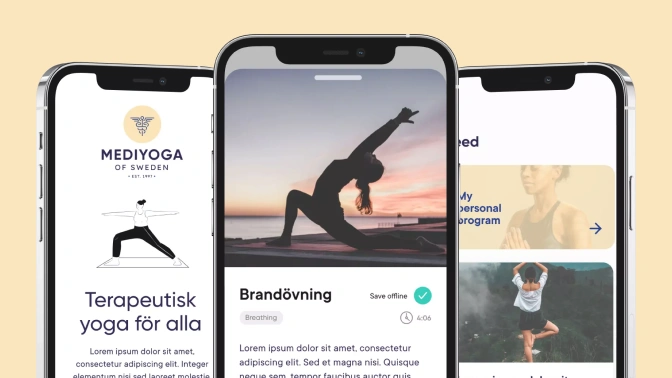
A state-of-the-art wellness and patient engagement platform built for Mediyoga, integrating guided care programs, health tracking, and provider-patient communication into a unified digital experience.
The right starting point depends on how much of the workflow touches other systems. This breaks down four common scopes by complexity and realistic timeline, not a single number that hides the variables.
| Automation Scope | Complexity | Typical Timeline |
|---|---|---|
|
Appointment reminders and eligibility checks |
Low |
2-4 weeks |
|
Clinical documentation automation (ambient/NLP) |
Medium |
6-10 weeks |
|
Prior authorization and revenue cycle automation |
High |
10-16 weeks |
|
Multi-site interoperability automation |
Very High |
4-6 months |
1-2 engineers integrated with your IT and clinical informatics team, best for a single-department pilot.
A full team taking automation from pilot to multi-department rollout on a fixed sequence.
End-to-end ownership of automation across a multi-site health system, including legacy interface replacement.
Most engagements start between $15,000 and $60,000 for a scoped first workflow, with multi-site rollouts running higher depending on interface complexity. <br></br>Book a call to get a number specific to your systems.
We treat duplicate-record resolution and terminology standardization as a required phase before automation, not a cleanup step after something breaks. It's the reason our automations don't fail silently three months in.
Requirements, workflow mapping, and stakeholder sign-off happen before a single rule is written, so what gets built matches how your staff actually work, not an assumption about it.
Each phase ships with its own measurable outcome before the next one starts, so you're never approving a budget for a system-wide rollout on faith.
No. Automation sits alongside your existing EHR using supported interfaces and APIs. Replacement is only necessary if the core system itself can't support the integrations the workflow needs.
Most health systems run both. We build FHIR R4B connections where the vendor supports them and maintain HL7 v2 interfaces where legacy systems still require them, mapped to a common data layer.
Rules built on vendor-supported APIs and standard interfaces are far less likely to break. We also monitor for vendor changelogs affecting active integrations as part of ongoing support.
Data validation and duplicate-record resolution happen before any rule goes live, with checkpoints built into the workflow so bad data gets flagged instead of silently propagating.
Yes. We connect through each vendor's supported API programs, Epic App Orchard, Oracle Health Ignite APIs, and athenahealth's marketplace, without requiring you to hold a separate development partnership.
Low-complexity workflows like reminders and eligibility checks typically show measurable time savings within 4-6 weeks of go-live. Higher-complexity phases are scoped with their own milestone before the next phase starts.
Every automation rule has a named internal owner and a documented review cadence, handed over to your team at go-live, so accountability doesn't disappear once the project closes.
Yes. We build prior-auth workflow automation aligned to the FHIR-based API structure CMS-0057-F requires, so the EHR-side workflow is ready before the January 2027 deadline, not scrambling to catch up.