Let’s Talk
Healthcare AI Solutions Healthcare AI Solutions

AI Triage Software Development for Faster Patient Routing

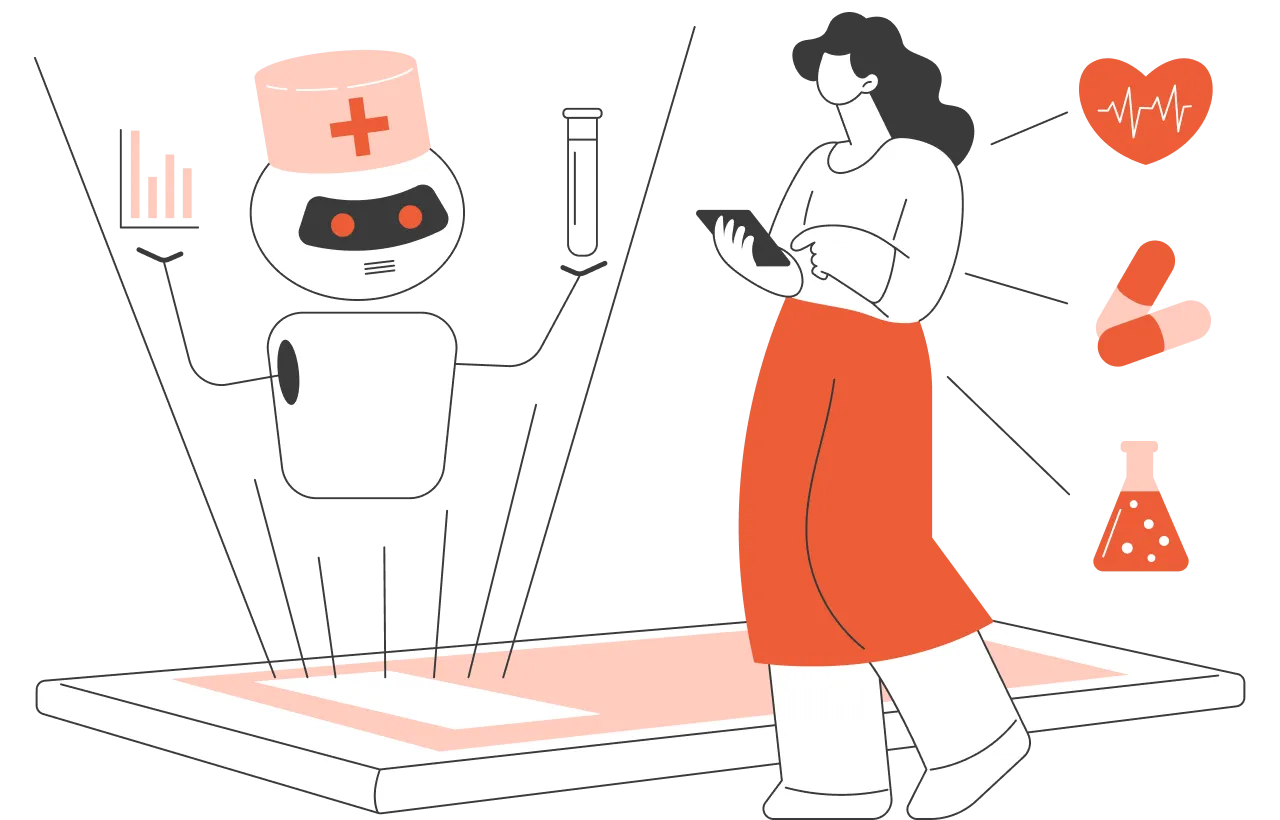
Emergency departments field hundreds of intake decisions a day, and every minute a low-acuity case sits ahead of a high-acuity one costs something, staff time, patient outcomes, or both. We build AI triage software that assesses symptoms, routes patients to the right care level, and integrates with the EHR your team already uses.

Hero Image

Trusted By Industry Leaders

Bosch
Deloitte
eClinicalWorks
Epic Systems
Flipkart
McKinsey
HSBC
Softbank
Allianz
Airbnb
United Health
Phelic
Sun Pharma
Target
US Foods
Advinow

Certifications and Accreditations

Core Capabilities of AI Triage Software Development

Structured Symptom Assessment

Patients describe symptoms in their own words, and the system converts that into structured, protocol-aligned data points a nurse or physician can act on immediately, not a transcript to re-read.

Automated Risk-Based Routing

The engine assigns an urgency level and routes the case to the right care pathway, whether that’s ED, urgent care, telehealth, or self-care guidance, based on rules your clinical team defines.

Real-Time EHR Context

Before a recommendation is made, the system pulls relevant history from the patient’s chart, so triage decisions account for existing conditions instead of treating every intake as a blank slate.

Escalation With a Logged Rationale

Every AI-flagged escalation ships with a plain-language explanation and a timestamped record of what data drove it, so the decision holds up when someone reviews it later.

Ready to Scope Your Triage Build?

Get a working assessment of what your triage system actually needs, not a generic sales deck.

Talk to Our Engineer

What Faster Triage Actually Saves You

Triage delays compound fast. A nurse spending an extra four minutes per intake on a busy shift adds up to hours of lost capacity a day, and every misrouted low-acuity patient who lands in the ED instead of urgent care costs the system money nobody budgeted for. Systems built for accurate, fast routing shift that math directly, cutting assessment time to a few minutes per patient and reducing unnecessary ED visits that were never the right level of care to begin with.


Fewer unnecessary ED visits from patients routed to the wrong care level

Reclaimed nurse hours previously spent on manual intake and re-asking questions already in the chart

Reduced after-hours call volume from patients who can self-triage safely first

Lower no-show rates when the routing itself sets accurate expectations upfront

Where Generic Triage Builds Break Down


Many "AI triage" tools on the market are really symptom checklists with a chat interface layered on top. That's fine for routine intake, but it falls apart the moment a patient describes something ambiguous, because there's no real clinical escalation logic underneath the conversation.

The second failure mode shows up after launch, when staff stop trusting the tool. A system that over-flags routine cases as urgent gets ignored within weeks, and once nurses start working around it instead of with it, the investment is dead weight regardless of how accurate the model technically is.

No clinician-readable explanation for why a case was flagged urgent or routine, which erodes trust fast in a high-stakes setting.

Over-flagging routine cases as urgent trains staff to ignore the system entirely within weeks.

Vendors hand over a login and a manual, with no plan for how staff actually change their daily workflow around it.

Launch-day accuracy is not the same as month-eighteen accuracy, and most vendors have no plan for the gap.

How Citrusbug Builds Triage Systems Staff Actually Keep Using

We design for day two hundred, not just launch day. That means the escalation logic is calibrated against your real patient volume before go-live, staff get trained alongside deployment instead of after it, and every AI-flagged escalation carries a clinician override so nobody has to take a recommendation on faith.

Human-in-the-Loop by Design

  • Clinicians review and can reverse any AI-flagged escalation before it changes a care pathway, with the override reason captured automatically.

Model Monitoring as a Deliverable

  • We ship a drift-monitoring dashboard with the system, not as an add-on, so accuracy degradation gets caught before it becomes a pattern.

Built Around Adoption

  • Our clinical decision support systems are calibrated with your clinical team’s actual thresholds, not a generic default, so staff trusts the output from week one.

What's Inside a Production-Grade Triage Engine

Multi-Channel Intake

Phone, web chat, patient portal, and kiosk intake all feed the same triage logic, so a patient gets the same standard of assessment regardless of how they walked in.

Protocol-Aligned Symptom Logic

Escalation rules map to recognized clinical protocols rather than an internal black box, so your medical director can review and sign off on the logic itself.

Continuous Model Monitoring

Automated drift detection flags when real-world accuracy starts diverging from validation benchmarks, with alerts routed to whoever owns clinical oversight on your team.

Bias and Fairness Testing

Model outputs get tested across demographic subgroups before launch and on a recurring cadence after, so under-triage patterns get caught in testing, not in a patient encounter.

AI Symptom Checker Integration

For lighter-touch use cases, the same architecture supports a standalone AI symptom checker that feeds structured data into the full triage engine.

Configurable Escalation Thresholds

Your clinical team sets and adjusts urgency thresholds without a code change, since protocols and staffing realities shift more often than most systems are built to handle.

What Changes for the Triage Nurse's Actual Shift

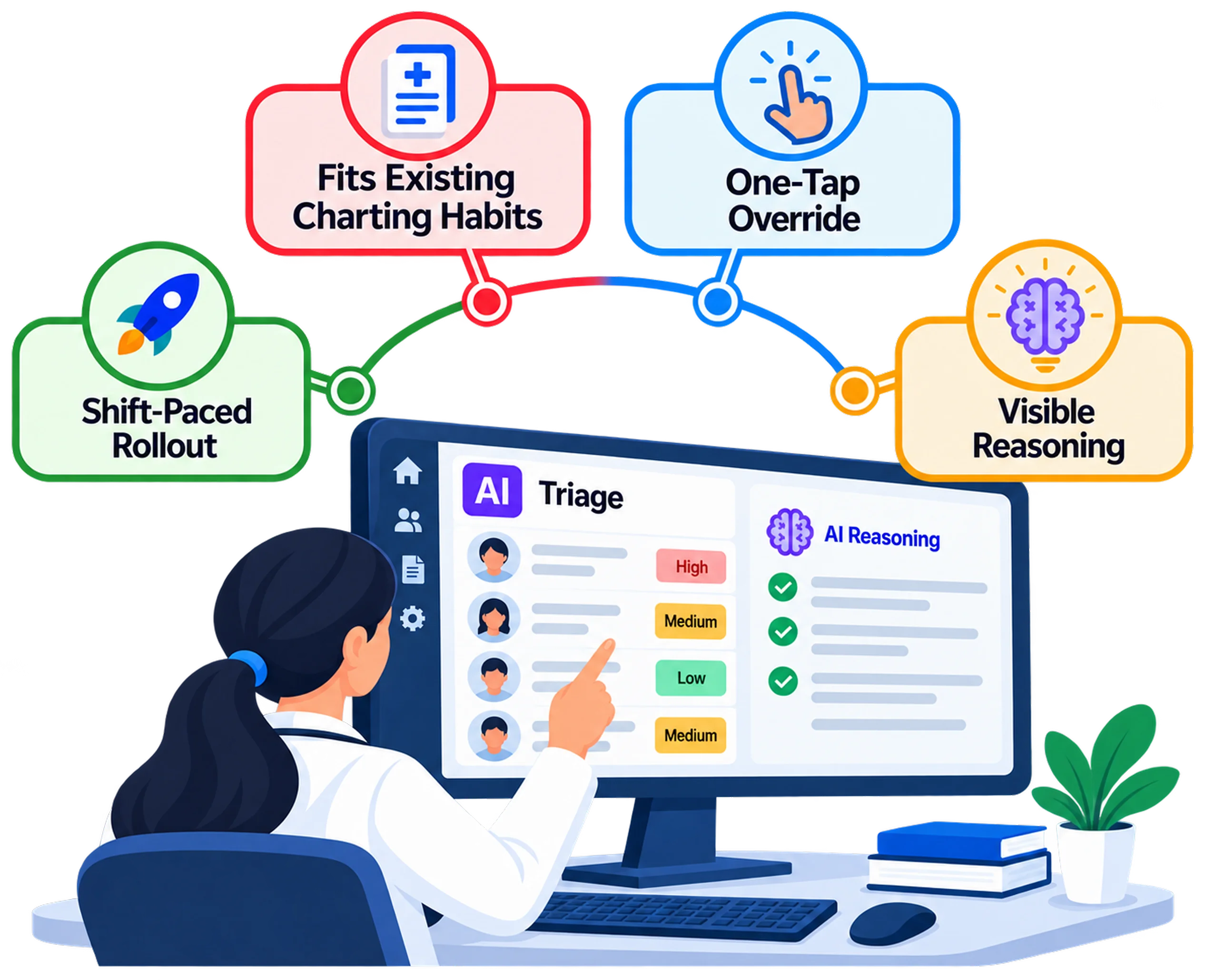
A triage nurse’s day doesn’t change because a system is accurate. It changes because the system fits into the fifteen seconds she has between patients. We build the intake screen and escalation alerts around the pace of a real shift, so structured data shows up where staff already look and overriding a recommendation takes one tap instead of a support ticket. Staff who trial the system on a slower shift first adopt it faster than teams handed a finished tool cold.

  • Check Icon

    Fits Existing Charting Habits: No new screen to memorize, the AI output appears inside the chart view staff already use.

  • Check Icon

    One-Tap Override: Reversing an AI recommendation takes the same motion as any other chart entry, no separate workflow.

  • Check Icon

    Shift-Paced Rollout: Pilot on a slower shift first, so staff build trust before the system handles peak volume.

  • Check Icon

    Visible Reasoning: The rationale behind each flag shows inline, not buried behind a click-through report.

What Changes for the Triage Nurse's Actual Shift

How Triage Software Connects to Your Existing Systems

A triage engine that can’t talk to your EHR is a standalone tool nobody trusts with real decisions. We build on FHIR R4/R4B for structured data exchange and account for HL7 v2.x messaging where legacy hospital systems still depend on it, so the triage layer reads real patient context and writes structured outcomes back without a manual re-entry step. Since regulators now scrutinize time-critical clinical software more closely than in past years, we build the escalation and override logic to hold up under that review from the start rather than retrofitting it later.

FHIR R4B data exchange with your EHR

HL7 v2.x support for legacy hospital messaging

Epic FHIR API and Cerner HL7 interface compatibility

HIPAA-compliant hosting on Azure or AWS HealthLake

What Delaying Your Triage Software Investment Costs You

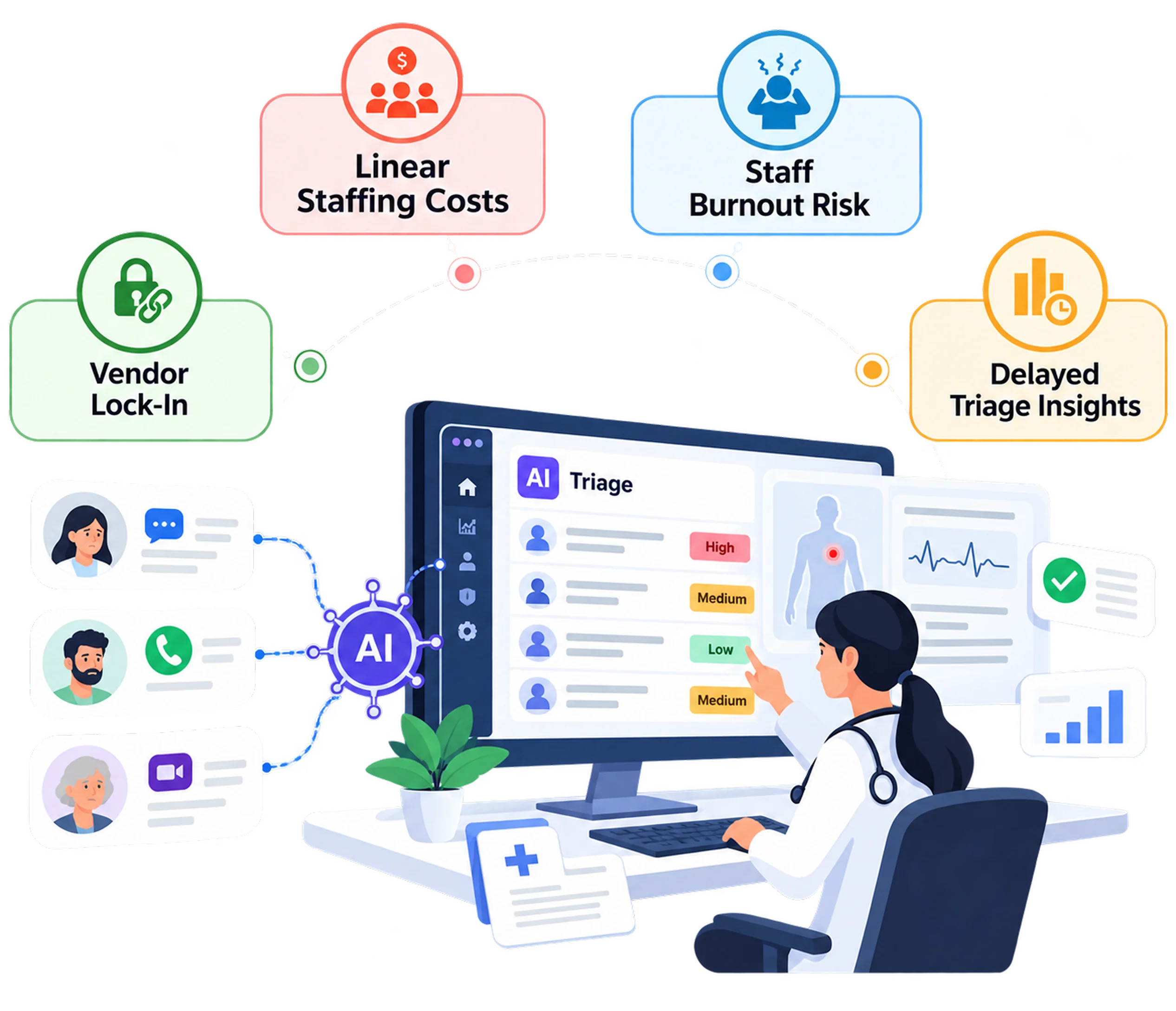
Sticking with manual triage or a generic off-the-shelf tool isn't a neutral choice; it has its own price. Manual triage caps how many patients your staff can safely assess per shift, and a poorly calibrated tool just trades that risk for another, staff either over-trust it or ignore it, and either way, it surfaces during a patient safety review, not a sales demo.

  • Staffing costs that scale linearly with patient volume, with no efficiency gain built in
  • Turnover risk from staff burned out by manual, repetitive intake work
  • Vendor lock-in with generic tools that can't be recalibrated to your actual protocols
  • Delayed data on where your own triage process is actually losing time

Client Testimonials (We're Rated 4.7 on Clutch)

Execution-Focused Delivery for Triage Software Development

01

Discovery and Clinical Mapping

Existing intake workflows, escalation protocols, and staffing patterns get mapped before any architecture decisions are made.

02

Escalation Logic & Architecture Design

We design the escalation rules and override points first, then choose the model architecture that supports them.

03

Build and EHR Integration

Development happens against your actual EHR's FHIR or HL7 interface, not a generic sandbox environment.

04

Clinical Validation & Staff Onboarding

Real-world scenarios get tested with your clinical team, and staff are trained alongside deployment, not after it.

05

Deployment and Ongoing Monitoring

We deploy the system, hand over a live drift-monitoring dashboard, and stay on to track accuracy from week one.

What Makes Clinical Teams Trust This AI Triage Software

Nurses see the rationale behind every AI recommendation, not just a color-coded urgency flag they have to take on faith.

Override decisions get logged the same way a manual triage call would, so nothing about the workflow feels like a black box bolted onto their day.

Our healthcare software testing and validation process runs scenarios your own clinicians helped write, not generic test cases.

Training runs alongside deployment instead of after it, so staff aren't learning a new system on a live shift.

How Much Does It Cost to Develop AI Triage Software?

Most hybrid triage builds with EHR integration land between $50K and $150K, though scope changes that fast. Tell us what you're working with and we'll size it on the first call.


    Your data and info stays secure. Read our Privacy Policy.


    Technologies and Platforms We Use

    LangChain
    Haystack
    OpenAI GPT-4
    Anthropic Claude
    OpenAI GPT-4
    Google Dialogflow
    Rasa
    Vapi.ai
    Azure Prompt flow
    DALL-E
    DALL-E
    Stable Diffusion
    Stable Diffusion
    TensorFlow
    Hugging Face Transformers
    Amazon Glu
    Amazon Glu
    Pandas
    Pandas
    Numpy
    Numpy
    Redshift
    Redshift
    opencv
    OpenCV
    Tesseract OCR
    Tesseract OCR

    Why Healthcare Teams Build Triage Software With Citrusbug

    Built for Adoption

    Built for Adoption

    We calibrate escalation logic against your actual patient volume and train staff alongside deployment, so the system earns trust in week one instead of getting worked around by week three.

    Discovery Before Any Code

    Discovery Before Any Code

    We map clinical workflows and get requirements sign-off before architecture decisions get made, so the build matches how your team actually triages, not a generic template.

    Senior Engineers From Day One

    Senior Engineers From Day One

    You work with senior-level engineers assigned to your project before the contract is signed, not a junior bench that rotates in after kickoff.

    Our Recent Insights on Healthcare & AI

    VISIT OUR BLOG →
    What Is Edge Computing in Healthcare? A Complete Guide to Use Cases and Benefits
    What Is Edge Computing in Healthcare? A Complete Guide to Use Cases and Benefits Artificial Intelligence

    What Is Edge Computing in Healthcare? A Complete Guide to Use Cases and Benefits

    The healthcare systems produce vast amounts of data every second. This data is received through bedside monitors, imaging systems, wearables, and connected medical devices. However, sending everything to the cloud…

    Read Article →
    A Complete Guide to Remote IoT Monitoring Solutions in Healthcare
    A Complete Guide to Remote IoT Monitoring Solutions in Healthcare Custom Software Development

    A Complete Guide to Remote IoT Monitoring Solutions in Healthcare

    In medical practice, information can save lives. Each day, hospitals and clinics are dealing with numerous patients, devices, and data. A remote IoT monitoring is a solution that links medical…

    Read Article →
    Blockchain in Healthcare: Securing Patient Data with Next-Gen Solutions
    Blockchain in Healthcare: Securing Patient Data with Next-Gen Solutions Artificial Intelligence

    Blockchain in Healthcare: Securing Patient Data with Next-Gen Solutions

    Managing patient data in healthcare is becoming more complex by the day. Hospitals, clinics, and insurance companies deal with large volumes of sensitive information, and their safety is always a…

    Read Article →

    FAQ’s

    Does AI triage software require FDA clearance?

    It depends on the function. Time-critical recommendations can fall under FDA's clinical decision support rules, and regulatory scrutiny here has increased recently. We help you classify this correctly before you build.

    Can this integrate with our existing EHR without a rip-and-replace?

    Yes. We build on FHIR R4/R4B and support HL7 v2.x where legacy systems require it, connecting to your existing EHR rather than replacing it.

    What does this actually save us versus manual triage?

    Reclaimed nurse hours on intake, fewer unnecessary ED visits from misrouted patients, and reduced after-hours call volume. Exact numbers depend on your current volume and staffing model.

    How do you get staff to actually trust and use this?

    We calibrate thresholds against your real data before go-live and train alongside deployment, not after. Systems handed over cold get worked around within weeks.

    What happens when the model drifts after deployment?

    We ship a drift-monitoring dashboard with the build and schedule retraining checkpoints, so accuracy degradation gets flagged before it becomes a pattern.

    Can nurses override the AI's recommendation, and is that logged?

    Yes, on every escalation. The override and the reason behind it are captured the same way a manual triage decision would be documented.

    How long does a build actually take?

    Most hybrid, EHR-integrated builds take 3-6 months. Simpler rule-based routing tools can ship in 2-3 months; multi-facility platforms run longer.

    Do you test for bias across patient demographics?

    Yes, before launch and on a recurring cadence afterward, so under-triage patterns in specific patient groups get caught in testing rather than in a real encounter.

    What's the risk of just sticking with our current process?

    Staffing costs scale linearly with volume, burnout drives turnover, and you lose visibility into where your own process is actually losing time.

    Ready to Build Triage Software Staff Will Actually Use?

    Get a working scope for your AI triage build, priced and timelined against what you're actually integrating with.