CarePoint
CarePoint is a comprehensive pharmacy and clinical management solution developed by Citrusbug, centralizing inventory, patient prescriptions, dispensing workflows, and compliance reporting for multi-location healthcare operations.
Most patient management platforms force your workflows into their architecture. When your scheduling logic, EHR integration surface, and compliance requirements don't match the template, you get workarounds - not solutions. Citrusbug builds custom Patient Management System Software from discovery to deployment, engineered for FHIR R4 interoperability, multi-facility scale, and the administrative realities your team deals with every day.
Trusted by Leading Healthcare Innovators
We build every layer of a patient management system: the data layer, the workflow layer, the integration layer, and the patient-facing layer. Each module is designed to work independently or as part of a unified platform.
Rules-based scheduling with real-time provider availability, multi-location calendar sync, automated reminders via SMS and patient portal, and configurable no-show logic to reduce unfilled slots.
Centralized patient profiles across facilities, departments, and care teams. Structured to USCDI v3 data elements with full audit trail logging and role-based access controls aligned to HIPAA minimum necessary standards.
End-to-end billing integration using ASC X12 5010 EDI for 837 (claims), 835 (remittance), and 270/271 (eligibility verification). Reduces claim errors and supports cleaner denial management across payer mixes.
Secure web and mobile portal for digital intake forms, appointment self-scheduling, lab results access, messaging, and consent management built to meet the 21st Century Cures Act information blocking provisions.
Ambient voice-to-clinical-note capture is integrated at intake, reducing administrative time per encounter. Structured outputs feed directly into the EHR record without manual transcription, using LLM pipelines trained on clinical note formats.
FHIR R4-based care coordination workflows for transitions of care, referral tracking, and care gap identification. Supports value-based care programs with real-time gap alerts surfaced through CDS Hooks.
Operational dashboards tracking appointment utilization, no-show rates, claim denial rates, and patient volume by provider and facility. Configurable by role, clinical, administrative, and executive views.
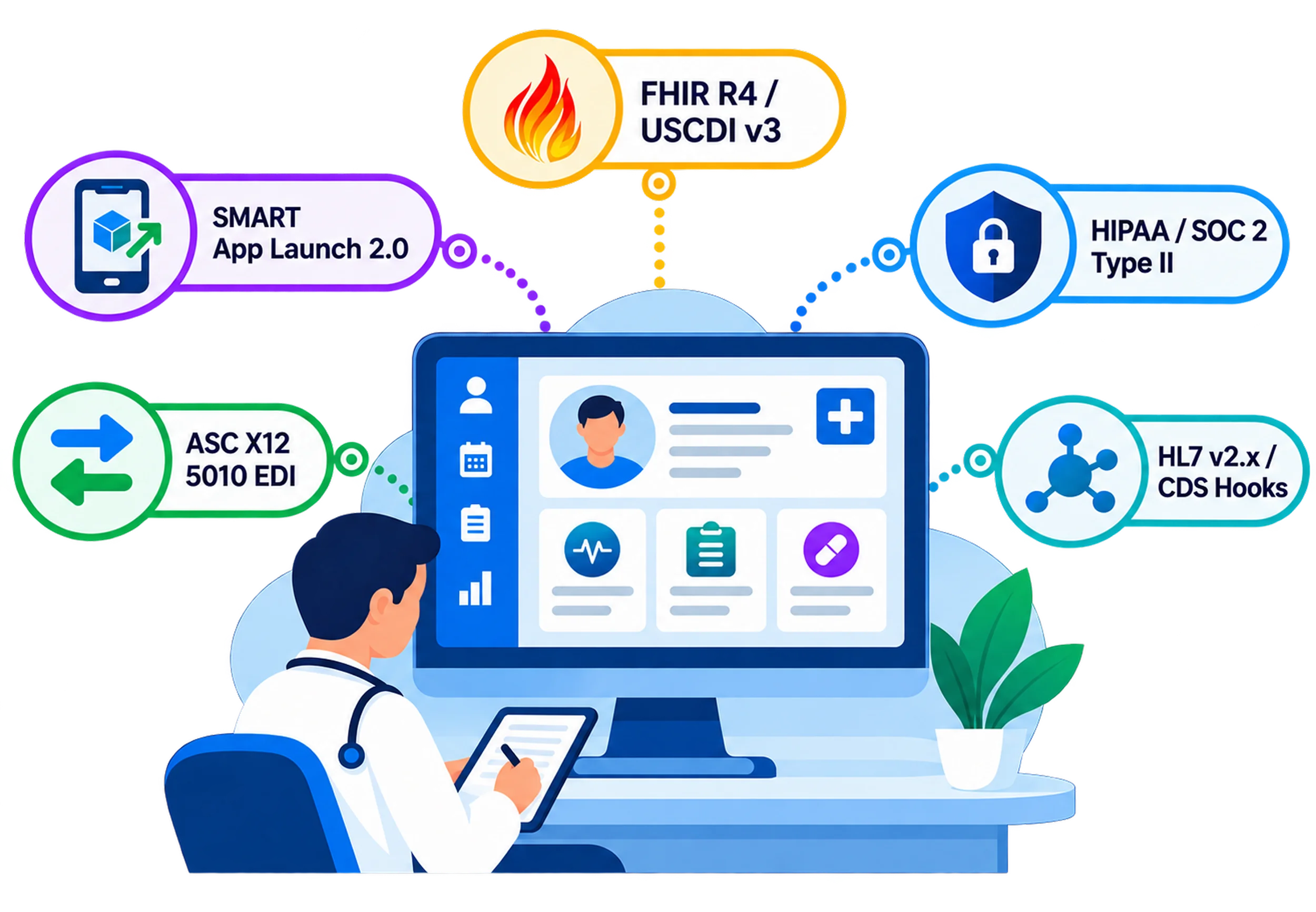
SMART on FHIR 2.0 app launch authorization, HL7 v2.x translation layers for existing Epic Hyperdrive and Oracle Health environments, and REST API contracts for third-party system connections.
Tell us your facility type, current stack, and compliance requirements. We'll map a build path in the first call.
Get a Patient Management Scoping CallMost healthcare organizations don’t have a software problem. They have an integration debt problem. Patient records live in one system. Scheduling lives in another. Billing pulls from a third. When a provider needs a patient’s full picture, someone is making phone calls or switching tabs.
The administrative overhead is measurable, front desk staff spending hours reconciling records that should sync automatically, billing teams chasing claim rejections caused by incomplete demographic data at intake, and clinical teams making decisions without the latest lab or referral context available in the room.
Custom Patient Management System Software eliminates these gaps by treating data unification as an architectural requirement, not a post-launch integration project. The scheduling system knows what the billing system knows. The patient engagement software reflects what the EHR reflects. The access controls enforce what your compliance officer requires down to the field level.
OAuth 2.0-based app authorization framework replacing SMART v1.0. Required for FHIR API certification under ONC HTI-1. We implement authorization scopes at the resource level, not just the application level.
US Core Implementation Guide 6.1.0 mandates structured clinical data fields across patient demographics, medications, allergies, problems, and care team members. We map all patient record schemas to USCDI v3 at the data model layer.
Standards-based integration point for surfacing care gap alerts, drug interaction warnings, and protocol reminders within clinical workflows. Our CDS Hooks implementations connect to Epic’s CDS Hooks sandbox and Oracle Health’s Millennium platform.
Legacy EHR environments still emit ADT, ORM, and ORU messages over HL7 v2.x. We build translation layers that convert these to FHIR R4 resources in real time, preventing data loss during the interoperability transition.
A patient management system touches scheduling, billing, clinical records, and compliance simultaneously. We don't start writing code until every stakeholder understands what is being built, how it integrates, and what it looks like when it's done.
We run structured discovery with clinical, administrative, and technical stakeholders. Output includes documented user stories, workflow maps, data flow diagrams, integration surface inventory, and a compliance requirement register.
System architecture scoped to your deployment model (cloud-native on AWS HealthLake or Azure Health Data Services, or hybrid). Patient data schemas mapped to USCDI v3. API contracts defined for every integration point before development begins.
Modular build sequence so scheduling, records, billing, and portal modules can be developed in parallel and integrated progressively. Each module carries its own unit and integration test suite. Security controls embedded at the code level using Secure ADLC methodology.
FHIR R4 API integration tested against live EHR sandbox environments. HIPAA access controls, encryption, and audit logging validated before staging deployment. ONC HTI-1 data element compliance confirmed for every patient-facing API endpoint.
Go-live support with staff onboarding documentation and role-based training materials. Full source code ownership at handover. Post-launch L1/L2/L3 SLA support tiers available with defined response time commitments.
Front desk and billing staff reclaim hours lost to manual record reconciliation, phone-based scheduling, and claim rework. Automated intake, eligibility checks, and reminder workflows run without human intervention.
Billing errors generated by incomplete demographic data at intake are eliminated when scheduling, registration, and billing share a single patient record. ASC X12 5010 EDI validation catches claim format errors before submission, reducing denial rates.
HIPAA access controls, FHIR R4 API endpoints, and audit logging are in place from day one. When regulatory requirements shift, as they have with ONC HTI-1 and the proposed 2026 HIPAA Security Rule updates, the architecture absorbs the change without a rebuild.
Source code ownership means your engineering team maintains, extends, and modifies the system without returning to a vendor. No license dependency. No feature roadmap you don't control. The EHR software development layer is documented and transferable.
Most custom patient management systems range from $20,000 for targeted module builds to $150,000+ for enterprise multi-facility platforms with full AI integration. Share your facility type and integration requirements and we will scope your project within one business day.
$20,000 – $50,000
Add specific capability to an existing platform: scheduling engine, patient portal, AI intake module, or billing integration. Defined scope, fixed timeline. Best for organizations with a working core system that needs targeted capability.
• Fixed scope and timeline
• FHIR R4 integration included
• Source code ownership at delivery
• 4 – 12 week engagement
$50,000 – $1000,000+
End-to-end patient management system built from discovery to deployment. Covers scheduling, records, billing, portal, integrations, and compliance architecture. Best for organizations replacing a fragmented multi-system setup.
• Full discovery and architecture phase
• Multi-module development
• EHR integration and compliance validation
• 16 – 28 week engagement
$80,000 – $1500,000+
Migrate from an aging PMS to a FHIR R4-ready, cloud-native platform while preserving data integrity and minimizing operational disruption. Includes data migration planning, phased rollout, and parallel-run period.
• Data migration and mapping
• Phased cutover plan
• Staff onboarding documentation
• Compliance posture assessment included
• 24 – 32 week engagement
The administrative burden in healthcare doesn’t come from one broken process. It comes from the accumulation of small manual steps: transcribing intake information, triggering prior authorization requests, identifying patients overdue for follow-up. Each one is low-value work that consumes clinical and administrative capacity.
Modern patient management systems embed AI at these specific friction points. Ambient voice capture at intake converts spoken patient information directly into structured FHIR R4 records, cutting documentation time per encounter. Agentic workflows initiate prior authorization requests automatically when a scheduled procedure triggers a known payer rule, reducing the time between scheduling and approval from days to hours. LLM-based care gap identification surfaces patients who meet protocol criteria for a follow-up, preventive screening, or medication review, feeding directly into the clinical workflow automation layer without manual list management. The 2026 CPT code updates now include dedicated billing codes for AI-augmented clinical services, meaning the administrative infrastructure for reimbursing these workflows is in place.
Built on FHIR R4-native data models with SMART App Launch 2.0 authorization and HL7 translation layers for legacy EHR environments. Deployed on Azure Health Data Services or AWS HealthLake, depending on your infrastructure requirements.
Patient management system requirements differ materially by setting. We have delivered across all of these.
Requirements, workflow maps, integration surface inventory, and data flow diagrams are delivered as documented outputs before development begins. You know what is being built before a sprint starts.
HIPAA controls, FHIR R4 API structure, and audit logging are embedded during development using Secure ADLC methodology, not added at the QA stage. Compliance gaps surface during design, not during a breach notification.
We build to the current standard. SMART App Launch 2.0, USCDI v3 data elements, CDS Hooks integration, and HL7 v2.x translation are built into every patient management system we deliver, not optional add-ons.
At delivery, you receive full source code, documentation, and deployment configuration. No license dependency. No feature requests routed through a vendor queue. Your engineering team owns and operates the system.
CarePoint is a comprehensive pharmacy and clinical management solution developed by Citrusbug, centralizing inventory, patient prescriptions, dispensing workflows, and compliance reporting for multi-location healthcare operations.
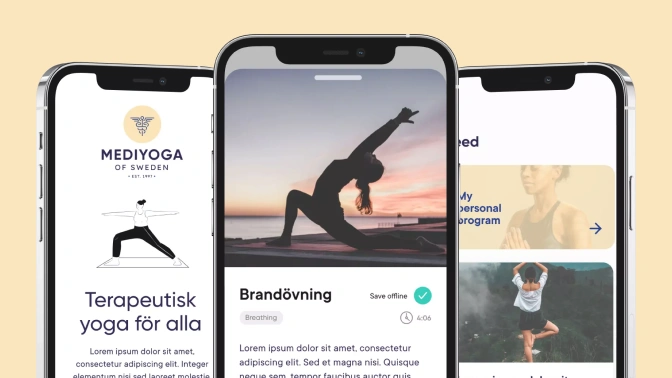
A state-of-the-art wellness and patient engagement platform built for Mediyoga, integrating guided care programs, health tracking, and provider-patient communication into a unified digital experience.
Designed for healthcare providers and researchers, the platform enhances early detection of neurological conditions
Operational Excellence
Tech Expertise
Consistent Commitment
Based on 43 Reviews
Patient engagement apps have become an essential tool for connecting patients with their doctors. These applications make it easier for patients to manage their health more efficiently and effectively, as…
Read Article →
Patient’s expectations are changing as healthcare does. Patients today expect more than occasional check-ins. They want real-time information, access to their data, and active participation in their treatment journey. Traditional…
Read Article →
Hospitals and clinics invest heavily in digital tools designed to keep patients connected between visits. Yet most off-the-shelf software falls short when workflows demand customization, EHR integration, and strict compliance.…
Read Article →A single-facility system covering scheduling, records, and billing typically takes 16 to 22 weeks. Multi-facility enterprise platforms run 24 to 36 weeks depending on integration count and compliance scope.
We build FHIR R4 integrations for Epic Hyperdrive, Oracle Health (Cerner), and athenahealth. For legacy environments, we build HL7 v2.x translation layers that convert ADT, ORM, and ORU messages to FHIR R4 resources in real time.
Yes. We build to current ONC HTI-1 requirements: FHIR R4 APIs with USCDI v3 data elements, SMART App Launch 2.0 authorization, and US Core IG 6.1.0. HIPAA access controls and audit logging are embedded from the architecture stage.
We deliver a data migration plan during discovery, covering schema mapping, data validation rules, transformation logic, and a phased cutover approach that maintains a parallel-run period before full cutover.
Yes. Patient-facing portals are built as responsive web applications accessible on mobile and desktop, supporting digital intake forms, appointment self-scheduling, results access, and secure messaging.
Full source code, deployment configuration, API documentation, and data model documentation are delivered at project close. You hold complete intellectual property rights with no ongoing license dependency on Citrusbug.
Yes. Multi-facility deployments are supported with facility-specific scheduling rules, role-based access by location, shared patient records across facilities, and consolidated reporting across the network.
Post-launch L1/L2/L3 SLA support tiers are available. L1 covers critical incident response, L2 covers operational issues, L3 covers engineering-level changes. Response time commitments are defined in the engagement agreement.