






















Let’s Talk
HEALTHCARE SERVICES

Telehealth Platform Development Engineered to Last

Citrusbug builds telehealth platforms for health systems, digital health startups, and provider networks that need virtual care infrastructure to keep working when Medicare rules lapse, DEA prescribing flexibilities shift, or a state changes its licensure requirements mid-year.

Hero Image
98%
Client Retention
4.7
Rated on Clutch

Certifications

HIPAA HIPAA
SOC 2 SOC 2
HITRUST CSF HITRUST CSF
ISO 27001 ISO 27001

Trusted By Industry Leaders

Bosch
Deloitte
eClinicalWorks
Epic Systems
Flipkart
McKinsey
HSBC
Softbank
Allianz
Airbnb
United Health
Phelic
Sun Pharma
Target
US Foods
Advinow

Certifications and Accreditations

The Compliance Layer Most Telehealth Builds Get Wrong


Most telehealth platforms are built against the rules that exist on the day the contract is signed. Originating site restrictions, audio-only visit eligibility, and DEA prescribing authority get hardcoded into the workflow logic because that's faster to ship. Then the rules change, as they did twice between October 2025 and February 2026 when Medicare telehealth flexibilities lapsed and were retroactively restored, and every one of those hardcoded checks becomes a support ticket.

That's not a compliance footnote. It's an architecture decision that determines whether your platform needs an engineering sprint every time Congress or the DEA moves a deadline, or whether an admin updates a rule set and the platform adapts on its own.

Whether a patient’s home qualifies as a covered origination point changes by payer, state, and sometimes by month. We model this as configurable data, not conditional statements buried in the booking flow.

Some services qualify for audio-only reimbursement, others require video, and the list shifts with each CMS rule cycle. The eligibility check needs to be editable without a deploy.

The current DEA extension permits Schedule II-V prescribing via audio-video telemedicine through December 31, 2026, with narrower audio-only allowances for opioid use disorder treatment. Prescribing workflows need to enforce whichever ruleset applies to that prescriber and that visit type.

A provider licensed in one state can’t automatically see a patient in another. Platforms that hardcode a single-state assumption break the moment a practice expands.

Ready to see how this holds up under your workflows?

Walk through your current telehealth setup with an engineer, not a salesperson.

Book a Platform Review

What a Telehealth Platform Actually Needs to Run

Video Consultation Infrastructure

  • Low-latency audio and video built on WebRTC-based infrastructure (Twilio, Vonage, Daily.co, or Agora, depending on your scale and cost profile), not a custom-built streaming stack that becomes a maintenance burden years later.

EHR & Practice Management Integration

  • Bidirectional data exchange with Epic, athenahealth, and other systems via FHIR R4/R4B and HL7, so visit notes, orders, and history flow without a second login.

Remote Patient Monitoring Ingestion

  • Continuous vitals data from connected devices routed into clinician dashboards with threshold-based alerting, not just a raw data dump nobody reviews.

E-Prescribing With DEA EPCS

  • NCPDP SCRIPT-based prescribing with DEA-compliant electronic prescribing for controlled substances built in from day one, not bolted on after a compliance audit flags it.

Asynchronous & Store-and-Forward Care

  • Not every visit needs to be live. Image-based dermatology consults, pre-visit questionnaires, and follow-up messaging reduce scheduling pressure on both sides.

Scheduling & Automated Reminders

  • Appointment booking, rescheduling, and no-show reduction through automated reminders tuned to the patient population, not a generic calendar widget.

Built Against Standards That Actually Get Audited

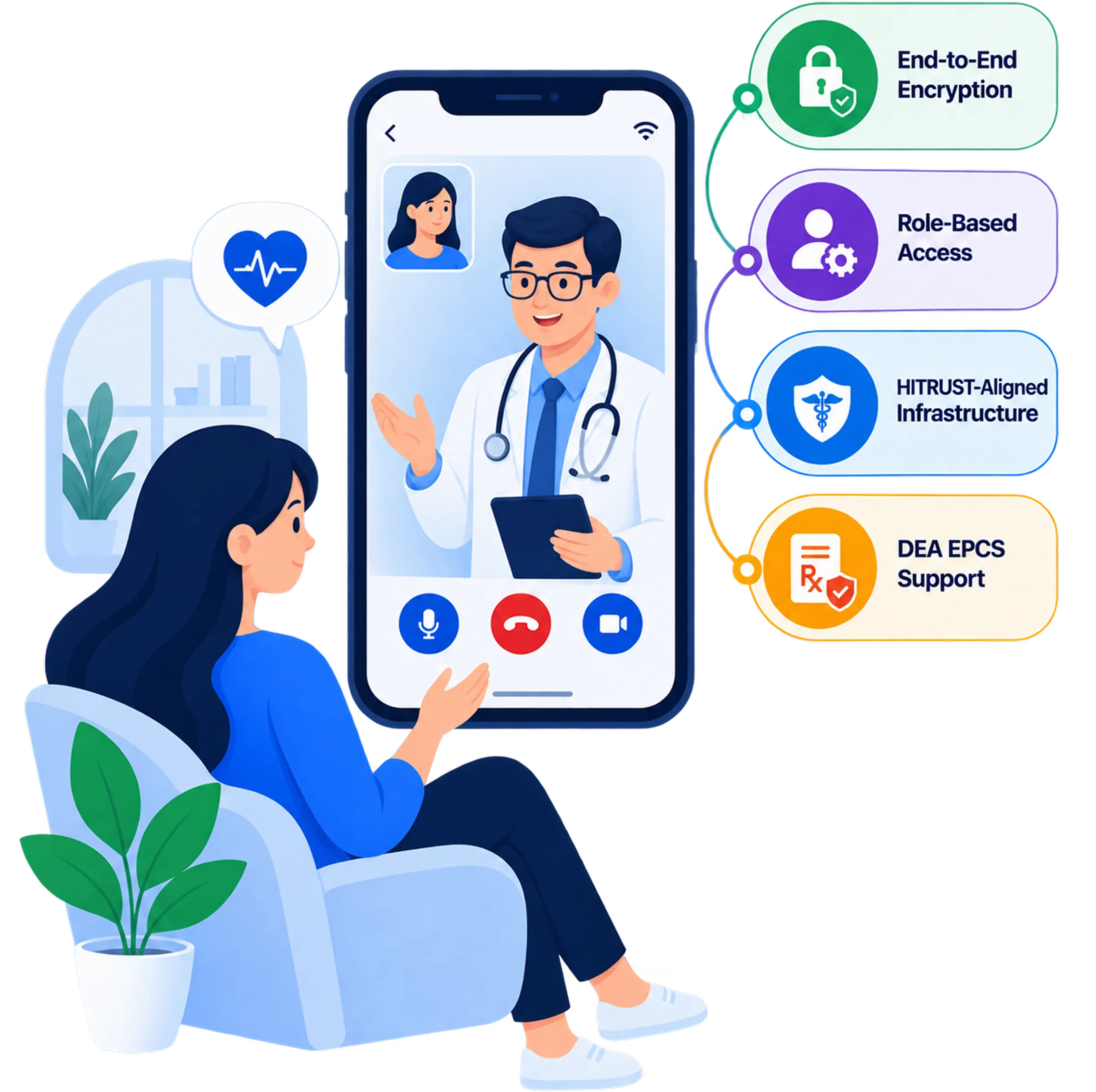
Telehealth platforms carry PHI across more surfaces than most healthcare software, video, chat, monitoring data, and prescribing records, which means the compliance architecture has to cover each surface individually rather than treating "HIPAA compliant" as one checkbox.

icon End-to-end encryption for video, messaging, and stored PHI icon Role-based access control with session-level audit trails icon HITRUST CSF-aligned infrastructure for enterprise buyers who require it icon DEA EPCS certification support for controlled-substance prescribing workflows
How We Build and Ship Your Telehealth Platform

1

Discovery & Rules Mapping

We map your specific compliance surface before writing code: which states you operate in, which payers you bill, whether controlled-substance prescribing is in scope, and which EHR you need to talk to. This becomes the configuration layer, not an afterthought bolted on post-launch.

2

Architecture & Compliance Design

We design the video, data, and integration layers alongside the rules engine that will hold your eligibility and reimbursement logic, so compliance changes later are configuration updates, not code changes.

3

EHR & Device Integration Build

Integration work happens early, not at the end, because EHR and RPM device connections surface the hardest edge cases. Waiting until launch week to discover an interoperability gap is the most common cause of slipped timelines we see.

4

Agile Development in Secure Sprints

Development runs in two-week sprints with working builds reviewed regularly, so scope drift gets caught before it becomes a rewrite.

5

Compliance Validation & Testing

Security testing, HIPAA safeguard verification, and DEA EPCS certification steps run in parallel with QA, not as a separate phase that adds months at the end.

6

Deployment & Post-Launch Monitoring

We deploy with monitoring in place from day one, so a spike in dropped video sessions or a failed EHR sync gets caught before patients notice.

How a Multi-State Behavioral Health Network Approached Telehealth Platform Development

We worked with a multi-state behavioral health provider to rebuild the compliance logic sitting underneath their video and scheduling layers, replacing rules that had been hardcoded per state with a configurable eligibility and prescribing engine that a compliance lead could update directly.

  • Check Icon

    Multi-state eligibility rules rebuilt as configuration, not code

  • Check Icon

    DEA prescribing logic isolated from state licensing checks

  • Check Icon

    Existing EHR integration carried through the rebuild without disruption

  • Check Icon

    Rules engine designed to absorb future CMS and DEA policy changes without a redeploy

Client Testimonials (We're Rated 4.7 on Clutch)

Where This Telehealth Platform Development Approach Fits

Multi-Specialty Virtual Consultation Platforms
Remote Chronic Disease Monitoring Systems
AI-Assisted Behavioral Health Platforms
Hospital-to-Home Care Delivery Solutions
Urgent Care Virtual Triage Systems
Second-Opinion Specialist Consult Networks

What Goes Into the Platform Architecture

Most vendors will show you a features list. What actually determines whether the platform survives its second year is the layer underneath the features, specifically whether compliance and reimbursement logic live as configurable rules or as scattered conditionals across the codebase.

Video & Streaming Layer

Video & Streaming Layer

Built on a WebRTC-based provider rather than custom infrastructure, giving you enterprise-grade reliability without owning the maintenance burden of a video stack.

Compliance Rules Engine

Compliance Rules Engine

Originating site, audio-only eligibility, and DEA prescribing rules live as editable configuration, not hardcoded logic, so policy changes are admin updates.

EHR & RPM Integration Layer

EHR & RPM Integration Layer

FHIR-based connectors to EHR systems and device APIs for continuous monitoring data, designed to avoid the vendor lock-in that comes from proprietary integration formats.

Identity & Access Layer

Identity & Access Layer

Role-based access spanning patients, providers, and administrative staff, with API contracts clean enough that adding a new payer integration doesn't touch unrelated modules.

Why This Matters Beyond the Engineering Team

A telehealth platform that hardcodes today's reimbursement rules isn't just a technical liability, it's a business risk every time a policy deadline approaches. When Medicare's telehealth flexibilities lapsed twice within five months, providers running rigid platforms faced real revenue exposure while their patients lost access to covered visits. The platforms that kept billing cleanly were the ones where eligibility logic could be updated in an afternoon.

Enterprise
Fewer denied claims from stale eligibility logic
Enterprise
Faster response to state-by-state licensure changes
Enterprise
Reduced dependence on engineering for compliance updates
Enterprise
Lower risk exposure during federal policy transitions

How Much Does It Cost to Develop a Telehealth Platform?

Costs typically range from $30,000 for a focused MVP to $100,000+ for a fully integrated, multi-state enterprise platform, depending on integrations, compliance scope, and prescribing requirements.


    Your data and info stays secure. Read our Privacy Policy.


    Choose the Scope That Matches Where You Are

    MVP Validation

    MVP Validation

    Core video visits, scheduling, and basic EHR sync to validate the model before scaling.

    • Single-state compliance scope
    • One EHR integration
    • 8-12 week delivery
    Core Platform Build

    Core Platform Build

    Full platform with RPM ingestion, e-prescribing, and the configurable compliance rules engine.

    • Multi-state ready
    • EHR + device integrations
    • 4-6 month delivery
    Enterprise Ecosystem

    Enterprise Ecosystem

    Multi-specialty platform with payer integrations, advanced analytics, and dedicated compliance tooling.

    • Full compliance rules engine
    • Multiple payer + EHR integrations
    • 9+ month delivery

    The Cost of Delaying Telehealth Platform Development Isn't Just Revenue

    Every quarter you delay telehealth platform development is a quarter your competitors capture patients who already prefer virtual visits for routine and follow-up care. Waiting for reimbursement rules to feel permanent has never worked, since federal telehealth policy has shifted on a near-annual cycle since 2020.

    The providers who built with adaptable compliance logic didn’t wait for stability. They built for volatility instead, and their platforms have carried them through two Medicare telehealth lapses without a single emergency deployment.

    Why Health Systems Choose Citrusbug

    Compliance as Configuration

    Compliance as Configuration

    We build eligibility and prescribing rules as editable data, so a DEA or CMS policy change is a configuration update, not a development ticket.

    Discovery Before Code

    Discovery Before Code

    Requirements, compliance mapping, and integration scope get documented before a single sprint starts, cutting the rework that comes from surprises mid-build.

    Full Source Ownership

    Full Source Ownership

    You get complete source code and documentation at delivery. No dependency on us to make future changes.

    Stalled Project Recovery

    Stalled Project Recovery

    We regularly take over telehealth builds that stalled with another vendor and get them to launch without a full restart.

    Latest Insights on Healthcare & AI

    VIEW ALL
    Different Types of AI in Healthcare: Technologies, Use Cases & Benefits
    Different Types of AI in Healthcare: Technologies, Use Cases & Benefits Artificial Intelligence

    Different Types of AI in Healthcare: Technologies, Use Cases & Benefits

    Artificial Intelligence (AI) is rapidly changing how healthcare is delivered and managed. From enhancing diagnostic accuracy to automating time-consuming administrative tasks, AI technologies are increasingly being woven into the fabric…

    Read Article →
    Custom NLP Solutions for Healthcare: Revolutionizing Patient Interaction
    Custom NLP Solutions for Healthcare: Revolutionizing Patient Interaction Artificial Intelligence

    Custom NLP Solutions for Healthcare: Revolutionizing Patient Interaction

    The healthcare sector is changing quickly in order to streamline and expedite operations. People have noticed significant changes in the healthcare industry since NLP was introduced. AI software development makes…

    Read Article →
    Healthcare Cloud Computing Market Statistics And Growth Outlook 2026
    Healthcare Cloud Computing Market Statistics And Growth Outlook 2026 Custom Software Development

    Healthcare Cloud Computing Market Statistics And Growth Outlook 2026

    Introduction Healthcare is deep into a cloud-first decade, where digital transformation, data-driven decision-making, and scalable cloud platforms are reshaping how care is delivered and managed. Electronic health records, imaging, telehealth,…

    Read Article →

    FAQs About Telehealth Platform Development

    What does telehealth platform development cost?

    MVPs typically start around $30,000. Fully integrated, multi-state enterprise platforms with e-prescribing and RPM run $60,000 to $100,000+, depending on compliance and integration scope.

    How long does development take?

    An MVP takes 8-12 weeks. A core platform with EHR and device integrations runs 4-6 months. Enterprise, multi-specialty builds take 9+ months.

    Can the platform adapt when Medicare or DEA telehealth rules change?

    Yes, if it's built that way. We architect eligibility, originating site, and prescribing rules as configurable data specifically so policy shifts don't require a rebuild.

    Can it integrate with our existing EHR?

    Yes, through FHIR R4/R4B and HL7-based connectors to systems like Epic and athenahealth, so records, orders, and visit notes sync without duplicate entry.

    Do you support DEA e-prescribing for controlled substances?

    Yes. We build NCPDP SCRIPT-based e-prescribing with DEA EPCS support, aligned with current prescribing flexibilities for audio-video and, where applicable, audio-only visits.

    Can we operate across multiple states with different licensure rules?

    Yes. Interstate licensure and per-state eligibility logic get built into the compliance rules engine rather than assumed as a single-state model.

    Can you take over a telehealth build that stalled with another vendor?

    Yes, this comes up often. We audit the existing codebase and compliance gaps first, then decide what to keep versus rebuild, rather than starting over by default.

    What happens after launch?

    We offer L1/L2/L3 support options post-launch, including monitoring for compliance rule updates as federal and state policy shifts occur.

    Build a Telehealth Platform That Doesn't Break When the Rules Do

    Talk to an engineer about your compliance scope, your EHR, and what your platform needs to survive the next policy cycle.