
 Back
Back








Key Takeaways
- The global financial automation market reached $8.91 billion in 2024, projected to grow at a 14.2% CAGR through 2032.
- More than 80% of banks have adopted robotic process automation for back-office operations like reconciliation and compliance monitoring.
- Compliance automation is the fastest-growing AI finance application, projected to grow at a 35.7% CAGR due to tightening global regulations.
- BFSI accounts for 48% of financial automation demand, driven by transaction volume and continuous regulatory requirements.
- 92% of finance leaders associate RPA adoption with business growth, reflecting near-universal institutional confidence in automation.
Financial institutions and enterprises are actively replacing manual financial processes with technology-driven systems. The financial automation market has advanced from early-stage experimentation into a mainstream investment priority, with automation programs now embedded in the operating plans of organizations across banking, insurance, and enterprise finance.
This transformation is being driven by several factors, including rising transaction volumes that exceed the capacity of manual processes and increasingly stringent regulatory requirements that demand faster and more accurate financial reporting. It is also fuelled by proven efficiency improvements achieved by organizations that have successfully implemented automation at scale. Technologies such as robotic process automation (RPA), intelligent process automation (IPA), and artificial intelligence (AI) are at the forefront of this change, reshaping functions across finance from accounts payable and receivable to regulatory compliance and reporting.
The market data confirms a sector growing steadily in scale, pace, and geographic reach across distinct technology categories and enterprise segments.
What is Financial Automation?
Financial automation uses technologies such as AI, machine learning, and robotic process automation to carry out financial tasks, including invoice processing, payroll management, compliance reporting, fraud detection, and cash flow monitoring, with minimal manual involvement. It replaces repetitive, high-volume steps with structured digital workflows.
It matters because financial operations are data-intensive environments where manual errors are costly, processing delays create downstream compliance risk, and skilled staff time is routinely consumed by work that automated systems can perform reliably at scale. Automation addresses these structural inefficiencies directly and consistently.
Financial Automation Market Size and Segment Overview
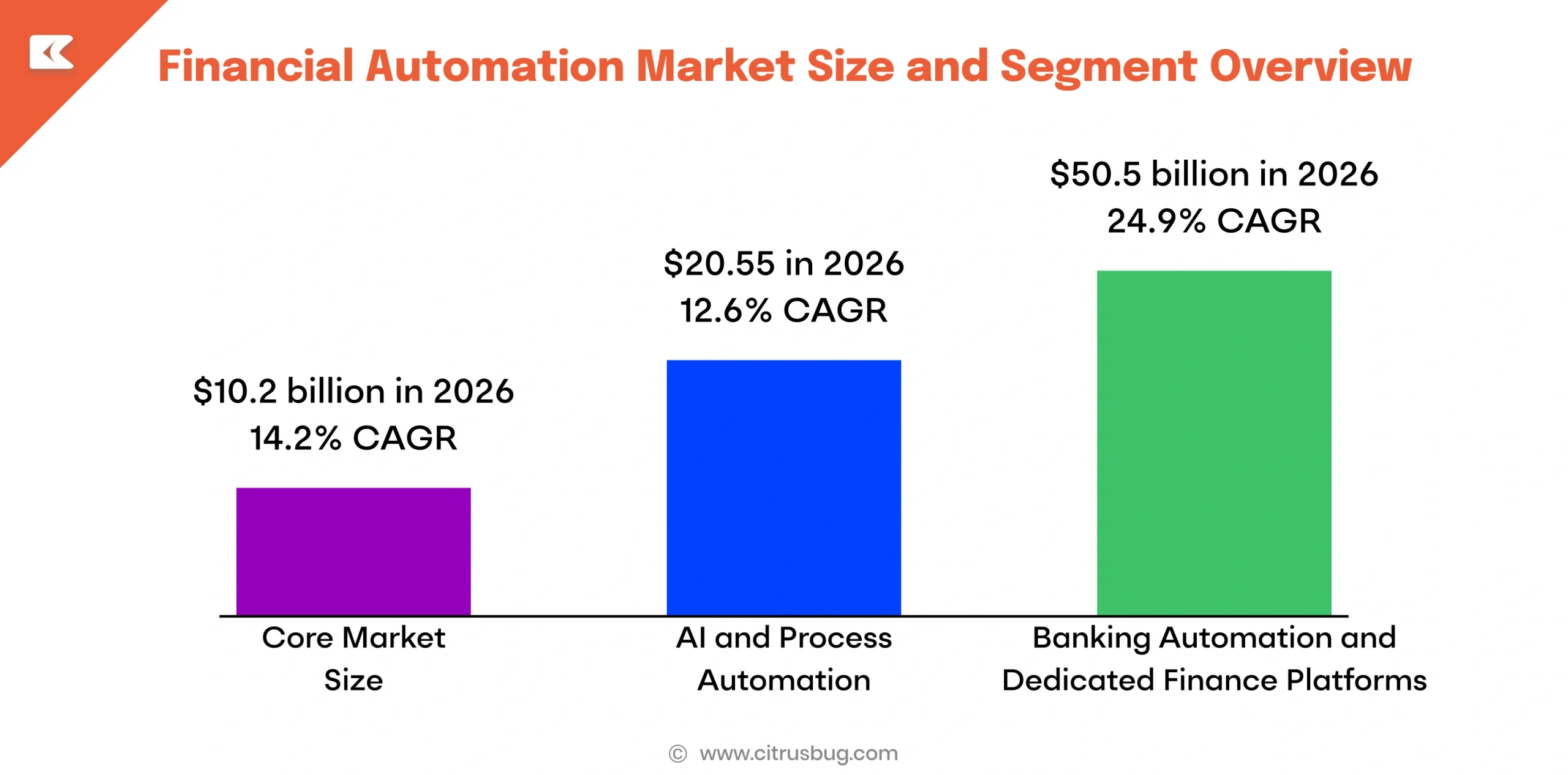
This market encompasses multiple technology layers, each addressing a distinct part of how financial tasks are executed at enterprise scale. To understand its full scope, it is necessary to look across the core automation segment, the AI-driven layer, and the banking-specific platforms that together define the investment landscape shaping this space in 2026.
Core Market Size and Growth Rate
The headline figures establish both the current scale of the market and the pace at which it continues to expand across enterprise sectors globally.
- The global market was valued at USD 8.91 billion in 2024. This scale reflects sustained enterprise investment across automated accounting, compliance, and payment processing functions within financial services organizations worldwide.
- The market is projected to grow at a CAGR of 14.2% between 2024 and 2032, driven by enterprise demand for cost reduction, error minimization, and accelerating digital transformation across financial services organizations.
- The financial process automation segment was valued at USD 10.2 billion in 2026. This figure confirms that enterprises have moved past pilot-stage deployments and are now actively scaling automated financial workflow platforms across multiple finance functions.
AI and Process Automation Technology Segments
Each automation technology category carries its own valuation and growth profile within the broader financial services ecosystem, driven by the specific workflow demands institutions are prioritizing for automation.
- The AI in finance market was valued at USD 38.36 billion in 2024, anchored by demand for real-time financial analytics, AI-powered risk management, and automated decision-support capabilities across global banking and capital markets operations.
- Robotic process automation in financial services reached USD 5.138 billion in 2024, with adoption concentrated in high-volume back-office functions including data reconciliation, transaction processing, KYC workflows, and regulatory reporting.
- The intelligent process automation market was valued at USD 20.55 billion in 2026. This valuation reflects the institutional shift from rule-based automation toward AI-integrated cognitive platforms capable of handling complex, exception-heavy financial processes.
Banking Automation and Dedicated Finance Platforms
Banking represents one of the highest-concentration investment areas within the broader automation ecosystem, with purpose-built AI platforms commanding substantial standalone market value on their own.
- The AI and automation in banking market totaled USD 42.64 billion in 2025, driven by rapid AI integration across risk monitoring, loan processing, customer operations, and compliance functions within financial institutions across all major markets.
How Financial Institutions Are Adopting Automation
Adoption of financial automation has moved well beyond selective early-mover programs. Banks, insurers, and enterprise finance teams are now expanding automation from isolated departmental deployments into enterprise-wide operational frameworks. Both the rates of active deployment and leadership confidence metrics confirm that the adoption curve remains well above its historical baseline.
Industry Commitment and Investment Plans
Finance organizations are translating confidence in automation into concrete forward investment, and the signals from leadership show that the adoption curve has not yet reached saturation even among organizations running active programs.
- 65% of finance firms reported plans to increase automation investment in 2025. Even organizations already running automation programs are prioritizing further expansion rather than simply sustaining current deployments.
- 92% of finance leaders associate RPA adoption with business growth, a figure that demonstrates near-universal institutional confidence in automation’s ability to improve financial operations and organizational performance.
- Approximately 36% of tasks in banking and capital markets were identified as automatable as of 2024. A significant share of current financial workflows still remains open for further digitization and sustained long-term investment.
(Source)
Active Deployment Rates Across the Sector
The scale of current active deployment confirms that automation investment has produced operational outcomes rather than remaining at the planning or pilot stage across most financial organizations.
- More than 80% of banks have adopted robotic process automation for back-office operations, handling repetitive financial tasks with continuous system availability and materially reducing the manual workload across reconciliation, compliance monitoring, and reporting.
- Over 65% of financial institutions were integrating at least one AI-driven automation tool in 2025, compared to only 38% in 2020. This gap illustrates the rapid and consistent acceleration of adoption across the sector over just five years.
- Intelligent automation accounted for 81.2% of the AI and automation in banking industry in 2025. AI-powered systems have overtaken legacy rule-based platforms as the dominant automation deployment model within financial institutions globally.
Key Trends in the Financial Automation Market
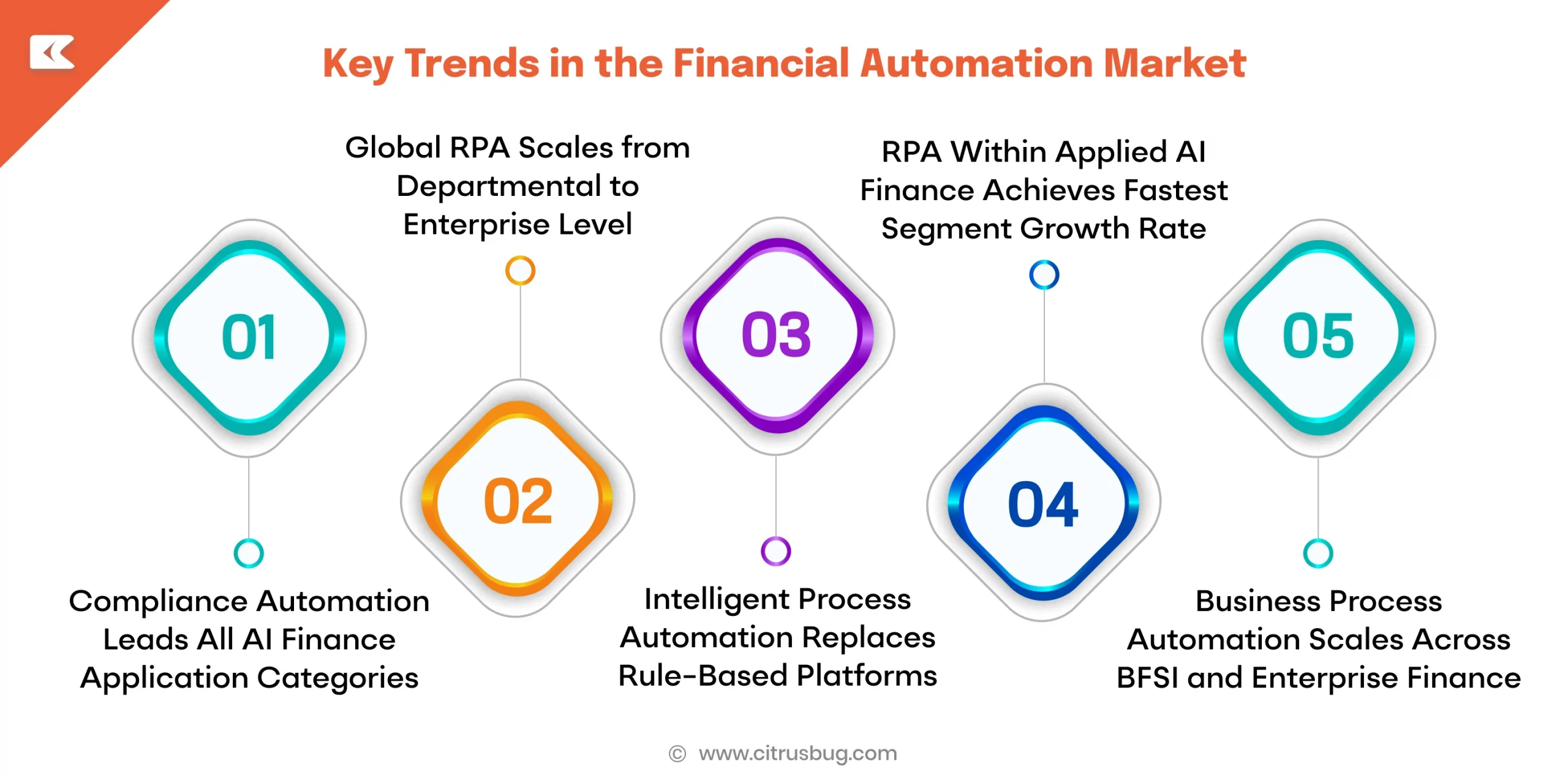
Several technology-level trends are defining where investment is concentrating and which capabilities are growing fastest across this rapidly evolving space. Each one reflects a structural change in how financial institutions are building and expanding their automation systems beyond initial deployments.
Compliance Automation Leads All AI Finance Application Categories
Regulatory complexity is producing the most rapid growth trajectory within the entire AI in finance ecosystem, with institutions prioritizing automated systems to manage audit trails, regulatory filings, and real-time risk monitoring at scale.
Compliance automation platforms are expected to grow at a CAGR of 35.7% within the AI in finance market. This is the highest growth rate across all application categories. The pace reflects how stricter global regulations are actively reshaping finance operations, as institutions move to automate reporting and compliance processes rather than relying on manual checks that introduce delays and material risk.
Global RPA Scales from Departmental to Enterprise Level
Robotic process automation is expanding from early finance department deployments into enterprise-wide operational infrastructure, with financial services remaining the primary vertical driving sustained growth.
The global RPA market is projected to grow at a CAGR of 19.10% from 2026 to 2034 as organizations embed automation across finance, HR, and operations rather than containing it within isolated departments. Financial services remains the highest-concentration deployment area, but cross-function expansion is widening the addressable opportunity for platforms with finance automation at their foundation.
Intelligent Process Automation Replaces Rule-Based Platforms
Financial institutions are advancing beyond basic RPA toward cognitive automation that handles tasks requiring interpretation, pattern recognition, and judgment-based decision-making, areas where traditional rule-based systems fall short.
The intelligent process automation market is forecast to grow at a CAGR of 12.6% from 2025 to 2033, as demand grows for systems that process unstructured data, adapt to process variations, and manage exceptions in accounts payable, credit analysis, and fraud detection workflows. This transition expands the range of automatable financial tasks well beyond structured data processing.
RPA Within Applied AI Finance Achieves Fastest Segment Growth Rate
Among all technology categories within applied AI finance frameworks, RPA is the single highest-growth segment. This positions it as the core technology integration within AI-first financial platforms going forward.
The RPA segment in applied AI in finance is expected to grow at the fastest rate of 17.9% CAGR, driven by its ability to automate structured, high-volume financial tasks across banking, insurance, and investment operations where transaction volumes are high and process consistency is critical for regulatory compliance.
Business Process Automation Scales Across BFSI and Enterprise Finance
Broad BPA platforms are gaining sustained traction within financial services as organizations pursue end-to-end workflow digitization rather than isolated task-level automation within a single system or department.
Business process automation is forecast to grow at a CAGR of 15.4% through 2030, with BFSI and enterprise finance functions representing major demand segments. Organizations are increasingly selecting BPA platforms for their capacity to integrate financial workflows end to end across accounting, procurement, and reporting.
Market Segmentation Overview
Demand for financial automation is distributed unevenly across industry verticals, enterprise sizes, deployment models, and application categories. These patterns reflect the structural differences in purchasing behavior and operational requirements of the primary buyer groups that shape where and how this market grows.
BFSI as the Dominant Industry Vertical
Banking, financial services, and insurance organizations generate the largest share of financial automation demand, and their position in the market reflects operational necessity as much as strategic investment priority.
The BFSI sector accounts for 48% of the financial automation market in 2024, driven by the volume and complexity of financial transactions, continuous regulatory requirements, and the critical need for automated fraud detection, compliance monitoring, and payment processing systems. Financial institutions operating at this scale treat automation as a structural requirement rather than a discretionary upgrade.
Large Enterprise Concentration
Enterprise organizations dominate financial automation spending, with large-scale deployments concentrated heavily at the top of the organization size distribution across all automation categories.
Large enterprises hold a 63% market share in financial automation in 2024, supported by their capacity for end-to-end workflow automation, multi-region compliance systems, and integrated real-time financial reporting infrastructure.
Deployment Model Preferences
On-premise deployment continues to hold the majority position in financial automation, particularly among large organizations with data sovereignty requirements and deep legacy system integration needs.
On-premise BPA software is expected to account for 54.20% of total BPA market revenue in 2025, driven by large enterprises’ preference for direct data control and tight integration with existing ERP infrastructure.
The overall business process automation market was valued at USD 17.1 billion in 2025. This confirms broad enterprise adoption of BPA platforms across finance, HR, and operations functions for workflow optimization. Cloud-based alternatives are growing faster and will gradually rebalance this split, but on-premise solutions continue to serve the critical needs of heavily regulated financial organizations.
Leading Application Segments
Specific application categories attract disproportionate investment due to their direct connection to risk management, compliance enforcement, and foundational finance function automation.
Fraud detection and prevention lead the applied AI in the finance market with a 32% share in 2025. This reflects high institutional urgency around real-time anomaly detection and financial crime mitigation tools. Core financial management applications, which automate billing, accounting, and cash management, were valued at USD 7.24 billion in 2024. This scale confirms the depth of investment in foundational finance function automation across enterprise organizations worldwide.
Regional Market Share and Growth Insights
The global financial services automation software market demonstrates strong regional variations in adoption and growth, reflecting differences in digital maturity, regulatory environments, and financial infrastructure. The market was valued at USD 14.5 billion in 2025 and is projected to reach USD 33.78 billion by 2032, growing at a CAGR of 12.85%.
North America
- North America was the largest regional market in 2025, generating approximately USD 6.12 billion in revenue and accounting for 42.19% of the global market share. The region benefited from advanced technological infrastructure and the strong presence of leading financial institutions. Significant investments in AI, robotic process automation (RPA), and cloud-based financial solutions continued to support market growth across the United States and Canada.
Europe
- Europe accounted for 28.00% of global revenue in 2025, with a market value of approximately USD 4.06 billion. The region’s growth was largely driven by stringent regulatory requirements and the increasing demand for automated compliance and reporting solutions. Financial institutions across countries such as Germany, the United Kingdom, and France adopted automation technologies to improve efficiency, transparency, and risk management.
Asia-Pacific
- Asia-Pacific accounted for 21.86% of the global market in 2025, generating approximately USD 3.17 billion in revenue. The region was positioned as the fastest-growing market due to rapid digital transformation, expanding fintech ecosystems, and increasing cloud adoption. Countries such as China, India, and Japan increasingly implemented financial automation tools to streamline operations and enhance customer experiences.
Latin America and Middle East & Africa
- Latin America accounted for approximately 4.97% of the global market in 2025, reaching USD 720.95 million in revenue. Meanwhile, the Middle East and Africa represented 2.97% of the market, with a value of approximately USD 430.65 million. Although these regions held smaller market shares, growing investments in digital banking, financial technology infrastructure, and modernization initiatives were expected to support steady market growth in the coming years.
(Source)
Factors Driving Financial Automation Adoption
Several structural forces are accelerating investment across every technology category within this space. Each factor adds consistent and compounding pressure on organizations to automate, sustaining demand well beyond any single technology cycle.
Rising Volume and Complexity of Financial Transactions
The number of transactions that banks and enterprises process has scaled well beyond what manual workflows can manage sustainably. As digital payments expand, cross-border transactions grow, and banking channels multiply, the volume of reconciliation, reporting, and verification requirements grows in proportion. Automation is the only operationally viable response to maintaining accuracy and throughput at this scale, and the pressure from transaction growth is not expected to ease.
Stricter Global Regulatory Requirements
Regulatory frameworks covering anti-money laundering, tax compliance, financial reporting, and data privacy have become more demanding across most major markets. Institutions face material penalties for late or inaccurate submissions and require consistent audit trails across every transaction processed. Automated compliance systems reduce manual error risk and allow organizations to meet reporting obligations on tighter timelines without expanding compliance teams at the same rate.
Cloud and SaaS Infrastructure Maturity
The maturity of cloud-based financial automation platforms has made enterprise-grade automation accessible to a broader range of organizations than in earlier adoption cycles. SaaS delivery models eliminate large upfront infrastructure costs and reduce deployment timelines significantly, bringing automation within reach for mid-market financial organizations that previously lacked the resources to build and maintain on-premise automation systems at scale.
Proven Outcomes Among Early Adopters
Organizations that deployed financial automation early have documented measurable reductions in processing costs, error rates, and cycle times across accounts payable, reconciliation, and compliance workflows. These results are widely referenced across the industry and actively influence the decisions of later adopters. The business case for automation has shifted from theoretical to verified, compressing internal approval timelines for new automation investment proposals.
Advances in AI and Machine Learning Capabilities
Improvements in machine learning, natural language processing, and predictive analytics have expanded the scope of what can be automated within financial operations. Tasks that previously required human judgment, including exception handling in accounts payable, fraud pattern detection, and credit risk scoring, can now be managed by AI-augmented automation systems. This capability expansion increases the addressable scope of the market and sustains long-term demand for increasingly sophisticated financial automation tools.
Future Outlook and Market Projections
This sector is positioned for sustained expansion across all major technology segments through 2032, with AI-first platforms, cloud-based deployments, and core financial management applications contributing to a significantly larger total addressable market over the next six years.
Market Forecast Through 2032
The overall market trajectory confirms continued growth well into the next decade, supported by maturing AI integration and broadening enterprise adoption across all major financial functions.
- The global financial automation market is forecast to reach USD 20.7 billion by 2032, driven by consistent enterprise-level adoption as AI integration matures and automation programs expand from individual functions into full financial operations coverage.
- Cloud-based financial automation deployments are projected to exceed USD 12.8 billion by 2032, as organizations migrate to scalable SaaS platforms that reduce infrastructure costs and accelerate deployment timelines across enterprise and mid-market segments.
AI-Driven Finance Segment Projections
The AI-powered layer of financial automation is forecast to grow at a significantly faster rate than the broader market, with long-term projections reflecting multi-fold expansion by the end of the decade across key sub-segments.
- The AI in finance market is projected to grow from USD 38.36 billion in 2024 to USD 190.33 billion by 2030 at a CAGR of 30.6%, driven by demand for real-time financial analytics, AI-native risk management, and personalized financial service infrastructure.
- The global accounts payable automation market is expected to reach USD 7.1 billion by 2030 at a CAGR of 12.5% from 2024 to 2030, as businesses prioritize invoice processing automation and supplier payment workflow digitization as core components of their finance transformation programs.
RPA and BPA Market Expansion
The adoption of robotic process automation (RPA) and business process automation (BPA) technologies continues to accelerate as financial institutions seek to improve efficiency, reduce operational costs, and enhance compliance management through intelligent automation.
- The global Robotic Process Automation (RPA) market is estimated at USD 6.04 billion in 2026 and is projected to reach USD 35.84 billion by 2033, growing at a CAGR of 29.0%. Financial institutions are increasingly adopting RPA to automate repetitive tasks such as transaction processing, account reconciliation, and regulatory reporting.
- Within the banking, financial services, and insurance (BFSI) sector, the RPA market generated USD 1.35 billion in 2025 and is expected to reach nearly USD 9.98 billion by 2033. This rapid growth reflects the industry’s focus on improving operational efficiency, reducing manual errors, and strengthening compliance management.
- The broader AI and automation in banking market is expected to reach USD 50.5 billion in 2026 and expand to USD 239.6 billion by 2033 at a CAGR of 24.9%. Banks and financial institutions are increasingly integrating AI-driven automation, intelligent document processing, and workflow management solutions to enhance customer experiences and support data-driven decision-making.
As organizations continue their digital transformation initiatives, RPA and BPA solutions are expected to play a critical role in modernizing financial operations, improving scalability, and enabling data-driven business processes across the global financial services industry.
Conclusion
The financial automation market is growing on a clear, data-backed trajectory, with adoption expanding across banking, insurance, and enterprise finance as organizations scale proven programs into full operational coverage. From compliance automation and RPA to AI-native platforms and core financial management applications, each segment is contributing its own momentum to a market that will continue expanding well through 2032.
For organizations building financial software solutions, these statistics provide a reliable benchmark for where demand is concentrating and what capabilities matter most to buyers. The data confirms that financial automation has become the standard operating model for competitive financial organizations globally.