
MARKETING

 Citrusbug Healthcare →
 ISO 27001
 SOC 2
SOC 2
 HIPAA
HIPAA
 GDPR-aligned
Trusted by industry leaders














Certifications and Accreditations


Before any code gets written, we test whether generative AI is actually the right tool for your problem, mapping data readiness, integration points, and a realistic cost-per-outcome so the build starts from evidence, not enthusiasm.
Our engineers build knowledge assistants, AI agents, copilots, and document intelligence systems from validated requirements through to a production deployment your team can actually operate and extend.
We connect whichever model fits the use case, proprietary or open-weight, into your existing applications and data sources, so it becomes part of your product instead of a separate tool bolted onto the side.
Model accuracy, response latency, and inference cost all get tuned against your actual traffic patterns, not a benchmark dataset that looks nothing like your production load.
Have a generative AI use case in mind but need to validate the right approach, architecture, or model strategy? Talk with our team to assess feasibility, define the scope, and identify the best path from proof of concept to production.
Schedule a Free 30-Min CallGenerative AI can produce an impressive proof of concept long before the underlying system is ready for real users. A chatbot may work against a curated dataset, but production introduces harder questions around data pipelines, security, access controls, evaluation, latency, inference costs, and ongoing monitoring.
Research from MIT’s NANDA initiative found that 95% of enterprise generative AI pilots failed to deliver measurable returns. The challenge is rarely getting a model to generate an answer. It is engineering the surrounding system so that the AI delivers reliable results within the organization’s operational, security, and cost requirements.
That means production readiness has to be considered from the beginning. Data needs to be structured for retrieval, outputs need measurable evaluation criteria, permissions need to follow existing access policies, and the architecture needs to support monitoring and iteration after launch.
Generative AI development services span more than plugging in an API key. These are the technical capabilities that separate a production system from a weekend demo.
We integrate GPT-5, Claude, Gemini 3, and open-weight models like Llama 4 into your existing stack, choosing per use case on latency, cost per inference, and data residency rather than defaulting to one vendor.
Our retrieval-augmented generation pipelines index your documents into a vector database and ground every response in your own data, cutting hallucination rate and giving compliance teams a traceable source for each answer.
When a base model’s tone or domain accuracy isn’t enough, we fine-tune on your data or engineer structured prompts, whichever gets you to production faster without overfitting the budget.
We build agent systems that hand off tasks, call your internal APIs, and escalate to a human when confidence drops, instead of one monolithic prompt trying to do everything at once.
API contracts, authentication, and data flow between the model and your existing systems get designed as a first-class part of the architecture, not an afterthought bolted on post-launch.
Every model we ship carries an evaluation framework tracking accuracy, cost, and drift after launch, because a model that scored well in testing can still degrade once real traffic hits it.
A production-ready build looks different from a pilot. It has a data pipeline that can handle real traffic, not a curated demo set. It has an evaluation framework that catches drift before a customer does. And it has governance controls that were part of the design, not a patch applied after a security review. Citrusbug tests feasibility first, then builds toward all three from day one.
Real production traffic looks nothing like a curated test set. We design ingestion, storage, and access controls for the data volume and sensitivity your generative AI system will actually see once it’s live.
Accuracy, hallucination rate, and cost per query get measured against thresholds you approve before launch, with structured generative AI integration points that flag drift automatically rather than waiting for a complaint.
Role-based permissions, audit trails, and human-approval checkpoints get built into the workflow itself, so a compliance review doesn’t turn into a redesign six weeks before launch.
Your engineers get the source code, the documentation, and a walkthrough of every decision we made, so the system is something your team owns and can extend, not a black box you’re stuck calling us about.


Customer records feed the model context in real time through secure connectors, monitored with the same MLOps practices that keep your other production systems stable.
We work with schemas that predate your current team, mapping fields and business logic before any data reaches the model.
SharePoint, Confluence, and file shares get indexed into a retrieval layer so answers are grounded in what your team actually wrote down.
Authentication, role-based access, and deployment run through your existing AWS, Azure, or GCP setup rather than a parallel environment nobody else can see.
Agents that take action, not just answer questions. They call your internal tools through AI agents, complete multi-step tasks, and escalate to a human when confidence drops below your threshold.
Tags: Tool Calling, Multi-Step Tasks, Human Escalation
Retrieval-grounded assistants that answer from your actual documents and data, not the model’s training set, with citations your team can verify in seconds.
Tags: Enterprise Search, Source Grounding, Citation Tracking
Generative AI built directly into the product your customers or employees already use, so it feels like a feature, not a separate tool they have to remember to open.
Tags: In-Product AI, Contextual Suggestions, Embedded Workflows
Every generative AI system Citrusbug ships carries its own access controls, audit trail, and evaluation framework from the first integration, not bolted on after a compliance review flags a gap. Governance decisions get made during design, when they're still cheap to change.
Every generative AI build is different, but most projects fall into one of three shapes. Here's roughly what each one takes, so budget conversations start from a realistic range instead of a guess.
| Engagement Tier | What It Proves | Typical Timeline | Estimated Cost | Complexity |
|---|---|---|---|---|
|
Use-Case Validation & PoC |
Feasibility, data readiness, and a working proof of concept |
3–5 weeks |
$10,000–$30,000 |
Low |
|
MVP Build |
A production-ready pilot with real users and real data |
8–14 weeks |
$30,000–$80,000 |
Medium |
|
Production-Scale Deployment |
Full governance, multi-agent orchestration, enterprise integrations, and monitoring |
4–7 months |
$80,000–$150,000+ |
High |
Get a realistic estimate based on your use case, data, integrations, AI requirements, and project scope.
Share your details to get a tailored cost estimate.
Every stage produces something concrete your team can see and challenge, not a status update. Here's what actually happens between the first conversation and a system running in production.
Before any model gets selected, we test whether the problem you're describing actually needs generative AI or whether a simpler system would solve it faster and cheaper. This includes a data readiness check, a rough cost-per-outcome estimate, and a working proof of concept scoped to your real constraints, not a generic demo dataset that proves nothing about your production environment.
Most delays trace back to data, not the model. We map what data exists, where it lives, who's allowed to touch it, and what shape it needs to be in before a model can use it reliably. Access controls and data contracts get defined here, not discovered during a security review three weeks before launch.
We evaluate foundation models against your latency budget, inference cost, data residency requirements, and the task itself, choosing between GPT-5, Claude, Gemini, and open-weight options like Llama rather than defaulting to whichever model is trending. The architecture gets documented before a single integration begins.
Engineers build the model layer, the retrieval or fine-tuning pipeline, and the connectors into your existing systems in parallel, with working demos at the end of every sprint. You see progress weekly, not a black box that reappears two months later claiming to be finished.
Before anything reaches real users, we run structured evaluation against the accuracy and safety thresholds agreed at kickoff, testing for hallucination rate, edge cases, and failure modes a demo would never surface. Guardrails and human-approval checkpoints get built in here, not bolted on after something goes wrong.
The system goes live in stages, with monitoring for cost, latency, and output quality from the first real request. Your team gets the source code, full documentation, and a walkthrough of every architectural decision, so the system is something you own and can extend.
Their agile way of working, competence, and friendliness are impressive.December 7, 2024
Citrusbug Technolabs handles a data extraction project for an education company. They're also responsible for managing an AI generation project for the client.
Citrusbug Technolabs has laid out and followed a clear project outline and consistently met deadlines. The team communicates well and demonstrates a strong understanding of the client's vision and goals. Their agile approach, high level of competence, and personable approach stand out.
 Read More
Their communication and ability to capture exactly what I was asking for were impressive.November 14, 2024
Citrusbug Technolabs built an automated system for a veteran medical company. The system needed to collect and store user data, generate customized letters based on surveys, and use AI to summarize reviews.
Citrusbug Technolabs delivered a functional automated system that successfully organized the client's records and auto-generated statements. The team was quick to respond, addressed all roadblocks, and communicated effectively. Overall, their ability to understand the client's needs stood out.
Read More
They were very calm and talented, and they did bring some of their own ideas.January 28, 2025
Citrusbug Technolabs has developed an MVP for a freight and capacity marketplace. The team has created three different interfaces for three market segments.
Citrusbug Technolabs has successfully developed an effective MVP. The team has delivered the project on time and almost within budget. Moreover, their responses have been timely. Overall, the team has been calm, talented, and innovative. This has led to the client's satisfaction.
Read More
What stood out most about them was their personalized approach and sense of ownership in every aspect of the project."February 27, 2024
Citrusbug Technolabs built a Flutter cross-platform mobile app for an education company. They also developed two web apps and an admin panel and provided DevOps support for the client's infrastructure.
Citrusbug Technolabs' support successfully boosted the client's user engagement by 8x, resulting in an 85% retention rate. The reliable team demonstrated a dedication to delivering on time and promptly responding to concerns and adjustments. Their personalized, client-centric approach stood out.
Read More
They didn't like the phrase "impossible to do", which made them very solution-oriented.February 19, 2024
A healthcare company hired Citrusbug Technolabs to design and develop a user-friendly application. The team provided tailored assistance to meet the client's requirements.
Citrusbug Technolabs successfully delivered an application that was ready for market. The team was highly professional and well-organized; they stayed focused throughout the engagement and were receptive to changes. Overall, they stood out for their trustworthiness and commitment to excellence.
Read More
They're 100% on time and transparent throughout each stage of the project.February 24, 2024
A financial technology company has hired Citrusbug Technolabs to build a custom web application. The team handles the development and design of the app.
The project is ongoing, but the client has been satisfied with Citrusbug Technolabs' services. The team is very professional — they always respect timelines and provide regular updates to ensure everyone's on the same page. Also, their transparent approach makes them a trustworthy partner.
Read More
"I do believe they are exceptional at where they stand."
Citrusbug Technolabs took on a mobile app development project for a Singapore-based development house. They were provided with UX designs to execute. Currently, they're finalizing and fine-tuning the product.
Citrusbug Technolabs contributed to the successful launch of the product, which has garnered over 10,000 users in just three months. The product has also received support from investors. They consistently followed-up with their progress and delivered at a speedy rate. The team is truly stellar.
Read More

We test whether generative AI is actually the right tool before committing your budget to a full build, so you’re not paying for a pilot that was never going to reach production.

Access controls, audit trails, and evaluation frameworks get designed into the architecture from the first sprint, not patched in after a compliance review flags a gap nobody planned for.

Foundation models change fast. We architect the integration layer so a new GPT or Claude release doesn’t mean rebuilding your system, just updating one component of it.

We regularly take over generative AI pilots that proved the concept but never reached production, auditing what exists first so working parts of the build don’t get thrown out.

Every line of code, every model configuration, and full documentation transfer to you at delivery. Nothing about your generative AI system stays locked to us.

Inference cost and hosting get architected for your actual traffic from the start, not scaled up after the first bill makes clear the default setup was overbuilt.
 Artificial Intelligence
Imagine a world where computers not only assist us but also create unique content, generate stunning visuals, and even compose music. Sounds a little far-fetched, right? Understand then, that this…
Read Article →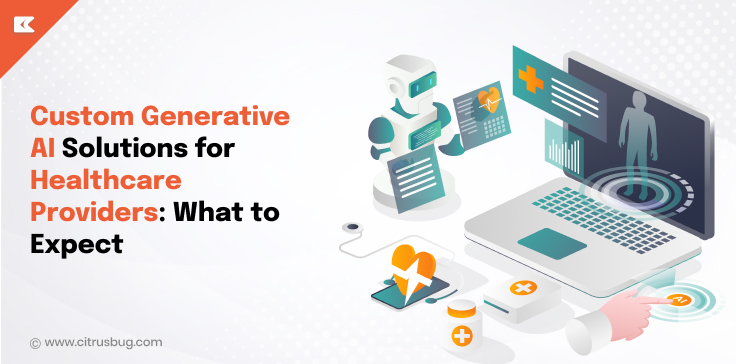 Artificial Intelligence
Artificial intelligence is a key factor driving the rapid transformation in the healthcare sector. AI has already had a discernible impact on everything from improving early diagnosis to expediting healthcare…
Read Article → Custom Software Development
The wealth management is changing rapidly. Clients demand tailored recommendations, live data, and smooth online experiences, whereas companies strive to enhance performance and cut expenses. Traditional systems struggle to keep…
Read Article →Most projects run 3-5 weeks for validation, 8-14 weeks for an MVP, and 4-7 months for a full production deployment with governance and enterprise integrations, depending on how much of your existing stack needs to change.
Cost depends on scope, data readiness, and how much of your existing stack needs to change. We size every engagement against a real scope during validation rather than quoting a number upfront.
Whichever fits the job. We build across GPT-5, Claude, Gemini 3, and open-weight options like Llama 4, and the choice comes out of the validation phase, not a standing preference for one vendor.
You get full source code ownership and documentation at delivery. Nothing stays locked in a vendor-only environment, and your team can extend or maintain the system without needing us in the room.
Yes. We regularly take over pilots that proved the concept but never reached production, auditing the existing build first so we don't rebuild what's already working.
Access controls, audit trails, and data handling get designed against your regulatory context from day one, whether that's HIPAA, GDPR, or EU AI Act obligations, rather than added after a compliance review.
A proof of concept proves the idea works on curated data. Production means a real data pipeline, evaluation framework, governance controls, and monitoring built to handle actual traffic and actual failure modes.
Yes, through post-launch SLA support options and continuous monitoring for cost, latency, and output quality, so drift gets caught before it becomes a customer-facing problem.


