



















Let’s Talk

Healthcare Business Intelligence Software That Turns Clinical Data Into Decisions

Most health systems are sitting on years of clinical, financial, and operational data. The problem is not the data. It is that it lives in EHRs, billing systems, lab platforms, and claims databases that do not talk to each other. We build custom healthcare business intelligence software that pulls this data together, structures it for analysis, and surfaces the insights your clinical and operations teams actually use.

500+
Projects Delivered
98%
Client Retention

Certifications

HIPAA Compliant HIPAA Compliant
HL7 / FHIR Compatible HL7 / FHIR Compatible
SOC 2 Type II SOC 2 Type II
ISO 27001 ISO 27001

Trusted Software Development Company By

Certifications and Accreditations

Core Capabilities of Our Healthcare BI Solutions

We develop healthcare business intelligence software that covers every layer of clinical, financial, and operational intelligence your organization needs to operate at scale.

Clinical Performance Analytics

Track quality metrics across care teams, facilities, and patient populations. We build dashboards aligned to CMS HEDIS measures, STAR ratings, and ACO performance targets so your clinical leads work from a single source of truth.

Predictive Risk Stratification

We integrate ML models trained on longitudinal EHR and claims data to identify high-risk patients before they escalate. Common targets- 30-day readmission risk, chronic disease progression, ED utilization prediction, and care gap identification.

Revenue Cycle Intelligence

Drill into the root causes, reimbursement patterns, payer mix performance, and AR aging across your RCM workflows. We link revenue cycle management systems data directly into the BI layer so finance and billing teams share the same operational picture.

Population Health Dashboards

Aggregate data across patient cohorts by diagnosis code, payer class, care setting, and social determinants. Our population health modules support value-based care programs, community health initiatives, and chronic disease management planning.

Operational and Staffing Analytics

Monitor bed utilization, staff productivity, OR throughput, and patient flow in real time. Decision-makers get the context to act on resource allocation before bottlenecks impact care delivery.

Financial and Cost-of-Care Analysis

We build cost-of-care models that segment expenses by DRG, service line, physician, and payer. Organizations use these to renegotiate contracts, reduce low-value care, and model financial scenarios before committing.

NLP-Powered Unstructured Data Analytics

Clinical notes, discharge summaries, and radiology reports hold critical insight that structured data misses. We apply fine-tuned NLP models to extract diagnoses, comorbidities, and sentiment from free text and route that data into BI pipelines.

Compliance and Audit Reporting

We generate audit-ready reports aligned to HIPAA, HITECH, ONC 21st Century Cures Act, and state-specific requirements. Role-based access control and PHI lineage tracking are built in from day one, not bolted on.

Ready to See What Your Healthcare Data Can Actually Do?

Talk to a BI specialist and get a scoped estimate for your use case.

Book a 30-Minute Call

The Real Problem Is Not Analytics - It Is the Data Foundation

Healthcare organizations do not lack data. They lack a usable version of it. Patient records exist in Epic or Cerner. Claims sit in a separate clearinghouse. Lab results feed from a different LIS. Scheduling data lives in a third system. None of these were built to share data, and none produce output in compatible formats.


Standard BI tools cannot resolve this on their own. They can visualize data, but they cannot fix fragmentation, enforce schema consistency, or reconcile conflicting patient identifiers across systems. A healthcare BI platform that works needs a data engineering layer underneath it,  ETL pipelines, a compliant data warehouse, FHIR-native data transformation, and governance controls that hold the whole structure together.


We build that foundation first, then build the analytics layer on top of it.

How We Architect Healthcare BI Software

Every BI engagement starts with a data architecture review. We map your source systems, identify integration points, and define the pipeline design before any dashboard is built. The result is a BI platform with a stable, compliant data core, not a visualization tool attached to a fragile ETL.

FHIR-Native Data Layer

We build FHIR R4-compliant data ingestion pipelines that extract clinical data from EHR systems including Epic, Cerner, and athenahealth, transform it into standardized resources, and load it into a central data warehouse. Terminology mapping covers SNOMED CT, LOINC, ICD-10, and CPT codes so clinical data is comparable across sources.

ETL and Data Pipeline Engineering

Our data engineering team builds automated ETL/ELT pipelines that handle ingestion from EHR/EMR systems, RCM platforms, claims clearinghouses, lab information systems, and patient engagement tools. We use medallion architecture (bronze, silver, gold layers) on AWS, Azure, or GCP to maintain data quality at every stage.

Compliant Data Warehouse and Lakehouse Design

We deploy HIPAA-compliant data warehouses using Snowflake, Azure Synapse, or Amazon Redshift, with Delta Lake for semi-structured clinical data. PHI is encrypted at rest and in transit, and all data access is logged for audit purposes. Our healthcare cloud management services team handles cloud configuration and cost optimization.

AI and ML Analytics Layer

We embed predictive and prescriptive analytics directly into the BI platform. Patient risk models run on XGBoost or PyTorch, NLP pipelines use BioBERT or Med-PaLM fine-tuning for clinical text, and agentic reporting agents can surface anomalies and generate narrative summaries on a schedule.

Role-Based Dashboards and Self-Service Reporting

Clinical leaders, finance teams, and compliance officers each get dashboards calibrated to their decision context. We configure self-service query tools, typically Power BI Embedded, Tableau Server, or a custom React-based dashboard layer, so teams can explore data without writing SQL.

Data Governance and PHI Lineage Tracking

We implement column-level data governance policies across every layer of the warehouse. PHI fields are tagged, masked by role, and traced from the ingestion source to the dashboard cell. Access logs, policy enforcement, and lineage metadata are queryable for compliance reviews and breach investigations.

From Data Audit to Production BI Platform

1

Discovery and Data Audit

We map your source systems, catalog available data assets, and assess data quality across EHR, billing, claims, and operational platforms. You get a written architecture recommendation and a scoped project plan before any code is written.

2

Data Pipeline and Warehouse Build

Our data engineers build FHIR-compliant ingestion pipelines, configure the data warehouse, and establish ETL processes for every source system in scope. We run data validation checks at each layer before moving to reporting.

3

Analytics and Dashboard Development

We build dashboards, KPI models, and predictive analytics modules against your defined use cases. Stakeholder reviews happen at regular intervals so final outputs match what your teams actually need, not what was assumed in the brief.

4

Compliance and Security Review

Every component passes a HIPAA compliance audit, penetration testing, and access control review before deployment. We produce compliance documentation your security and legal teams can use directly.

5

Deployment, Training, and Support Handover

We deploy to your chosen environment, cloud-native, on-prem, or hybrid, and conduct structured training sessions with your clinical, operations, and IT teams. L1/L2/L3 SLA support options are available for post-launch operations.

Integration Capabilities That Connect Your Full Data Ecosystem

Healthcare BI software is only as valuable as the data flowing into it. We build production-grade integrations with the systems your organization already runs, using HL7 v2, FHIR R4 APIs, and custom connectors for legacy platforms.

Our team assesses your existing ecosystem before any integration work begins, so the scope is defined accurately and surprises are avoided downstream.

EHR and EMR Systems

Direct integration with Epic, Cerner, athenahealth, eClinicalWorks, and other major platforms via FHIR R4 APIs and HL7 v2 feeds. Patient records, clinical workflows, lab results, and care team data flow into the BI layer on configurable refresh cycles.

Revenue Cycle and Billing Platforms

We connect RCM systems, billing clearinghouses, and accounts receivable platforms to surface financial KPIs alongside clinical data. Claim status, denial tracking, and reimbursement performance feed directly into the BI dashboards your finance teams use.

Claims and Payer Databases

Integration with CMS claims data, commercial payer feeds, and EDI 837/835 transaction sets allows population-level cost analysis, care gap identification, and value-based care performance tracking across your attributed patient panel.

Lab and Imaging Systems

We pull structured and unstructured results from LIS and PACS platforms into the central data warehouse. LOINC-coded lab values and DICOM metadata become queryable within the BI environment, supporting clinical outcome analysis and quality reporting.

How Much Does It Cost to Build Healthcare Business Intelligence Software?

Custom healthcare BI software typically ranges from $30,000 for a focused MVP with two to three integrations and core dashboards, to $150,000 or more for enterprise-scale platforms with AI analytics layers, multi-system data pipelines, and value-based care reporting modules. Discovery phase pricing and fixed-price delivery options are available. Share your requirements for a detailed estimate.


    Your data and info stays secure. Read our Privacy Policy.


    A Build Methodology Designed for Regulated Data Environments


    Healthcare BI development cannot follow a standard software sprint model. PHI governance, audit logging, and compliance validation have to be built into the engineering workflow itself, not treated as a final checkpoint before go-live.

    We follow a Secure ADLC (Agile Development Lifecycle) that embeds compliance controls at every stage. Every sprint has a security review checkpoint. Every data pipeline component is documented for HIPAA audit purposes before it ships. The result is a system your compliance and legal teams can sign off on without delays.

    Technologies and Platforms We Use

    LangChain
    Haystack
    OpenAI GPT-4
    Anthropic Claude
    OpenAI GPT-4
    Google Dialogflow
    Rasa
    Vapi.ai
    Azure Prompt flow
    DALL-E
    DALL-E
    Stable Diffusion
    Stable Diffusion
    TensorFlow
    Hugging Face Transformers
    Amazon Glu
    Amazon Glu
    Pandas
    Pandas
    Numpy
    Numpy
    Redshift
    Redshift
    opencv
    OpenCV
    Tesseract OCR
    Tesseract OCR

    Built by a Team That Has Delivered Healthcare Data Systems

    FHIR-First Data Engineering

    We build HL7 FHIR R4-compliant pipelines as the default, not an add-on. Every integration is validated against FHIR conformance profiles before it reaches production.

    Compliance-First Architecture

    HIPAA, HITECH, SOC 2, and ISO 27001 requirements are embedded into the architecture from the discovery phase. No retroactive hardening. No compliance gaps discovered at audit time.

    AI Layer With Clinical Context

    Our ML models are trained on healthcare-specific datasets and validated against clinical benchmarks. We do not apply generic predictive models to clinical data without domain adaptation.

    Source Code and Data Ownership

    Every pipeline, model, warehouse schema, and dashboard component ships with full source code ownership. You are not locked into a vendor platform or proprietary toolchain after delivery.

    Client Testimonials (We're Rated 4.7 on Clutch)

    Digital Health Systems Delivered

    View All Case Studies →
    Healthcare Advinow

    Advinow

    It's an AI-driven healthcare platform that automates patient engagement and consultation processes, helping healthcare providers deliver efficient, on-demand services while improving operations for urgent care.

    Read Case Study
    Healthcare Carepoint

    Carepoint

    Carepoint is a solution dedicated to the pharmacy industry with a variety of tools needed to manage any pharmacy.

    Read Case Study
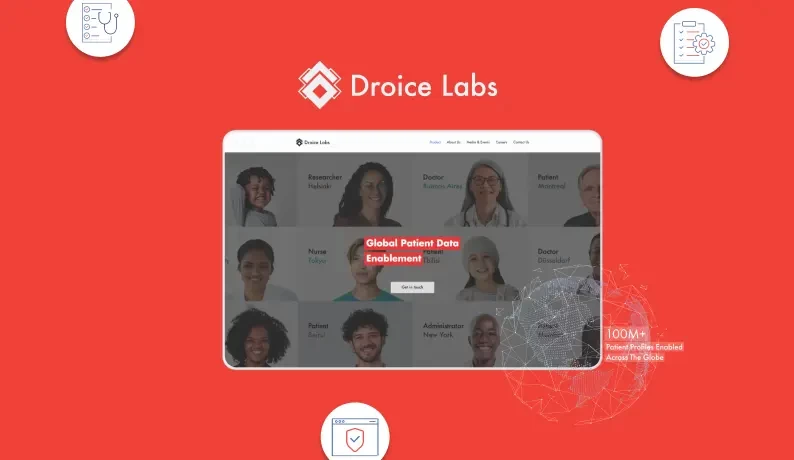
    Healthcare Droice Labs

    Droice Labs

    Droice Labs is a middleware designed to transform messy, unstructured patient data into clean, analysis-ready formats for clinical trials.

    Read Case Study

    Our Recent Blogs on Healthcare

    VIEW ALL
    Different Types of AI in Healthcare: Technologies, Use Cases & Benefits
    Different Types of AI in Healthcare: Technologies, Use Cases & Benefits Artificial Intelligence

    Different Types of AI in Healthcare: Technologies, Use Cases & Benefits

    Artificial Intelligence (AI) is rapidly changing how healthcare is delivered and managed. From enhancing diagnostic accuracy to automating time-consuming administrative tasks, AI technologies are increasingly being woven into the fabric…

    Read Article →
    Healthcare Business Intelligence Market: Size, Growth, and Key Statistics for 2026
    Healthcare Business Intelligence Market: Size, Growth, and Key Statistics for 2026 Artificial Intelligence

    Healthcare Business Intelligence Market: Size, Growth, and Key Statistics for 2026

    Introduction Healthcare organizations increasingly use data to aid in clinical, financial, and operational decision-making. With a growing amount of patient records, claims and administrative information, decision makers need context rather…

    Read Article →
    Healthcare Predictive Analytics Market Statistics 2026: Data-Driven Outlook
    Healthcare Predictive Analytics Market Statistics 2026: Data-Driven Outlook Artificial Intelligence

    Healthcare Predictive Analytics Market Statistics 2026: Data-Driven Outlook

    Introduction The healthcare predictive analytics market is moving from experimental pilots to system level adoption across hospitals, payers, and life sciences. Advanced models now sit inside electronic health records, claims…

    Read Article →

    FAQs on Healthcare Business Intelligence Software

    What is healthcare business intelligence software?

    Healthcare business intelligence software collects, integrates, and analyzes clinical, financial, and operational data from systems like EHRs, billing platforms, and claims databases, turning it into dashboards and reports that support evidence-based decision-making.

    How is custom BI software different from off-the-shelf tools like Power BI or Tableau?

    Off-the-shelf tools provide visualization. Custom healthcare BI software adds the data engineering layer underneath - FHIR-compliant pipelines, HIPAA-ready data warehouse design, domain-specific analytics models, and integrations with healthcare source systems built to your specific architecture.

    What compliance standards does the software need to meet?

    At minimum: HIPAA, HITECH, and HL7 FHIR R4 for data exchange. Depending on your use case, you may also need alignment with ONC 21st Century Cures Act certification requirements, SOC 2 Type II, CMS HEDIS reporting standards, and GDPR if patient data is processed in EU-regulated environments.

    Which healthcare systems can you integrate with?

    We integrate with Epic, Cerner, athenahealth, eClinicalWorks, and most other major EHR platforms via FHIR APIs and HL7 v2/v3 feeds. We also connect to RCM systems, lab information systems, claims clearinghouses, and pharmacy management platforms.

    How long does it take to build and deploy a healthcare BI system?

    A focused MVP covering three to five use cases with core integrations and dashboards typically takes 3 to 5 months. Full-scale platforms with AI analytics modules and multi-system integrations range from 6 to 12 months, depending on data complexity and source system accessibility.

    Can you work with legacy systems that do not support FHIR?

    Yes. We build custom middleware connectors and API wrappers for legacy platforms, and can implement HL7 v2 message parsing pipelines for older systems that do not expose FHIR endpoints.

    What engagement models do you offer?

    We offer Fixed-Price, Time and Material, and Dedicated Team models depending on how well-defined your requirements are at the start. For new BI platforms, we recommend a discovery phase on a fixed-price basis before committing to a full build contract.

    Turn Your Healthcare Data Into a Clinical and Financial Advantage

    Partner with a team that has built healthcare data systems end-to-end across pipelines, compliance, analytics, and all.