















Advinow
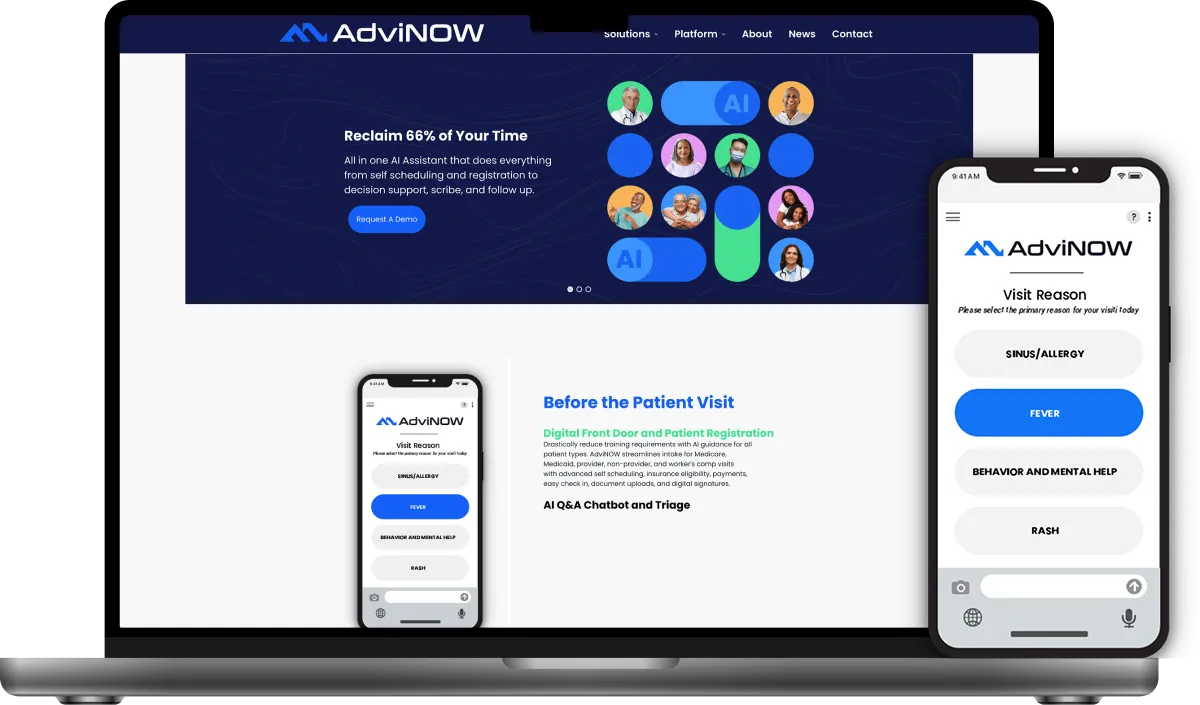
It's an AI-driven healthcare platform that automates patient engagement and consultation processes, helping healthcare providers deliver efficient, on-demand services while improving operations for urgent care.

More InfoWe build custom wellness apps for fitness, mental health, nutrition, sleep, and corporate well-being. Every build is HIPAA-compliant, wearable-ready, and backed by AI personalization your team owns.
Trusted Software Development Company By
From single-focus fitness trackers to multi-modal corporate platforms, we build apps that are clinically informed and consumer-grade.
Goal-based workout planning, activity logging, GPS route tracking, VO2 max estimation, and HealthKit or Google Health Connect sync. Built for consumer apps and B2B employee wellness programs.
Mood journaling, CBT-based self-help tools, guided meditation flows, therapist access modules, and PHQ-9 screening integration. Designed to meet HIPAA and GDPR data sensitivity requirements.
Barcode-scan food logging, macro tracking, AI-generated meal plans, allergen flagging, and integration with nutritionist portals. Supports condition-specific plans including diabetic and renal diets.
Sleep stage analysis via wearable SDKs, sleep diary logging, HRV trend tracking, smart alarm triggers, and relaxation audio libraries. Paired with Fitbit, Oura, and Apple Watch data streams.
Streak visualization, push notification logic, habit stacking frameworks, behavioral insight dashboards, and peer accountability group features. Includes AI coach prompts via LLM integration.
Cycle tracking with symptom correlation, fertility window prediction, perimenopause logging, hormone insight dashboards, and clinical note sharing with OB/GYN integrations.
Multi-tenant B2B architecture, SSO with Okta and Azure AD, HRIS connectors for Workday and ADP, aggregate wellness dashboards with privacy-preserving analytics, and configurable challenge modules.
Diabetes glucose logging, hypertension medication reminders, asthma trigger tracking, care team messaging, and EHR integration via FHIR R4. HIPAA-compliant from the data layer up.
Off-the-shelf platforms give you someone else’s engagement model. Engagement drops when the app can’t adapt to a user’s actual patterns, actual conditions, or actual goals. You end up with generic push notifications, static content libraries, and no pathway for clinical integration.
The harder problem is compliance. Collecting health data without a HIPAA-grade architecture is not a gap, it’s a liability. And in corporate wellness, employee privacy expectations mean aggregate-only analytics is not optional; it’s the baseline.
We build from those constraints, not around them. The AI layer is on-device where it needs to be. The data model is auditable. The user experience is personalized.
Our wellness apps use on-device ML models via TensorFlow Lite and Core ML for real-time pattern recognition. Behavioral data stays on device. Aggregate trends power coaching prompts without routing personal health data through cloud inference.
The architecture supports LLM-driven coaching loops, such as user journeys that adapt week over week based on activity variance, mood trends, and goal completion rates. You own the model. You own the data.
On-Device ML: TensorFlow Lite and Core ML inference runs locally. No personal health data leaves the device for model scoring.
LLM Coaching Loops: Behavioral adaptation via fine-tuned language models. Prompts evolve based on user patterns, not static content trees.
Wearable SDK Integration: Apple HealthKit, Google Health Connect, Fitbit Web API, Garmin Connect IQ, and Oura REST API. Real-time and historical data pipelines.
FHIR R4 Interoperability: Clinical-grade data exchange for apps that integrate with EHRs, care team portals, or payer platforms.
Privacy-Preserving Analytics: Differential privacy and k-anonymity for corporate wellness dashboards. Individual data is never surfaced.
Offline-First Architecture: Full functionality without connectivity. Background sync via WorkManager and BackgroundTasks framework.
Tell us your product concept. We will map the build in a free 30-minute session.
Book a Free Discovery CallEvery engagement produces a complete, production-ready system. Here is what gets delivered.
▪ iOS (Swift/SwiftUI) and Android (Kotlin/Jetpack Compose) native builds
▪ React Native cross-platform where performance requirements allow
▪ HealthKit, Google Health Connect, and third-party wearable SDK integrations
▪ Push notification infrastructure with behavioral trigger logic
▪ In-app AI coaching layer with configurable prompt templates
▪ HIPAA-compliant data storage with AES-256 encryption at rest
▪ Biometric authentication (Face ID, Touch ID, Android Biometric API)
▪ Role-based access controls for multi-user platforms (corporate, clinical)
▪ Admin dashboard for content management, user analytics, and cohort reporting
▪ App Store and Google Play submission support
Whether you are launching a consumer product or a managed B2B platform, the build requirements differ. Here is where we operate.
We map your user personas, product goals, integration requirements, and compliance obligations. You walk away with a defined scope, a data flow diagram, and a feature priority matrix before any code is written.
We define the technical architecture, select the SDK and API stack for your device integrations, and produce HIPAA-reviewed data models alongside UX wireframes. Named senior engineers are assigned at this stage.
Sprint-based delivery with daily updates, weekly demos, and continuous integration on TestFlight and Firebase App Distribution. Wearable integration, AI coaching logic, and compliance controls are built in parallel.
Full regression testing, HIPAA audit trail verification, App Store submission, and L1/L2/L3 SLA support post-launch. Free maintenance period included. Clients also have the option of a money-back guarantee on milestone delivery.
Defined scope, defined budget. Works for well-specified MVPs and feature builds where requirements are locked.
Flexible scope with sprint-based billing. Built for products that evolve through user feedback and market testing.
A named team embedded in your product cycle. Handles ongoing development, iterations, and platform scaling.
Compliance is not added at the end. Every wellness app we deliver is designed around HIPAA-grade data handling, audit logging, and access controls from day one of architecture.
We have shipped integrations across HealthKit, Google Health Connect, Garmin Connect IQ, Fitbit Web API, and Oura. SDK-level work, not surface-layer data pulls.
You know who is building your product before you sign. No switching of resources mid-sprint. The team you meet in discovery is the team that ships your app.
Full source code and IP are transferred at delivery. NDA signed by default. You are never dependent on us to run your own platform after launch.
Every project begins with documented requirements, user stories, and wireframes. We do not write a line of code until the scope is agreed and the architecture is validated.
Verified reviews from digital health and SaaS clients. Our 98% client retention reflects what happens after the first project, not just during it.
Most wellness app builds fall between $10,000 and $150,000 depending on scope, AI features, wearable integrations, and compliance requirements. Share your brief and we will scope it accurately.
It's an AI-driven healthcare platform that automates patient engagement and consultation processes, helping healthcare providers deliver efficient, on-demand services while improving operations for urgent care.
More Info
Carepoint is a solution dedicated to the pharmacy industry with a variety of tools needed to manage any pharmacy.
More Info
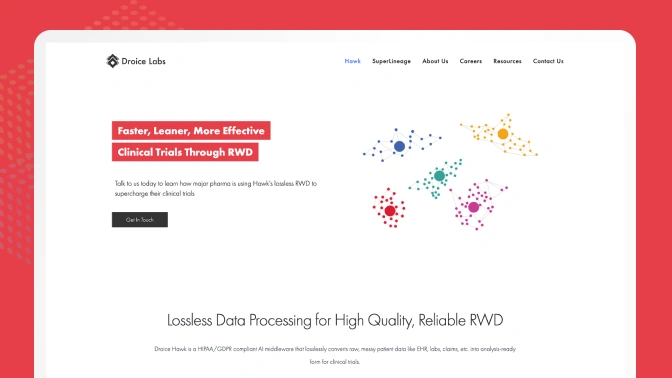
Droice Labs is a middleware designed to transform messy, unstructured patient data into clean, analysis-ready formats for clinical trials.
More Info
Healthcare delivery has shifted beyond hospital walls, with providers increasingly using digital platforms to consult, monitor, and engage with patients remotely. This shift has made terms like telehealth and telemedicine…
Read Article →
AI chatbots have revolutionized healthcare by heightening patient participation, simplifying administrative work, and enhancing access. AI virtual assistants like chatbots offer live health information through personalized interactions and immediate assistance;…
Read Article →
AI technology is revolutionizing healthcare delivery by increasing efficiency and accessibility to medical services. AI’s role in healthcare advancement has been unparalleled – from aiding in accurate diagnoses to driving…
Read Article →Apps that collect, store, or transmit protected health information (PHI) in connection with a covered entity or business associate must comply with HIPAA. Consumer-only apps without clinical touchpoints may fall outside HIPAA scope, but data security best practices still apply.
A focused MVP wellness app typically ranges from $10,000 to $50,000. Corporate wellness platforms with SSO, HRIS connectors, and multi-tenant architecture run $50,000 to $150,000 or more. Scope, device integrations, and AI components are the main cost drivers.
An MVP with core tracking, user accounts, and one wearable integration takes 8 to 20 weeks. Full-featured platforms with AI coaching, compliance controls, and admin dashboards typically require 20 to 36 weeks.
We build native iOS (Swift/SwiftUI), native Android (Kotlin/Jetpack Compose), and cross-platform (React Native). Platform selection depends on your performance requirements, wearable SDK compatibility, and audience device mix.
Yes. We have production-level SDK experience with Apple HealthKit, Google Health Connect, Fitbit Web API, Garmin Connect IQ, and Oura. We handle both real-time streaming and historical data sync.
We do. Corporate wellness builds require multi-tenant architecture, SSO with Okta or Azure AD, HRIS connectors for Workday or ADP, and privacy-preserving analytics. These are standard capabilities for us, not exceptions.
We provide L1/L2/L3 SLA support options post-launch. Most clients continue with a retainer for ongoing development, A/B testing, and feature iteration based on user analytics.