




























Let’s Talk

Diagnostic Solution Development Built for Clinical Accuracy

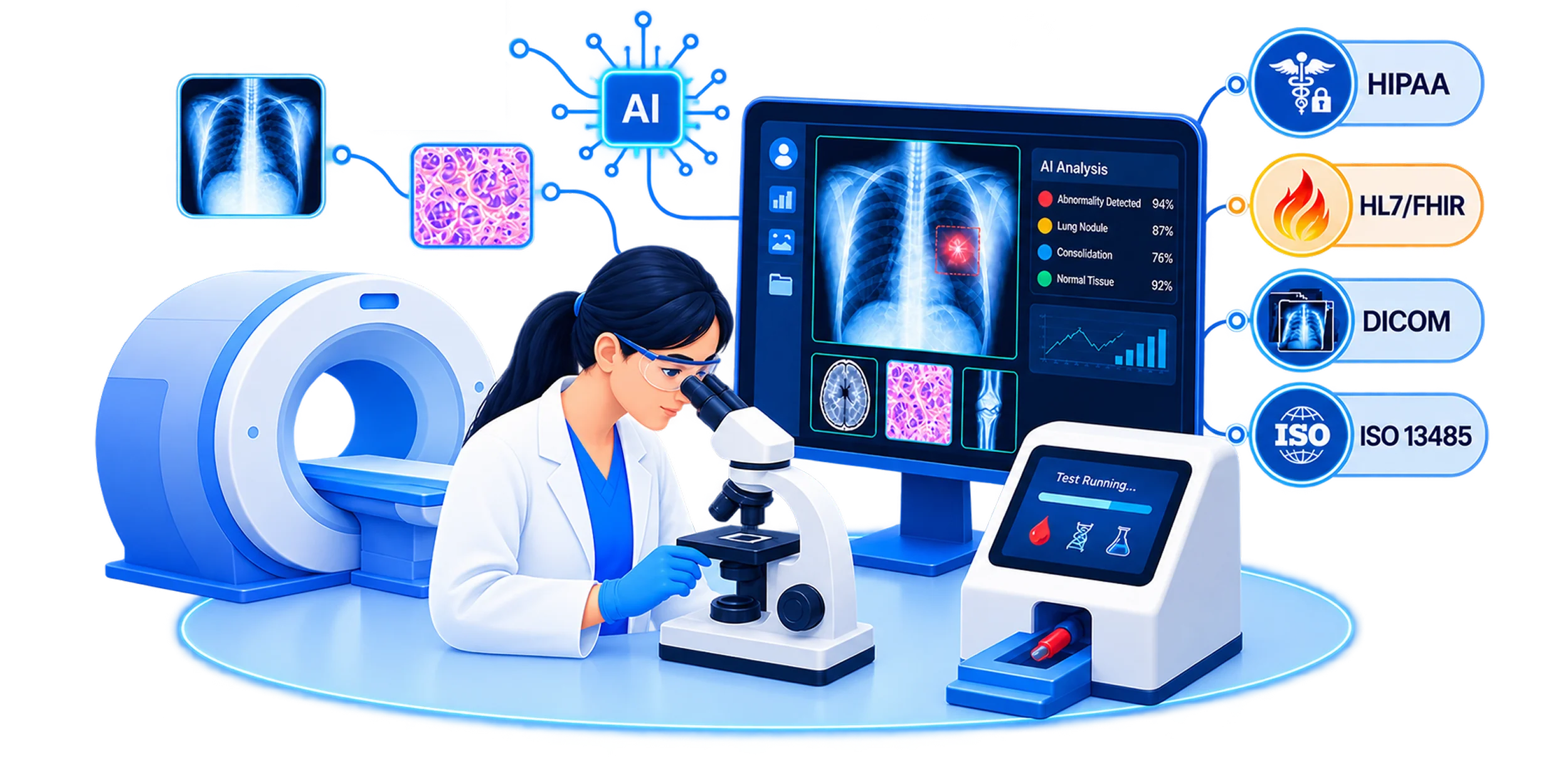
Most diagnostic backlogs come from systems that don't talk to each other, not from a shortage of data. We build diagnostic solutions that pull lab results, imaging studies, and patient history into one validated pipeline, so clinicians get a structured read instead of three disconnected screens.

Diagnostic Solution Development Built for
500+
Projects Delivered
98%
Client Retention Rate

Certified By

HIPAA HIPAA
GDPR GDPR
ISO 13485 ISO 13485
HL7 HL7
SOC 2 SOC 2

Trusted by industry leaders

Certifications and Accreditations

When Diagnostic Data Outpaces the System Reading It

A radiology department generating hundreds of studies a day still routes most of them through a PACS that has no structured link to the EHR. A lab processing thousands of panels a week still reconciles results manually because the LIS speaks HL7v2 and the EHR expects FHIR. Neither gap shows up as a single failure. It shows up as turnaround time creeping up, as a clinician re-requesting a result because the first one never landed in the chart, as a false positive that gets caught two days too late because no one flagged the trend across three prior results.

These aren’t capacity problems. They’re integration problems wearing a capacity costume. A diagnostic solution that actually closes this gap has to treat PACS, LIS, and EHR as one connected read, not three systems exporting reports at each other.

Diagnostic Capabilities That Cover the Full Workflow

Clinical Diagnostic Systems

We build rule-based and AI-assisted diagnostic logic that processes patient history, vitals, and lab panels together, flagging the combinations a single-source view would miss and routing edge cases to a clinician instead of auto-closing them.

Medical Imaging Diagnostics

Our imaging diagnostic builds connect to PACS and VNA through DICOMweb, layer detection models trained for the specific modality, and surface findings inside the radiologist’s existing reading workflow instead of a separate app they have to context-switch into.

Lab Result Interpretation Platforms

We structure incoming LIS data against LOINC-coded reference ranges, flag abnormal trends across a patient’s result history rather than single readings, and push interpreted results back into the EHR in a format clinicians can act on immediately.

Remote and Point-of-Care Diagnostics

For wearable and point-of-care data, we build ingestion pipelines that normalize device output into the same structured format as in-facility results, so a home reading and a lab reading land in the same diagnostic record without manual reconciliation.

Not Sure Where Your Diagnostic Data is Actually Getting Lost?

We'll map your current PACS, LIS, and EHR data flow before you commit to anything.

Book the Workflow Audit

How the Integration Layer Actually Works


Most vendors treat "EHR integration" as a single line item. We treat it as three separate connections that each need a different mechanism, because PACS, LIS, and EHR don't share a native data model.

For imaging, we expose a FHIR ImagingStudy resource alongside your existing DICOM storage, so the EHR can discover and retrieve studies through DICOMweb WADO-RS without you migrating your PACS. For lab data, we map LIS output through HL7v2 or FHIR Observation resources depending on what your LIS already speaks. For legacy diagnostic hardware that has no modern API, we build a direct integration layer rather than forcing a rip-and-replace.

FHIR ImagingStudy resource exposed alongside existing DICOM storage. No PACS replacement required, just a discovery and retrieval layer the EHR can read.

Result mapping through HL7v2 or FHIR Observation depending on existing LIS protocol, with LOINC coding applied at ingestion so results are comparable across systems.

Structured diagnostic output pushed into the patient chart in the format the EHR vendor (Epic, Cerner, Allscripts) actually accepts, not a generic export the clinician has to manually reconcile.

Direct integration layer built for diagnostic devices with no modern API, so older lab or imaging hardware doesn’t become the reason a new platform can’t launch.

Standards We Build Against

Compliance isn't a checklist we run at the end. It's the data model we design around from the first architecture decision.

  • HIPAA
  • HL7/FHIR
  • DICOM
  • ISO 13485

Why Rule-Based and AI Diagnostic Logic Belong in One Pipeline

Rule-based logic catches the known patterns reliably, while the AI layer catches the patterns a fixed ruleset was never written to expect, and both run against the same patient record instead of two separate systems disagreeing.

Training the detection model on your actual historical results, not a generic dataset, means the false positive rate drops against your patient population specifically, not a benchmark population that doesn't match your case mix.

Building the AI layer into the same validated pipeline as the rule-based logic from day one means accuracy improvements later don't require re-architecting the base system, just retraining the model.

A clinician can see why a flag was raised, rule match or model confidence score, instead of getting a black-box alert they have to trust blindly or ignore.

How We Build Your Diagnostic Solution

1

Map the Diagnostic Workflow

We start by tracing how a result actually moves today, from sample or scan capture through LIS or PACS, into the EHR, and to the clinician's screen. This surfaces exactly where data gets re-entered, where turnaround time gets lost, and which integration gaps are causing the most clinical risk, not just the most visible complaints.

2

Design the Data Model and Diagnostic Logic

Our solution architects define the rule-based diagnostic logic first, validated against your existing clinical protocols, before any AI model gets introduced. This gives you a working, auditable system early, and a clear baseline to measure any AI-driven accuracy improvement against later.

3

Build the Integration and Detection Layers

Engineers connect PACS, LIS, and EHR through the FHIR/DICOMweb pathway specific to your existing stack, while data scientists train detection models on your historical case data. Both tracks are tested against the same validation dataset so the rule-based and AI layers stay consistent with each other.

4

Validate Against Compliance and Clinical Accuracy Benchmarks

Before deployment, we run the system against held-out historical cases to measure false positive and false negative rates, document the validation process for HIPAA and, where applicable, ISO 13485 audit trails, and get clinical sign-off on the diagnostic logic before it touches live patient data.

5

Deploy, Train, and Monitor

We deploy with structured onboarding for clinical and IT staff, then monitor real-world performance against the validation benchmarks for the first several months, retraining the model as your case mix shifts rather than letting accuracy drift unnoticed.

Where This Gets Used

Hospital Imaging Diagnostics

A radiology department running behind on study reads because the PACS has no structured link to referring physicians. We build the FHIR ImagingStudy layer that lets the EHR pull studies directly, plus AI-assisted triage that flags urgent findings before a radiologist opens the file, cutting the time between scan and actionable read.

Lab and Pathology Result Interpretation

A diagnostic lab processing high panel volume with results landing in the EHR hours after they're finalized in the LIS. We build the HL7/FHIR mapping layer and trend-based flagging so abnormal results surface the moment they're confirmed, not after a batch export runs overnight.

Technologies and Platforms We Use

LangChain
Haystack
OpenAI GPT-4
Anthropic Claude
OpenAI GPT-4
Google Dialogflow
Rasa
Vapi.ai
Azure Prompt flow
DALL-E
DALL-E
Stable Diffusion
Stable Diffusion
TensorFlow
Hugging Face Transformers
Amazon Glu
Amazon Glu
Pandas
Pandas
Numpy
Numpy
Redshift
Redshift
opencv
OpenCV
Tesseract OCR
Tesseract OCR

How Much Does It Cost to Develop a Diagnostic Solution?

Cost depends on integration count, diagnostic logic complexity, and whether an AI detection layer is included. Most projects fall between $30,000 and $150,000+ depending on scope.


    Your data and info stays secure. Read our Privacy Policy.


    Engagement Models for Diagnostic Solution Development

    Diagnostic Module Add-On

    For teams adding diagnostic logic to an existing platform rather than building from scratch.

    • Single diagnostic workflow (imaging, lab, or clinical logic)
    • Integration with one existing system (PACS, LIS, or EHR)
    • Rule-based logic, AI layer optional add-on later
    • 3-4 months typical delivery

    Full Diagnostic Platform

    For organizations building a standalone diagnostic system across multiple data sources.

    • Multi-source integration (PACS, LIS, EHR combined)
    • Rule-based diagnostic logic across full clinical workflow
    • Compliance documentation and audit trail built in
    • 5-7 month typical delivery

    Platform + AI Detection Layer

    For teams that want AI-assisted detection trained on their own case data from launch.

    • Everything in Full Diagnostic Platform
    • AI detection model trained on historical case data
    • Validation reporting against false positive/negative benchmarks
    • 7-9 month typical delivery

    Ready to Stop Losing Time Between Result and Read?

    Every gap between a finished scan and a charted result is a turnaround number you can fix. Let's find out where yours is actually breaking.

    Talk to a Healthcare Diagnostic Engineer

    Why Healthcare Teams Build Their Diagnostic Solutions With Us

    Compliance-First Architecture

    We design the HIPAA and ISO 13485 audit trail into the data model from the first sprint, not as documentation written after the system is already built and harder to retrofit.

    Validated Diagnostic Logic

    Rule-based diagnostic logic gets clinical sign-off and a measured false positive baseline before any AI model is layered on, so you know what’s actually improving and by how much.

    Interoperability Without Migration

    We connect to your existing PACS and LIS through FHIR and DICOMweb instead of requiring a system replacement, which keeps your existing investment intact while closing the integration gap.

    Secure ADLC Methodology

    Our agentic delivery methodology embeds security checkpoints from day one of development, reducing the audit risk that typically surfaces only after a system handles real patient data.

    Discovery Before Any Code

    We map your actual diagnostic workflow, not a generic template, before writing requirements, which is why our integration plans tend to survive contact with your legacy systems.

    Post-Launch Model Retraining

    As your case mix shifts, we retrain detection models against new data rather than letting accuracy drift quietly until someone notices a missed pattern.

    Client Testimonials (We're Rated 4.7 on Clutch)

    Diagnostic and Clinical Platforms We've Built

    View All Case Studies →
    Healthcare Brainkey

    Brainkey

    Platform leverages AI to analyze brain imaging data, providing insights into brain health. Designed for healthcare providers and researchers, the platform enhances early detection of neurological conditions, enables predictive analytics, and optimizes treatment planning. The platform empowers clinicians with accurate and data-driven decision-making capabilities.

    View More
    Healthcare CarePoint

    CarePoint

    Carepoint is a solution dedicated to the pharmacy industry with a variety of tools needed to manage any pharmacy. This pharmacy management solution also offers integral support to manage dispensing, medication therapy, compounding support, A/R & reconciliation, and perpetual inventory.

    View More
    Healthcare Droice Labs

    Droice Labs

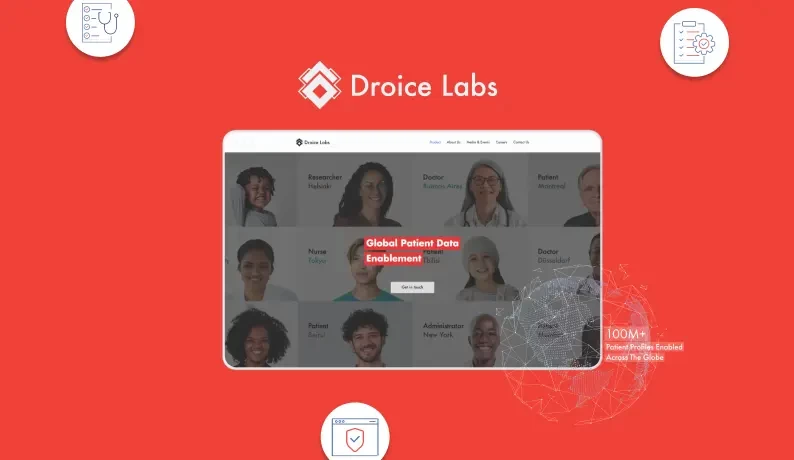
    Droice Labs is a middleware designed to transform messy, unstructured patient data into clean, analysis-ready formats for clinical trials.

    View More

    Recent Insights on Healthcare

    View All Blogs →
    A Complete Guide to Digital Transformation in Healthcare
    A Complete Guide to Digital Transformation in Healthcare Artificial Intelligence

    A Complete Guide to Digital Transformation in Healthcare

    Digital transformation in healthcare is more than just a trending phrase. It is impacting every aspect of healthcare delivery, including how care is provided and managed. With the current pace…

    Read Article →
    A Complete Guide to Remote IoT Monitoring Solutions in Healthcare
    A Complete Guide to Remote IoT Monitoring Solutions in Healthcare Custom Software Development

    A Complete Guide to Remote IoT Monitoring Solutions in Healthcare

    In medical practice, information can save lives. Each day, hospitals and clinics are dealing with numerous patients, devices, and data. A remote IoT monitoring is a solution that links medical…

    Read Article →
    A Practical Guide to Medical Device Software Integration for Healthcare Providers
    A Practical Guide to Medical Device Software Integration for Healthcare Providers Custom Software Development

    A Practical Guide to Medical Device Software Integration for Healthcare Providers

    Healthcare providers today use a wide range of medical devices, from bedside monitors and ventilators to imaging systems and wearables. Such devices are continuously generating useful patient information, but in…

    Read Article →

    Frequently Asked Questions

    What's actually included in a custom diagnostic solution?

    A diagnostic solution typically includes data ingestion from your existing PACS/LIS/EHR, structured diagnostic logic (rule-based, AI-assisted, or both), compliance documentation, and an interpretation layer clinicians can act on directly.

    How does this connect to our existing PACS without replacing it?

    We expose a FHIR ImagingStudy resource alongside your existing DICOM storage, accessed via DICOMweb WADO-RS. Your PACS stays in place; the EHR gets a discovery layer it can read.

    Can you add an AI detection layer to a system we already built?

    Yes, provided the existing system has a clean data model to train against. We validate against your historical case data before deployment so improvements are measurable, not assumed.

    How long does a full diagnostic platform take to build?

    A single-module add-on typically takes 3-4 months. A full multi-source diagnostic platform with AI detection runs 7-9 months, depending on integration complexity and validation depth required.

    What happens if our LIS or PACS uses an older protocol?

    We build a direct integration layer for legacy hardware and older HL7v2 systems rather than requiring a protocol upgrade first. The goal is connecting what you have, not forcing a replacement.

    How do you validate diagnostic accuracy before going live?

    We test the rule-based logic and any AI model against held-out historical cases, measure false positive and false negative rates, and require clinical sign-off before the system touches live patient data.

    Is the diagnostic logic HIPAA and ISO 13485 compliant?

    Compliance is built into the data model and audit trail from the first sprint. Documentation needed for HIPAA and, where the platform qualifies as medical device software, ISO 13485 is generated as part of delivery, not added after.

    Do you support the system after launch?

    Yes. We monitor real-world performance against validation benchmarks and retrain detection models as your case mix changes, so accuracy doesn't quietly drift after go-live.

    Let's Map Your Diagnostic Workflow

    See exactly where your PACS, LIS, and EHR are losing time before you commit to a build.