
 Back
Back







Minimum Viable Product examples from companies like Dropbox, Airbnb, and Uber prove that billion-dollar businesses often launch with stripped-down versions of their final product.
An MVP enables founders to test core assumptions, collect real user feedback, and validate product-market fit before committing significant resources.
This guide covers top proven MVP examples, practical development approaches, essential features, and the critical mistakes that derail early-stage product validation.
What is a Minimum Viable Product (MVP)?
A Minimum Viable Product is the simplest functional version of a product that delivers enough value to attract early adopters while testing a core business hypothesis.
Rather than building a fully featured platform, founders launch an MVP product with only the essential capabilities needed to solve a specific user problem and generate measurable market response.
The MVP concept, popularized by Eric Ries in the lean startup methodology, prioritizes learning over perfection. By releasing a basic version early, teams gather actionable customer feedback, reduce development waste, and make data-driven decisions about which features deserve further investment.
Why MVP Development Matters for Startups in 2026
Building a product without market validation is the fastest path to failure. MVP development forces founders to confront real user behavior before exhausting the runway on untested assumptions.
In 2026, where venture capital scrutiny has intensified and customer acquisition costs continue rising, demonstrating validated demand through an MVP is often a prerequisite for funding.
The financial case is equally compelling. Understanding the cost to build an MVP reveals that startups can validate product ideas for a fraction of full-scale development budgets.
This lean approach preserves capital, accelerates iteration cycles, and positions founders to scale confidently once product-market fit is confirmed.
Proven Minimum Viable Product (MVP) Examples
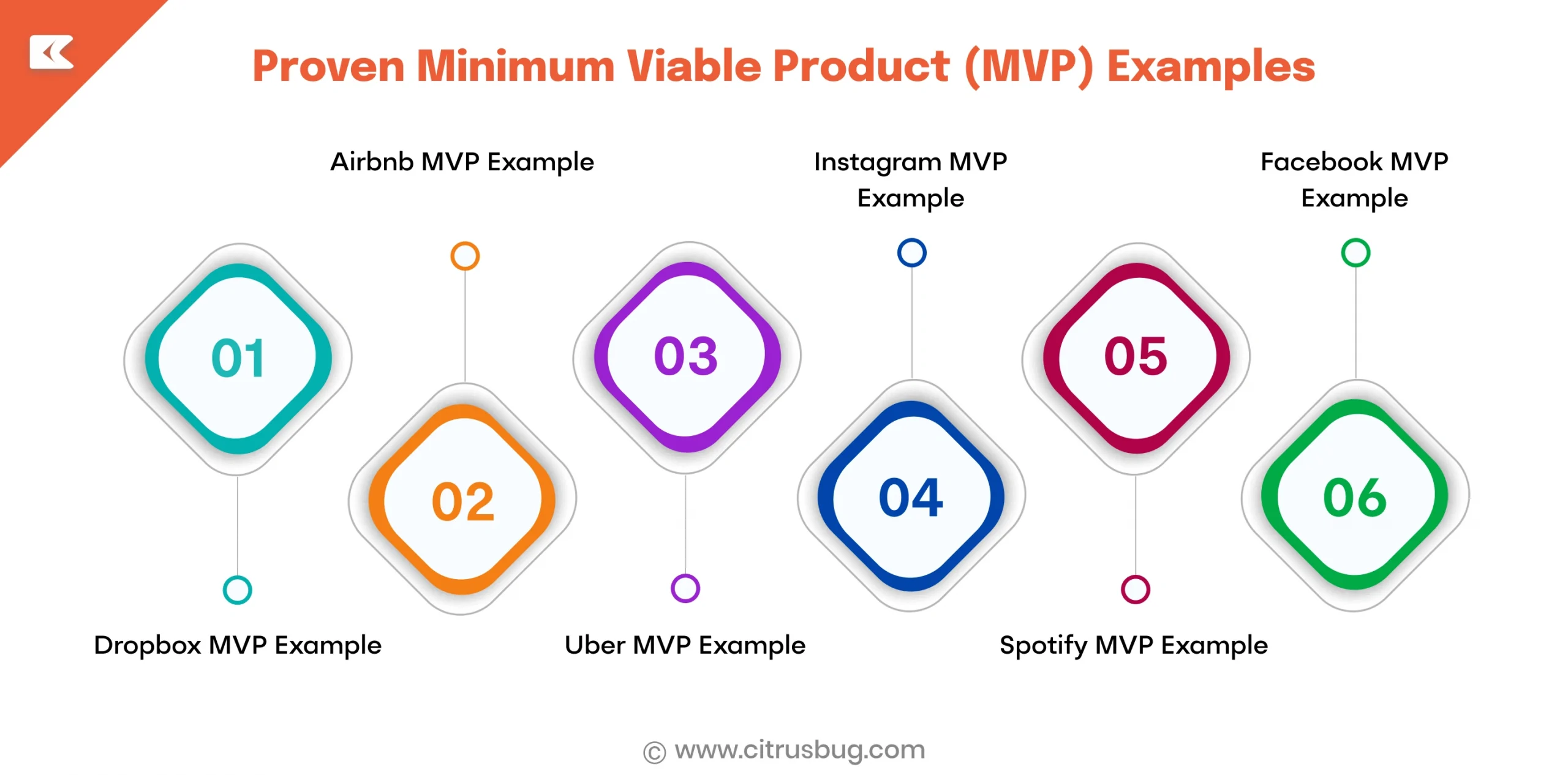
1. Dropbox MVP Example
Dropbox validated demand for cloud file synchronization without building the actual product first. Founder Drew Houston created a three-minute explainer video demonstrating how the service would work, targeting a tech-savvy audience on Hacker News. The video generated 75,000 email signups overnight.
This approach confirmed massive market demand at virtually zero development cost. The signup surge provided concrete proof of concept that justified full engineering investment.
Dropbox’s MVP example demonstrates that market validation sometimes requires nothing more than a clear articulation of the problem and solution.
2. Airbnb MVP Example
Airbnb began when founders Brian Chesky and Joe Gebbia listed their own apartment on a simple website during a San Francisco design conference.
The initial MVP was a basic landing page with photos, a description, and a manual booking process no payment integration, no reviews, no map search.
Those first three guests validated the core hypothesis that travelers would pay to stay in a stranger’s home.
This concierge-style MVP approach allowed the founders to test customer willingness directly before investing in platform development, iterative feature building, or automated systems.
3. Uber MVP Example
Uber launched as UberCab in San Francisco, offering a stripped-down mobile app development solution that connected riders with black car drivers through SMS-based dispatch.
The initial product served only a small geographic area and supported a single vehicle class with no fare estimates or driver ratings.
This single-feature MVP validated that users would pay a premium for on-demand car service through a smartphone.
Uber expanded features incrementally, adding fare splitting, driver ratings, and multiple vehicle tiers only after confirming strong demand within its initial market.
4. Instagram MVP Example
Instagram launched as Burbn, a location-based check-in app with photo-sharing capabilities. When founders Kevin Systrom and Mike Krieger analyzed user behavior, they discovered that photo sharing dominated all other engagement metrics by a wide margin.
They stripped the product down to its core photo capture, a single filter, and a social feed, and relaunched as Instagram.
This feature prioritization decision, driven by actual user data rather than assumptions, demonstrates the power of MVP iteration. Instagram gained 25,000 users on its first day.
5. Spotify MVP Example
Spotify’s MVP focused on solving one problem delivering music streaming with zero buffering lag.
The initial product launched as an invite-only desktop application in Sweden with a limited music catalog and basic playlist functionality. No mobile app, no social features, no podcast support.
By concentrating engineering resources on streaming performance alone, Spotify achieved buffer-free playback that differentiated it from every competitor.
This single-feature MVP validated that users valued speed and reliability above catalog size, establishing the technical foundation for global expansion.
6. Facebook MVP Example
Facebook launched as TheFacebook, a bare-bones social directory restricted exclusively to Harvard University students. The initial MVP included only a profile page, a friend connection feature, and a campus-specific wall.
No news feed, no groups, no messaging, no marketplace. This deliberate constraint created artificial scarcity and intense demand within a controlled user base.
Facebook validated its engagement hypothesis within a single campus before expanding to other universities and eventually the global market, a textbook example of iterative development and staged market validation.
Common MVP Development Approaches
Landing page MVP
Having a landing page MVP presentation example as your product concept through a single web page can provide you with a clear value proposition and a call-to-action, typically an email signup or waitlist registration.
Conversion rates on such MVP landing page directly measure market interest before any product development begins.
Explainer video MVP
An explainer video MVP uses a short demonstration video to communicate how your product solves a specific problem. Dropbox pioneered this approach with remarkable results.
The video format conveys complex product concepts more effectively than static pages and generates measurable interest through signups.
Concierge MVP
A concierge MVP delivers the product’s core value through direct, personal service rather than software automation.
Founders personally guide each customer through the experience, gathering detailed qualitative feedback while validating willingness to pay through high-touch customer development.
Single-feature MVP
A single-feature MVP is the best example to isolate the one capability that addresses your users’ most pressing pain point and builds only that.
By eliminating feature bloat, teams ship faster, reduce development costs, and generate an unambiguous signal about whether the core value proposition resonates.
Prototype MVP
A prototype MVP creates a functional but limited version of the product for user testing and stakeholder demonstrations.
Interactive prototypes built through professional prototyping and development services validate usability assumptions and secure investor buy-in before full-scale engineering.
Essential Features Every MVP Should Have
While every MVP differs based on its target market and problem domain, certain foundational elements are non-negotiable. Founders planning to build an MVP for their SaaS startup or any other product category should ensure these core capabilities are present from day one.
- User-friendly interface: A clean, intuitive design that eliminates friction and enables users to accomplish core tasks without confusion, documentation, or onboarding overhead.
- Core functionality: The single most important feature that solves the primary user problem, nothing more, nothing less delivered with reliability and polish.
- Basic analytics tracking: Event tracking and usage metrics that reveal how users actually interact with the product, enabling data-driven iteration and feature prioritization decisions.
- Scalability considerations: Architecture decisions that accommodate growth without requiring a complete rebuild, including database design, API structure, and infrastructure planning.
- Feedback collection mechanism: Built-in channels for users to report issues, suggest improvements, and share their experience the raw material for agile iteration cycles.
Critical Mistakes to Avoid in MVP Development
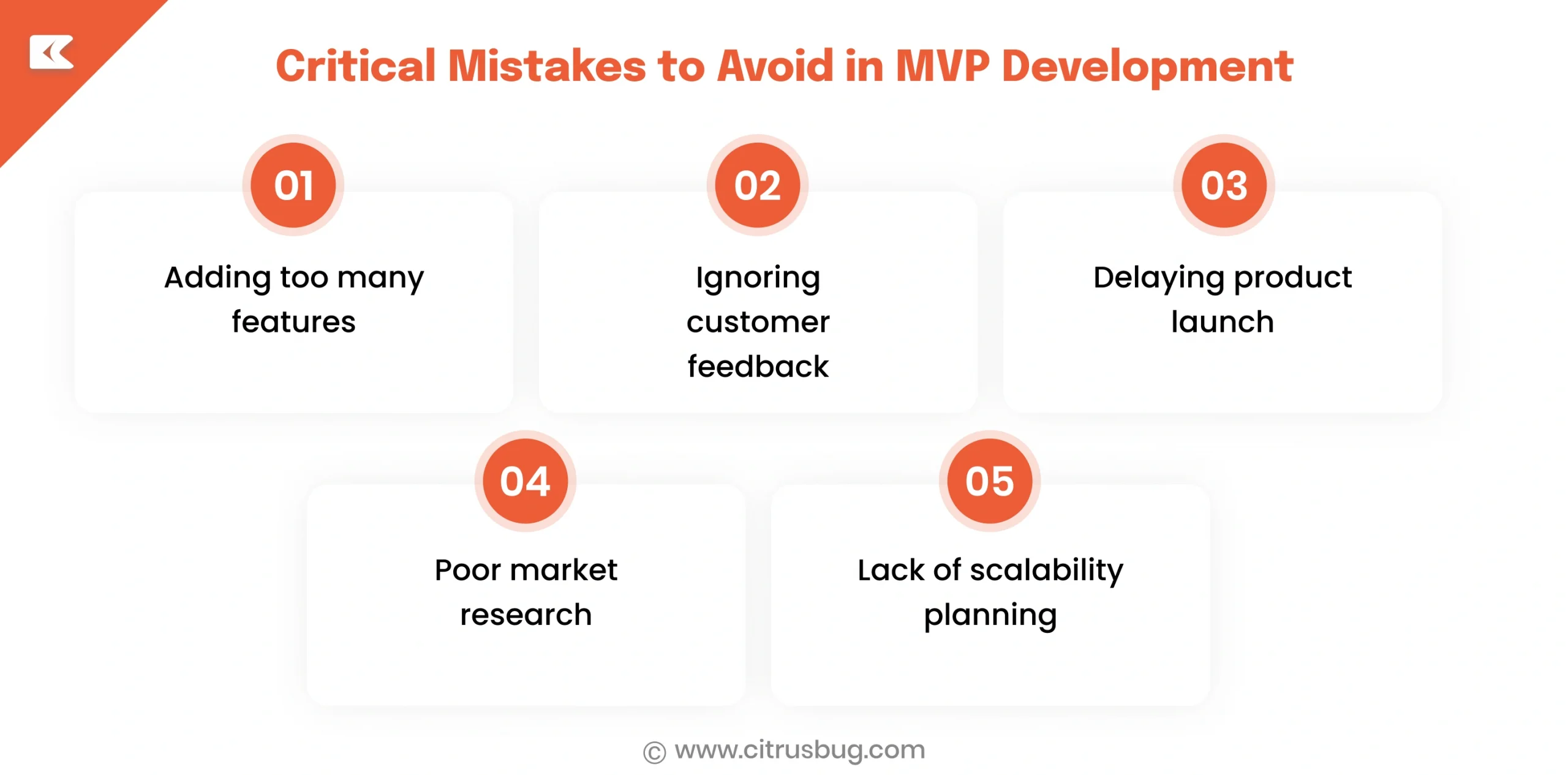
Even experienced founders make avoidable errors during MVP development that waste resources and delay market validation. Recognizing these patterns early protects your timeline, budget, and competitive positioning.
- Adding too many features: Feature creep transforms an MVP into a bloated product that takes months to ship and obscures which capabilities actually drive user value.
- Ignoring customer feedback: Treating user input as optional rather than foundational undermines the entire purpose of launching a minimum viable product in the first place.
- Delaying product launch: Perfectionism delays market exposure, burns runway, and gives competitors time to capture the audience you are still building for.
- Poor market research: Skipping competitive analysis and customer interviews leads to products that solve problems nobody actually has the most expensive mistake in startup development.
- Lack of scalability planning: Building on architecture that cannot handle growth forces expensive rewrites precisely when engineering resources should focus on feature development and user acquisition.
Industries Where MVP Development Delivers the Best Results
MVP development applies across virtually every sector. So these enlisted Minimum Viable Product examples are great for certain industries that benefit disproportionately from the lean validation approach. The following industries get the advantage due to their market dynamics, regulatory landscapes, and technology requirements.
- SaaS applications: Subscription-based platforms leverage MVPs to validate pricing models, test feature adoption, and demonstrate recurring value. Professional SaaS application development teams frequently use MVP strategies to de-risk product launches.
- FinTech platforms: Payment solutions, lending platforms, and investment tools use MVPs to test regulatory compliance workflows and user trust in handling financial transactions before scaling.
- Healthcare applications: Telemedicine, patient engagement, and clinical workflow products validate HIPAA-compliant architectures and clinical user acceptance through controlled MVP releases.
- eCommerce startups: Online marketplaces and direct-to-consumer brands test product demand, checkout flows, and fulfillment logistics through focused MVP launches before expanding catalogs.
- AI-powered applications: Machine learning products use MVPs to validate model accuracy, user trust in automated decisions, and the commercial viability of AI-driven features with real-world data.
- Mobile app startups: Native and cross-platform mobile products test engagement, retention, and monetization hypotheses through focused MVPs before investing in platform-specific optimizations.
Future of MVP Development in 2026
MVP development is evolving rapidly as new tools and methodologies reshape how founders validate product ideas.
AI-assisted development platforms now generate functional prototypes in hours rather than weeks, compressing the timeline from concept to testable product.
Teams leveraging MVP in agile development frameworks integrate continuous user feedback directly into sprint cycles for faster iteration.
No-code and low-code platforms have democratized MVP creation, enabling non-technical founders to build and test functional products without engineering teams.
Meanwhile, advanced analytics and AI-driven user behavior tracking provide deeper validation insights from smaller user samples, reducing the time and cost required to confirm product-market fit and make confident scaling decisions.
Conclusion
These minimum viable product examples prove that successful companies prioritize validation over perfection.
Whether you use a landing page, an explainer video, or a single-feature prototype, the MVP approach transforms assumptions into evidence before significant capital is committed.For startups ready to validate their next product idea, adopting a structured MVP approach and opting for MVP development services is the most reliable path from concept to market-validated, investor-ready product.