
 Back
Back








The cost to develop MVP remains one of the most critical questions for founders and product leaders entering 2026. With AI-driven development tools reshaping timelines and remote engineering teams compressing budgets, the pricing landscape has shifted significantly from even two years ago. This guide offers a real MVP development cost breakdown by complexity, industry, team structure, and technology stack so you can plan your budget with confidence, not guesswork.
What is an MVP in Software Development?
A minimum viable product (MVP) is the leanest version of a software application that delivers enough core functionality to attract early adopters and validate a business idea.
Rather than building a full-featured product, an MVP focuses on solving one primary user problem, generating real-world feedback that shapes the product roadmap before significant capital is committed.
Why an MVP-First Approach Saves Development Costs
Launching with an MVP reduces financial risk by limiting initial investment to only the features users actually need. Teams avoid spending months building functionality that may never gain traction.
According to industry data, startups that validate through a structured MVP development process spend up to 60% less on post-launch rework compared to those that ship a full product immediately.
Common Types of MVPs
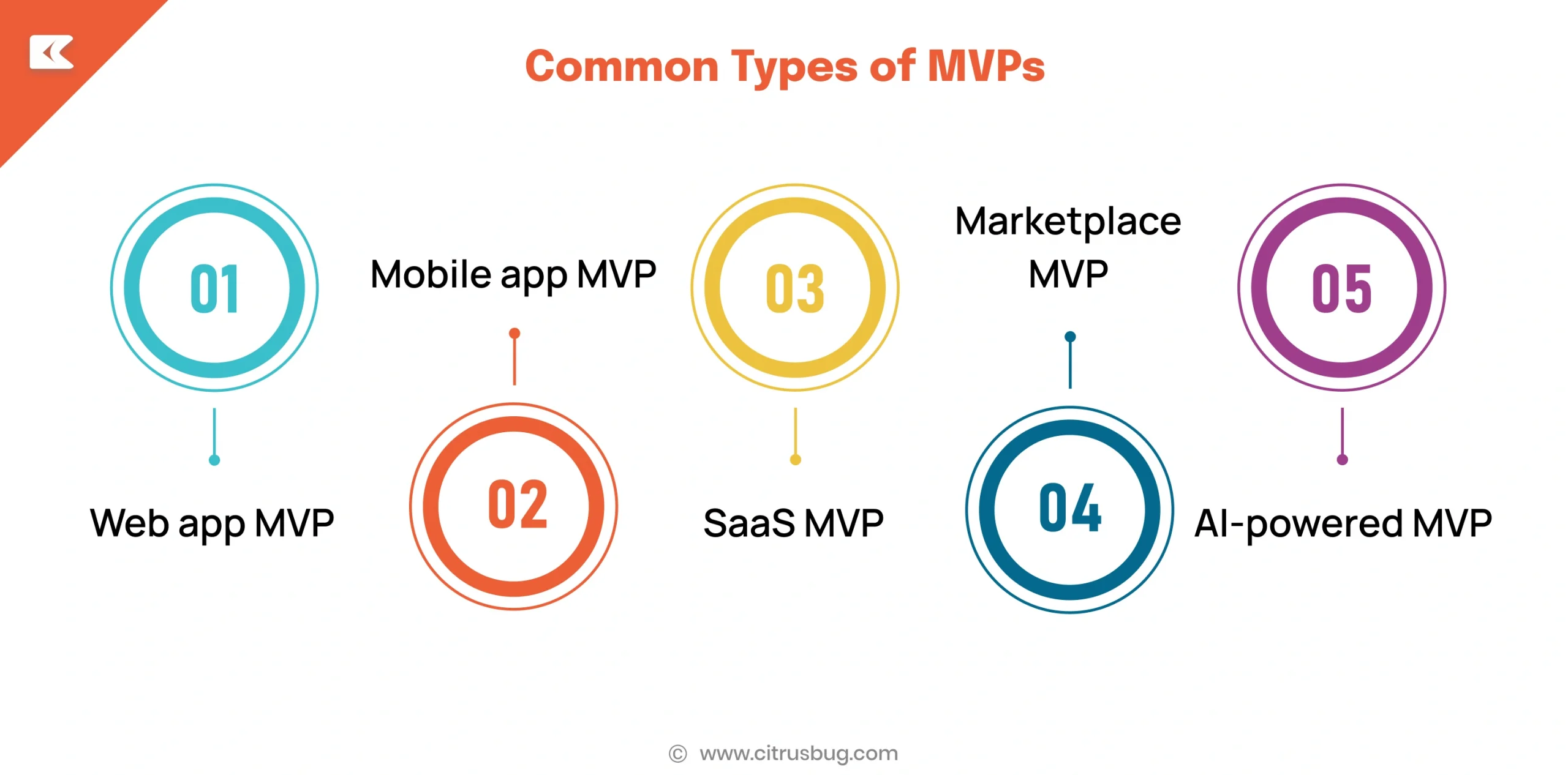
The cost to develop an MVP varies dramatically depending on the product category. Each type carries distinct technical requirements and budget implications:
- Web app MVP: Browser-based applications with responsive interfaces, typically the fastest and most cost-effective MVP category to launch.
- Mobile app MVP: Native or cross-platform mobile applications requiring platform-specific design guidelines, device testing, and app store compliance.
- SaaS MVP: Subscription-based platforms demanding multi-tenant architecture, user authentication, billing integration, and scalable cloud infrastructure.
- Marketplace MVP: Two-sided platforms connecting buyers and sellers, requiring separate user flows, transaction processing, and trust-building features.
- AI-powered MVP: Products embedding machine learning models or natural language processing, adding data pipeline and model training costs to the baseline budget.
Reviewing successful MVP examples across these categories helps founders benchmark realistic scope and budget expectations for their own product.
MVP Development Cost in 2026
In 2026, the average cost to develop an MVP falls between $15,000 and $250,000, a wide range shaped by scope, technology choices, and team location.
Understanding where your project sits within this spectrum requires examining three dimensions: complexity tier, development stage allocation, and the relationship between timeline and total budget.
MVP Cost Range by Complexity
MVP complexity is the single largest cost driver. The ranges below reflect 2026 market rates based on globally distributed development teams:
| Complexity Tier | Cost Range | Timeline |
| Basic MVP core – functionality, standard UI, minimal integrations | $15,000 – $40,000 | 4–8 weeks |
| Mid-level MVP – custom UI/UX, API integrations, admin dashboards | $40,000 – $100,000 | 3–5 months |
| Advanced MVP – AI/ML, compliance modules, multi-platform | $100,000 – $250,000+ | 5–10 months |
Cost Breakdown by Development Stage
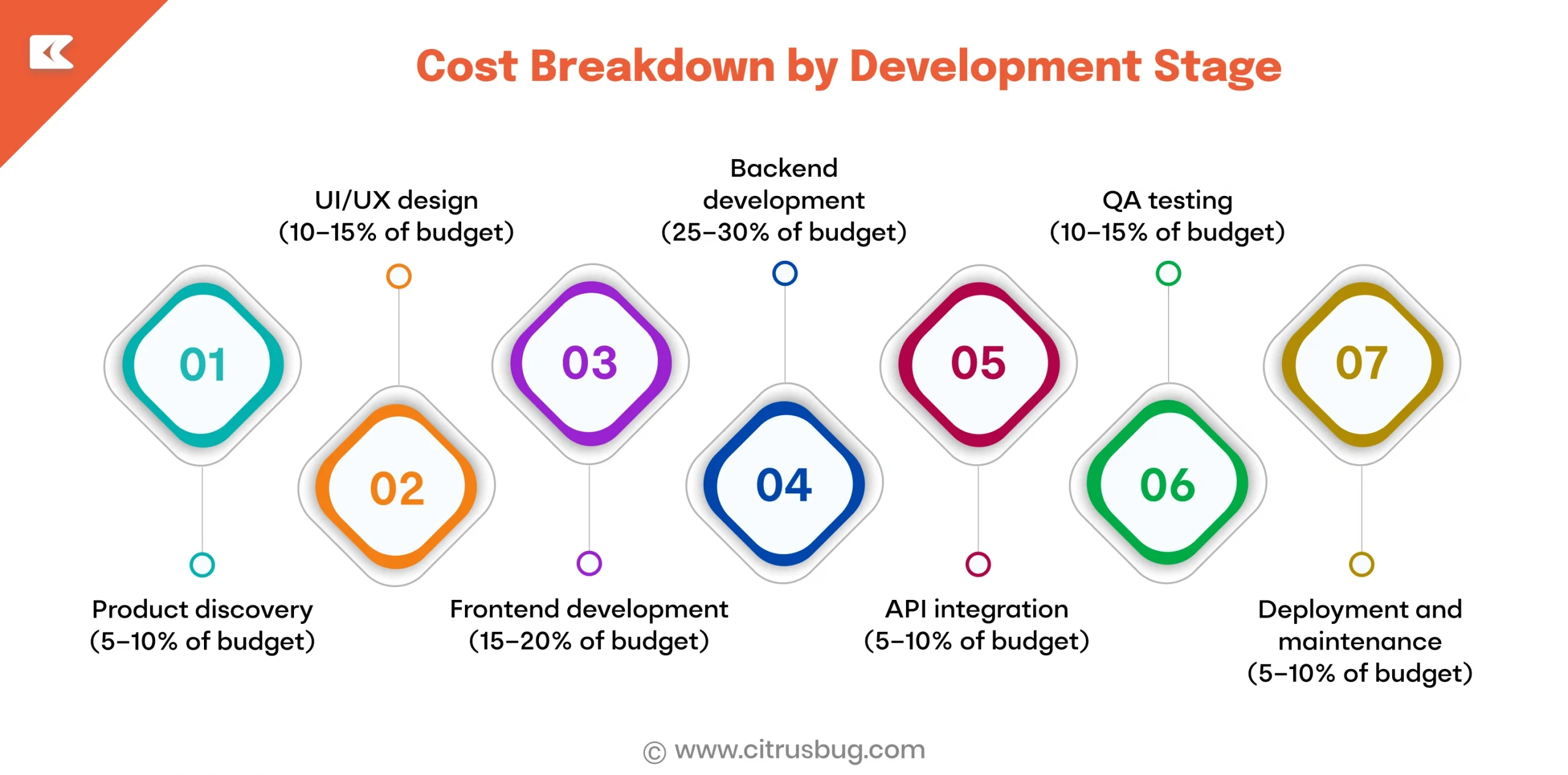
Every MVP budget is distributed across seven core development stages. Knowing the percentage each stage consumes helps founders allocate resources accurately and avoid mid-project budget surprises:
- Product discovery (5–10% of budget): Defines user personas, validates assumptions, maps the feature set, and produces a technical specification document guiding all downstream work.
- UI/UX design (10–15% of budget): Covers wireframing, prototyping, visual design systems, and usability testing, directly impacting user retention and conversion rates.
- Frontend development (15–20% of budget): Transforms approved designs into interactive interfaces using frameworks like React or Vue, ensuring responsive performance across devices.
- Backend development (25–30% of budget): Builds server-side logic, database architecture, authentication systems, and business rules powering every user-facing feature.
- API integration (5–10% of budget): Connects third-party services like payment gateways, analytics platforms, and communication APIs into the application workflow.
- QA testing (10–15% of budget): Validates functionality, performance, security, and cross-device compatibility through manual and automated testing before public release.
- Deployment and maintenance (5–10% of budget): Covers cloud hosting setup, CI/CD pipelines, monitoring configuration, and the first three months of post-launch optimization.
How MVP Development Timelines Impact Your Budget
Development speed directly correlates with total cost to develop MVP. Compressed timelines demand larger teams working in parallel, while extended schedules accumulate ongoing labor costs:
- 1–2 month MVP ($15,000–$40,000): Ideal for validating a single hypothesis with a lean feature set, typically involving two to three developers using pre-built component libraries.
- 3–6 month MVP ($40,000–$120,000): Supports multi-feature products with custom interfaces, third-party integrations, and cross-platform deployment the most common startup timeline.
- Enterprise-grade MVP ($120,000–$300,000+): Required for regulated industries needing compliance frameworks, advanced security layers, and complex workflow automation over six to twelve months.
Key Factors That Affect MVP Development Cost
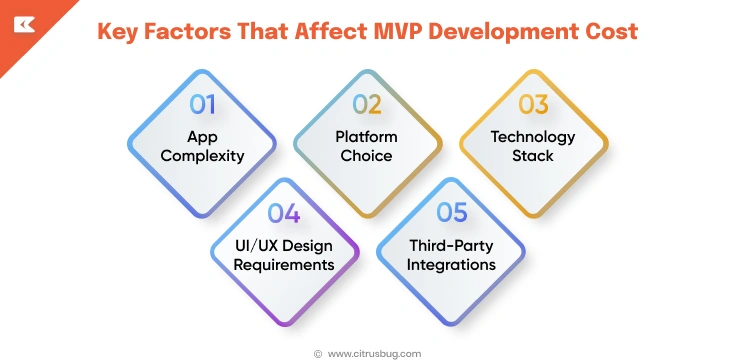
Beyond complexity and timeline, five specific variables influence your final MVP development cost. Each factor can shift the budget by 20–40% in either direction making it critical to evaluate them during the product discovery phase rather than mid-development.
App Complexity
Feature count, user role variety, and data processing requirements define app complexity. A single-role application with five core screens costs significantly less than a multi-role platform with real-time dashboards, notification engines, and automated workflows. Each additional feature layer compounds development hours across frontend, backend, and QA workstreams simultaneously.
Platform Choice
Building for iOS alone, Android alone, or both platforms simultaneously impacts cost by 30–50%. Cross-platform frameworks like React Native and Flutter reduce this gap by enabling shared codebases, but platform-specific features like biometric authentication or hardware integrations still require native development adding to the baseline startup development budget.
Technology Stack
Tech stack selection affects both immediate development speed and long-term maintenance costs. Established frameworks like React, Node.js, Django, and PostgreSQL offer extensive community support, reducing debugging time. Emerging technologies such as serverless architecture or edge computing may accelerate specific features but carry higher specialist labor rates and steeper learning curves.
UI/UX Design Requirements
Custom-designed interfaces with motion graphics, micro-interactions, and branded design systems cost three to five times more than template-based approaches. However, investing in professional UI/UX design services increases user engagement metrics by up to 200%. For consumer-facing MVPs, design quality directly determines whether early adopters convert into retained users.
Third-Party Integrations
Each external service integration payment processors like Stripe, communication APIs like Twilio, and analytics platforms like Mixpanel add 20–60 development hours depending on API complexity and documentation quality. Pre-built SDKs reduce integration time, but custom middleware for legacy systems or niche platforms can expand the overall software development cost significantly.
MVP Development Cost by Industry
Industry vertical determines MVP cost as much as technical complexity. Regulated sectors like healthcare and finance require compliance layers that increase both development time and testing overhead. Below is a 2026 cost breakdown across five high-demand verticals.
FinTech MVP
FinTech MVPs range from $50,000 to $150,000 due to mandatory compliance with PCI-DSS, KYC/AML regulations, and financial data encryption standards. Payment processing integrations, real-time transaction monitoring, and multi-factor authentication add complexity that standard consumer apps rarely require. Working with an experienced fintech development partner reduces compliance-related rework significantly.
MVP for Healthcare
Healthcare MVPs typically cost $60,000 to $200,000. HIPAA compliance, HL7/FHIR data interoperability standards, and patient data encryption requirements create a regulatory baseline that drives costs above general-purpose applications. Telehealth features, EHR integrations, and diagnostic workflows each add dedicated agile development sprints to the project timeline.
MVP for E-commerce
E-commerce MVPs range from $30,000 to $80,000, benefiting from mature ecosystem tools like Stripe, Shopify APIs, and pre-built cart frameworks. Core requirements include product catalog management, secure checkout flows, inventory tracking, and order fulfillment dashboards. Marketplace models with multi-vendor support push costs toward the higher end of this range.
MVP for EdTech
EdTech MVPs typically cost $35,000 to $90,000. Core features include content delivery systems, progress tracking dashboards, assessment engines, and role-based access for students, instructors, and administrators. Video streaming infrastructure and real-time collaboration tools represent the largest variable cost components within this vertical.
Logistics MVP
Logistics MVPs range from $40,000 to $120,000, driven by real-time GPS tracking, route optimization algorithms, fleet management dashboards, and multi-party coordination workflows. IoT sensor integrations and predictive delivery analytics push costs toward the upper range. Companies investing in scalable logistics platforms often partner with a SaaS application development company to build multi-tenant architecture from the start.
MVP Development Cost Comparison: Freelancers vs In-House vs Agency
Your team structure choice impacts not just cost but delivery speed, code quality, and long-term maintainability. Each model carries distinct tradeoffs that founders must weigh against their budget constraints, timeline pressure, and technical oversight capacity.
Hiring Freelancers for MVP Development
Freelancers charge $25–$100 per hour depending on geography and specialization, making them the lowest-cost option on paper. However, coordination overhead across multiple independent contractors, inconsistent code quality, and limited accountability often result in hidden costs through delayed timelines and post-launch technical debt requiring expensive refactoring.
Building an In-House MVP Development Team
An in-house team provides maximum control but carries the highest cost $80,000 to $150,000 annually per developer before benefits, equipment, and workspace expenses. For startups without existing engineering infrastructure, the recruitment timeline alone can delay product launch by three to six months, consuming runway before a lean startup approach can even begin.
Partnering with an MVP Development Agency
Agencies offer dedicated cross-functional teams of designers, frontend and backend developers, QA engineers, and project managers at a predictable project cost of $40,000 to $200,000. Professional MVP development services provide structured agile workflows, code review processes, and deployment pipelines that reduce time-to-market while maintaining production-grade quality standards.
How AI Is Changing MVP Development Costs in 2026
Artificial intelligence is reshaping how MVPs are built and what they cost. From accelerating development workflows to becoming a core product feature, AI’s dual role in 2026 creates both cost-saving opportunities and new budget considerations that every founder should evaluate before scoping their project.
AI-Assisted Development
AI coding assistants like GitHub Copilot, Cursor, and Amazon CodeWhisperer now generate 30–50% of boilerplate code in production environments. Development teams using these tools report 25–40% faster sprint completion rates. This productivity gain translates directly into reduced labor hours, compressing a typical three-month MVP timeline into eight to ten weeks.
Generative AI Features in MVPs
Embedding generative AI capabilities chatbots, content generation, image analysis, and recommendation engines into an MVP adds $10,000 to $50,000 depending on model complexity and data requirements. Pre-trained API services reduce this cost versus custom model training, but prompt engineering and fine-tuning still require specialized AI software development solutions expertise.
Cost Impact of AI Integrations
AI integrations create a cost paradox: they reduce development labor through automation while simultaneously adding infrastructure expenses through GPU compute, model hosting, and data pipeline maintenance. In 2026, the net effect depends on whether AI serves as a development tool, a product feature, or both each scenario producing distinctly different budget profiles for prototype-to-product journeys.
How to Choose the Right MVP Development Company
Selecting the right development partner determines whether your MVP launches on budget and on schedule. Beyond hourly rates, five evaluation criteria separate reliable partners from vendors who deliver incomplete products. Founders who invest time in partner evaluation during discovery consistently report lower total project costs.
Technical Expertise
Evaluate the team’s proficiency in your required tech stack — not just language capabilities, but experience with your specific architecture pattern. A company building an MVP for your SaaS startup should demonstrate expertise in multi-tenant architecture, subscription billing, and horizontal scaling rather than simply listing programming languages on their website.
Industry Experience
Domain expertise reduces development time by 20–30% because teams familiar with industry-specific compliance requirements, user expectations, and integration ecosystems avoid the learning curve that inflates app development budgets. Ask for case studies in your vertical generic portfolios signal that compliance and domain logic will be learned at your expense.
Portfolio Evaluation
Review completed projects with attention to UI quality, load performance, and feature depth not just visual screenshots. Request access to live applications or demo environments. Companies showcasing successful MVP examples across multiple industries demonstrate the architectural versatility needed to handle unexpected scope changes without derailing your timeline.
Communication & Agile Process
Weekly sprint reviews, daily standups, and transparent task boards are non-negotiable. Ask how the team handles scope changes mid-sprint, how they document technical decisions, and what their escalation process looks like when blockers arise. Poor communication remains the leading cause of MVP budget overruns, exceeding any purely technical factor.
Pricing Transparency
Reputable companies provide detailed cost breakdowns by development stage, not single lump-sum estimates. Request a phase-wise budget showing product discovery, design, development, testing, and deployment costs separately. This granularity lets you compare proposals accurately, identify where one vendor’s quote differs from another’s, and maintain product-market fit alignment throughout development.
What Will MVP Development Cost in 2027 and Beyond?
Three forces will reshape MVP costs through 2027: AI-generated code reducing manual development hours by an estimated 40–60%, no-code and low-code platforms enabling non-technical founders to build basic MVPs independently, and rising cybersecurity requirements adding compliance costs across all verticals. The net effect will likely lower entry-level MVP costs while increasing budgets for advanced, scalable architecture products significantly.
Final Takeaway: What Should Your MVP Budget Look Like in 2026?
The cost to develop an MVP in 2026 ranges from $15,000 for a basic validation prototype to $250,000+ for an enterprise-grade product with AI capabilities and regulatory compliance. Your final budget depends on complexity, industry, team model, and technology choices. Rather than optimizing for the lowest price, invest in a development partner who delivers a product that achieves product-market fit because the most expensive MVP is one that nobody uses.