
 Back
Back







Healthcare data breach statistics for 2026 show that attacks are growing faster than most hospitals can respond to them, and the money being spent to fix that gap is growing just as fast.
Patient records sit at the center of this problem because they hold everything an attacker needs in one place identity details, insurance numbers, billing history, and clinical history.
That combination makes a single stolen record worth far more on the black market than a stolen credit card number, which is exactly why hospitals, insurers and health tech vendors keep showing up at the top of breach reports year after year.
This article walks through the numbers behind that pressure, but it does not stop at the statistics. Each major cause of healthcare data breaches is paired with the solution the industry is actually building for it, and the market value tied to that solution.
What Counts as a Healthcare Data Breach
A healthcare data breach happens when protected health information, things like medical records, insurance details, or patient identifiers, gets accessed, stolen or exposed without permission.
It can come from a hacking attempt, a ransomware attack, a lost laptop, an employee mistake, or a vulnerability in a third-party system that connects to a hospital network.
The reason these incidents get so much attention is simple. A stolen health record cannot be reset the way a password or a credit card number can. Once medical history and insurance information are exposed, they can be used for identity theft and insurance fraud for years afterward.
On top of that, providers face regulatory fines, expensive cleanup work and a hit to patient trust that can outlast the breach itself by a long stretch. That combination is what pushes prevention and fast detection to the top of the priority list for almost every health system.
Healthcare Data Breach Statistics 2026: The Scale of the Problem
Before getting into causes and fixes, it helps to see just how large this problem has become. The numbers below describe reported incidents rather than spending, and they set the stage for everything that follows.
Breach Volume and Records Exposed
Large-scale healthcare breaches reached 677 major incidents in 2024 alone, exposing 182.4 million patient records across the country. A large share of these events traced back to third-party vendors and business associates rather than a direct hit on a hospital’s own network, which says a lot about where the weakest links actually sit.
Separately, official reporting channels logged 725 large healthcare data breaches in 2024. Consistent reporting like this gives regulators and providers a much clearer picture of where incidents originate, which in turn shapes where new security spending gets directed.
Year-Over-Year Escalation
Breach activity did not just stay high. It kept climbing, increasing by 55.2% year over year heading into 2025. That pace has outrun growth in most other categories of reported cybercrime, and it is the single biggest reason healthcare cybersecurity budgets keep expanding rather than leveling off.
The Root Causes Behind Healthcare Data Breaches, and What’s Being Built to Fix Each One
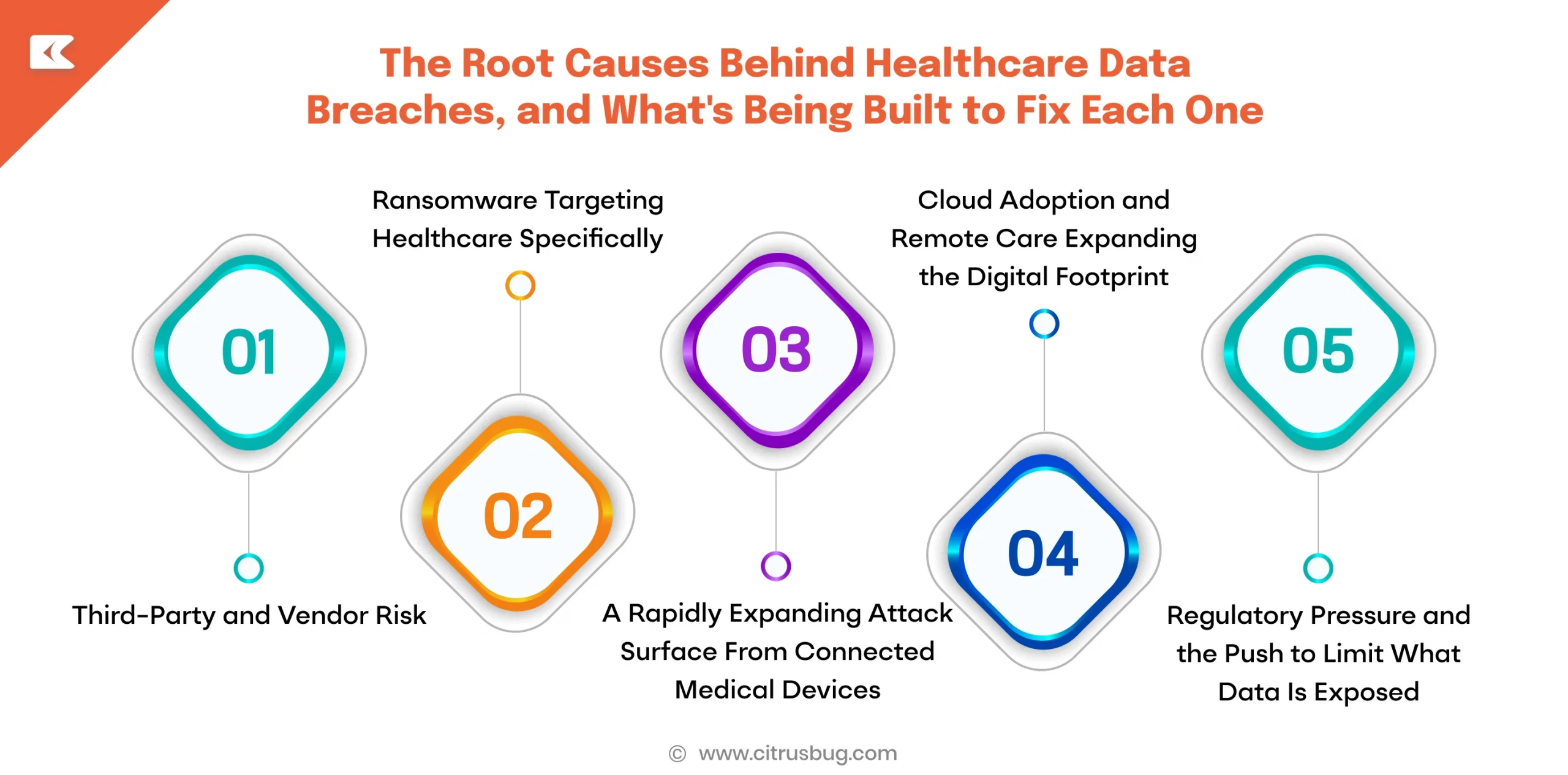
Statistics alone do not explain why breaches keep happening. The sections below break the problem into its main causes, and next to each one sits the solution category the industry is actually investing in, along with the market value attached to it.
Cause 1: Third-Party and Vendor Risk
A large portion of major healthcare breaches trace back to vendors and business associates rather than the hospital’s own systems.
Billing companies, cloud hosting partners, scheduling platforms and outside labs all touch patient data at some point, and each connection is a door an attacker can walk through if the vendor’s own security is weak.
The solution: Instead of building every security function in-house, more health systems are outsourcing continuous monitoring to specialists who watch vendor connections around the clock.
Managed security services built specifically for this kind of oversight are projected to grow to USD 77.01 billion worldwide by 2030, as smaller providers lean on outside teams rather than trying to staff this expertise internally.
Cause 2: Ransomware Targeting Healthcare Specifically
Ransomware groups have gone after healthcare more aggressively than almost any other sector, because a hospital under attack faces urgent pressure to pay quickly just to keep patient care running.
One dominant ransomware operation alone has been linked to roughly one-third of all reported ransomware attacks across the United States, which shows how concentrated these campaigns against a single industry have become.
The solution: Detection has shifted from periodic scans to continuous, automated monitoring built to catch ransomware before it spreads. Modern detection platforms now block up to 96% of real-time threats before they ever reach a hospital network, and that level of performance has become a baseline expectation for any vendor selling into this market rather than a selling point.
Cause 3: A Rapidly Expanding Attack Surface From Connected Medical Devices
Hospitals now run thousands of connected devices, from infusion pumps to remote patient monitors to diagnostic imaging systems.
Each one is a potential entry point, and many of them run specialized software that cannot be patched the same way a normal laptop can.
More than 60% of healthcare organizations now use Internet of Medical Things solutions across clinical and administrative work, which means the device fleet security teams have to protect just keeps growing.
The solution: Purpose-built device security has become its own market rather than an add-on to general IT security.
That segment reached USD 9.07 billion in 2026, with software and platform tools making up 56.2% of that spending.
Looking ahead, medical device security spending on its own is projected to climb to USD 12.17 billion by 2031 as manufacturers start building protection directly into new equipment instead of treating it as a separate purchase.
Cause 4: Cloud Adoption and Remote Care Expanding the Digital Footprint
Telehealth platforms, remote monitoring tools and cloud-hosted patient records have all expanded how much of a hospital’s data lives outside its own four walls.
Over 78% of hospitals have now adopted at least one cloud-enabled application, and 81% rank cloud cybersecurity as a top priority, which tells you how quickly this shift has outpaced older security models built around a single physical network perimeter.
The solution: Zero Trust architecture, which requires continuous verification of every user and device rather than automatic trust once someone is inside the network, has become the standard response.
Healthcare now accounts for 31.1% of the broader market, with adoption strongest among large health systems managing multiple facilities and a wide mix of connected devices.
Cause 5: Regulatory Pressure and the Push to Limit What Data Is Exposed
Regulators keep tightening reporting timelines and security requirements for anyone handling patient data, and providers are increasingly treating compliance spending as mandatory rather than optional.
One direct response to this pressure has been the growth of data de-identification, the practice of removing or masking identifiable patient details before data is shared for research or analytics, which limits exposure even if a breach occurs.
The solution: This segment grew from USD 0.4 billion in 2025 to USD 0.5 billion in 2026, a pace equal to a 12.3 percent compound annual growth rate.
Growth here tracks closely with rising demand for healthcare data analytics, since de-identified records carry less regulatory risk if they are ever intercepted.
Healthcare Cybersecurity Market Value: What the Industry Is Spending to Fix All of This
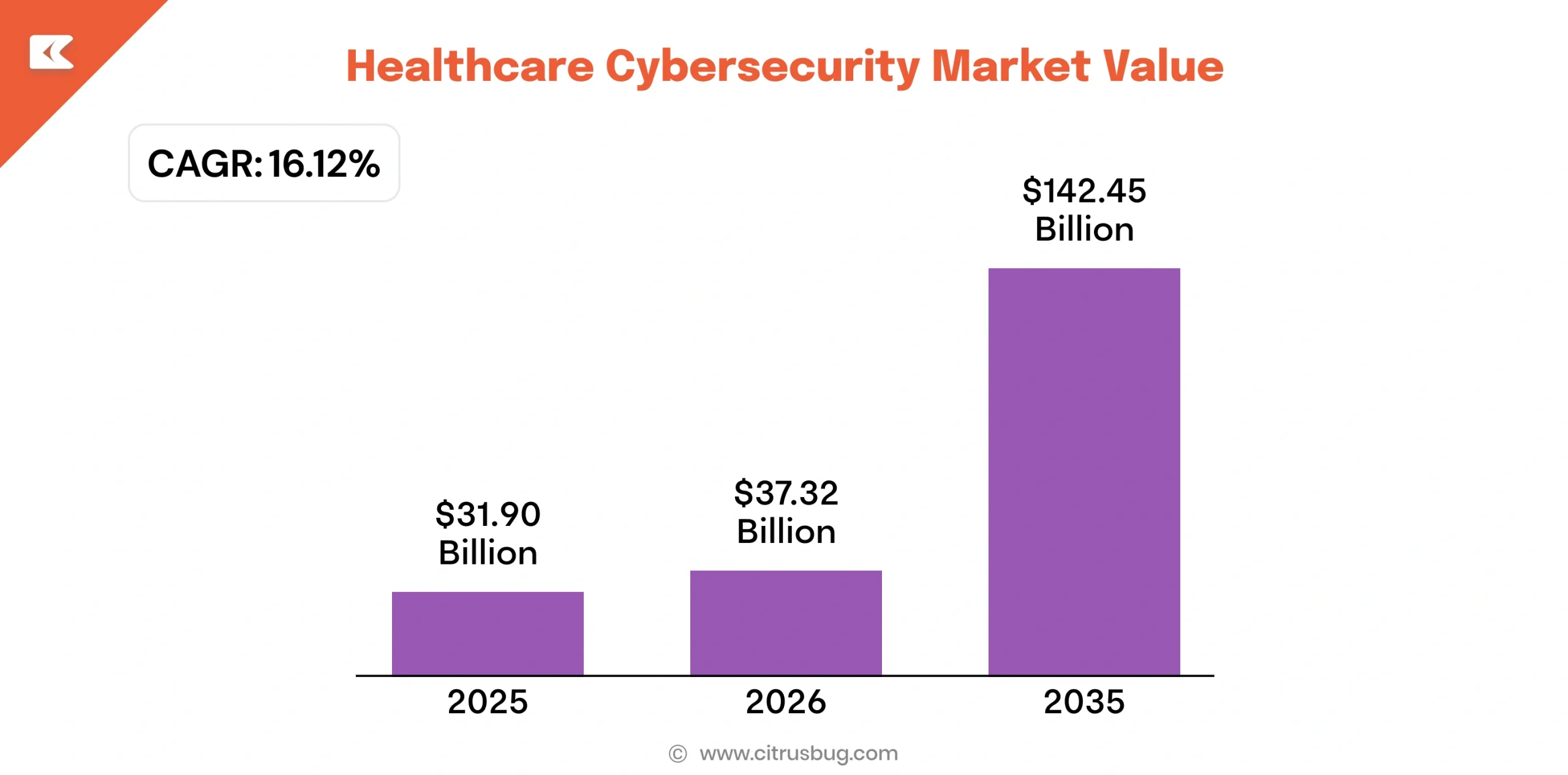
Every cause above feeds into one overall number how much healthcare organizations are spending on security in total.
Global Market Size and Growth Rate
The global healthcare cybersecurity market reached USD 31.90 billion in 2025 after several consecutive years of steady growth. It is projected to climb to USD 37.32 billion in 2026 as adoption spreads from large hospital systems down to smaller clinics and regional providers.
That expansion works out to a compound annual growth rate of 16.12% between 2024 and 2030, a pace that places healthcare among the faster-growing segments of the broader cybersecurity industry.
Growth at that rate points to durable, structural demand rather than a short-term reaction to a bad news cycle.
Where the Spending Actually Goes
Software-based protection tools draw the largest share of healthcare cybersecurity budgets by a wide margin.
Categories like endpoint protection, encryption and access management dominate purchasing decisions, and this category alone holds 65.29% of the overall healthcare cybersecurity market in 2026, well ahead of managed services and consulting work combined.
Vendors here increasingly compete on how deeply their tools integrate with existing hospital software rather than on price alone.
Regional Investment Patterns
Spending is not distributed evenly around the world. Regulatory pressure, hospital digitization, and market maturity all shape how fast each region has moved to address the causes described above.
North America
North America holds the largest share of the healthcare cybersecurity market, valued at USD 8.68 billion in 2025, equal to 38.50% of global revenue. That figure is projected to reach USD 10.12 billion in 2026.
This scale reflects a dense concentration of large health systems and health technology vendors that already run dedicated cybersecurity budgets, and ongoing consolidation among providers has concentrated purchasing power among fewer, larger buyers.
Asia Pacific
Asia Pacific reached USD 4.64 billion, a 20.60% global share, in 2025, with regional spending projected to climb to USD 5.49 billion in 2026.
Growth here is tied closely to rapid hospital digitization across several fast-growing economies, where government-led digital health initiatives keep expanding the base of hospitals investing in dedicated security infrastructure for the first time.
Europe
Europe’s healthcare cybersecurity market stood at USD 5.99 billion in 2025, equal to 26.60% of global revenue, and is projected to reach USD 7.02 billion in 2026.
Cross-border data protection rules add another layer of complexity for providers operating in multiple countries, which helps explain the region’s steady, sustained investment growth.
[Source: Fortune Business Insights]
How Solutions Are Actually Being Implemented on the Ground
The statistics above describe budgets and market segments, but it helps to see what that spending looks like in practice.
Device security partnerships: Device manufacturers are partnering directly with health systems to build security into diagnostic and treatment equipment from the start, covering firmware hardening, encrypted device communication and simplified patch management. Shared roadmaps like this also let smaller hospitals access protections they could never build on their own.
Network segmentation: Larger health systems now divide internal networks into isolated segments, so a single compromised device or workstation cannot reach patient record systems directly. This buys security teams extra time to detect and contain an intrusion before it turns into a full network compromise.
Ransomware response planning: Health systems are building detailed response playbooks that spell out which systems to isolate, who to notify, and how to keep patient care running if core systems go offline. Regular tabletop exercises let clinical and IT staff practice these steps long before a real incident happens.
Cloud migration with built-in compliance: Providers moving records and applications to the cloud are increasingly choosing platforms that build compliance controls into the infrastructure itself, cutting down the manual work needed to pass audits while still letting clinical staff access records securely from multiple devices and locations.
Future Outlook: Where This Spending Is Headed Next
Every trend covered above points toward continued growth across nearly the entire security stack, with investment broadening beyond large hospital systems into smaller practices, outpatient clinics and regional health networks.
Global market value is projected to reach USD 35.3 billion by 2028 as adoption spreads to smaller providers that historically under-invested in dedicated security staff.
Longer-term, the market is projected to reach USD 56.3 billion by 2030, reflecting sustained investment in prevention and detection as breach-related costs keep climbing.
The broader health IT security segment, which includes infrastructure spending across insurers, clearinghouses and health technology vendors beyond direct providers, is forecast to reach USD 96.3 billion by 2032. That wider figure shows how security budgets now extend well past the walls of any single hospital.
Conclusion
Healthcare data breach statistics for 2026 describe an industry that is finally treating cybersecurity as core to patient care rather than a background IT function.
Every cause behind rising breach numbers, from vendor risk and ransomware to connected devices, cloud expansion and regulatory pressure, now has a corresponding solution attracting real, measurable investment.
As threats keep evolving, the providers that pair strong internal practices with well built healthcare software and purpose-made security platforms will be the ones that keep patient data safe and hold on to patient trust in the years ahead.