CarePoint
CarePoint is a comprehensive pharmacy and clinical management solution developed by Citrusbug, centralizing inventory, patient prescriptions, dispensing workflows, and compliance reporting for multi-location healthcare operations.
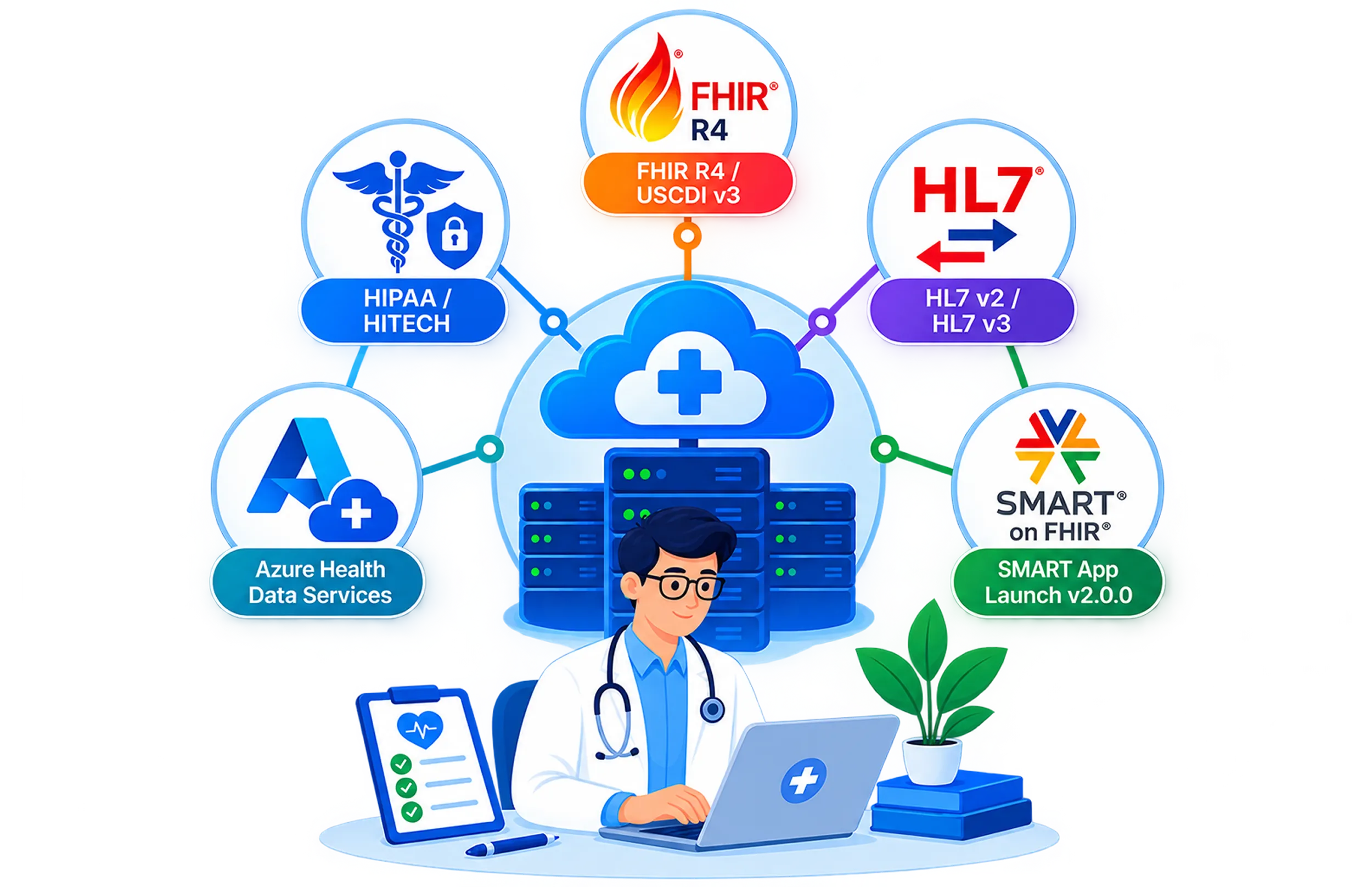
Citrusbug builds custom software for hospitals, health networks, and integrated delivery systems from FHIR R4-ready EHR integration and prior authorization engines to AI-driven clinical documentation and revenue cycle platforms. Every system ships HIPAA-compliant, USCDI v3-aligned, and built to survive the next regulatory cycle without a rebuild.
Trusted by industry leaders
Hospital technology environments are rarely designed; they accumulate. A health system that has grown through acquisition typically runs three or four different EHR platforms, each with its own data model, each requiring separate credentialing, and none sharing patient records automatically. Care coordination breaks down at handoffs. Clinicians document the same information twice. Prior authorization queues grow because payer APIs and EHR ordering workflows were never connected.
The financial consequences are measurable: denial rates climb when coding is inconsistent, patient flow slows when bed management runs on phone calls, and revenue leaks when remittance reconciliation is manual. The systems exist. What’s missing is the integration layer that makes them work as a single clinical operation.
Talk to a healthcare software engineer who has built for this environment before.
Book a Free ConsultationCustom electronic health record platforms and module extensions for specialty workflows built for ONC CEHRT requirements, USCDI v3 data elements, and seamless attachment to Epic or Oracle Health environments without forking the core EHR footprint.
Patient-facing web and mobile applications covering appointment booking, secure messaging, prescription refill requests, and telehealth access. Connected to back-office scheduling and EHR systems via FHIR R4 APIs and SMART App Launch v2.0.0 for single-sign-on patient access.
Platforms covering charge capture, claim scrubbing, payer contract management, and denial root-cause analysis. Built with X12 EDI transaction support and real-time eligibility verification to reduce clean claim rate variance across payer mix.
Decision Support Intervention (DSI)-aligned tools that deliver evidence-based alerts at the point of care, surface risk stratification data for care management teams, and log algorithm transparency data per ONC HTI-1 predictive DSI requirements.
Analytics platforms built on Azure Health Data Services or AWS HealthLake, aggregating data across care settings for population health management, quality measure reporting, and value-based care program performance tracking.
IoT-connected RPM platforms that integrate wearable and medical device data directly into the EHR care plan with alert logic, escalation workflows, and chronic disease management protocols tailored to each program’s clinical team.
Hospital software projects range from $30,000 for a focused integration or patient portal build to $150,000+ for multi-system programs covering EHR integration, prior authorization automation, and AI-assisted documentation. Scope, compliance requirements, and integration complexity drive the range. Fill out the form and we'll send a tailored estimate within one business day.
Citrusbug builds health system software on the frameworks regulators require and clinical environments demand, from FHIR APIs to cloud-native data infrastructure.
We build provider-side Prior Authorization API systems aligned with ONC HTI-4 criteria (§170.315(g)(31-33)) and integrated into EHR ordering workflows. When a clinician places an order, the system queries payer coverage rules in real time and triggers the prior auth process without a separate staff workflow. This connects directly to payer Prior Auth APIs mandated under CMS 2024 interoperability rules, reducing authorization turnaround from days to hours.
We build AI-assisted documentation pipelines that listen during patient encounters, generate structured clinical notes, and push draft content into the EHR for physician review and signature. Healthcare AI consulting services cover PHI handling, responsible AI governance, and documentation accuracy validation before any system touches live encounters. The result: physicians spend less time on note completion and more time on the next patient.
We build revenue cycle management software that covers the full lifecycle from charge capture to remittance posting with denial prediction models trained on payer-specific patterns, automated coding review for high-value DRGs, and remittance reconciliation that closes the loop on underpayments. Clean claim rate improvements and days-in-AR reduction are the direct operational outputs.
Requirements gathering, regulatory gap analysis, and documentation of HIPAA compliance obligations, FHIR endpoint architecture, and payer integration scope completed before any code is written. Includes BAA execution and security architecture review.
System architecture design covering EHR integration patterns, data flow diagrams, API contract definitions, and cloud infrastructure selection, including Epic FHIR API scope, Azure Health Data Services configuration, or AWS HealthLake design as applicable to the environment.
Development under Citrusbug's Secure ADLC methodology, security controls, PHI handling, and audit logging embedded at the code level from sprint one. Daily progress updates and regular demos keep clinical and IT stakeholders aligned throughout the build cycle.
Functional testing, security penetration testing, HIPAA technical safeguards review, and clinical workflow validation with actual end-user scenarios. Compliance documentation, including audit trail verification and access control testing delivered alongside the QA report.
Production deployment with zero clinical downtime planning, data migration with full historical record preservation, and post-launch support under structured SLA tiers. Teams have access to L1/L2/L3 support options covering incident response, patch management, and enhancement requests.
Most healthcare legacy software modernization projects fail for one of two reasons: the vendor replaces everything simultaneously, or they modernize the UI without touching the data layer. The result is either months of clinical disruption or a modern-looking system still running on a 2009 database that can’t support FHIR R4 API queries.
Citrusbug takes a module-by-module approach. We identify which components block USCDI v3 compliance, which workflows generate the most manual overhead, and which integration points create the highest denial risk, then sequence the modernization to deliver operational improvements at each phase rather than requiring a complete cutover before anything changes.
Every system is designed with HIPAA technical safeguards, role-based access controls, audit logging, and PHI encryption in transit and at rest from sprint one, not added after the build is complete.
Clients see the specific engineers assigned to their project before signing. No offshore hand-offs mid-project, no rotating junior teams, the same engineers who scoped the architecture deliver the production system.
Citrusbug builds FHIR-native APIs, SMART App Launch v2.0.0 flows, and USCDI v3 data element support aligned with ONC HTI-1 requirements that became mandatory across certified health IT as of January 2026.
Clients receive full source code, documentation, and deployment assets at delivery. No vendor lock-in, no ongoing licensing dependency, no renegotiation required when your technical strategy changes.
Citrusbug’s Secure ADLC embeds security controls, PHI handling standards, and audit trail requirements at the code level throughout the development cycle, reducing compliance remediation costs after go-live.
Structured L1/L2/L3 support tiers covering incident response, compliance patch management, and enhancement delivery are available for teams that need a long-term operational partner, not just a project handover.
A scoped build targeting a single system or integration - prior auth API, a patient portal, or an RCM module.
A phased delivery program covering multiple interconnected systems, EHR integration, workflow automation, and analytics sequenced over 6-12 months.
An embedded Citrusbug team that works within your IT organization on ongoing development, compliance updates, and system evolution.
A reference of the regulatory standards and interoperability frameworks covered across Citrusbug's hospital and health system service lines.
| Service Area | Key Standards | ONC Compliance Scope | Complexity |
|---|---|---|---|
|
EHR Integration |
FHIR R4, USCDI v3, HL7 v2, SMART App Launch v2 |
HTI-1 API Criteria (§170.315(g)(10)) |
High |
|
Prior Authorization APIs |
§170.315(g)(31-33), CMS Prior Auth API, X12 278 |
HTI-4 Criteria |
High |
|
Clinical Documentation (AI) |
ONC Predictive DSI Transparency, PHI Handling |
HTI-1 DSI Criterion (b)(11) |
High |
|
Revenue Cycle Platforms |
X12 EDI, NCPDP, CMS-1500, UB-04 |
CMS Promoting Interoperability |
Medium |
|
Patient Portal / Digital Front Door |
FHIR R4, SMART App Launch v2, HIPAA |
21st Century Cures Act |
Medium |
|
Remote Patient Monitoring |
FHIR, HL7, FDA SaMD Class II (if applicable) |
FDA, HIPAA |
High |
|
Analytics / Population Health |
HL7 FHIR Bulk Data, Azure Health Data Services |
ONC Insights Condition |
Medium |
CarePoint is a comprehensive pharmacy and clinical management solution developed by Citrusbug, centralizing inventory, patient prescriptions, dispensing workflows, and compliance reporting for multi-location healthcare operations.

A state-of-the-art wellness and patient engagement platform built for Mediyoga, integrating guided care programs, health tracking, and provider-patient communication into a unified digital experience.
Droice Labs is a middleware designed to transform messy, unstructured patient data into clean, analysis-ready formats for clinical trials.
Yes. Citrusbug builds on top of existing EHR environments using Epic FHIR Hyperdrive APIs, Oracle Health REST APIs, and Redox-based HL7 routing. We extend functionality without requiring a core EHR replacement.
We execute a BAA before work begins and apply Citrusbug's Secure ADLC methodology throughout the build. PHI handling, encryption, role-based access, and audit logging are enforced at the code level from sprint one.
USCDI v3, now the ONC baseline per HTI-1 (effective January 2026), requires certified health IT to support an expanded set of data elements, including Social Determinants of Health data, updated clinical note types, and revised vocabulary standards. We scope USCDI v3 alignment into every EHR integration project from the architecture design.
A provider-side Prior Auth API aligned with ONC HTI-4 criteria typically takes 10-16 weeks from requirements to production, depending on payer API maturity and EHR integration complexity. We deliver milestone demos throughout, not just a final handover.
Yes. Citrusbug regularly inherits stalled or partially delivered projects. We audit existing code, identify what's salvageable, and deliver a realistic completion plan before committing to a timeline.
We build on Azure Health Data Services, AWS HealthLake, and GCP Healthcare API, depending on existing hospital infrastructure and regulatory requirements. All deployments include encryption at rest, disaster recovery planning, and HIPAA-compliant access controls.
Data migration includes full historical record preservation, format conversion to FHIR-compatible data structures where applicable, validation against target system schemas, and a parallel-run period before final cutover. No records are lost or truncated in transition.
Yes. Structured L1/L2/L3 SLA support tiers are available covering incident response, compliance patch management, and enhancement delivery. Teams that need a long-term engineering partner rather than a project handover can engage in a dedicated support model.