Back
Back







Big data analytics is the collection of processes and advanced technologies used by organizations to adopt the data-driven decision-making model. Here, we’ll discuss how big data analytics can unleash the power of data and help a business to achieve its goals.
The data-driven decision-making model is a powerful way to maintain business competitiveness, improve customer satisfaction, and increase revenue. In today’s world, businesses rely on artificial intelligence tools to collect, store, and analyze large volumes of data. Big data analytics offers the necessary speed, efficiency, and agility to harness its data and make effective decisions in real-time.
The global big data analytics market is projected to reach over $500 billion by 2028, growing at a CAGR of around 13%, driven by enterprise adoption of cloud platforms, AI-powered analytics, and real-time data processing across industries. According to NewVantage’s Data and AI Executive survey, 97.2% of the major organizations globally are investing in big data, artificial intelligence tools, and Ad Intelligence Tools that help them track digital campaign effectiveness and refine ad strategies.
But how does big data analytics help a business unlock the power of data? What benefits does it offer to an enterprise? Let’s find out in this blog.
What is Big Data Analytics?
Big data analytics is the process of collecting, cleaning, sorting, arranging, and analyzing vast volumes of data. It is used to detect complex patterns, trends, hidden correlations, and other insights. The insights help the management and employees make faster, better, and more proactive decisions to boost the business.
Big data analytics requires advanced tools and algorithms. AI, machine learning for data analytics, and process mining are used to analyze large datasets and derive insights that are structurally impossible to surface through traditional query-based analytical techniques, particularly in detecting non-obvious correlations, classifying unstructured content, and building predictive models that improve with each new data cycle.
How Big Data Analytics Works?
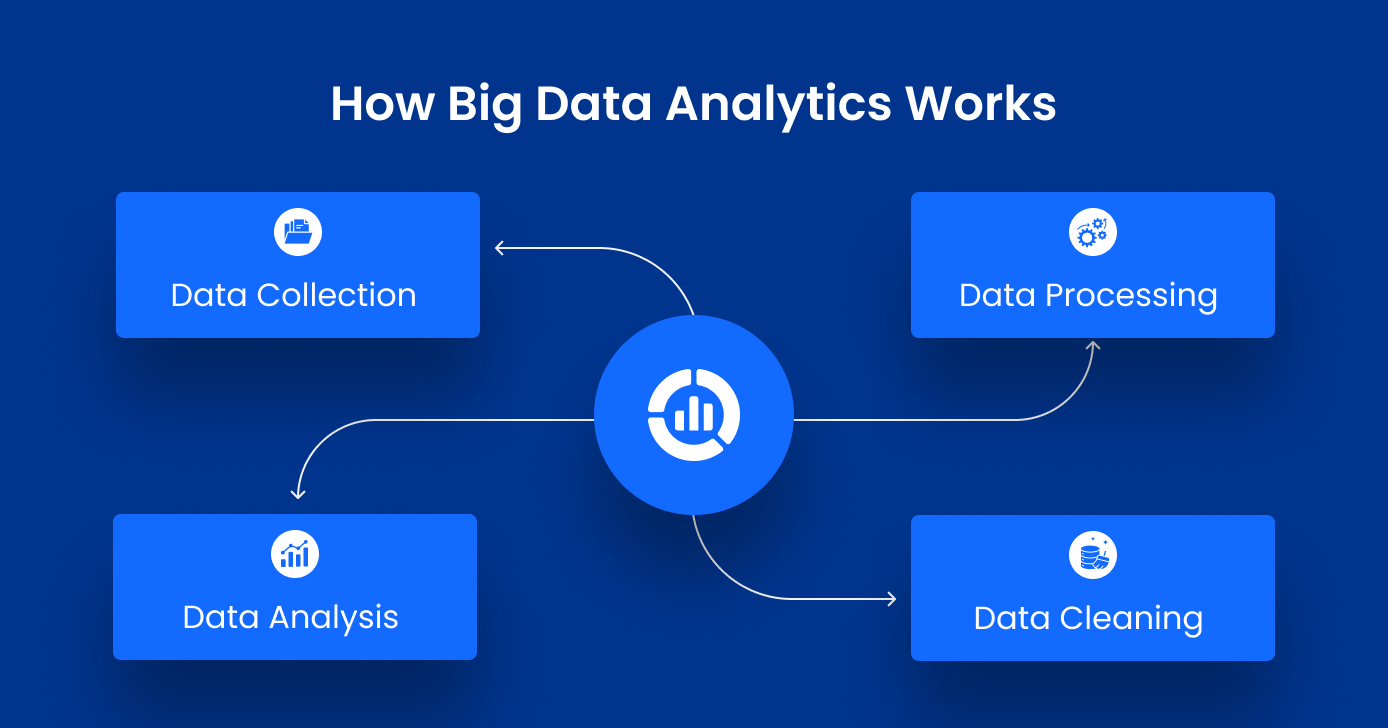
Big data analytics is a series of automated and semi-automated tasks that make an organization’s big data operational and useful for decision-making.
Data Collection
A business should collect data from multiple sources. The latest technology makes it possible for a business to gather structured, semi-structured, and unstructured data from internal and external sources. Many companies prefer investing in cost-efficient web scraping tools to collect data at scale. Using a reliable data scraping tool, businesses can automate the extraction of valuable insights from websites and online platforms, ensuring accuracy and saving time compared to manual collection. For large-scale web scraping operations, implementing a web scraping proxy infrastructure is essential to avoid IP blocks and access restrictions. Proxy rotation enables businesses to distribute requests across multiple IP addresses, preventing detection and ensuring uninterrupted data collection from target websites, which is critical for maintaining reliable data pipelines.
This data can be stored in a central data warehouse or a data lake. IoT (Internet of Things) devices, cloud platforms, mobile apps, web apps, websites, departmental data silos, Customer Retention Management (CRM) software and HRM software, etc., are some examples of data sources.
Data Processing
The collected data has to be processed before it is cleaned. This increases data availability. Data can be processed in batches, where large datasets are sorted, filtered, and labeled over time. It can also be managed through stream processing, where several small batches of data are handled simultaneously. This reduces the time between data collection and data analytics. It is, however, an expensive method.
Data Cleaning
The quality and accuracy of insights depend on the quality of the data analyzed. Data cleaning helps remove duplicate data and reduce the risk of errors. Unwanted data is separated to ensure only high-quality and correctly labelled data is sent to the analytical tools. Skipping this step can lead to incorrect insights and wrong decisions. For effective data management, businesses can also explore Smartsheet alternatives that offer robust project tracking and data organization features.
Data Analysis
The cleaned data is ready for analysis and sent through the analytical tools to be transformed into a usable format. Big data analytics require advanced techniques to process large datasets in real-time and deliver in-depth insights. A few common big data analytical techniques are as follows:
- Predictive Analytics: Historical data is used to determine the possible future AI & ML trends and patterns in the market. It helps analyze the potential risks, challenges, opportunities, and market conditions a business has to deal with soon.
- Data Mining: Data mining is a technique used to uncover hidden patterns, trends, and correlations in the data. A business can use data mining to identify anomalies and build data clusters to avoid repeating past mistakes and be proactive in the market.
- Deep Learning: The deep learning technique uses machine learning algorithms and tools to analyze the data and find patterns that cannot otherwise be detected. This method is most suitable for analyzing complex and unstructured data.
Why Big Data Analytics Is Critical for Business Competitiveness in 2026
SMBs and large enterprises need big data analytics to streamline their business and achieve goals. It helps an organization in different ways by improving operational efficiency, reducing costs, and increasing customer satisfaction.
-
Faster and More Effective Decisions
Businesses cannot afford to spend too much time on decision-making in this competitive world. Big data analytics empowers an organization to analyze data streamed from multiple sources in real-time and use the insights to make quick decisions.
-
Reducing Cost and Optimizing Resources
Big data analytics are best run on cloud platforms. This eliminates the need for large on-premises data storage options and multiple silos. The entire business data can be stored on the cloud. Additionally, the insights from the analytics can help businesses reduce wastage and use their resources comprehensively.
-
R&D and Efficient Marketing Strategies
Understanding customer requirements and market demands will help an enterprise develop between products and services. It also helps create impactful marketing strategies to attract a larger target audience to the business.
Challenges of Big Data Analytics
Even though big data analytics is beneficial for a business, the implementation requires time, effort, and experience. Most establishments hire big data analytics service providers to enable end-to-end solutions to implement the technologies in their business and streamline the processes.
-
Data Engineering and Management
With tremendous amounts of data being created every day, businesses need to find ways to store this data. Choosing the right data storage method, setting up proper data flow and system integrations are crucial for a business to effectively implement big data analytics.
-
Data Security and Governance
No business can afford to violate data security and privacy regulations. Government cybersecurity solutions and data compliance should be considered when storing large volumes of business data on-premises and on the cloud.
How to Choose the Right Big Data Analytics Tools and Platform for Your Business
Analytical tools are constantly changing as technologies evolve. The market already has a wide range of big data analytical solutions. However, a business should choose the right tools based on the type of data storage, existing technologies in the ecosystem, and specific requirements to achieve long-term goals.
-
Cultural Adjustments
Despite big data analytics becoming commonplace in many organizations, the management and employees continue to seamlessly integrate it with the work culture. An enterprise can overcome this challenge by updating employees about the latest adoptions and training them to use new technologies. Maintaining two-way communication, addressing employees’ concerns, and aligning the technologies with business goals will help better cultural adjustment.
Benefits of Big Data Analytics
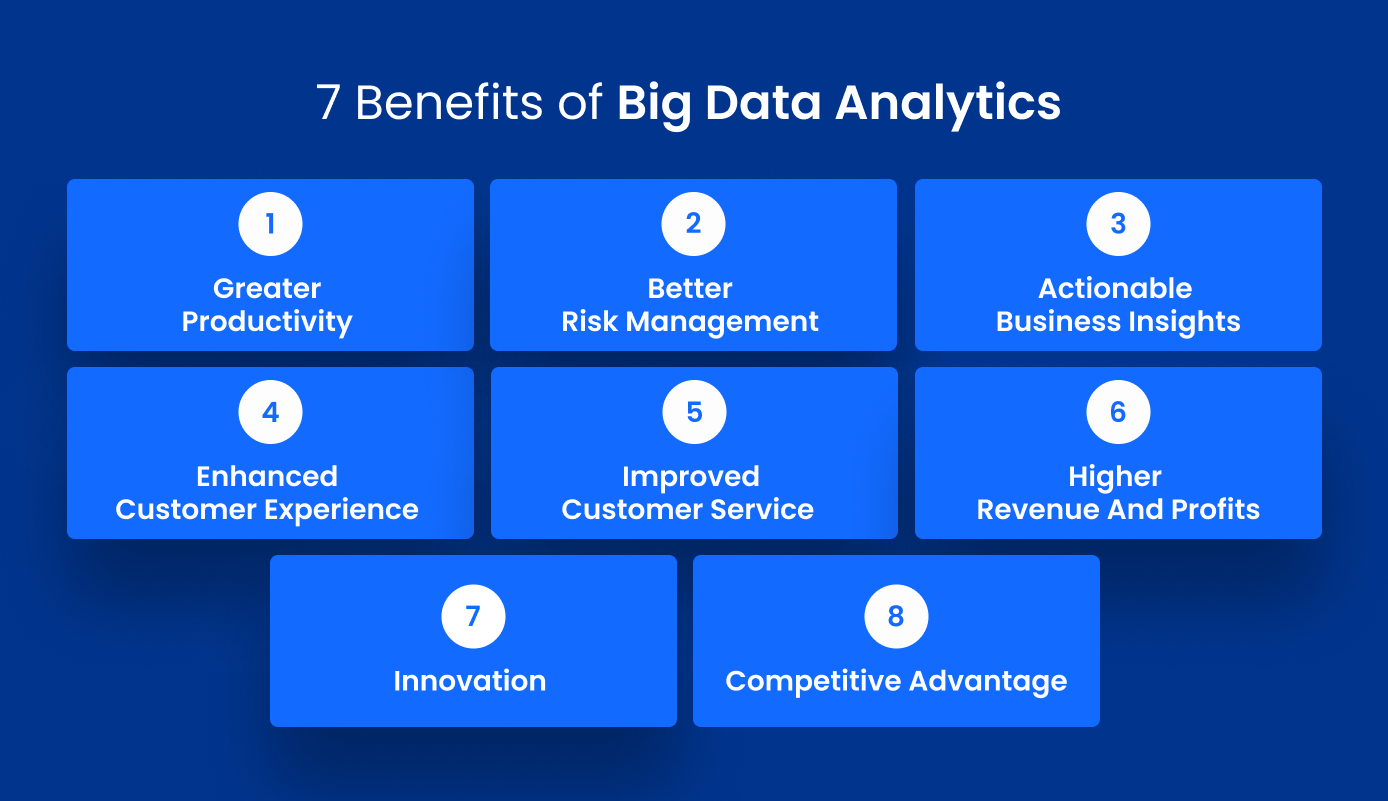
Every business can benefit from big data analytics. It can be used in any industry and customized to suit the requirements of different organizations. Big data analytics offers the following benefits:
-
Greater Productivity
Big data analytics helps streamline repetitive processes through automation. This saves time and allows employees to complete more work in less time without compromising quality. It helps optimize work processes.
-
Innovation
Businesses need to develop new products and services to attract more customers and keep them engaged with the enterprise. Furthermore, the existing products have to be modified or enhanced based on customer feedback and market conditions. Big data analytics provide the necessary insights to innovate according to customer expectations.
-
Enhanced Customer Experience
Customers are vital for the success of an organization. Big data analytics processes customer data from multiple sources, like CRM systems, social media, websites, etc., to identify ways to improve products and services. This enhances customer experience, which, in turn, boosts customer loyalty.
-
Improved Customer Service
The customer support department can use the reports generated by bug data analytics in real-time to effectively answer customers’ queries and solve their issues in quick time. It aids in closing the tickets faster and increases customer satisfaction with the business. This will ultimately lead to greater sales and profits.
-
Better Risk Management
Big data analytics provides businesses with reports to detect prospective risks based on historical and real-time data. This can help avert the issue or find a way to resolve it without attracting losses. Businesses can be proactive instead of struggling with damage control after a crisis strikes.
-
Higher Revenue and Profits
Big data analytics can boost business revenue in many ways. From finding new ways to generate revenue to increasing sales through robust marketing strategies and building a larger customer base, the insights derived from big data analytics can improve the business’s financial position in the long term.
-
Competitive Advantage
Every business needs to consider its competitors in the local and global markets. Staying a few steps ahead is the only way to survive in today’s markets. Big data analytics give an organization an edge over other businesses to make the most of the opportunities.
Big Data Analytics Use Cases by Industry: Where the ROI Is Highest
Big data analytics is not a single technology applied uniformly — it generates different ROI in different sectors based on data volume, decision frequency, and the cost of poor decisions. Understanding where it delivers the highest impact helps organizations prioritize which use cases to implement first.
-
Financial Services
Fraud detection using real-time transaction pattern analysis is the single highest-ROI big data application across any industry — financial institutions using AI-powered big data analytics for fraud prevention report 30–50% reductions in fraud losses. Risk scoring, algorithmic trading, and regulatory reporting automation are secondary high-value applications.
-
Healthcare
Clinical data analytics for patient outcome prediction, supply chain optimization for hospital inventory, and population health management are the leading healthcare use cases. Hospitals using predictive analytics for readmission risk have reduced 30-day readmission rates by 10–20%.
-
Retail and eCommerce
Demand forecasting, personalized recommendation engines, and dynamic pricing are the core retail applications. Amazon’s recommendation engine — fundamentally a big data analytics system — is attributed with driving approximately 35% of the company’s total revenue.
-
Manufacturing
Predictive maintenance, quality control through sensor analytics, and supply chain optimization deliver measurable cost reductions. Manufacturers using IoT-connected big data platforms report 20–40% reductions in unplanned downtime.
-
Logistics
Route optimization, carrier performance analytics, and demand-driven network planning are the primary logistics applications. Real-time data from GPS, IoT sensors, and carrier systems enables dynamic routing decisions that reduce fuel costs and improve delivery reliability simultaneously.
Widely Used Big Data Analytical Tools
The market has many tools to run big data analytics. The most used ones are as follows:
- Tableau
- Microsoft
- Hadoop
- SAS
- IBM Watson
- HPCC
- Lumify
- Apache Spark and Storm
Conclusion
Big data analytics helps with innovation and business transformation. By hiring the right partner, an enterprise can hugely benefit from big data implementation and effectively convert vast datasets into actionable insights.
An organization can promote overall development and productivity by implementing big data analytics in all departments and across various verticals. However, what a business does with big data analytics will determine the results. Create a robust strategy to unlock the power of data through big data analytics and become an industry leader.