
 Back

Key Takeaways
- Healthcare claims denial management helps providers recover unpaid claims, identify recurring errors, and prevent future denials.
- Denial rates vary by dataset, payer, and measurement method. Compare benchmarks only when their definitions align.
- Automation can flag claim errors, prioritize denial work, and support appeals, but complex clinical decisions still require human review.
- Software selection should consider prevention capabilities, EHR integration, reporting, security, and total cost of ownership.
- The right approach may involve buying software, building custom functionality, outsourcing denial work, or combining these options.
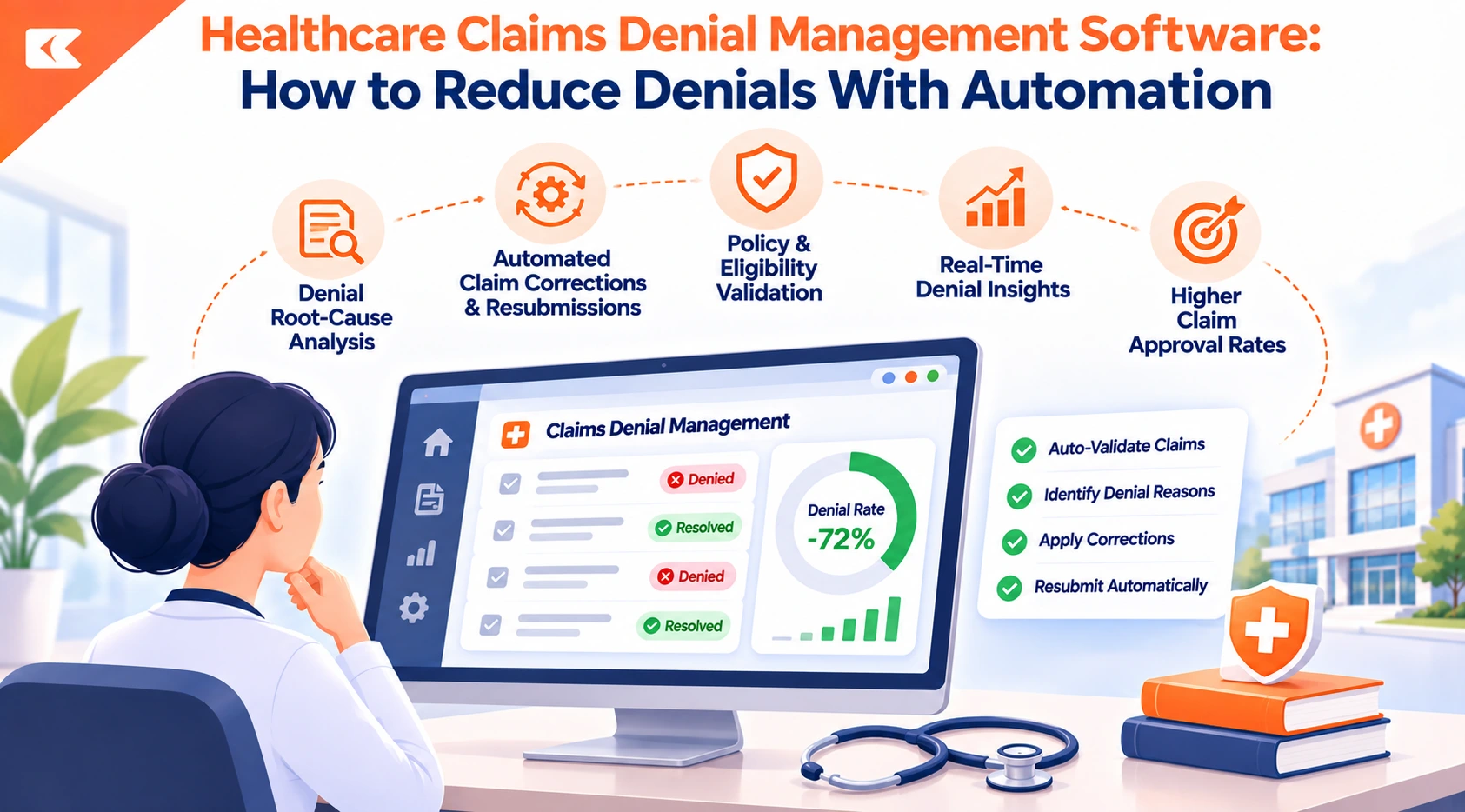
Healthcare claims denial management is the process of identifying why an insurer refused to pay a claim, correcting the issue or appealing the decision, and preventing similar denials in the future. For healthcare providers, effective denial management can improve collections, reduce administrative rework, and help protect revenue.
However, resolving denials one claim at a time is rarely enough. Providers also need to understand why denials occur, which problems have the greatest financial impact, and where technology can prevent them.
This guide explains the healthcare claims denial management process, common denial reasons, relevant industry benchmarks, and how automation can help. It also covers software evaluation, implementation, costs, and the decision to buy, build, or outsource.
What Is Healthcare Claims Denial Management?
Healthcare claims denial management is a structured process for investigating, correcting, appealing, and learning from unpaid insurance claims. It connects billing teams, coders, clinical staff, and revenue cycle leaders to address both individual claims and the operational issues behind recurring denials.
An effective process covers five activities:
- Prevention: Verify eligibility, authorization requirements, registration details, and claim information before submission.
- Identification: Capture denials from remittance advice and payer systems.
- Resolution: Correct claims, submit supporting documentation, or appeal when appropriate.
- Root-cause analysis: Identify recurring issues by payer, denial reason, department, and service line.
- Monitoring: Track denial trends, appeal outcomes, recovery amounts, and the cost of handling denials.
Denial management is one part of the broader revenue cycle. Problems that appear during payment collection often originate earlier, during scheduling, registration, authorization, documentation, or coding. Reviewing the stages of revenue cycle management in healthcare helps teams understand where those issues begin.
Claim Denial vs. Claim Rejection: What’s the Difference?
A claim rejection occurs before adjudication, when a clearinghouse or payer identifies a submission problem that prevents the claim from being processed. A denial occurs after adjudication, when the payer evaluates the claim and refuses payment in full or in part.
| Factor | Claim rejection | Claim denial |
| When it occurs | Before adjudication | After adjudication |
| Common reasons | Missing fields, invalid identifiers, formatting errors | Coverage restrictions, authorization issues, coding errors, medical necessity |
| Typical response | Correct the data and resubmit | Correct and resubmit, appeal, or take another appropriate action |
| What to monitor | Rejection rate and resubmission time | Denial rate, appeal outcomes, recovery, and root causes |
The distinction matters because each problem requires a different workflow. Tracking denials without measuring rejections can hide avoidable administrative work that occurs before claims reach adjudication.
Why Do Healthcare Claims Get Denied?
Claims can be denied for administrative, technical, contractual, or clinical reasons. Identifying the underlying cause is more useful than treating every denial as an isolated billing error.
Common Denial Reasons
- Eligibility and registration errors
Claims may be denied when coverage is inactive, member information is incorrect, or the submitted details do not match the payer’s records. Eligibility verification and accurate registration can help prevent these problems.
- Missing prior authorization
Some services require payer approval before treatment. When authorization is missing, expired, or inconsistent with the service delivered, the resulting claim may be denied.
- Coding and documentation problems
Incorrect procedure or diagnosis codes, incomplete clinical documentation, and mismatches between the documented service and the submitted claim can lead to denials.
- Medical necessity disputes
A payer may determine that the submitted documentation does not establish that a service meets its coverage criteria. These cases often require clinical review and supporting evidence rather than a simple data correction.
- Duplicate claims and timely filing
Submitting the same claim more than once or missing a payer’s filing deadline can prevent payment. Automated checks and deadline tracking can reduce these avoidable errors.
What Do Denial Reason Codes Tell You?
Electronic remittance advice (ERA) and electronic remittance data help billing teams understand how a payer adjusted or denied a claim. Claim Adjustment Reason Codes (CARCs) identify the adjustment reason, while Remittance Advice Remark Codes (RARCs) can provide additional information.
| CARC | General meaning | What to investigate |
| 16 | Missing information or a submission or billing error | Required fields, claim data, and accompanying remark codes |
| 18 | Exact duplicate claim or service | Duplicate submissions and claim history |
| 29 | Filing deadline exceeded | Submission timestamps and payer filing limits |
| 50 | Service not considered medically necessary | Clinical documentation and applicable coverage criteria |
| 97 | Payment included in another service or procedure | Bundling rules and related claims |
| 109 | Claim not covered by this payer | Member coverage and payer routing |
| 197 | Required authorization or notification missing | Authorization records and service details |
These are simplified descriptions. The official X12 Claim Adjustment Reason Code list should be used to confirm current definitions and applicable usage rules.
A code identifies what the payer reported, but it does not always establish the underlying operational cause. For example, a missing-authorization denial could result from a missed workflow step, an incorrect authorization record, or a mismatch between the approved and billed service.
What Do the Latest Claim Denial Benchmarks Show?
Published denial statistics are useful for understanding industry pressures, but they should not be treated as interchangeable. A hospital’s initial denial rate, a medical group’s first-pass denial rate, and a health insurer’s claim denial rate may measure different populations and stages of the process.
The September 2026 analysis from Kodiak Solutions offers a useful example. Based on data from more than 2,300 hospitals and 375,000 physicians, Kodiak reported that the overall initial claim denial rate fell from 12.00% in the first half of 2025 to 10.63% in the first half of 2026. Yet, post-payment takebacks increased during the same period.
Kodiak reported that takebacks rose from 1.38% to 1.57% of accounts receivable, while post-payment appeal recoveries fell from 2.48% to 2.21%. These measures describe different aspects of financial performance and should not be confused with the initial denial rate. See the September 2026 Kodiak analysis.
The takeaway is straightforward: a lower denial rate does not necessarily mean that a provider is collecting and retaining more revenue.
When evaluating performance, track a consistent set of measures:
- Initial denial rate: The proportion of submitted claims initially denied, using a clearly defined denominator.
- Final denial rate: The proportion or value of claims that remain denied after the applicable resolution process.
- Appeal overturn rate: The share of appealed denials that are reversed, with the calculation method documented.
- Days in denial inventory: How long denied claims remain unresolved.
- Net collections and takebacks: How much revenue is collected and retained after subsequent adjustments or recoupments.
- Cost to resolve: Staff time and operational expense required to work denials.
There is no single denial-rate target that fits every provider. Establish a baseline using your own claims, payer mix, specialties, and reporting definitions before setting improvement goals.
How Does Healthcare Claims Denial Management Work?
An effective denial management workflow moves from identification to resolution and then feeds the findings back into the processes that caused the problem.
1. Capture Denials
Collect denial information from electronic remittance advice, payer portals, billing systems, and work queues. Preserve the claim identifier, payer, reason codes, denied amount, service details, and relevant deadlines.
2. Categorize and Prioritize
Group denials by reason, payer, department, dollar value, and age. Prioritize cases using financial impact, appeal deadlines, likelihood of recovery, and the resources needed to resolve them.
A high-value claim approaching its appeal deadline may deserve attention before a low-value claim that can be corrected easily.
3. Investigate the Cause
Review the reason codes, payer policy, authorization records, coding, and supporting documentation. Determine whether the issue is a correctable submission error, a coverage dispute, or a clinical documentation problem.
4. Correct or Appeal
Correct errors and resubmit when permitted. When the denial warrants an appeal, assemble the relevant documentation, follow the payer’s requirements, and submit the appeal within the applicable deadline.
For example, Original Medicare has formal appeal levels and specific filing windows. CMS explains the first-level redetermination process and the second-level reconsideration process. Commercial payer deadlines differ, so teams should verify the applicable contract and rules.
5. Prevent Repeat Denials
Send the findings to the team responsible for the underlying process. If missing authorization causes repeated denials, improve the authorization workflow. If incorrect registration data is responsible, address the registration process rather than repeatedly correcting claims downstream.
How Can Providers Reduce Denials Before Submission?
Preventing a denial is generally less labor-intensive than investigating and appealing it. Providers can reduce avoidable errors by strengthening the checks that occur before a claim reaches the payer.
Verify eligibility and coverage. Confirm active coverage and relevant plan details during registration, then recheck when circumstances or service dates require it.
Track authorization requirements. Identify services requiring prior authorization, capture approval details, and verify that the approved service aligns with the service delivered and billed.
Improve documentation and coding. Give coding and clinical teams access to the information needed to support the submitted claim. Review recurring errors by department and service line.
Scrub claims before submission. Apply validation rules to identify missing fields, inconsistent identifiers, potential duplicates, and known coding or billing issues.
Use denial data to improve upstream workflows. Review recurring reasons and assign clear ownership for corrective action. Measure whether changes reduce repeat denials instead of relying only on the number of claims reworked.
Prior authorization approval also does not guarantee payment. Coverage, coding, documentation, and other claim requirements may still affect the final adjudication.
What Does Denial Management Automation Actually Do?
Healthcare claims denial management software can automate repetitive checks, organize denial work, and help teams identify patterns. Different technologies serve different purposes, and not every task should be fully automated.
| Workflow | What software can do | Where human review matters |
| Eligibility verification | Check coverage data and flag mismatches | Resolve exceptions and conflicting records |
| Authorization management | Track requirements, approvals, and missing documentation | Assess unusual cases and clinical exceptions |
| Claim scrubbing | Apply validation and coding rules before submission | Review complex coding questions and update rules |
| Denial triage | Rank cases by value, deadline, and recovery potential | Set priorities and review recommendations |
| Appeal preparation | Gather records and draft appeal letters | Verify clinical arguments, evidence, and final submissions |
| Payer follow-up | Retrieve statuses and flag overdue cases | Handle disputes and complex payer communications |
| Root-cause analytics | Group trends by payer, code, department, and service | Decide which operational changes to implement |
Rules Engines, Predictive Models, and Generative AI
Rules engines apply defined conditions to detect known problems. They work well for consistent checks, such as missing data or authorization requirements.
Predictive models, a common application of machine learning in healthcare, estimate the likelihood of a denial or rank cases by risk. Their value depends on representative data, suitable validation, and ongoing monitoring.
Generative AI can summarize records, extract relevant details, and prepare draft appeal letters. It can also omit important context or produce inaccurate statements, so outputs require review before use.
Automation should support staff decisions rather than replace accountability for clinical judgments, coverage disputes, or high-value appeals.
Examples of Healthcare Automation in Practice
Citrusbug Technolabs has worked on healthcare systems involving authorization review and denial prevention.
For Anterior, a US healthcare AI workflow automation platform, the Anterior case study reports 99.24% clinical accuracy against medical necessity criteria and a 60% reduction in turnaround time. These figures describe the reported project outcomes and should be interpreted within that system’s scope and evaluation method.
For Ember, a US revenue cycle platform, the Ember case study reports a 47% reduction in initial claim denials, a 35% decrease in claims processing time, and a 28% increase in clean claim rate over six months. These are reported client results, not guaranteed outcomes for other implementations.
How Do You Evaluate Healthcare Claims Denial Management Software?
The right software should help your team prevent avoidable denials, resolve outstanding claims efficiently, and understand why problems recur. Evaluate products against your actual workflows rather than choosing solely on the basis of feature lists or vendor-reported performance.
Essential Evaluation Criteria
Prevention capabilities: Check whether the system supports eligibility checks, authorization tracking, claim validation, and denial-risk identification before submission.
Denial prioritization: Determine whether work queues consider financial value, filing deadlines, payer requirements, and the likelihood of recovery.
Reporting and root-cause analysis: Look for reports that help teams identify recurring problems by payer, reason code, department, and service line.
Integration with existing systems: Confirm how the product exchanges data with your EHR, practice management system, billing platform, and clearinghouse. Check which information can be read or written back, how failed transactions are handled, and whether claim status and remittance data stay synchronized. These details are particularly important when billing and clinical records live in separate systems. EHR integration services can help connect healthcare systems and support data exchange through APIs and interoperability standards.
Auditability and human oversight: Review how the system records changes, tracks appeal decisions, and flags AI-generated content for verification.
Security and access controls: Assess role-based access, audit logs, data protection, vendor responsibilities, and applicable HIPAA obligations. Where a business associate relationship applies, review the required business associate agreement and the safeguards supporting it.
Total cost of ownership: Include implementation, integration, training, maintenance, usage fees, and internal staff time.
What Types of Software Should You Compare?
Different categories address different needs:
- Revenue cycle management platforms: Broad systems that combine billing, claims, payment, and denial workflows.
- Specialized denial and appeal tools: Products focused on identifying denial patterns, prioritizing cases, or supporting appeals.
- EHR-native functionality: Tools integrated into an existing EHR or practice management environment.
- Technology-enabled denial services: External teams that combine software with human claim review and appeal work.
Some organizations use more than one category. A provider might keep billing in its existing EHR, add specialized analytics, and outsource a portion of its appeal backlog.
During vendor evaluations, ask for a demonstration using representative denial scenarios, a clear explanation of performance metrics, and an integration plan based on your actual systems and data.
How Much Does Denial Management Software Cost?
Pricing varies by product and implementation scope. Some vendors charge subscriptions or usage-based fees, while others offer enterprise licensing or services priced around the work performed or revenue recovered.
The main cost drivers include:
- Claim volume and the number of users.
- EHR, practice management, and clearinghouse integrations.
- Required modules, reporting, and automation capabilities.
- Implementation, data migration, and staff training.
- Ongoing maintenance, payer-rule updates, and support.
- Internal review time for automated recommendations and appeals.
When comparing options, request a three-year total cost estimate rather than comparing subscription prices alone. Ask who maintains integrations and rules, what happens when payer requirements change, and how your data can be exported if you change providers.
A lower-cost product may be sufficient for a practice with straightforward workflows. A larger health system with multiple facilities, payer contracts, and legacy systems may need broader integration and reporting capabilities.
Should You Buy, Build, or Outsource Denial Management?
The decision depends on your existing systems, denial volume, internal expertise, workflow complexity, and how quickly you need to improve performance.
| Factor | Buy software | Build custom software | Outsource denial work |
| Best fit | Standard workflows supported by an existing product | Specialized workflows or integration requirements | Staffing constraints or a backlog of claims |
| Initial timeline | Depends on configuration and integration | Usually requires more design and development | Depends on contracting and onboarding |
| Control | Limited by product capabilities and vendor roadmap | Greater control over workflows and functionality | Depends on the service agreement |
| Ongoing responsibility | Configuration, monitoring, and vendor coordination | Maintenance, integration updates, and rule changes | Performance monitoring and service management |
| Cost structure | License, subscription, or usage fees | Development plus ongoing maintenance | Contracted service fees or other agreed pricing |
The decision also depends on which side of the claims process your organization manages. Healthcare providers need to track submitted claims, resolve denials, and improve collections. Insurers and health plans must also manage benefit rules, claims adjudication, eligibility, and payment decisions. These different workflows affect the software architecture and integrations each organization needs. For payer-side requirements, health insurance software development covers the broader systems involved in managing policies, members, and claims.
When Buying Makes Sense
Buy when an existing product supports your workflows, integrates with your systems, and offers the reporting and controls you need. A ready-made solution may be the most practical choice when customization requirements are limited.
When Building Makes Sense
Custom development may be appropriate when your denial workflows involve specialized payer rules, multiple legacy systems, unique reporting requirements, or integration gaps that existing products cannot address adequately.
Citrusbug develops custom healthcare revenue cycle management software around provider workflows and system requirements. Depending on the project, this may include eligibility verification, claim scrubbing, denial classification, root-cause reporting, and authorization tracking.
The first step is to understand the existing workflow, source data, payer mix, and integration constraints before deciding which capabilities need to be built.
When Outsourcing Makes Sense
Outsourcing can help when internal teams lack the capacity or specialized experience to manage denial volumes. Before contracting, define which claims the service provider will handle, how performance will be measured, how sensitive data will be protected, and who remains accountable for appeal decisions.
These options are not mutually exclusive. A provider can purchase a core platform, build integrations or specialized functionality, and outsource selected denial categories.
How Do You Implement Automation and Measure ROI?
Start with a clearly defined denial problem instead of applying healthcare automation to every workflow at once. A focused pilot makes it easier to establish a baseline, test the process, and determine whether the technology delivers measurable improvement.
Step 1: Establish a Baseline
Review six to twelve months of claim and remittance data, where available. Group denials by reason code, payer, service line, and financial value. Identify the categories responsible for the greatest preventable losses or administrative workload.
Step 2: Select a Focused Pilot
Choose a denial category with a clear cause, enough volume to measure, and a practical intervention. Examples include missing registration information, incomplete authorization records, or a recurring claim validation error.
Step 3: Define the Measures
Track metrics such as:
- Initial and final denial rates, using consistent definitions.
- Clean claim rate and claim resubmission volume.
- Appeal overturn rate and recovered revenue.
- Time spent resolving denials.
- Days in denial inventory.
- Post-payment takebacks and net collections.
- Software, implementation, and operating costs.
Step 4: Compare Results With the Baseline
Measure whether the pilot reduced the targeted problem without creating new errors or excessive manual review. Account for changes in claim volume, payer mix, and operational conditions before attributing improvements to automation.
Step 5: Expand and Maintain
If the pilot works, extend it to other suitable denial categories. Assign owners for rule updates, integration maintenance, exception handling, and performance monitoring.
An Illustrative Cost-Saving Calculation
Consider a hypothetical provider submitting 100,000 claims annually. If its initial denial rate is 10%, it would receive 10,000 initially denied claims.
Suppose the provider reduces that rate to 8%. That would mean 2,000 fewer initially denied claims, assuming the total number of submitted claims and the measurement method remain consistent.
If the provider’s measured administrative cost per denied claim were $50, avoiding 2,000 denials would represent $100,000 in potential administrative cost savings before implementation and operating costs.
This is an illustration, not a forecast. It excludes changes in collections, appeal outcomes, claim values, and post-payment adjustments. Providers should use their own cost and performance data to estimate ROI.
What Regulatory Changes Should Providers Watch?
Prior authorization requirements can affect the information providers collect, the timing of requests, and how they manage authorization-related denials.
The CMS Interoperability and Prior Authorization final rule, CMS-0057-F, introduced operational requirements for specified Medicare Advantage organizations, Medicaid and CHIP programs, Medicaid managed care plans, and certain marketplace plans. The exact requirements and applicable dates vary by payer type.
For impacted payers covered by the rule, decision timeframes generally began in 2026: no later than 72 hours for expedited requests and seven calendar days for standard requests, subject to the applicable rules and exceptions. These timeframes apply to medical items and services, not drug authorizations, and the rule excludes federally facilitated exchange qualified health plan issuers from those particular timeframe requirements.
CMS also established requirements for specific prior authorization metrics and API capabilities, with many API compliance dates beginning in 2027. Providers should consult the official CMS-0057-F fact sheet and the current CMS guidance for details relevant to their payer relationships.
For denial management teams, the practical priority is to maintain accurate authorization records, track request and decision dates, retain supporting documentation, and make sure systems reflect the rules that apply to each payer.
Where Should You Start?
Start with your own denial data. Identify the largest preventable denial category, trace it to the workflow that caused it, and establish a baseline for measuring improvement.
Then decide whether process changes, existing software, or custom development would address the problem most effectively. For providers whose current systems cannot support the required payer rules, claim validation, or reporting, healthcare claim management software solutions can bring these workflows into a more connected system.
The goal of healthcare claims denial management is not simply to process denials faster. It is to prevent recurring errors, reduce administrative rework, and retain more of the revenue providers have earned.
Frequently Asked Questions
What is healthcare claims denial management software?
Healthcare claims denial management software helps providers identify denied claims, organize work queues, investigate denial reasons, support corrections and appeals, and analyze recurring problems. Depending on the product, it may also automate eligibility checks, authorization tracking, claim validation, and denial-risk prioritization.
What is the difference between a claim denial and a claim rejection?
A rejection occurs before adjudication, usually because the submitted claim contains missing or invalid information. A denial occurs after the payer evaluates the claim and refuses payment in full or in part. Rejections are typically corrected and resubmitted, while denials may require correction, appeal, or further investigation.
What is a good healthcare claim denial rate?
There is no single target that applies to every provider. Rates vary with payer mix, specialty, claim type, and calculation method. Establish a baseline using consistent definitions and compare performance over time before adopting a target.
Can automation reduce claim denials?
Yes. Automation can catch data errors before submission, flag authorization gaps, prioritize denial work, and support appeal preparation. Its impact depends on data quality, workflow design, and how well staff handle exceptions. Complex clinical and coverage decisions still need appropriate human review.
How much does denial management software cost?
Costs depend on claim volume, modules, integration requirements, licensing, implementation, and maintenance. Some products use subscription or usage-based pricing, while technology-enabled services may charge according to contracted work. Compare total costs over several years rather than license fees alone.
Should a healthcare provider build or buy denial management software?
Buying is often practical when an existing product meets workflow and integration requirements. Building may suit providers with specialized processes or significant integration gaps. Outsourcing may help address staffing constraints or backlogs. The decision should reflect operational needs, cost, control, and long-term maintenance.
How can providers measure denial management ROI?
Track the change in denial rates, clean claim rates, appeal recoveries, resolution time, administrative effort, and post-payment adjustments. Compare these results with implementation and operating costs using a consistent baseline. Avoid attributing every improvement to software when payer mix, staffing, or other processes have also changed.