
 Back
Back







Key Takeaways
- Revenue cycle management (RCM) is the full financial process from scheduling a patient to collecting final payment, and it runs through seven distinct stages, not just billing.
- Denials are a major and growing source of revenue loss: 41% of providers report denial rates above 10%, and the 2,300+ hospitals in Kodiak Solutions' benchmarking data lost more than $48 billion in 2025 to final denials and bad debt combined, up 25% from 2024.
- A CMS rule now requires many payers, including Medicare Advantage and Medicaid plans, to decide prior authorization requests within 72 hours for expedited cases and seven calendar days for standard ones, effective January 1, 2026. Drug authorizations are excluded.
- Artificial intelligence (AI) and automation are now common in revenue cycle teams, but return on investment (ROI) is uneven. In one HFMA and FinThrive survey, 63% of organizations had adopted AI or automation in the revenue cycle, and only 15% of those reported a positive return.
- The stage where revenue is leaking the most should drive your in-house, outsourced, or hybrid decision, not a blanket policy.
A claim can be coded correctly and submitted on time, and still be denied because of a detail that was wrong at check-in. That is why revenue cycle management in healthcare is hard to fix one department at a time: problems that surface at the end of the cycle usually start at the beginning.
This guide walks through the seven stages of healthcare revenue cycle management, from scheduling to patient collections. For each stage, it explains what happens and where revenue most often leaks.
It also covers the 2026 changes worth knowing, including the CMS prior authorization deadlines and the fiscal year 2027 ICD-10 update, plus the KPIs to track, where AI is and isn’t delivering returns, and how to choose between in-house, outsourced, and hybrid models.
What Is Revenue Cycle Management in Healthcare?
Revenue cycle management is the process a healthcare organization uses to track a patient’s financial journey from the moment they schedule an appointment to the moment their bill is fully paid.
It covers scheduling, insurance verification, clinical documentation, coding, claim submission, payment posting, denial handling, and patient collections as one connected system, not a set of separate departments working in isolation.
The point of treating it as one system is simple: a mistake made in the first stage, like entering the wrong insurance ID at check-in, doesn’t stay contained there. It resurfaces weeks later as a denied claim, and by then it costs far more time and money to fix than it would have taken to catch at intake.
RCM vs. Medical Billing: Why the Terms Aren’t Interchangeable
Medical billing is the act of generating and submitting a claim for services rendered. Revenue cycle management is the entire financial lifecycle that billing sits inside, including everything that happens before a claim is created and everything that happens after it’s submitted.
Confusing the two leads organizations to fix the wrong problem. A practice with a high denial rate often assumes it has a billing problem and adds billing staff, when the actual failure point is upstream, in eligibility verification or prior authorization.
Medical billing software development can help streamline the billing-specific workflows, but treating RCM as a single cycle rather than a billing department with some paperwork attached is what makes it possible to identify where revenue is actually leaking.
Front End, Middle, and Back End: How the 7 Stages Group Together
Most revenue cycle frameworks group the seven stages into three phases. Front-end functions (scheduling, eligibility verification, prior authorization) happen before or at the point of care and largely determine whether a claim will be clean.
Mid-cycle functions (charge capture, coding, claim submission) translate clinical care into a billable claim. Back-end functions (payment posting, denial management, patient billing) close the loop once a claim has been submitted.
Grouping the stages this way matters operationally, because most preventable revenue loss originates at the front end but only becomes visible at the back end, once a claim bounces. A team that only measures back-end metrics, like final denial rate, is diagnosing a symptom several stages downstream of its cause.
Why Does Revenue Cycle Management Matter More in 2026?
Denials are rising, not falling. Experian Health’s 2025 State of Claims survey of 250 healthcare professionals, conducted in June and July 2025, found that 41% of providers report that more than 10% of their claims are denied. In the same survey, 54% say claim errors are increasing overall.
The dollar impact is concrete, not abstract. Kodiak Solutions’ 2026 revenue cycle benchmarking data, drawn from more than 2,300 hospitals, found that final denials and bad debt together cost providers $48 billion in 2025, up 25% from $38.6 billion in 2024.
Separately, the American Hospital Association’s 2025 Costs of Caring report estimates that hospitals spent $43 billion in 2025 trying to collect payments from insurers. In 2024, the average hospital employed about 64 administrative and billing staff dedicated to this work, roughly 6.5% of total hospital employment.
Regulation is also tightening the front end. CMS’s prior authorization final rule adds real deadlines to a process that used to have none, which we cover in Stage 2 below. Any new RCM technology also has to handle patient data safely, and our healthcare data breach statistics show why that matters.
The 7 Stages of Revenue Cycle Management at a Glance
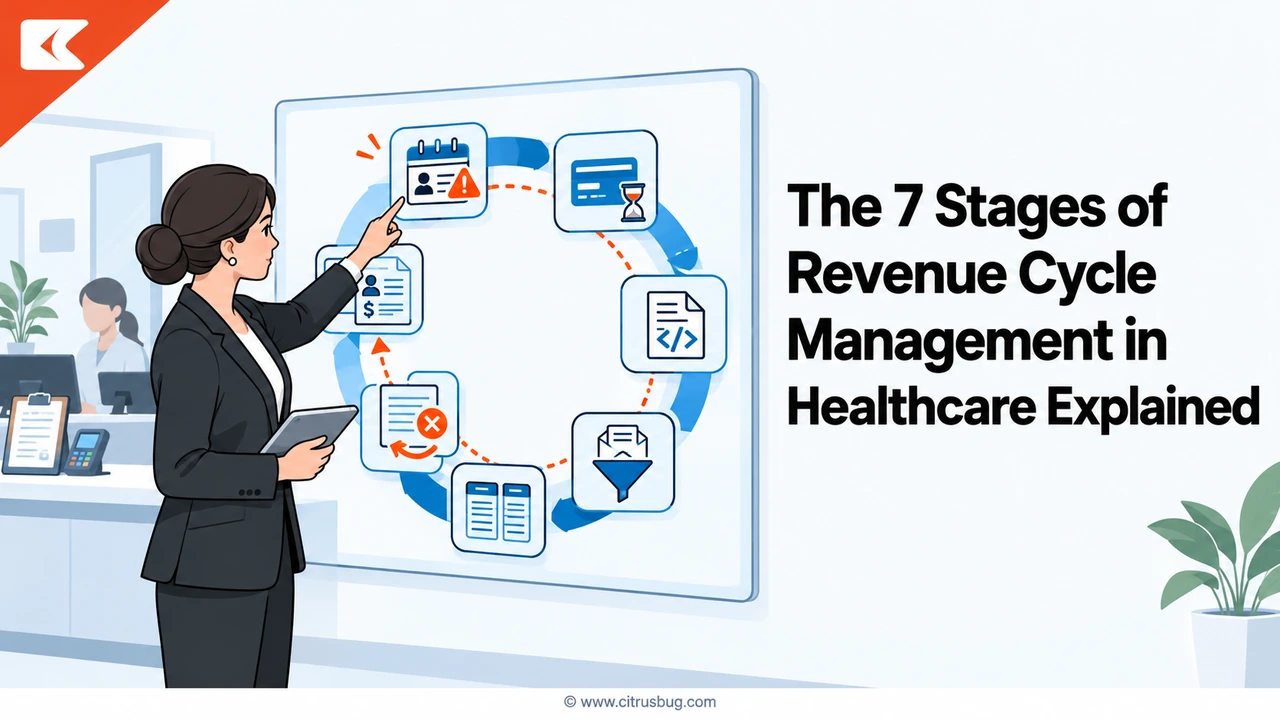
The seven stages are: scheduling and pre-registration, eligibility verification and prior authorization, charge capture and medical coding, claim submission, payment posting and reconciliation, denial management and accounts receivable (A/R) follow-up, and patient billing and collections.
Different frameworks describe this same cycle at different levels of granularity; some split it into 5 broader phases or as many as 12 to 16 discrete steps. The table below maps those framings onto the 7-stage structure this article uses, so the differences read as detail level, not disagreement.
| This article’s 7 stages | Broader phase framing | Granular step framing |
|---|---|---|
| Scheduling & pre-registration | Front-end intake | Scheduling, demographics capture, insurance data entry |
| Eligibility & prior authorization | Front-end intake | Eligibility check, benefits verification, authorization request |
| Charge capture & coding | Mid-cycle | Charge entry, code assignment, documentation review |
| Claim submission | Mid-cycle | Claim scrubbing, clearinghouse transmission, payer acknowledgment |
| Payment posting & reconciliation | Back-end | Remittance posting, contractual adjustment, reconciliation |
| Denial management & A/R follow-up | Back-end | Denial classification, appeal, resubmission, aging follow-up |
| Patient billing & collections | Back-end | Statement generation, payment plans, bad debt referral |
Stage 1: Scheduling and Pre-Registration
Scheduling and pre-registration is where a patient’s demographic and insurance information first enters the system, before any clinical service happens. This stage sets the accuracy ceiling for everything downstream: a claim can’t be more accurate than the data it started from.
The most common failure here is entering insurance information from memory or an outdated card rather than verifying it in real time. That single error can cause a denial weeks later that has nothing to do with the clinical care provided.
Stage 2: Eligibility Verification and Prior Authorization
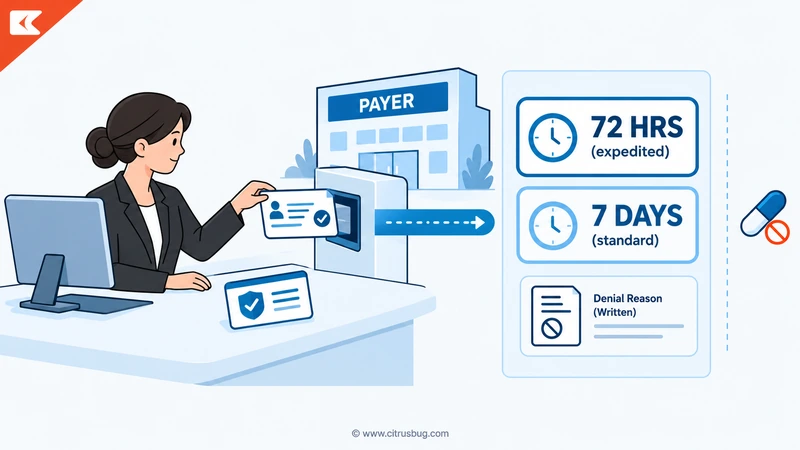
Eligibility verification confirms that a patient’s insurance is active and that the planned service is covered. Prior authorization is a separate, additional approval some payers require before certain procedures, medications, or imaging can proceed.
Prior authorization has historically been one of the slowest, least standardized parts of the entire revenue cycle, with no consistent deadline for a payer to respond. That changes under CMS’s Interoperability and Prior Authorization Final Rule (CMS-0057-F), which requires impacted payers to begin complying on January 1, 2026.
Under the rule, impacted payers must issue expedited decisions within 72 hours and standard decisions within seven calendar days, per the CMS fact sheet, and must give a specific reason when a request is denied. The timeframes do not cover prior authorizations for drugs. Most API requirements take effect January 1, 2027.
In Citrusbug’s work with Anterior, a US healthcare AI platform that automates prior authorization review for health plans, we built a system combining large language model (LLM) based document review with rules engines and human-in-the-loop checks.
The system now processes more than 1 million prior authorizations a year, with a 76% increase in auto-approvals and a 60% reduction in turnaround time.
Stage 3: Charge Capture and Medical Coding
Charge capture is the process of recording every billable service a patient received. Medical coding then translates that clinical documentation into standardized codes that payers use to determine what they’ll pay.
Diagnoses are coded using ICD-10-CM. Procedures and supplies are coded using CPT or HCPCS codes.
Code sets change annually, and getting the current version wrong is a real risk. The fiscal year 2027 ICD-10 update takes effect October 1, 2026, adding new diagnosis codes that coding teams and any coding software need to reflect on day one. Worth stating plainly: ICD-11 is not a current US billing requirement.
ICD-10-CM and ICD-10-PCS remain the mandated code sets for US claims, and organizations shouldn’t plan around ICD-11 adoption for billing purposes. Because documentation review routinely involves protected health information (PHI), coding teams should also follow current HIPAA safeguards.
Stage 4: Claim Submission
Claim submission is the point where a coded claim is scrubbed for errors and transmitted to the payer. This usually happens through a clearinghouse, which runs an initial round of automated checks before the payer ever sees the claim.
A claim that fails clearinghouse-level scrubbing never reaches the “denied” statistic, but it still costs staff time to fix and resubmit. Teams that only track denial rate, and not clearinghouse rejection rate, are missing a meaningful share of their actual claim friction.
Integrating claim scrubbing and rejection tracking into your workflows can help close that gap, with healthcare claim management software development supporting these capabilities within a broader claims management system.
Stage 5: Payment Posting and Reconciliation
Payment posting records what a payer actually paid against what was billed, applies any contractual adjustment the payer is entitled to under its contract, and reconciles the remainder.
This is also where underpayments, a payer paying less than its contracted rate without formally denying the claim, get caught, if anyone is looking for them.
Underpayments are easy to miss because they don’t trigger the same review workflow a denial does. A claim that gets paid, even partially, often gets closed out rather than audited.
Stage 6: Denial Management and A/R Follow-Up
Denial management is the work of classifying why a claim was denied, correcting the underlying issue, and either appealing or resubmitting it. A/R follow-up is the broader discipline of tracking every unpaid claim until it’s resolved, not just the ones that were formally denied.
Denial management is where the front-end problems from Stages 1 and 2 resurface as dollars. Missing or inaccurate data was the leading cause of denials in Experian Health’s 2025 survey, with authorizations and incomplete patient information also among the top reasons.
That finding points to a practical fix: a common way to reduce denials at this stage is to correct something that happened weeks earlier at intake, rather than only adding appeals staff.
In Citrusbug’s work with Ember, a healthcare fintech startup, we built claim scoring and denial prediction models that flag likely-to-be-denied claims before submission rather than after. The result was a 47% reduction in initial claim denials and a 28% increase in clean claim rate over a six-month engagement.
Stage 7: Patient Billing and Collections
Patient billing and collections is the final stage: generating a clear statement of what the patient owes after insurance has paid its share, offering payment options, and pursuing unpaid balances, ultimately as bad debt if collection efforts fail.
Patient-owed balances have grown as high-deductible health plans have become more common, which means this stage now carries more revenue risk than it used to. A confusing statement or a clunky payment process doesn’t just frustrate patients; it directly increases the amount that ends up written off.
What KPIs Should You Track in Revenue Cycle Management?
Track key performance indicators (KPIs) using a standardized framework, such as the Healthcare Financial Management Association’s (HFMA) MAP Keys, which defines 29 KPIs across patient access, pre-billing, claims, account resolution, and financial management.
Because the MAP Keys standardize how each metric is calculated, the most useful benchmark for most organizations is their own trend over time, measured consistently quarter to quarter.
Kodiak Solutions’ 2026 data offers one useful directional signal: the median final denial rate rose to 2.7% in 2025, up from 2.5% in 2024, and the median bad debt rate rose to 1.3%, up from 1.1%. A rising trend on either metric is worth investigating even from a low starting point.
Common RCM Challenges (and What Causes Them)
| Challenge | Root Cause | Stage It Originates In |
|---|---|---|
| Rising denial rates | Missing or inaccurate data, often from intake | Scheduling & pre-registration |
| Slow prior authorization | Manual, payer-specific processes | Eligibility & prior authorization |
| Coding errors | Outdated code sets, unclear documentation | Charge capture & coding |
| Underpayments going uncaught | No systematic contract-rate reconciliation | Payment posting |
| Growing patient A/R | High-deductible plans, unclear billing | Patient billing & collections |
How AI and Automation Are Changing Revenue Cycle Management in Healthcare
AI adoption in the revenue cycle is now widespread, but results are mixed. An HFMA and FinThrive survey of 101 healthcare organizations, conducted between October and November 2024, found that 63% already use AI or automation somewhere in their revenue cycle, but only 15% of those report a positive ROI so far. Another 38% of organizations are still laying groundwork or considering pilots.
The gap between adoption and ROI often comes down to scope. Broad, do-everything AI rollouts can stall.
Narrowly scoped automation, aimed at one specific failure point like denial prediction or prior authorization review, tends to produce results faster. It solves one well-defined problem instead of trying to reinvent an entire department.
Should You Keep RCM In-House, Outsource It, or Run a Hybrid Model?
There’s no single correct model. The right choice depends on where revenue is leaking and what your team can realistically staff.
- In-house gives the most control over process and data, and makes sense when an organization already has stable staffing and the losses are concentrated in a stage that needs deep institutional knowledge, like complex payer contract negotiation.
- Outsourced RCM shifts staffing and technology risk to a specialist vendor. Third-party review platforms such as Clutch publish verified client reviews and ratings for service providers, which can help you build a shortlist. Independently verified pricing benchmarks for outsourcing aren’t publicly available, so get a specific quote rather than budgeting off a generic percentage.
- Hybrid models keep high-judgment or high-risk stages in-house, like denial appeals on large claims, while outsourcing or automating high-volume, repetitive stages, like eligibility verification. This is a common approach for organizations building or buying purpose-built automation rather than a full outsourcing contract.
How Citrusbug Helps Healthcare Organizations Modernize RCM
At Citrusbug, we build and modernize the software healthcare organizations use to run their revenue cycle, from eligibility verification and prior authorization automation to denial prediction and coding assistance.
Rather than replacing existing EHR or billing systems, we typically build focused automation layers that sit alongside them, targeting the specific stage causing the most revenue leakage.
Our healthcare revenue cycle management services cover the financial lifecycle from patient registration to final payment, with automation and AI applied where they can improve specific revenue cycle workflows.
Conclusion
Revenue cycle management doesn’t fail at one point; it fails in sequence. A missed eligibility check at intake becomes a coding gap, then a denial, then a write-off months later.
That’s why the fixes that work best are narrow and specific: correct the intake step causing the most downstream denials, automate the one KPI you’re already tracking inconsistently, or get ahead of the CMS prior authorization deadlines before they become a compliance problem.
2026 raises the stakes. Denial rates are climbing, new CMS and ICD-10 requirements are now in effect, and AI adoption has outpaced AI return. None of that is solved by a single tool, it’s solved by treating the seven stages as one connected system and choosing the operating model that matches where your team can realistically absorb the work.
Get the front end right, and the rest of the cycle gets measurably easier.
FAQs
What are the 7 stages of revenue cycle management?
⇒ Scheduling and pre-registration, eligibility verification and prior authorization, charge capture and medical coding, claim submission, payment posting and reconciliation, denial management and A/R follow-up, and patient billing and collections. Different vendors group or split these into 5 to 16 steps, but they describe the same underlying cycle.
What’s the difference between RCM and medical billing?
⇒ Medical billing is generating and submitting a claim. Revenue cycle management is the entire financial process around it, including everything before the claim (scheduling, eligibility, authorization) and after it (payment posting, denial handling, patient collections).
What is the biggest cause of claim denials?
⇒ Missing or inaccurate data is the leading driver of denials, according to Experian Health’s 2025 State of Claims survey, with authorizations and incomplete patient information also among the top reasons. That makes front-end data accuracy one of the highest-leverage fixes for many organizations.
Is ICD-11 required for US medical billing?
⇒ No. ICD-10-CM and ICD-10-PCS remain the current mandated code sets for US healthcare claims, with annual updates, most recently for fiscal year 2027. ICD-11 is not a US billing requirement.
Should a hospital outsource its revenue cycle management?
⇒ It depends on where revenue is being lost. Outsourcing suits organizations facing staffing or scale constraints; keeping RCM in-house suits organizations whose losses concentrate in areas needing deep institutional or payer-contract knowledge. Many organizations land on a hybrid model instead of an all-or-nothing choice.