
































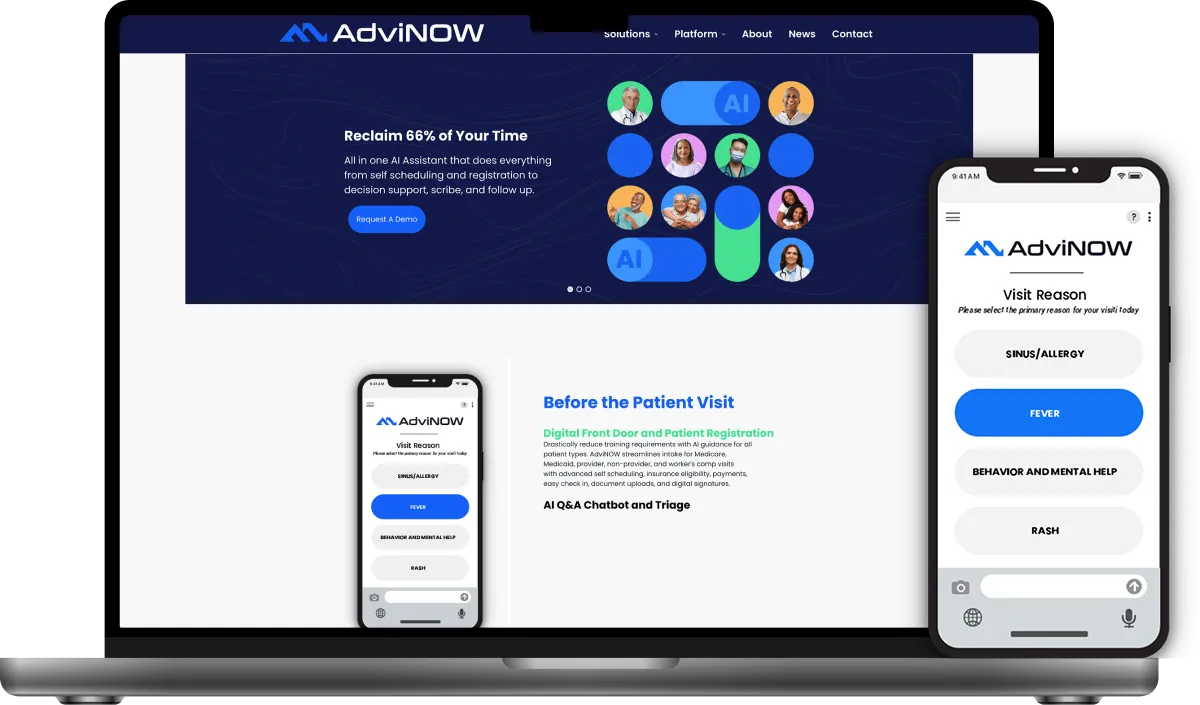
Advinow
It's an AI-driven healthcare platform that automates patient engagement and consultation processes, helping healthcare providers deliver efficient, on-demand services while improving operations for urgent care.

Read Case StudyMost healthcare organizations that struggle with outsourced development chose a vendor based on a proposal, not proven delivery. We work differently. Citrusbug builds HIPAA-compliant, interoperable healthcare systems with expert senior engineers, full source code ownership, and post-launch SLA support at every tier.
Trusted By
We build EHR software with custom workflows for clinics, hospitals, and specialty practices, covering patient records, provider notes, order entry, and care coordination modules that integrate with existing HIT stacks.
Video consultation, asynchronous messaging, and remote triage – our telehealth platform development team builds HIPAA-compliant virtual care systems for providers who need to see patients beyond the clinic walls.
Claim submission, denial management, ERA/EOB processing, and payer connectivity are operationally critical. We build RCM software that reduces billing lag and gives revenue teams real-time visibility into claim status and collections.
We integrate clinical decision support, predictive readmission modeling, NLP-based documentation assistants, and AI triage into existing clinical environments without disrupting provider workflows or requiring a system rip-and-replace.
Patient-facing apps for appointment booking, medication tracking, RPM data collection, and secure messaging, plus provider mobile tools for care team coordination and real-time alert management, built for iOS and Android.
HL7 v2, FHIR R4, and API-first architecture for connecting EHR, PACS, billing systems, identity providers, and third-party platforms through healthcare API integration that keeps data clean and compliant across every touchpoint.
Share your requirements with our team and get a structured delivery estimate within 48 hours.
Talk to a Healthcare EngineerChoosing the wrong outsourcing partner in healthcare is more costly than choosing the wrong vendor in most other industries. A missed HIPAA control is a breach notification event. A broken HL7 interface stops care coordination. A vendor that cannot navigate FHIR R4 leaves your system unable to meet interoperability mandates.
The risk is not that outsourcing is the wrong strategy. The risk is signing with a team that produces functional software but not compliant, interoperable, production-hardened software. That distinction is what separates vendors who have delivered healthcare systems at scale from those who treat healthcare like any other vertical.
We run a structured delivery model built for healthcare environments where scope changes, compliance requirements evolve, and integration complexity is high.
We start with your requirements, stakeholders, compliance obligations, and integration landscape before any code is written. The output is a documented architecture, user stories, and a realistic delivery roadmap.
HIPAA controls, SOC 2 alignment, data encryption, access management, and audit logging are built into the architecture at this stage, not retrofitted at QA.
Your senior engineer leads sprint delivery with daily status updates, bi-weekly demos, and a dedicated Slack or Teams channel. No communication gaps at any stage.
HL7, FHIR R4, and API connectivity are tested against live or sandbox environments before launch. EHR and third-party system integrations are validated end-to-end, not just at the interface layer.
We hand over the fully documented codebase, deployment environment, and SLA support structure. You own the source code completely. L1, L2, and L3 support tiers are available post-launch for every engagement.
Most healthcare software outsourcing projects fall between $25,000 for a scoped MVP and $250,000 or more for enterprise systems with full EHR integration, AI capabilities, and multi-market compliance coverage. Share your requirements to get a specific estimate for your build.
DEFINED SCOPE, FIXED BUDGET
Healthcare software rarely runs in isolation. EHR systems connect to PACS, billing platforms, pharmacy systems, identity providers, and patient portals. When those connections break or are built incorrectly, clinical teams feel it directly.
We build with HL7 v2 and FHIR R4 as the integration foundation, not an afterthought. Every interface is tested against real system environments, not hypothetical schemas, before your project moves to production.
FHIR R4 resource design and conformance validation
HL7 v2 message parsing and routing (ADT, ORM, ORU, MDM)
SMART on FHIR authentication and authorization
CDS Hooks integration for clinical decision support workflows
OAuth 2.0 and OpenID Connect for identity federation
EHR vendor sandbox testing (Epic, Cerner, Athena, eClinicalWorks)
PACS and medical imaging system connectivity
Payer and clearinghouse API integration for RCM workflows
Outsourcing healthcare software development should leave your team with a system you actually own and can operate without the original vendor present.
The entire codebase is yours at delivery, no licensing dependency, no vendor lock-in, no restrictions on future modifications. NDA is signed by default before any work begins.
Environment setup, CI/CD pipeline configuration, secrets management, and infrastructure-as-code are documented to your team's technical level, not assumed.
Security controls mapping, audit log configurations, data flow diagrams, and HIPAA BAA documentation are delivered as part of the project close, not as an afterthought or add-on.
L1, L2, and L3 post-launch support tiers are available with defined response times and escalation paths. We include 30 days of free maintenance after delivery to resolve any production issues that surface in the first month.
You see who is building your system before signing. Senior engineers are named, not anonymous, and they stay through delivery, not just scoping.
Compliance controls are designed in at the architecture stage. Encryption, access management, and audit trails are built before a single business feature is coded.
Every engagement starts with documented requirements, user stories, and architecture review. No estimates are given before the scope is fully understood.
Our engineers have delivered HL7 and FHIR R4 integrations against Epic, Cerner, eClinicalWorks, and Athena. Interoperability is a core skill, not a stretch task.
We use an agentic delivery methodology that embeds security at every sprint. It reduces development cost and eliminates the compliance retrofit problem that delays healthcare software launches.
Security and compliance controls are built into the architecture from day one. There is no retrofit phase, no audit scramble, and no delay at launch because of issues that should have been caught in sprint one.
It's an AI-driven healthcare platform that automates patient engagement and consultation processes, helping healthcare providers deliver efficient, on-demand services while improving operations for urgent care.
Read Case Study
Carepoint is a solution dedicated to the pharmacy industry with a variety of tools needed to manage any pharmacy.
Read Case Study
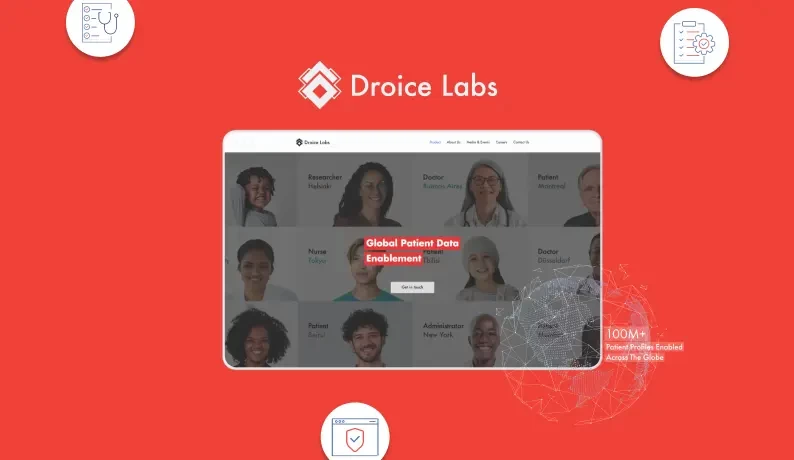
Droice Labs is a middleware designed to transform messy, unstructured patient data into clean, analysis-ready formats for clinical trials.
Read Case Study
Introduction Healthcare is deep into a cloud-first decade, where digital transformation, data-driven decision-making, and scalable cloud platforms are reshaping how care is delivered and managed. Electronic health records, imaging, telehealth,…
Read Article →
Healthcare now treats intelligent conversations as a core part of digital care, not a side feature. Virtual assistants, triage bots, and voice interfaces guide patients, support staff, and assist clinicians…
Read Article →
Introduction The healthcare predictive analytics market is moving from experimental pilots to system level adoption across hospitals, payers, and life sciences. Advanced models now sit inside electronic health records, claims…
Read Article →It covers the full build: architecture design, HIPAA-compliant development, EHR and API integrations, QA, deployment, and post-launch support. The scope depends on whether you choose a fixed-price, T&M, or dedicated team model.
Most projects range from 3 to 12 months depending on complexity, integration requirements, and regulatory scope. A clearly scoped MVP with defined integrations typically delivers in 2 to 5 months.
Yes. Our engineers are trained on HIPAA technical safeguard requirements, HITECH provisions, and the compliance implications of data storage, transmission, and access control in healthcare applications.
Fixed-Price works well for defined scopes with clear feature lists. Time and Material suits projects where requirements evolve during delivery. A dedicated team is best for organizations that need full-time engineers embedded into their product team long-term.
Yes. We have delivered integrations with Epic, Cerner, eClinicalWorks, Athena, and other major EHR platforms using HL7 v2 messaging and FHIR R4 APIs. Integration complexity is assessed during the discovery phase.
You receive the complete codebase, deployment documentation, compliance artifacts, and access to all environments. Source code ownership transfers fully at delivery. Post-launch SLA support is available at three tiers.
Projects typically range from $25,000 for scoped MVPs to $250,000+ for enterprise-scale systems with complex EHR integrations, AI components, and multi-environment deployments. We provide a structured estimate after the discovery session.