
 Back
Back







The healthcare crm market has reached a stage where patient engagement technology is no longer a secondary priority for health systems. As care delivery shifts toward value-based models, managing patient relationships at scale has become a fundamental operational requirement, not an optional capability.
Growing patient populations, complex care journeys, and mounting pressure to reduce preventable readmissions are pushing hospitals, clinics, and payers toward purpose-built CRM platforms. These tools now handle everything from outreach scheduling and appointment management to post-discharge follow-up and chronic disease monitoring programs.
The result is a market expanding at a consistent double-digit pace across nearly every major geography. Investment activity, enterprise adoption, and a wave of AI-enhanced capabilities are all pointing in the same direction: healthcare CRM is moving from a back-office function to a central pillar of how care is delivered and managed.
What is Healthcare CRM?
Healthcare CRM is a category of software designed to help medical organizations manage patient relationships across the full care continuum. It centralizes patient data, automates CRM workflows, and gives care teams a structured view of engagement at every touchpoint.
Beyond basic contact management, these platforms support appointment scheduling, referral tracking, post-discharge outreach, and chronic disease monitoring. For hospitals, clinics, and payers alike, healthcare CRM serves as the operational layer connecting clinical outcomes to the patient experience.
Healthcare CRM Market Size and Revenue Trends
Patient engagement demand and sustained digital investment across health systems have fueled consistent market expansion. Growth has been substantial over the past two years, with momentum holding across both large technology-intensive health networks and smaller clinical organizations building out digital patient engagement infrastructure for the first time.
Healthcare CRM as a technology category sits at the intersection of clinical operations and digital health investment. Organizations across provider networks, payer institutions, and pharmaceutical companies are all increasing their spend on patient relationship infrastructure as healthcare economics shift away from volume-based care delivery. The numbers reflect that transformation clearly.
Market Valuation and Revenue Trajectory
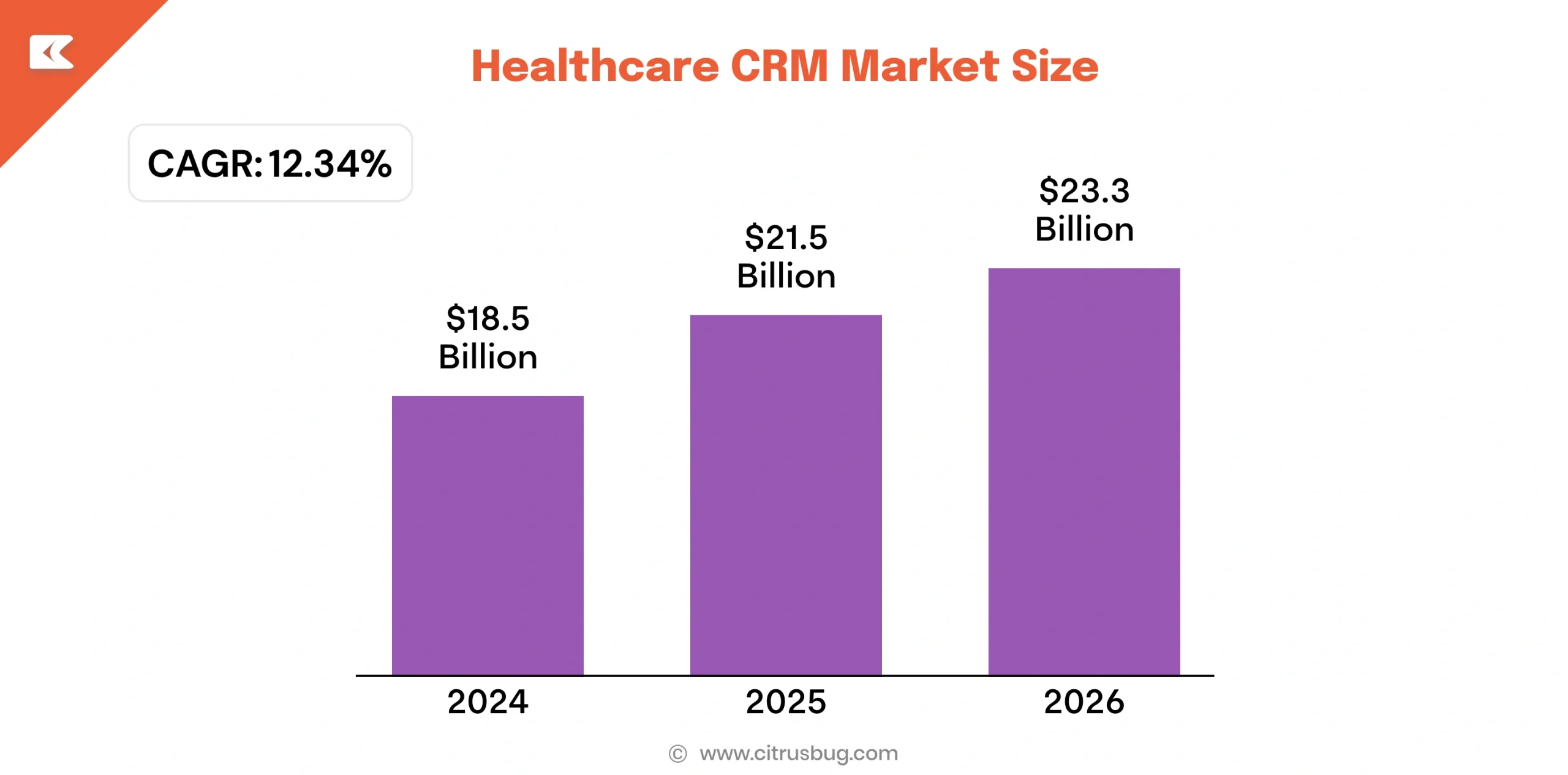
- The global healthcare CRM market was valued at USD 18.5 billion in 2024, reflecting strong baseline demand driven by hospital digitization, insurance sector investments, and the expansion of outpatient care management programs across major economies.
- Market size grew to USD 21.5 billion in 2025, as adoption deepened across health systems that had prioritized patient retention and engagement technology following sustained infrastructure investments in the post-pandemic period.
- For 2026, the market is on track to reach USD 23.3 billion, driven by continued cloud migration, AI-assisted patient workflows, and growing demand for automated outreach programs across outpatient and specialty care settings.
- Growth is sustained at a compound annual growth rate of 12.34% through 2031, positioning this sector well ahead of most broader enterprise software verticals and reflecting deep structural demand rather than short-term market enthusiasm.
Dominant Functionality and Product Segments
- The sales functionality segment held a 27.2% revenue share in 2025, reflecting sustained investment by pharmaceutical companies, medical device firms, and healthcare staffing organizations in CRM tools designed to manage provider relationships and commercial pipelines at scale.
- Software components commanded 65.12% of total market revenue in 2025, with the remainder generated by managed services, consulting, and end-to-end implementation support offerings from specialist healthcare IT vendors.
The competitive landscape spans established enterprise software vendors expanding into health-specific CRM capabilities and purpose-built healthcare platforms serving specialized clinical workflows.
Both segments are scaling rapidly, with AI-native entrants gaining ground particularly in population health segmentation and automated care gap identification.
Healthcare CRM Segmentation Insights
Adoption does not look the same across all care settings or organization types. The patient population managed, the clinical workflows supported, and the scale of the organization all influence which segment leads in revenue and strategic investment.
Application Type and Care Setting Adoption
Healthcare providers captured around 44% of total revenue as the largest end-user group, encompassing physician groups, hospital systems, and integrated care networks that coordinate care across multiple departments and patient touchpoints. Their scale and patient volume make structured CRM platforms a near-essential part of population health and engagement operations.
Patient management holds the leading application position with a 38% share of the overall market, driven by the volume of patients requiring structured follow-up and longitudinal engagement programs. This segment continues to expand alongside chronic disease management programs, post-acute care coordination, and preventive care outreach campaigns where consistent patient contact is a clinical priority.
The sales functionality segment accounts for approximately 21% of revenue by application in 2024, covering commercial operations in pharmaceutical account management, payer contracting, and specialist referral network development across integrated health systems.
Organization Size and Deployment Scale
Large organizations represent the dominant segment by scale, controlling 60% of the overall market within the CRM landscape.
Health systems and hospital networks with large patient registries have the operational complexity and volume that justifies enterprise-grade CRM infrastructure, including multi-site architecture, granular role-based access controls, and native integration with electronic health record systems.
Smaller clinical organizations and independent practices are also entering the market at a faster pace, particularly as cloud-based deployment options lower the upfront cost and technical barrier to entry.
The combination of affordable SaaS pricing models and pre-built EHR integrations has broadened the addressable customer base significantly beyond large enterprise accounts, contributing to overall market expansion across the mid-market segment.
Cloud-based deployment has become the preferred model for most market entrants, particularly among organizations migrating away from legacy EHR-based contact management.
The infrastructure maturity of healthcare cloud environments, combined with vendor-managed compliance and security frameworks, has made cloud deployment the lower-risk choice for mid-sized clinical organizations entering the CRM space.
How Healthcare Organizations Are Adopting CRM Solutions
CRM adoption in healthcare has moved well beyond early movers and pilot programs. Health systems across all organization sizes are integrating these platforms into core operational workflows, from initial patient contact to post-discharge monitoring, in direct response to clinical quality targets and patient retention pressures that have intensified as risk-based contracting becomes more prevalent.
Patient Outreach Automation and Engagement
- Approximately 53% of healthcare organizations now use CRM software to automate patient engagement activities, including telehealth scheduling, appointment reminders, and post-visit follow-up communication across primary and specialty care settings.
The shift toward digital outreach has also changed how care coordinators manage high-volume patient panels. Rather than relying on manual tracking or spreadsheet-based follow-up lists, organizations are using CRM automation to trigger timely interventions at each stage of the care journey.
Care teams are also using CRM platforms to close care gaps across population health programs.
When a diabetic patient misses a scheduled lab appointment or a post-surgical patient skips a follow-up call, CRM systems can flag the gap and trigger an automated outreach sequence.
Clinical Integration and Patient Outcomes
The adoption of CRM tools within clinical operations is generating measurable results in patient retention and hospital efficiency metrics. Organizations that connect CRM workflows to post-discharge monitoring programs are seeing consistent improvements in care plan adherence and reductions in avoidable care events across multiple service lines.
- Healthcare organizations using data-driven CRM systems have reduced hospital readmissions by nearly 30% through predictive analytics capabilities that flag high-risk patients for proactive outreach before readmission thresholds are reached.
Beyond readmission prevention, CRM platforms are being used to coordinate between referring physicians, specialists, and primary care teams, ensuring that patients returning from acute care settings receive timely follow-up within the critical first 30 days.
This coordination function has grown in strategic importance as health systems take on more risk-based contracts and face direct financial consequences for preventable care gaps.
Key Drivers Accelerating Healthcare CRM Adoption
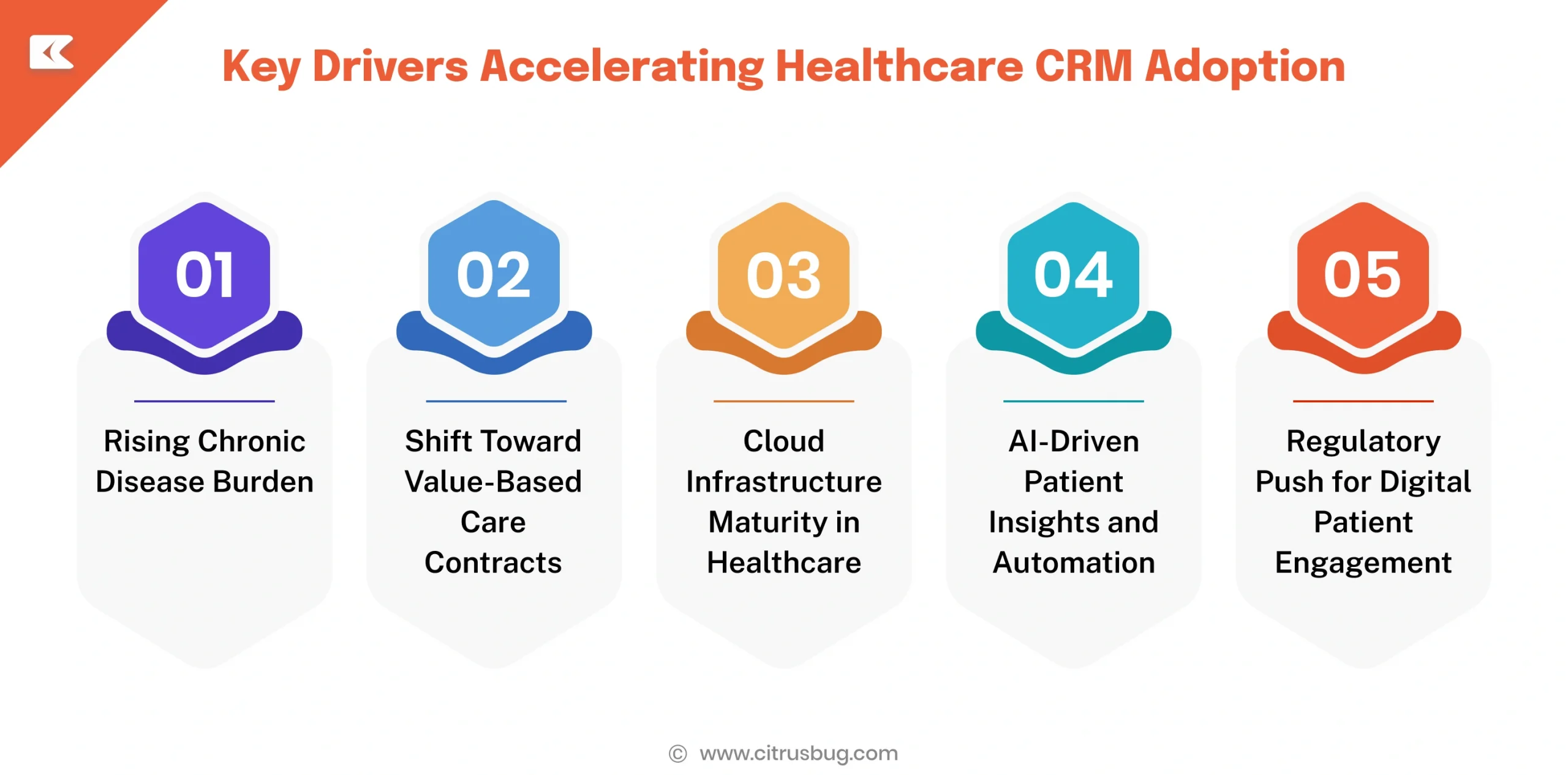
Several structural forces are driving consistent expansion in this sector beyond technology trends alone. These drivers reflect deep changes in healthcare economics, patient demographics, and regulatory expectations that create sustained long-term demand for patient relationship management infrastructure.
Rising Chronic Disease Burden
Growing populations of patients with long-term conditions such as diabetes, cardiovascular disease, and chronic respiratory illness require continuous engagement between clinical episodes.
Healthcare organizations need scalable tools to track, communicate with, and support these patients across multi-year care journeys, which drives direct investment in CRM platforms purpose-built for condition management and longitudinal follow-up workflows.
Shift Toward Value-Based Care Contracts
As payers and health systems transition away from volume-based reimbursement toward outcome-driven contracts, tracking patient engagement and care plan adherence becomes financially consequential.
Organizations in value-based arrangements need CRM systems that can document patient interactions, flag care plan non-compliance, and support proactive outreach programs to prevent costly complications before they escalate to emergency or inpatient events.
Cloud Infrastructure Maturity in Healthcare
Cloud computing infrastructure for healthcare has matured considerably in recent years, reducing implementation risk for health systems evaluating CRM platforms.
Standardized hosting environments, healthcare-specific security certifications, and scalable subscription pricing have lowered the barriers for mid-sized organizations and independent practices to deploy and maintain enterprise-grade CRM systems without building internal data center capacity.
AI-Driven Patient Insights and Automation
Artificial intelligence capabilities embedded in modern CRM platforms are changing how healthcare organizations use patient data. Predictive risk scoring, automated follow-up triggers, and natural language processing for clinical documentation are enabling care teams to surface actionable insights without manual data analysis, which increases the practical return on CRM investment across different care settings and patient panel sizes.
Regulatory Push for Digital Patient Engagement
Government mandates around interoperability, digital patient access, and care transition documentation are creating compliance pressure that aligns directly with what healthcare CRM platforms provide.
Organizations implementing CRM tools to meet engagement and data transparency requirements are also benefiting from improved clinical workflows and reduced administrative burden, making regulatory compliance and operational efficiency mutually reinforcing outcomes rather than competing priorities.
Regional Market Share and Growth Insights
CRM adoption in healthcare does not expand uniformly across all geographies. Differences in healthcare infrastructure, regulatory frameworks, patient population complexity, and digital investment levels shape where growth is fastest and which markets are deepening penetration most aggressively.
North America
North America market generated a revenue of USD 7.3 billion, maintaining its position as the dominant regional market by a significant margin.
The United States accounts for the large majority of this share, supported by a mature health technology ecosystem, widespread EHR adoption, value-based care contract proliferation, and a regulatory environment that increasingly ties reimbursement to demonstrable patient engagement outcomes across provider and payer organizations.
Asia Pacific
The Asia Pacific region reached USD 3.4 billion in CRM adoption, with expansion driven by large patient populations in India and China, accelerating smartphone penetration, and government-backed digital health infrastructure programs pushing public and private health systems toward more structured patient engagement platforms.
Mobile-first CRM deployment models are gaining particular traction among outpatient clinic networks across the region, where patient-facing digital tools see high engagement rates.
Latin America and Middle East & Africa
Latin America and the Middle East & Africa combined reached USD 2.0 billion in market value, with growth concentrated in tech-forward markets including Brazil, the UAE, and Saudi Arabia.
Digital health investment programs, private hospital group expansion, and national health information network development in these markets are all creating structured demand for patient relationship management tools beyond the large enterprise segment.
[Source: Growth Market Reports]
5 Healthcare CRM Benefits for Clinics
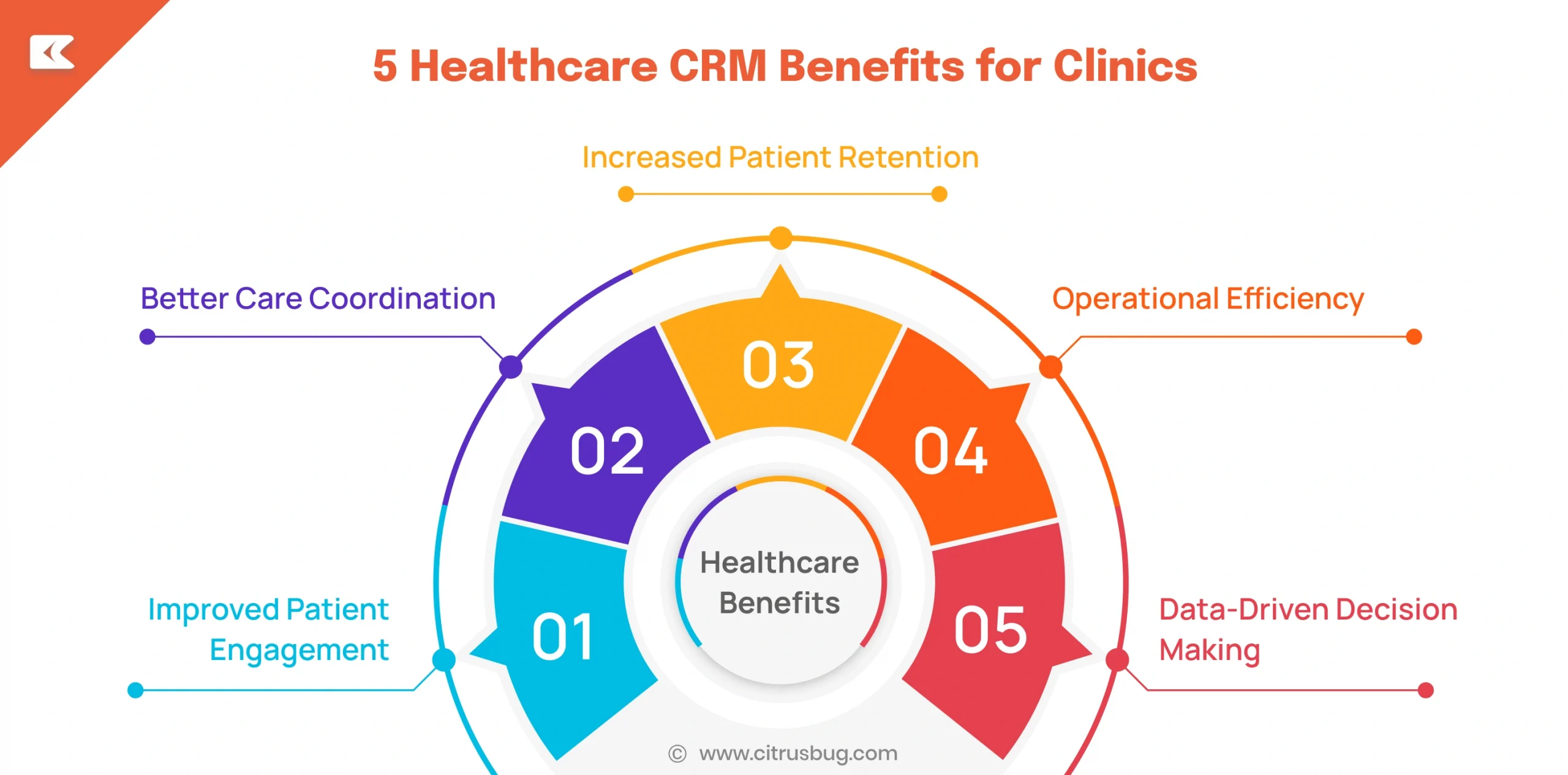
1. Improved Patient Engagement
- Deliver personalized communication through email, SMS, phone calls, and patient portals.
- Send automated appointment confirmations and reminders.
- Share preventive care reminders, health tips, and wellness campaigns.
- Improve medication adherence with timely follow-up notifications.
- Offer consistent communication throughout the patient journey.
- Increase patient satisfaction with personalized interactions.
- Build stronger, long-term relationships through continuous engagement.
2. Better Care Coordination
- Maintain a centralized patient record accessible to authorized care teams.
- Enable seamless communication between physicians, specialists, and support staff.
- Track referrals and patient care transitions efficiently.
- Reduce information gaps across departments.
- Coordinate follow-up appointments and ongoing treatment plans.
- Improve collaboration for chronic disease management.
- Ensure patients receive timely and consistent care.
3. Increased Patient Retention
- Automate follow-up messages after appointments and procedures.
- Conduct patient satisfaction surveys to gather valuable feedback.
- Re-engage inactive patients through targeted outreach campaigns.
- Personalize health recommendations based on patient history.
- Strengthen patient trust with proactive communication.
- Encourage repeat visits through wellness and preventive care reminders.
- Foster long-term loyalty with a more personalized healthcare experience.
4. Operational Efficiency
- Automate appointment scheduling and reminder workflows.
- Reduce manual data entry through centralized patient information.
- Streamline patient registration and intake processes.
- Minimize missed appointments with automated notifications.
- Improve staff productivity by reducing administrative workload.
- Standardize communication workflows across departments.
- Save time and reduce operational costs through automation.
5. Data-Driven Decision Making
- Analyze patient engagement trends and communication performance.
- Track referral sources and patient acquisition channels.
- Monitor appointment attendance and follow-up rates.
- Generate reports on patient demographics and service utilization.
- Measure the effectiveness of marketing and outreach campaigns.
- Identify opportunities to improve patient satisfaction and retention.
- Support strategic planning with real-time analytics and actionable insights.
Future Outlook and Growth Projections
The healthcare crm market is expected to grow in both absolute value and strategic importance as AI capabilities, interoperability requirements, and value-based care contracts drive deeper adoption globally across provider, payer, and pharmaceutical segments.
The market is projected to reach USD 52.41 billion by 2030, growing at a 16.8% CAGR from 2025 through 2030.
This trajectory reflects the compounding effect of new user segments entering the market, including smaller clinical practices, insurance carriers, and home health operators adopting CRM platforms for the first time.
As these segments mature, average contract values and platform complexity are both expected to increase substantially.
The Future of Healthcare CRM
As healthcare continues its digital transformation, Healthcare CRM platforms will evolve beyond patient relationship management into intelligent ecosystems that support personalized care, having their share in the predictive analytics market.
AI, automation, cloud technologies, and interoperability will shape the next generation of CRM solutions, enabling providers to improve patient outcomes while streamlining operations.
- AI-powered patient engagement will become the standard, with CRM platforms using predictive analytics to identify at-risk patients, automate personalized outreach, and recommend preventive interventions before health conditions worsen.
- Deeper integration with healthcare ecosystems will enable seamless data exchange between Electronic Health Records (EHRs), telehealth platforms, wearable devices, pharmacy systems, and insurance providers, creating a unified patient view across the continuum of care.
- Automation will transform administrative workflows, reducing manual tasks such as appointment scheduling, patient onboarding, referral management, insurance verification, and follow-up communications, allowing healthcare professionals to dedicate more time to patient care.
- Value-based care initiatives will drive CRM adoption, as organizations increasingly rely on CRM platforms to monitor patient engagement, track quality metrics, improve care coordination, and meet reimbursement requirements tied to clinical outcomes.
- Personalized omnichannel communication will become a competitive differentiator, enabling healthcare organizations to deliver consistent experiences across email, SMS, mobile apps, patient portals, chatbots, and virtual assistants while respecting patient preferences.
- Cloud-first and scalable CRM platforms will accelerate adoption among small and mid-sized healthcare providers, offering lower implementation costs, faster deployment, enterprise-grade security, and easier compliance with evolving healthcare regulations.
Conclusion
The healthcare crm market reflects a sector in structural transformation, where patient engagement technology has moved from a supplementary function to a core operational investment. Adoption data, outcome statistics, and regional growth figures consistently point to a market deepening in penetration and expanding in scope across every major geography.
For healthcare organizations evaluating their technology roadmap, CRM platforms offer a measurable path to improved patient outcomes, reduced readmissions, and more efficient care coordination. Investing in the right healthcare software development now positions providers and payers to meet both clinical and financial goals as this market continues to scale.