
 Back
Back

Machine learning (ML) has emerged as a game-changer in diverse fields, giving business operations a fresh new look and opening up exciting new paths for creativity and efficiency. In 2024, it is important to grasp key figures that underscore the expansion, uptake, and influence of machine learning across varied sectors. This piece explores Machine Learning Statistics, providing an all-encompassing snapshot of the machine learning scenario in 2024.
What Is Machine Learning?
Machine learning (ML) is a major branch of artificial intelligence (AI) that uses statistical models and algorithms to let computer systems learn from data and improve at specific tasks over time.
It’s widely applied across natural language processing, computer vision, speech recognition, and predictive analytics.
The machine learning market includes software tools, platforms, and services that make it easier to build, train, and deploy ML applications at scale.
Key Players
The machine learning market is characterized by two primary performance indicators: overall market size and market size by industry. The overall market size is mostly driven by the funding received by AI companies.
Industry giants like Amazon Web Services, Google Cloud Platform, and Microsoft Azure are the prominent players. These companies provide extensive ML development services. They have become increasingly popular due to their scalability and accessibility.
Several key trends are currently defining the machine learning landscape. A significant trend is the emergence of deep learning, a machine learning subset that utilizes deep networks to analyze diverse data types. Deep learning has demonstrated exceptional effectiveness in tasks involving image and speech recognition, helping in precise predictions and decision-making processes.
The development of new ML algorithms aimed at improving the precision and effectiveness of ML models is another major trend walking hand in hand with deep learning.
These advances produce more accurate and dependable outcomes essential for mission-critical industries like healthcare, banking, and retail.
For example, machine learning algorithms are used in banking for risk management and fraud detection, and in healthcare for diagnostics and personalized treatment planning.
Machine Learning Statistics: Market Size, Share, Growth, and Trends
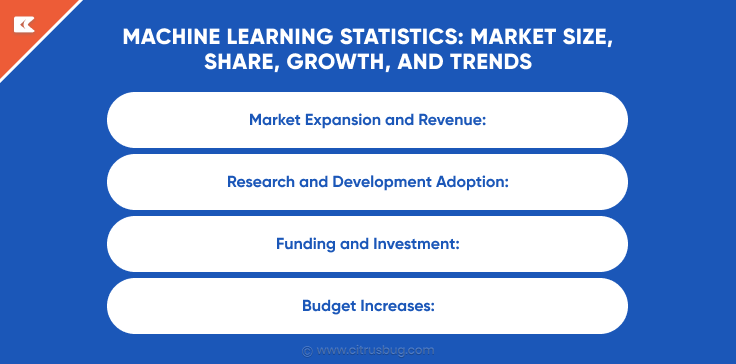
- Market Expansion and Revenue: In the past few years, the machine learning market has grown at an exponential rate. By 2035, the market would generate $1,709.98 billion in sales as compared to $93.95 billion in 2025. Because machine learning technologies are being rapidly adopted and integrated across many sectors, this represents an almost 400% rise over the course of six years.
- Research and Development Adoption: In 2025, approximately 78% to 88% of global enterprises are using AI and machine learning in at least one business function, with 71% of companies regularly utilizing generative AI. This high rate of adoption points to a major change in the direction of using data-driven insights to promote innovation and advance science.
- Funding and Investment: In 2019, system applications designed by machine learning raised $28.5 billion in funding. Additionally, machine learning platforms require about 14.4 billion dollars in funding. These figures highlight the substantial financial backing and investor confidence in machine learning technologies.
- Budget Increases: Machine learning increased by at least 25% between 2020 and 2021, indicating the increasing awareness of its importance.
Machine Learning Adoption Statistics Across Industries
- Cybersecurity: About 66% of businesses are now using machine learning to stop cybercrime. This shows how important machine learning has become in making cybersecurity better and keeping sensitive data safe, particularly through applications like fraud detection software that flags suspicious transactions in real time.”
- Business Analysis and Security: In 2018, machine learning was specifically adopted to offer better analysis of problems, with security being another vital reason for its integration into business technologies.
- Predictive Text and Route Suggestions: Since 2017, about 39% of people in Australia who use smartphones have been using predictive text, which is a simple way that machine learning is used. Additionally, about 20.5% of the global population now actively uses voice search, and there are approximately 8.4 billion active voice assistant devices worldwide. These statistics highlight the pervasive nature of machine learning in everyday applications.
ML Statistics That Highlight Business Benefits and Impact
- Cost Reduction and Customer Service: A third of firms report improved customer service outcomes as a result of implementing machine learning technologies, and about 38% of enterprises utilize machine learning to save costs. These advantages highlight the improved customer experiences and efficiencies that machine learning can offer.
- Fraud Detection and Prevention: Around 27% of companies have successfully leveraged machine learning to identify and eliminate fraudulent activities, showcasing the technology’s potential in enhancing financial security and integrity. This is especially visible in the rise of AML software that screens transactions and flags compliance risks.
- Entertainment Industry: ML has significantly enhanced the entertainment industry. A prime example is Netflix, which managed to save $1 billion. This was achieved through machine learning algorithms to customize content, thereby boosting user interaction.
- Healthcare Applications: During the COVID-19 pandemic, machine learning achieved an accuracy rate of 92% in predicting infected patients showing its potential in transforming healthcare diagnostics and treatment planning.
Sales and Marketing Enhancement Statistics of ML
- Sales Efficiency: Machine learning has dramatically improved sales processes, with an estimated 80% of businesses reporting higher revenues after implementation. On top of that, companies see up to a 60% reduction in customer acquisition costs through ML-driven targeting and lead scoring.
- Customer Insights: Approximately 57% of customers expect companies to anticipate their needs before communication, indicating the importance of machine learning in enhancing personalized marketing efforts.
- Voice Assistants and Predictive Analytics: It is anticipated that 8 billion people worldwide will be using machine learning-powered voice assistants by the end of the following year. This broad application displays the increasing reliance on machine learning to improve user experiences.
Employment and Skill Demand Stats of ML
- Job Market for Data Scientists: The demand for AI and machine learning skills continues to surge. As the report projects 34% growth in data scientist positions from 2024 to 2034 much faster than average, making it one of the fastest-growing occupations in the U.S. economy.
- Impact on Employment: While AI models have displaced 1.8 million jobs, they are expected to produce over 2.3 million new positions. This change demonstrates machine learning’s transformational potential for changing the job sector.
- Salaries for Data Scientists: The high demand for and value placed on machine learning professionals is reflected in the $120,000 average salary for data scientists in the US.
ML Statistics Focusing on Challenges & Limitations
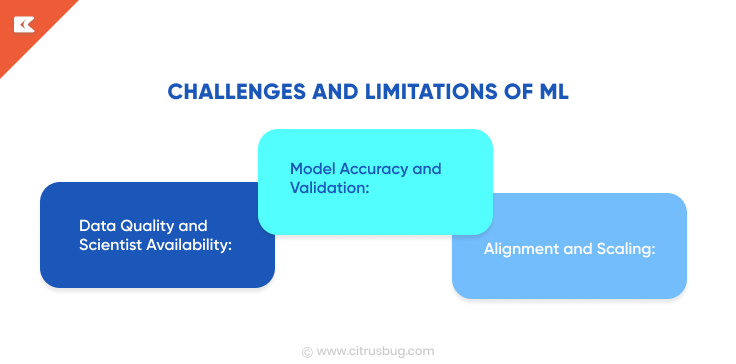
- Data Quality and Scientist Availability: The top challenges businesses face when implementing machine learning include poor data quality (43%), difficulty finding qualified data scientists (33%), and a lack of sufficient training data (38%). These limitations underscore the urgent need for stronger data management practices and modern talent acquisition strategies.
- Model Accuracy and Validation: Only about 40% of businesses regularly check the accuracy of their machine learning models, highlighting the need for better validation practices to ensure reliable outcomes.
- Alignment and Scaling: Achieving alignment across the organization (34%), scaling (43%), and envisioning future models (41%) are identified as significant limitations to machine learning implementation. Addressing these challenges is important for maximizing the potential benefits of machine learning technologies.
Machine Learning Stats for Future Projections & Trends
- Economic Contribution: Predictions show machine learning and AI contributing 14% to global GDP. This signifies their substantial economic influence. In around 10 years,a 38% surge in business profits is expected. This will add an amount of $14 trillion into the world economy.
- Patent Ownership: With thousands of patents to their names, corporations like NTT, Microsoft, and IBM have been at the forefront of machine learning innovation. Given the fierce rivalry and quick progress in the field of machine learning, IBM had more than 55% of the patents in this domain in 2020.
- Retail and E-commerce: ML has played a significant role in the changes that the retail business is experiencing. An increasing number of retailers—31% in 2018—are using machine learning to enhance their operations, with growing adoption of AI in e-commerce, such as personalised recommendations, demand forecasting, and dynamic pricing.
- Voice-Activated Applications: Given that 51% of consumers say they prefer applications run by command, it is expected that the use of these applications in cars would rise. This pattern displays how machine learning is increasingly being used to improve user experiences in various sectors.
Challenges and Future Prospects
Despite the promising growth, the machine learning market faces several challenges. A significant hurdle is the shortage of skilled talent. Creating and using good machine learning models needs special skills and knowledge, and right now, we don’t have enough people who can do this. Also, worries about keeping data private and safe could slow down how quickly machine learning technologies are being used everywhere.
In summary, Machine learning is a fast-changing area with a lot of promise for many different kinds of businesses. The fact that we have more data than ever, better computers, and a big push for automation are all helping this market grow. But, we need to find more experts and take care of data privacy to really get all the good stuff out of machine learning.
Conclusion
The numbers and trends we’ve discussed in this article sheds light on how the world of machine learning looks like in 2024. From significant market growth and popularity across industries to big benefits in business operations and customer service, machine learning continues to drive innovation and efficiency. However, there are few challenges like data quality and talent acquisition which are to be addressed to fully utilize the potential of machine learning.
As businesses and industries start accepting machine learning, its impact will become increasingly visible. By keeping up with the latest trends and using information from data, companies can use machine learning to grow, work more efficiently, and keep up with changes in technology.
If you are looking to navigate these changes effectively, seeking expert guidance can be beneficial. By getting machine learning consulting services from professionals in the field, companies can better manage data complexities and implement advanced algorithms, ensuring they stay at the forefront of innovation.