
 Back
Back







Key Takeaways
- Predictive analysis in finance uses historical data, statistics, and AI to forecast outcomes like loan defaults, fraud, and future revenue.
- Core techniques include regression models, classification models, and time-series forecasting, each suited to different financial prediction problems.
- Real-world applications span fraud detection, credit scoring, portfolio optimization, and cash flow forecasting across banking and investment operations.
- Custom predictive analytics solutions offer tailored models, scalable architecture, and stronger data compliance compared to rigid off-the-shelf tools.
- Implementation costs range from $20,000 for a basic MVP to $300,000+ for advanced, real-time AI-driven solutions with full system integration.
Past financial data alone is no longer sufficient in a quickly moving market. Leveraging Predictive analysis in finance, organizations can evolve from retrospective models to a forward-looking approach by detecting trends and predicting outcomes for faster and more detailed decision-making. This is paramount as risks such as fraud, credit defaults and market volatility keep on rising.
The fintech sector is already moving fast with the adoption of AI and advanced analytics technology. Actually, now more than 55% of organizations are using predictive tools to predict trends, reduce risks and enhance customer engagement. This illustrates that financial institutions are transitioning toward predictive and data-led decision-making.
In this blog, we shall take a look at how predictive analysis can play a role in counteracting the key challenges faced by finance professionals and what practical use cases can deliver value where it matters with predictive analysis, and lastly, on how businesses can remain competitive from the front-end by building scalable AI-powered solutions in-house.
What Is Predictive Analysis in Finance?
Predictive analysis in finance refers to the process of using historical financial data, statistical techniques, and advanced algorithms to forecast future outcomes. Instead of only analyzing what has already happened, it helps businesses anticipate trends, identify risks, and make proactive financial decisions.
In simple terms, it answers questions like: What is likely to happen next? This could include predicting loan defaults, detecting unusual transactions, or estimating future revenue. By using data patterns and models, financial teams can reduce uncertainty and improve decision-making.
It also differs from other types of analytics. Descriptive analytics focuses on past data and explains what happened, while diagnostic analytics looks deeper into why something happened. Predictive analysis goes a step further by using this data to forecast future events, making it more valuable for planning and risk management.
At the core of predictive analysis are three key elements: data, algorithms, and AI. Financial data from multiple sources is collected and processed, algorithms identify patterns, and AI models continuously improve predictions over time. This combination enables faster, more accurate insights that support real-time financial decisions.
Types of Predictive Analytics Used in Finance
Regression Models
Regression models estimate relationships between variables (data points like price, demand, or income) and are commonly used for forecasting revenue, interest rates, or asset prices.
Classification Models
These models categorize data into groups, such as identifying whether a transaction is fraudulent or whether a borrower is high-risk.
Time-series Forecasting
These models analyze data over a period of time to predict future trends, such as stock prices, market demand, or cash flow patterns.
Key Financial Challenges Solved by Predictive Analysis
Financial problems aren’t mere technical matters. These processes have a direct impact on revenue, risk exposure, and customer experience. Investing in predictive analysis in finance organizations shifts their focus from reactive decision-making to proactive control, working overcoming all these challenges by leveraging data-driven insights for execution.
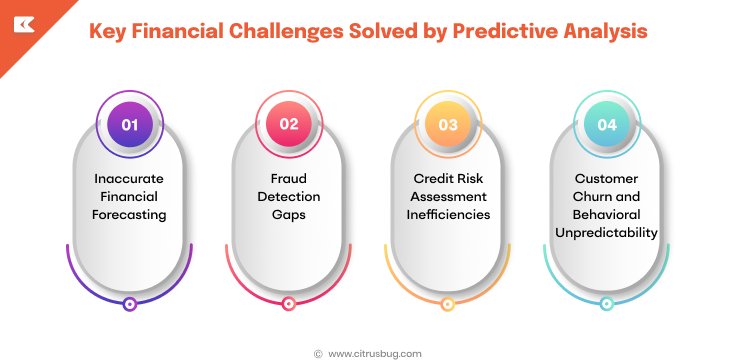
Inaccurate Financial Forecasting
The challenge:
The main problem with traditional forecasting that it is based on historical level data and static models, which can be ineffective in dynamic market conditions.
Business impact:
Inaccurate forecasts lead to poor budgeting, missed revenue targets, and inefficient resource allocation.
How predictive analysis solves it:
Predictive models analyze real-time and historical data together, adjust for trends and seasonality, and continuously refine forecasts for better accuracy.
Fraud Detection Gaps
The challenge:
Equated to a static system, rule-based can not trace the new or evolved patterns of fraud.
Business impact:
Late detection leads to higher financial losses and damages customer confidence.
How predictive analysis solves it:
By analyzing transaction patterns and identifying anomalies in real time, predictive models can detect and prevent fraud before it escalates.
Credit Risk Assessment Inefficiencies
The challenge:
There is limited data and manual evaluation for evaluating credit decisions.
Business impact:
Suggestions for higher default rates or missed opportunities with creditworthy customers.
How predictive analysis solves it:
It leverages multiple behavioral, historical, and trend variables to provide more accurate and faster credit risk evaluations.
Customer Churn and Behavioral Unpredictability
The challenge:
Financial institutions often talk about how changing customer behaviour is hard for them to understand.
Business impact:
Increased churn reduces lifetime value and impacts long-term growth.
How predictive analysis solves it:
Predictive systems that detect early warning signs of churn empower proactive communication with tailored tactics.
Real-World Applications of Predictive Analysis in Finance
The theory is nice to know, but it’s all about how it works in real life. Core financial functions that need accuracy and low risk can use predictive analysis in finance as an anchor point for better decision-making. Here are some of the most impactful real-world use cases.
Fraud Detection Using Predictive Modeling
Transaction Pattern Analysis
Predictive models assess historical transaction data to establish what normal user behaviour looks like. Including where and when they spend their money, how much money they have for a transaction, and what devices they use.
Anomaly Detection with AI
Once a baseline is finalized, AI models can automatically highlight anomalies like abnormal transactions and location mismatches. This approach is typical with AI for fraud detection, in which systems track suspicious behavior as it happens and aid in minimizing financial loss.
Credit Scoring and Risk Assessment
Predictive Credit Models
Credit scores are predictive models with AI algorithms that banks use to assess borrower risk based on factors such as credit history, income trends and repayment behavior.
Loan Approval Optimization
Using these insights can automate and help optimize loan approvals, automating manual effort while providing accuracy. Lenders can be faster in making the best available credits, whilst still having the least chance of defaults.
Investment and Portfolio Optimization
Predictive Signals for Market Trends
They analyze old market data, economic indicators, and behavioral patterns in predictive models to recognize possible investment leads.
Portfolio Performance Forecasting
By forecasting returns and risks, businesses can adjust portfolio allocations proactively, ensuring better performance and reduced exposure to market volatility.
Cash Flow and Financial Forecasting
Revenue Prediction
Predictive analysis is used to calculate future revenue based on previous performance, seasonal patterns, and market situation. It helps to know and stop revenue leakages to keep low revenue lost for businesses.
Expense Pattern Analysis
It also monitors patterns of spending to predict future expenditures, which aid organizations in effectively managing their budgets and maintaining a healthy cash flow.
How AI and Machine Learning Power Predictive Analysis in Finance
AI and machine learning improve predictive analysis by making models more adaptive, data-driven, and capable of handling complex financial scenarios. They allow systems to learn from past outcomes and refine predictions as new data becomes available.
Machine Learning Models for Financial Prediction
Machine learning models focus on identifying patterns and relationships across large and complex financial datasets. They can process multiple variables simultaneously and adjust predictions based on changing inputs.
- Credit risk scoring and loan default prediction
- Revenue and demand forecasting
- Market trend and price movement analysis
NLP for Financial Documents and Sentiment Analysis
Natural Language Processing allows financial systems to interpret human language and extract meaning from text-based data. This helps bring unstructured data into predictive models, which is often overlooked in traditional analysis.
- Analysis of financial reports and earnings calls
- Sentiment tracking from news and market updates
- Customer interaction and feedback analysis
Real-Time Analytics Powered by AI
AI enables continuous data processing, ensuring that insights are generated as events happen rather than after delays. This is essential in financial environments where timing directly impacts outcomes.
- Real-time fraud detection and anomaly alerts
- Continuous transaction and behavior monitoring
- Instant decision-making and automated responses
Benefits of Predictive Analysis in Finance for Businesses
Businesses use predictive analysis to make better decisions because it provides them with future business predictions, while accelerating AI adoption across financial operations through data-driven insights. The system enables organizations to forecast their results while their financial performance improves through risk reduction.
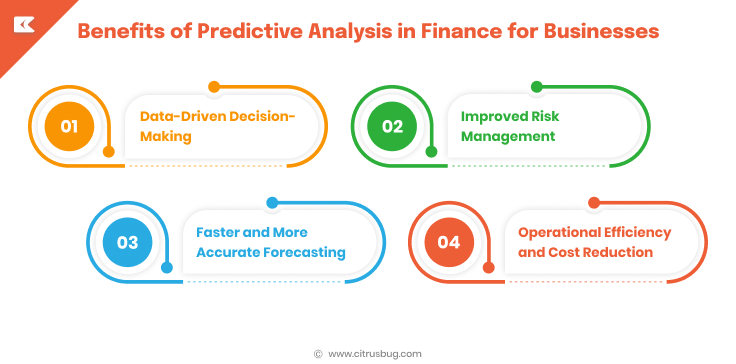
Data-Driven Decision-Making
- Replaces guesswork with data-backed insights
- Enhances strategy planning and financial decisions
- Allows for enhanced investment and budgetary decisions
Improved Risk Management
- Detects risks before they affect operations
- Detects fraud and anomalies early
- Strengthens credit risk assessment
Faster and More Accurate Forecasting
- Generates reliable forecasts using real-time and historical data
- Quick to adapt towards ever-changing financial conditions
- Reduces forecasting errors
Operational Efficiency and Cost Reduction
- Automates repetitive financial processes
- Reduces manual effort and operational costs
- Improves overall productivity and speed
Why Off-the-Shelf Tools Fall Short
Canned predictive analytics tools can address some basic use cases, but taper off as real financial operations with their complex interdependencies take shape.
These constraints are increasingly glaring and impossible to overlook as data scales up and needs change.
Limited customization options prevent organizations from building specific financial solutions through model and workflow adjustments. Organizations must change their operations to match tool functions because the tool does not support their business plans.
Data silos still represent a significant obstacle. Because predictive models are picking patterns based on the data they receive, separated datasets mean that they simply don’t have access to the whole view of everything.
Integration challenges slow down adoption. Integrating these tools with existing systems, particularly legacy infrastructure, necessitates extra work and can slow down time-to-value.
Compliance gaps are risk in regulated environments. Even though most of the tools do not have enough flexibility to meet specific regulatory needs, which will make it more difficult for data security and governance.
Why Businesses Choose Custom Predictive Analytics Solutions
Traditionally limited to generic capabilities, as financial information turns more complex and business needs become more granular, organizations need solutions. Custom predictive analytics systems enable the flexibility, control and accuracy that can create real-world financial impact.
Tailored Financial Models
They are specifically custom-built for your unique financial workflow, data structures, and business goals. Such tailored predictions can guide decision-making rather than producing generic output.
Scalable Architecture
Custom systems grow as your business grows with increased volume and complexity. They are highly scalable and designed to handle an increasing amount of work without affecting performance or response time.
Seamless Integration
Tailored predictive analytics solutions seamlessly integrate with the current finance systems, including third-party applications and legacy platforms. This guarantees uniformity in data flow, as well as preventing operational bottlenecks.
Stronger Data Control And Compliance
Businesses can enjoy greater control with a custom-built solution in respect of data access, security and regulatory compliance. This is particularly important in finance, where compliance requirements are stringent and ever-changing.
Sustainable Competitive Advantage
Custom models and insights are specific to your business they’re hard for others to replicate. This enables businesses to make quicker, more intelligent choices and maintain a competitive edge in financial markets.
Key Features of a Predictive Analysis in Finance Solution
A robust predictive analytics solution in finance is built as a combination of interconnected layers, each responsible for transforming raw data into actionable financial insights.
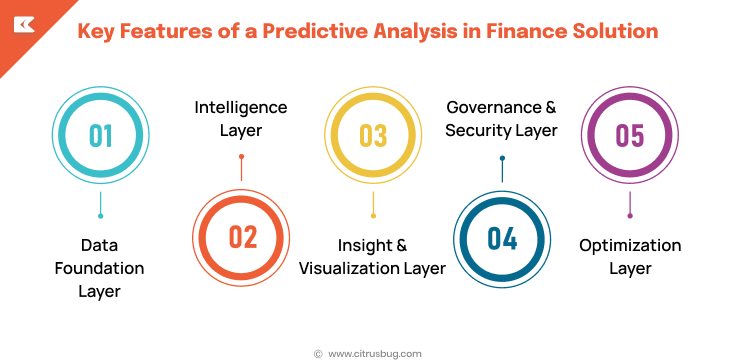
Data Foundation Layer
This layer ensures that data flows seamlessly from multiple sources into a centralized system, creating a reliable base for analysis.
- Integration with APIs, banking systems, and third-party tools
- Unified data pipelines for structured and unstructured data
Intelligence Layer
At the core of the system, AI and machine learning models process data to identify patterns, trends, and future outcomes.
- Custom AI/ML model development
- Predictive modeling for forecasting and risk analysis
Insight & Visualization Layer
This layer transforms complex outputs into clear, actionable insights for business users.
- Real-time analytics dashboards
- Interactive reporting and financial visualization
Governance & Security Layer
Ensures that the system meets regulatory requirements while maintaining data integrity and protection.
- Security frameworks and access controls
- Compliance readiness for financial regulations
Optimization Layer
Continuous monitoring and improvement keep the system accurate and aligned with changing financial conditions.
- Model performance tracking
- Continuous learning and updates
Cost and Implementation Considerations
The cost and timeline of implementing predictive analysis in finance depend on integration complexity, data readiness, and the level of customization required.
Key Factors Affecting Cost and Effort
| Factor | Specific Considerations |
| Customization Level | Whether you need use-case-specific models (fraud detection, credit scoring, forecasting) or standard predictive models |
| Data Readiness | Availability of 2–5 years of historical financial data and effort required for cleaning and structuring |
| Integration Complexity | Number of systems involved (core banking, CRM, payment systems) and legacy infrastructure challenges |
| Implementation Scope | MVP vs full-scale solution with real-time analytics and multiple use cases |
| Infrastructure Requirements | Cloud (AWS, Azure, GCP) vs on-premise and scalability needs |
Estimated Cost and Timeline
| Implementation Type | Estimated Cost | Timeline | What’s Included |
| Basic Integration (MVP) | $20,000 – $50,000 | 6 – 10 weeks | Single use case (e.g., forecasting), basic model, limited integrations |
| Mid-Level Implementation | $50,000 – $120,000 | 10 – 16 weeks | Multiple use cases, improved models, integration with key systems |
| Advanced AI-Driven Solution | $120,000 – $300,000+ | 4 – 8 months | Real-time analytics, multiple predictive models, full system integration, dashboards |
How to Get Started with Predictive Analysis in Finance
Implementing predictive analysis in finance requires a structured approach that aligns with your data, systems, and business goals. Following the right steps helps ensure faster adoption and better outcomes, and is a key part of driving digital transformation in fintech.
Step 1: Define Clear Financial Use Cases
Start by identifying where predictive analysis will create the most value, such as fraud detection, credit risk assessment, or financial forecasting. Clear use cases help prioritize efforts and avoid unnecessary complexity.
Step 2: Assess Data Availability and Quality
Evaluate whether you have sufficient historical data and whether it is clean, structured, and accessible. Data readiness directly impacts the accuracy of predictive models.
Step 3: Choose the Right Integration Approach
Decide how predictive capabilities will fit into your existing fintech systems, whether through APIs, third-party tools, or custom integrations with core financial platforms.
Step 4: Develop and Validate Predictive Models
Build models tailored to your use cases and test them against real-world scenarios. Continuous validation ensures the predictions are reliable and aligned with business needs.
Step 5: Deploy, Monitor, and Optimize
Once implemented, monitor model performance and refine it over time. Regular updates and improvements help maintain accuracy as financial conditions and data patterns evolve.
Conclusion
Predictive analysis in finance enables businesses to move from reactive decision-making to proactive financial planning. By improving forecasting accuracy, strengthening risk management, and enabling real-time insights, it helps organizations operate with greater clarity and control. The real impact, however, depends on how well these capabilities are integrated into existing systems and aligned with specific financial use cases.
At Citrusbug Technolabs, we help organizations implement predictive analytics within custom finance software development, ensuring seamless integration, scalable systems, and models tailored to real-world financial needs. This approach allows businesses to turn data into actionable insights and build a stronger, future-ready financial foundation.