





Pave
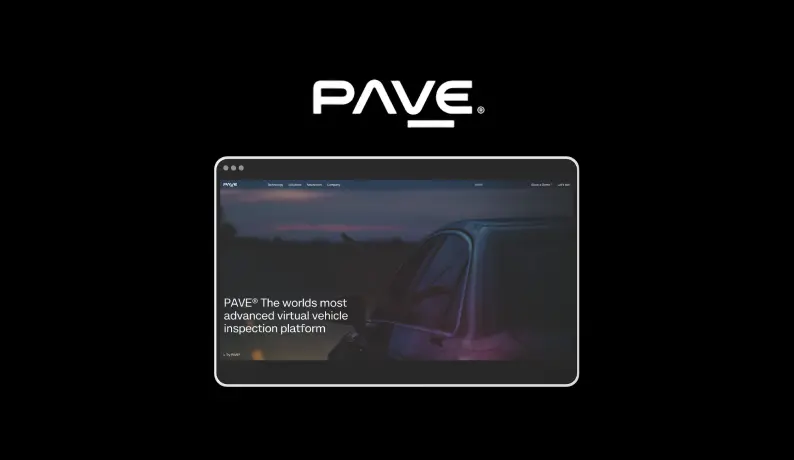
Pave.ai is an AI-driven vehicle inspection platform that enables users to conduct accurate and comprehensive inspections using just a smartphone, automating damage detection, appraisals, and fleet management.
View Case Study →
Trusted By Industry Leaders
Every engagement draws from the same set of consulting services for RAG implementation, scoped to what your data and systems actually need. Some clients need one piece; others need the full path from assessment to production.
We audit your data sources, access controls, and existing AI stack to determine whether retrieval-augmented generation is the right fit, then scope a pipeline architecture matched to your accuracy requirements and infrastructure constraints.
We design chunking, embedding, and retrieval strategy around your document types, combining dense and keyword search with a reranking layer so the model receives the right context instead of just the closest match. This is where our RAG development team takes a design from paper to a working pipeline.
Retrieval pipelines connect to CRMs, document repositories, and internal knowledge bases through permission-aware access controls, so retrieval respects who is allowed to see what before a single answer gets generated.
We define groundedness and retrieval accuracy metrics before launch, then monitor drift, latency, and hallucination rate in production so the system stays reliable as your data and usage grow.
A 30-minute call covering your data sources, systems, and what a working pilot could look like.
Book a Free Strategy CallSupport or sales-facing AI that guesses instead of citing your actual policy documents.
Answers live across wikis, PDFs, tickets, and databases that were never built to be searched together.
Responses need to stay inside access boundaries and leave an audit trail.
Content changes faster than a fine-tuned model can be retrained to reflect it.
Review the sources your AI application needs to use, how that data is structured, where it lives, and whether it is suitable for retrieval.
Assess chunking, embeddings, vector search, keyword search, reranking, and retrieval patterns against your data and expected queries.
Map permissions, data boundaries, and governance requirements to determine how retrieval should handle sensitive or restricted information.
Define the retrieval and response metrics, test cases, and evaluation approach needed to measure relevance, groundedness, and answer quality.
Vector database choice gets the most attention in RAG conversations, but it rarely determines whether a system works. The decisions that matter happen earlier, in how content gets chunked and retrieved, and we treat evaluation, groundedness scoring, and drift monitoring as a deliverable defined before a single line of the pipeline gets built.
Retrieval-augmented generation earns its keep fastest in industries where answers have to be both accurate and traceable back to a source document, and where the underlying data changes too often for a fine-tuned model to stay current.
Grounding clinical and administrative answers in EHR data, care protocols, and payer policy documents that update constantly.
Retrieving regulatory guidance, product terms, and risk policy in real time for advisory, underwriting, and compliance workflows.
Surfacing SOPs, carrier contracts, and shipment exception rules for dispatch and support teams working against the clock.
Connecting AI assistants to listing data, lease terms, and compliance documentation that vary by market and jurisdiction.
Connecting AI workflows to policy documents, claims guidelines, underwriting rules, and regulatory requirements that change across products and jurisdictions.
Retrieving contracts, case documents, internal knowledge, and regulatory materials to support research, review, and document-heavy workflows.
Grounding AI assistants in equipment manuals, maintenance records, SOPs, and quality documentation to support plant and operations teams.
Connecting AI applications to course materials, institutional policies, research resources, and student-support knowledge bases for context-aware responses.
We start by mapping your data sources, document formats, and existing AI or search infrastructure, then interview the teams who will actually use the system. This surfaces the real questions users actually ask instead of the ones a demo script assumes, and flags data that isn't retrieval-ready before it becomes a production problem.
We design the chunking strategy, embedding approach, and hybrid retrieval setup around your document types and query patterns, then define where reranking and metadata filtering fit in the pipeline. This is where most of the accuracy work actually happens, well before any code gets written.
We build the retrieval pipeline and connect it to the systems it needs to read from, whether that's a document repository, a CRM, or an internal wiki, enforcing role-based access at the retrieval layer so the system never surfaces content a user shouldn't see.
We run the system against a test set of real questions, measuring groundedness, retrieval precision, and hallucination rate, then tune chunking, reranking, and prompt design until the answers hold up under scrutiny.
We deploy with monitoring in place for latency, retrieval drift, and answer quality, then hand your team dashboards and documentation so they can see how the system is performing.
Pave.ai is an AI-driven vehicle inspection platform that enables users to conduct accurate and comprehensive inspections using just a smartphone, automating damage detection, appraisals, and fleet management.
View Case Study →
A RAG system can only generate useful answers when the right information reaches the model at the right time. Retrieval strategy, ranking, evaluation, and access controls all influence the quality and reliability of the final response.
Even a capable model can produce a weak answer when the retrieved context is irrelevant, incomplete, or outdated.
Reranking helps prioritize the most useful passages when multiple documents contain similar language but different meanings or levels of relevance.
Retrieval accuracy, groundedness, and answer quality metrics help identify weaknesses before they become recurring production issues.
Permission-aware filtering ensures users only retrieve information they are authorized to access before that context reaches the model.
RAG consulting typically ranges from $10,000 to $50,000+, depending on how many systems retrieval needs to touch, data complexity, security requirements, and whether you need an architecture assessment, pilot, or production implementation. Most engagements start with a scoped assessment, then move to fixed-price or time-and-material delivery based on the defined scope.
Share your requirements to get a more accurate estimate based on your data sources, retrieval needs, integrations, and target use case.
SCOPED, FIXED-PRICE
ONE USE CASE, PROVEN FIRST
DEDICATED TEAM, LONG-TERM
Enterprise data carries more than information. It comes with access rules, retention requirements, and audit obligations that retrieval pipelines need to account for before data reaches the model. Our security and compliance services can support these requirements where needed.
Role-based access enforced at the retrieval layer
Audit logging for every retrieved source and generated answer
HIPAA- and SOC 2-aligned data handling patterns
Relevant retrieval and reranking give the model stronger source context to work from, reducing the likelihood of answers being generated from incomplete or irrelevant information. Responses can also include source references for easier verification.
Employees and customers can find information through natural-language queries instead of manually searching across wikis, shared drives, and document repositories. The retrieval pipeline brings relevant content into the response workflow without requiring users to locate each source themselves.
Retrieved sources can be surfaced alongside generated answers, giving users a way to verify where the information came from. This is particularly useful for workflows involving policies, contracts, compliance documentation, and other source-sensitive content.
A RAG-based chatbot answers questions by retrieving relevant information from your own documents before generating a response, instead of relying only on what a language model learned during training. Done…
Read Article →
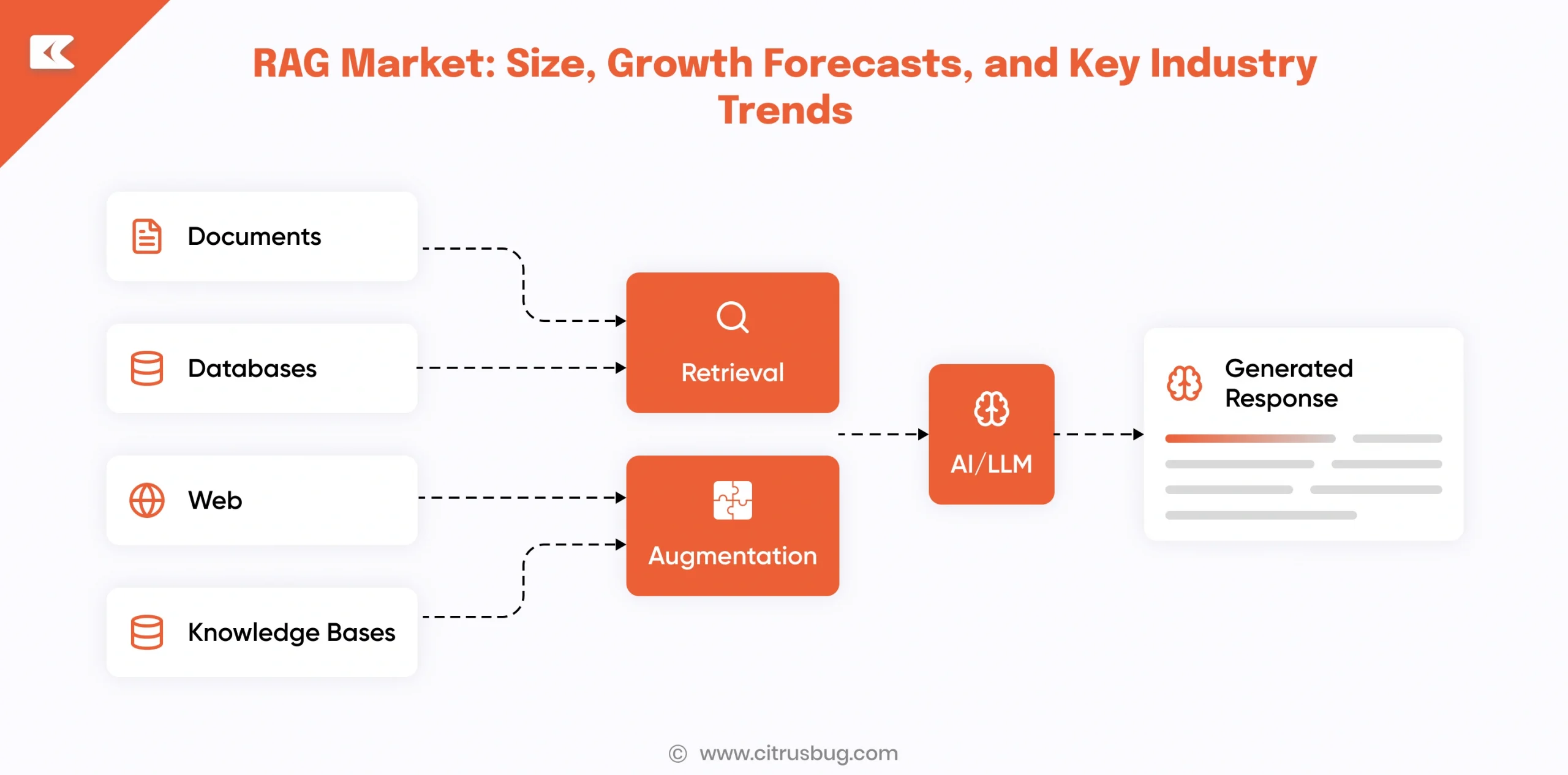
Retrieval-Augmented Generation has moved from a niche AI architecture to a foundational infrastructure layer for enterprises requiring accurate, context-aware language model outputs. The RAG market is expanding at a pace…
Read Article →
AI is quietly becoming the backbone of modern healthcare transformation. From reducing diagnostic errors to enhancing administrative workflows, its impact can be seen across the entire care continuum. Yet, successful…
Read Article →RAG consulting services focus on architecture and retrieval decisions rather than model training. Working with a RAG consultant gets you a scoped assessment and pipeline design without hiring or managing a full internal AI team.
Yes. We design retrieval pipelines that run inside your VPC or on-premises environment when data residency or security requirements rule out external hosting.
You get that finding in writing, along with what would work instead, whether that's fine-tuning, a simpler search tool, or no AI investment yet.
You do. Source code, documentation, and architecture decisions transfer at delivery, so your team can maintain or extend the system without us.
An assessment usually runs two to four weeks. A pilot for one workflow typically takes six to ten weeks before you decide whether to scale it.
Yes. We build access-aware retrieval with audit logging and role-based controls for healthcare, fintech, and other regulated data environments.
Yes, that's most of the work. We build ingestion and indexing layers for legacy databases, document stores, and internal tools that were never search-ready.
We track groundedness, retrieval precision, hallucination rate, and latency against a test set of real questions before and after launch.
Long context windows still cost more per query and don't scale to millions of documents. Retrieval keeps only relevant content in context, which stays faster and cheaper at scale.
Look for a scoped assessment before any commitment, clear evaluation metrics, and a stated cost and timeline range. Vague promises about accuracy without a way to measure it are a red flag.