
 Back
Back







Introduction
The role of software in healthcare has grown enormously over the past few years. The surge is being seen in the healthcare industry through healthcare software trends such as maintaining customer data, increasing the diagnosis process, and automatic administrative procedures. The field is being greatly transformed by the application of new technologies such as artificial intelligence, telemedicine, cybersecurity, and smart medical devices.
In a report by Grand View Research, it was mentioned that the global healthcare IT market was estimated at $866.48 billion in 2025 and is expected to reach $2,864.39 billion by 2033, growing at a CAGR of approximately 16.2% over the forecast period.
This blog discusses the key healthcare software trends driving change in healthcare software, as well as its applications.
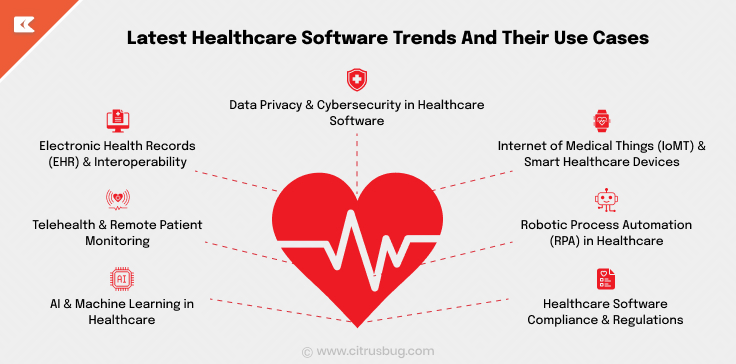
Latest Healthcare Software Trends And Their Use Cases
1. AI & Machine Learning in Healthcare
Overview
The healthcare industry is booming. It is one of those major industries that have fully embraced Artificial Intelligence (AI) and Machine Learning (ML), which have now revolutionized the sector through the use of enhanced diagnostics, workflow automation and patient risk prediction. The global AI in healthcare market was estimated at $36.67 billion in 2025 and is projected to reach $505.59 billion by 2033, growing at a CAGR of 38.90% from 2026 to 2033.
Use Cases
- AI-assisted Radiology: Medical imaging AI is one of the most proven applications in the field 76% of all AI-enabled medical devices authorized for sale in the US are used in radiology, where models are consistently reducing diagnostic error rates for tumour detection, chest X-ray interpretation, and CT scan analysis.
- Predictive Analytics for Patient Risk Assessment: A predictive analytics program can be used for patient risk assessment by implementing algorithms that look at patient data, such as EHR data, to diagnose diseases (e.g., heart disease or sepsis) and identify the high-risk patients.
- Chatbots and Virtual Assistants: Language processing features AI chatbots, which serve as personal virtual assistants for patients and help users obtain treatment by using the symptoms of the user and the doctor’s schedule and availability.
Innovations
- AI-assisted Drug Discovery: AI helps in the faster development of new drugs and makes it possible for new prescribed medicines to get to the market in the shortest time.
- Personalized Treatment Plans: Machine learning algorithms recommend personalized treatment based on a patient’s genetics and medical background.
2. Telehealth & Remote Patient Monitoring
Overview
After the pandemic, telehealth has grown more widespread today, providing both the patient monitoring and distant consultations. This trend has already started, as shown by the study, which says 78.6% of hospitals in the United States have established telemedicine services in the prior year. As of 2025, over 71 million Americans (26% of the population) are using some form of remote patient monitoring (RPM) service, with the total number of patients using RPM solutions globally expected to reach $115.5 million by 2027.
Use Cases
- Remote Consultations: Telemedicine solutions improve accessibility by enabling virtual doctor consultations. According to a McKinsey & Company report, the use of telehealth services grew 38 times compared to pre-pandemic levels.
- Wearable Devices: Heart rate, oxygen levels, and sleep patterns are continuously monitored by fitness trackers and smartwatches.
- Chronic Disease Management: Mobile apps assist in managing conditions like diabetes by monitoring blood sugar levels and medication compliance.
Innovations
- AI-based Telehealth Triage Systems: AI helps determine symptoms before virtual consultations, prioritizing urgent situations.
- Virtual Reality (VR) in Therapy: VR is utilized for pain treatment, mental illness therapy, and rehabilitation therapies.
- Alongside telehealth platforms, secure patient communication tools are also playing a critical role. For example, Textline provides HIPAA-compliant messaging for appointment reminders, follow-ups, and quick updates – reducing no-shows, improving chronic disease management, and enhancing patient engagement.
3. Electronic Health Records (EHR) & Interoperability
Overview
The necessity for smooth data exchange between healthcare systems is driving the use of interoperable EHRs. By 2021, about 88% of physicians in U.S. offices had implemented an EHR, with 78% making use of certified systems.
Use Cases
- Cloud-Based EHRs: Facilitates coordination among healthcare professionals through granting immediate access to patients’ records. Web/cloud-based EHRs maintained dominant market penetration, accounting for 83.51% of the U.S. EHR market share in 2025, with this segment expected to continue growing at the fastest CAGR.
- Blockchain for Safe Data Exchange: Blockchain improves data integrity and prevents manipulation with patient records. The blockchain in healthcare market, valued at USD 78 million in 2025, is projected to reach USD 641 million by 2035, at an updated CAGR of 23.5% over the forecast period.
Innovations
- AI-driven Automation: AI transforming medical billing has led to automation in data entry and billing, significantly reducing the administrative workload for healthcare providers.
- Federated Learning for Privacy: AI models preserve privacy by processing healthcare data without exposing sensitive patient information.
4. Data Privacy & Cybersecurity in Healthcare Software
Overview
Data privacy and cybersecurity are becoming significant concerns in healthcare software trends since the number and intensity of cyber attacks on patient data are growing. Stronger security mechanisms must be included since cyberattacks on patient data are becoming more frequent.
In 2023, the Office for Civil Rights of the U.S. Department of Health and Human Services received 725 reports of healthcare data breaches that exposed more than 133 million records. This trend continued in 2024, with the number of breached records increasing by 63.5% to 275 million, affecting approximately 82% of the population in the U.S.
Use Cases
- Multi-factor Authentication (MFA): Ensures secure access to electronic health records. For more security, 61% of consumers have enabled MFA for online healthcare portals and mobile apps.
- AI-powered Threat Detection: Using AI to monitor health networks can lower response times against cyberattacks, thus reducing possible damages. According to the 2025 Cost of a Data Breach Report, the average cost of a healthcare data breach fell to $7.42 million in 2025, down from $9.77 million in 2024, yet healthcare remained the costliest industry for breaches for the consecutive year, taking an average of 279 days to detect and contain.
Innovations
- Zero-Trust Security Models: Implementing into practice a zero-trust model ensures that every access request is thoroughly examined before granting access to private data, resulting in a low level of unauthorized access.
- Blockchain for Decentralized Identity Management: By enabling patients to control their own digital identities, blockchain technology reduces the possibility of identity theft and unauthorised access to data.
5. Internet of Medical Things (IoMT) & Smart Healthcare Devices
Overview
IoMT consists of Internet-enabled medical devices that gather and report health information in real-time, having a significant contribution to patient care as well as health care effectiveness. As one of the most transformative healthcare software trends, IoMT market is driving advancements in patient monitoring and diagnostics.
Use Cases
- Smart Inhalers and Insulin Pumps: Technologies such as artificial pancreas devices are changing the game of diabetes treatment. In England, the NHS has bought the devices for hundreds of thousands of patients with type 1 diabetes, potentially freeing them from having to take insulin injections. An estimated 270,000 people in England live with type 1 diabetes, and this technology could dramatically enhance their quality of life and cut costs for healthcare. [Source]
- Monitoring of the ICU in real time: In order to enable prompt action and better patient outcomes, remotely connected devices monitor crucial data and notify doctors in the case of an emergency.
Innovations
- 5G-enabled IoMT: By integrating 5G technology, healthcare data transfer becomes faster and more efficient, enabling more effective and timely patient care.
- Digital Twin Technology: Through this technology, practitioners can simulate the effects of therapies and thus have a better understanding of how to treat patients, which may lead to a higher success rate and lower the stakes for errors.
The global IoMT market was estimated at $230.69 billion in 2024 and is expected to reach $284.90 billion in 2025, growing to $658.57 billion by 2030 at a CAGR of 18.2%, driven by rapid adoption of connected monitoring, wearables, and AI-integrated medical devices. These advances confirm the incredible influence of IoMT and smart healthcare devices in the future of medical treatment.
6. Robotic Process Automation (RPA) in Healthcare
Overview
Robotic Process Automation (RPA) is increasingly transforming healthcare by automating repetitive administrative and clinical tasks, thus reducing errors and workload. This is among the fastest-growing healthcare software trends, enabling significant cost savings and efficiency improvements.
Use Cases
- Appointment Scheduling and Billing: Utilizing the RPA will save time for patients and help them in avoiding long waiting lines in addition to reducing administrative workload.
- AI Chatbots for Patient Inquiries: Automation of repetitive common patient questions will not only relieve human resources but also will directly engage the patient to be more attentive.
Innovations
- AI and RPA Integration: Enables autonomous decision-making in patient management by combining AI and RPA.
- Robotic-assisted Surgeries: Increases precision during complex surgical operations.
The global RPA in healthcare market reached $2.80 billion in 2025 and is anticipated to grow to $22.56 billion by 2034, expanding at a CAGR of 26.10% between 2025 and 2034. Additionally, according to a McKinsey analysis, RPA in healthcare could generate $350 billion to $410 billion annually by 2025.
These figures demonstrate the significant impact and quick adoption of RPA technology in the medical field.
7. Healthcare Software Compliance & Regulations
Overview
The safe and moral use of medical technology is guaranteed by regulatory frameworks. Nearly 4,500 data breaches have revealed 500 or more medical records in the last ten years, with an average yearly rise of 25% in such incidents. Notably, 2015 was particularly challenging because of significant breaches at organisations like Anthem Inc. and Premera Blue Cross that resulted in the compromise of over 133 million medical records. These occurrences demonstrate why such strict compliance procedures are needed.
Use Cases
- GDPR and HIPAA Compliance: Upholds data privacy standards for medical practitioners. Regulatory agencies keep stepping up their enforcement in response to growing cyberthreats, making sure healthcare institutions adjust to evolving data security requirements.
- AI Regulation in Medical Software: Regulates ethical application of AI in diagnosis and treatment planning. In 2024, significant legislative activity in the U.S. at the state level worked towards regulating AI-based healthcare decision-making, including utilization management and prior authorization practices (source). The U.S. FDA also put forward new methods for AI/ML-based software changes under review, recognizing the special challenge of regulating adaptive AI technologies for healthcare.
Innovations
- Regulatory Sandboxes: Allow experimenting with novel healthcare AI models within managed settings. Around the world, AI healthcare is chiefly regulated through Software as a Medical Device (SaMD) schemes.
- Automated Compliance Monitoring: AI-based software regularly verifies applications for compliance with the rules. The increased usage of AI-enabled monitoring technologies aids healthcare providers in addressing compliance landscapes and safeguarding against threats due to data breaches and regulatory offenses.
Future Outlook: What’s Next for Healthcare Software?
- Integration of AI, IoMT, and Blockchain: Healthcare platforms will integrate AI analytics, connected devices, health coaching software and secure data-sharing technologies.
- Ethical AI and Bias Reduction: Top AI algorithms will be put through more stringent testing to reduce biases in healthcare decisions.
- Quantum Computing in Drug Research: Quantum algorithms will accelerate drug discovery and genomic research.
Conclusion
The very rapid advancements in data security, operational effectiveness and patient care are the result of the fast growth of healthcare software development. The healthcare sector changes with the aid of emerging technologies such as blockchain, IoMT, and AI. Medical businesses are seeking IT consulting services for better patient outcomes and the implementation of advanced technologies within their existing process.
Frequently Asked Questions About Healthcare Software
What are the latest healthcare software trends in 2026?
⇒ Key trends include AI-powered diagnostics, cloud-based platforms, telehealth integration, and automation tools. These innovations help improve efficiency, data accuracy, and patient engagement.
How does healthcare software improve patient care?
⇒ Healthcare software provides real-time access to patient records and automated alerts. This enables faster diagnosis, better coordination, and more personalized treatment.
What are the benefits of cloud-based healthcare software?
⇒ Cloud-based solutions offer scalability, remote access, and improved data security. They also reduce infrastructure costs and support seamless collaboration.
What statistics show the growth of healthcare software market?
⇒ The healthcare software market is growing due to digital transformation and increased telehealth adoption. Rising demand for automation and data-driven healthcare is accelerating market expansion.
How does healthcare software reduce operational costs?
⇒ Healthcare software automates repetitive tasks such as scheduling, billing, and reporting. This reduces manual workload, improves efficiency, and lowers operational expenses.