
 Back
Back







Fintech extends to innovation in the finance industry through better-digitized solutions. There is a growing reliance on AI-powered financial tools, blockchain technology, and mobile payment systems to execute business transactions.
Investment scrutiny in the FinTech space has increased multifold, and the adoption of FinTech services is rising at an exponential rate. Even traditional financial services firms have started embracing digital transformation to retain their market share. The finance industry is experiencing a transformational shift, and FinTech statistics highlight the rapid market growth and changing client preferences. With the rise of FinTech app development, businesses are leveraging innovative solutions to enhance user experience and stay competitive in the evolving financial landscape.
New technologies for contactless payments, digital wallets, and decentralized finance transactions have become common worldwide. Developing economies, in particular, are adopting the features of the global financial technology market very quickly. The overwhelming investment of billions of dollars into contactless payment systems, fintech, and financial services innovation is creating a boom in lending, wealth management, and even insurance.
At the same time, regulatory authorities that embrace innovation but prefer security will have to solve the challenge of creating rules for an increasingly digitized economic environment. With the development of AI and blockchain technology, the service sector of finance will be transformed radically, making the fintech industry a bright prospect.
Fintech Market Growth: An Overview
Fintech refers to the use of software and programmed systems to improve and automate the provision of financial products. It allows companies, businesses, and individuals to manage their economic activities seamlessly through computers and smart devices. Fintech confines functions of banking and other financial institutions, investments, insurance, trading, and even financial risks simplistically.
Alterations in the utilization of the internet and smart devices, along with the increase in the use of digital payment systems, are some of the key reasons for the rise in the use of financial technology. FinTech statistics show a rapid increase in adoption, especially among younger millennials and Gen-Z consumers
Fintech Statistics: Key Insights and Market Trends
- The global fintech market was valued at USD 394.88 billion in 2025 and is projected to reach USD 460.76 billion in 2026. The market is expected to expand at a compound annual growth rate (CAGR) of 18.20%, reaching approximately USD 1760.18 billion by 2034.
- The global fintech market reached an estimated USD 264.80 billion in 2025. The market is set to grow at a CAGR of 16.80%, reaching USD 1,251.26 billion by 2035. Fintech industry revenues are growing at roughly 15% annually, more than double the 6% growth rate seen at traditional banks.
- As of 2025, North America leads with over 12,000 companies, growing slightly from 2023. Europe remained the second-largest hub with 9,200 fintech firms, while the Asia-Pacific had 6,365.
- The United States continues to dominate, accounting for $56.6 billion of global fintech investment across 1,977 deals in 2025. The U.S. hosts five times more fintech unicorns than the United Kingdom.
- Fintech fundraising in India almost doubled to $51.30 billion in 2026 and had larger gains in Singapore, which grew to $2,722.89 million.
- Digital payments led the fintech market, with billions of users, and are expected to reach $140.22 billion in 2025. Other segments have fewer users, including digital assets, with 860 million, digital investment, with 590 million, and digital banking, with 300 million. Statista Market Insights predicts that all segments will grow, but digital payments will stay dominant.
Key Fintech Trends Shaping the Industry
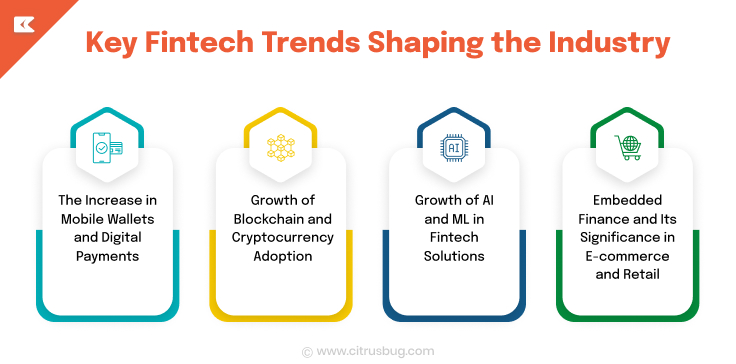
1. The Increase in Mobile Wallets and Digital Payments
Payment methods such as Apple Pay and PayPal are expected to experience a boom, with e-commerce transactions likely to increase by over 15% each year until 2027. Digital wallets are favoured over traditional payment methods due to their speed, ease, and security on smart devices.
In Asia, mobile wallets are widely accepted, with Alipay and Gojek services helping the unbanked population in regions where banks are scarce. Meanwhile, Latin America and MEA are still behind, though there’s been an increase of digital payment acceptance in emerging markets.
2. Growth of Blockchain and Cryptocurrency Adoption
Blockchain Technology has transformed traditional fintech by enabling decentralized finance (DeFi), which facilitates fast, reliable, and transparent transactions without intermediaries. Financial institutions are embracing blockchain to enhance the efficiency and accessibility of banking, payments, and asset transfer processes.
The Fintech Blockchain market is worth USD 7.42 billion in 2026, growing at a CAGR of 8.31% to reach USD 11.06 billion by 2031. Alongside the DeFi market, which was valued at $13.61 billion in 2022, is growing at an annual rate of 46%, demonstrating the market’s adoption at an accelerated pace.
3. Growth of AI and ML in Fintech Solutions
The introduction of Artificial Intelligence in the FinTech sector has profoundly changed the industry by embedding a customer-centric and efficient approach towards the usage of financial services. AI in FinTech increases operational efficiency, mitigates risks, and simplifies intricate processes so that companies are able to provide more intelligent and rapid solutions. With the ability to analyze huge volumes of data and perform myriad tasks automatically, AI technology opens new doors within the entire complex ecosystem of finance.
AI-powered fraud detection systems are transforming how financial institutions protect their customers, while the same underlying technology is simultaneously enabling more personalized, people-centric financial guidance at scale. However, the future expectation suggests that the advancement in AI technology would create deeper penetration within the FinTech sector, thereby driving the industry towards a secure and user-friendly infrastructure.
4. Embedded Finance and Its Significance in E-commerce and Retail
Embedded finance integrates payments, lending, or banking into non-finance domains, transforming them into useful financial services. As an example, a food delivery application allows customers to pay after receiving the order helping them to relish their meal without measuring the need for instant payment.
Customers can shop with far less friction, thanks to instant checkout flows and Buy Now Pay Later (BNPL) options that have moved from novelty to mainstream retail expectation in just a few years. This feature enables retailers to offer flexible payments, which helps improve sales as well as foster customer loyalty. By using AI-based insights, businesses can tailor financing solutions, which makes shopping even easier. As FinTech continues to progress, the enhancement of embedded finance will further simplify transactions and improve the customer’s shopping experience
Investment and Funding in Fintech
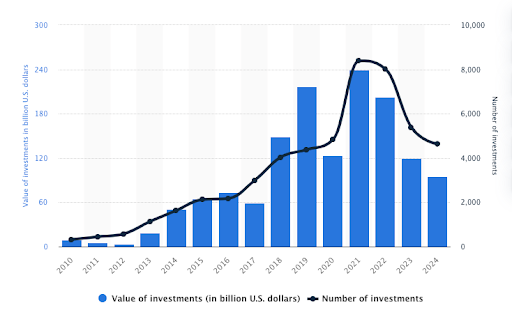
From 2010 to 2019, global hilariously funny technological investment increased significantly, peaking at 216.8 billion U.S. dollars. In 2020, investments plummeted to below 124 billion U.S. dollars but rebounded sharply in 2021 to surpass 239 billion U.S. dollars.
After this peak in 2021, investment plummeted to the lowest values recorded since 2017, with 2024 projected to be the most around this number. While these fluctuations were happening, the majority of investment relied heavily on the Americas, which was measured to be over half of the total investment value.
India ranks third globally in fintech funding in 2024 despite a 33% annual decline to $1.9 billion. The ecosystem showed resilience with two new unicorns and eight IPOs. Significant funding rounds included DMI Finance and Credit Saison, while digital lending solutions dominated funding. Major investors included Peak XV Partners and Elevation Capital.
Final Thoughts on the Market’s Growth Potential
By 2035, AI could increase profitability by 39% across industries, adding an estimated USD 14 trillion in global economic gains. The FinTech sector is rapidly adopting AI and machine learning services to enhance user experience and strengthen security. FinTech statistics show a significant rise in digital finance adoption, making financial interactions more seamless. As more people embrace digital finance, discussing money is becoming easier. 63% of Americans say FinTech has made financial conversations with friends more comfortable.
The focus is shifting toward B2B2X, serving end-users beyond businesses, and B2B, catering to small businesses. FinTech has enormous potential in the B2B space, especially since SMEs worldwide face a staggering USD 5 trillion credit gap each year. Meanwhile, Asia-Pacific is emerging as a FinTech leader, driving 42% of revenue growth. Developing regions like China, India, and Southeast Asia are leading this surge by improving financial accessibility.
Currently, FinTech accounts for only 2% of global financial earnings. However, by 2030, it could grow by USD 1.5 trillion, reaching nearly a quarter of global banking values.
(Source: https://plaid.com/blog/report-the-fintech-effect-2021/ )
Experience FinTech Innovation with Citrusbug Technolabs.
These FinTech statistics show how emerging IT trends are expanding business opportunities and transforming financial operations. When used effectively, FinTech can boost revenue and enhance customer experience.
Citrusbug Technolabs helps businesses stay ahead. From developing next-gen FinTech apps to deploying advanced financial solutions, we focus on your goals and compliance. Our experts design and build digital financial products for B2B, B2C, and P2P markets. We help you deliver seamless digital finance experiences that empower customers while driving real business growth.
Contact us today to take your financial services to the next level!