

 Back
Back Agentic Development Life Cycle (ADLC): A Framework for Building, Deploying, and Governing AI Agents at Enterprise Scale

Executive Summary
Artificial intelligence is no longer a peripheral tool that accelerates individual developer tasks. It has become the operational core of enterprise software delivery. The rise of agentic AI, systems that perceive their environment, reason over goals, select tools, and execute multi-step workflows with limited human intervention marks the most significant shift in software development since the advent of Agile methodologies.
Yet most enterprises are discovering that their existing Software Development Life Cycle (SDLC) frameworks, refined over four decades of deterministic engineering, break down when applied to autonomous AI agents. Agents do not execute fixed instructions. They reason probabilistically, adapt to context, call external tools, and produce outputs that vary between identical inputs. The governance, testing, and deployment disciplines that served traditional software teams are insufficient for systems whose behavior cannot be fully specified in advance.
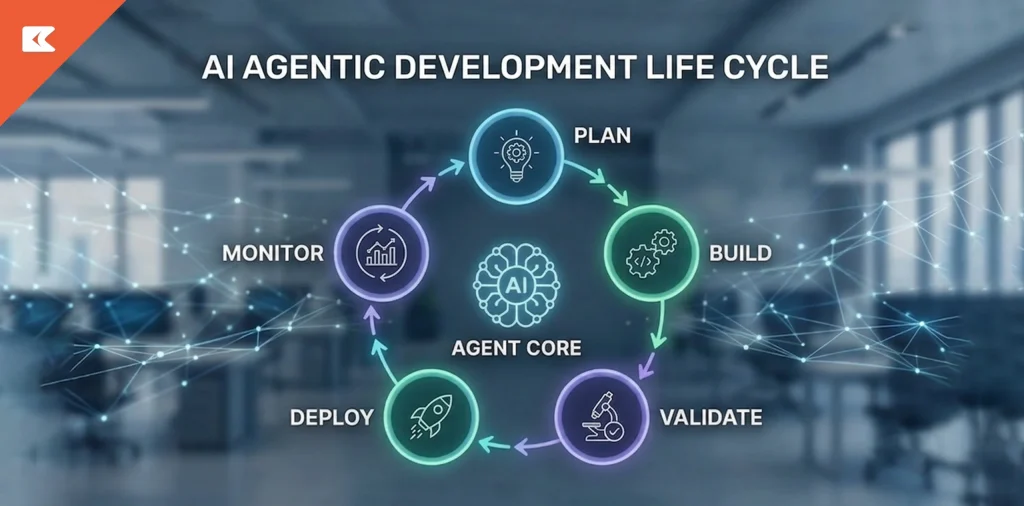
This whitepaper introduces the Agentic Development Life Cycle (ADLC), a structured, enterprise-grade AI agent lifecycle framework for building, validating, deploying, and continuously governing AI agents in production. Drawing on industry research from Gartner, IBM, Google Cloud, OWASP, EPAM, Salesforce, and Citrusbug's own client engagements, it defines six core phases: Discovery and Intent Specification, Architecture and Agent Design, Development (the Inner Loop), Behavioral Testing and Validation, Deployment and Orchestration, and Monitoring and the Outer Loop, underpinned throughout by a governance and security discipline.
The business case is unambiguous. The global agentic AI market was valued at approximately $7.6 billion in 2025 and is projected to reach between $139 billion and $196 billion by 2034, growing at a compound annual rate exceeding 43%. Gartner forecasts that 40% of enterprise applications will include task-specific AI agents by the end of 2026, rising to 33% of all enterprise software by 2028. Google Cloud's 2025 ROI of AI report found that 74% of executives achieving production deployments report a return on investment within the first year. Companies report average AI automation ROI of 171%.
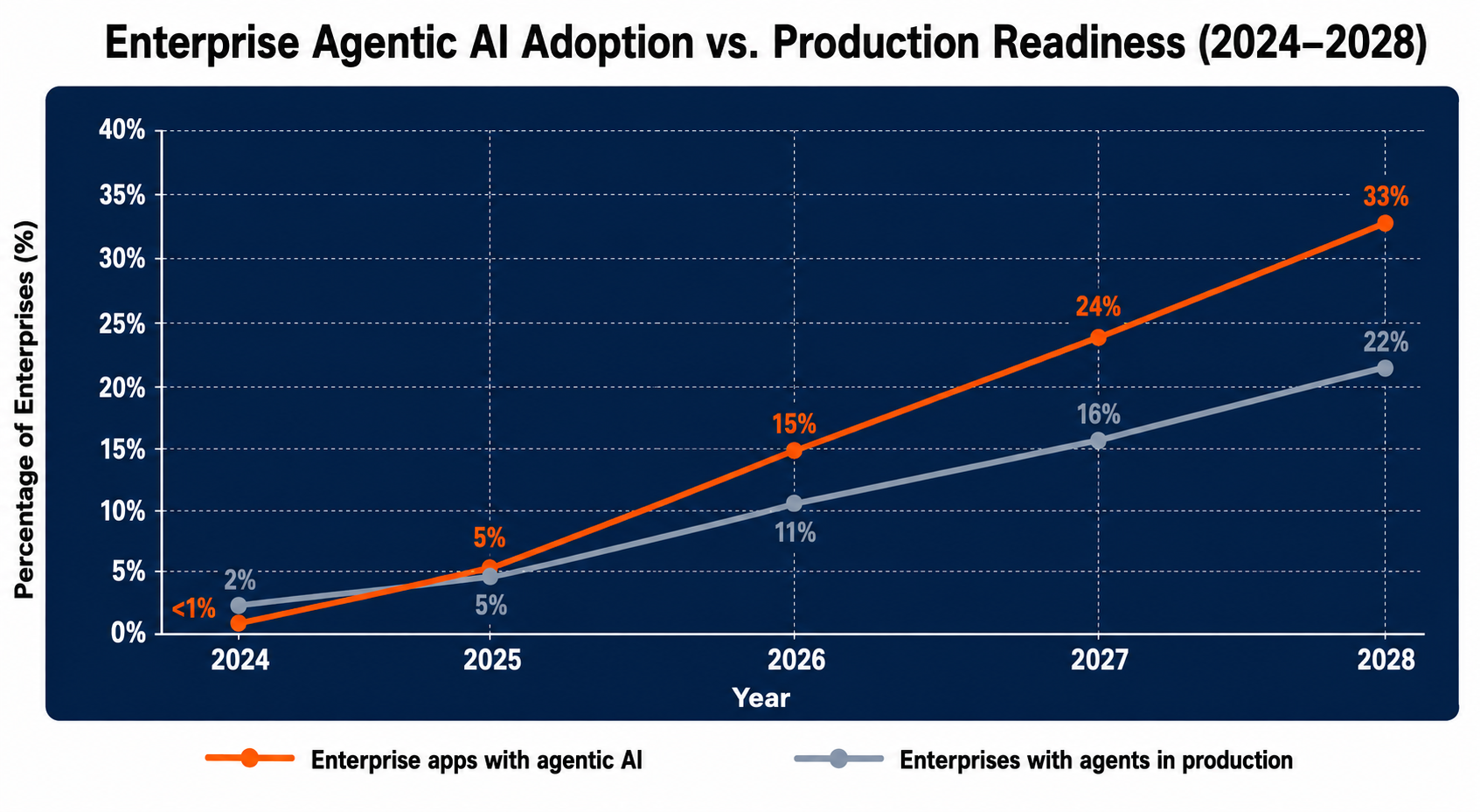
Despite this momentum, a critical gap exists between adoption and production readiness. As of 2026, 79% of organizations report some level of AI agent adoption, yet only 11% are running agents in production at scale. Gartner warns that more than 40% of agentic AI projects risk cancellation by 2027 due to unclear value, inadequate governance, and rising operational costs. The difference between organizations that capture the value of agentic AI and those that stall in pilot purgatory is largely an enterprise AI governance and process question, precisely what ADLC is designed to answer.
Key Takeaways
- ADLC is not SDLC with AI tools bolted on. It is a purpose-built lifecycle for systems whose behavior is probabilistic, context-dependent, and continuously evolving.
- The six ADLC phases form two interlocking loops: the Inner Loop (Discovery, Design, Development, Testing) handles agent construction; the Outer Loop (Deployment, Monitoring, Governance) ensures sustained production reliability.
- Security is a first-class ADLC concern. The OWASP Top 10 for Agentic Applications 2026, developed by over 100 industry experts, identifies prompt injection, tool misuse, and identity abuse as leading risks requiring architectural-level mitigations.
- Human-in-the-loop (HITL) integration is not a temporary scaffold, it is a permanent governance pattern, calibrated to the risk profile of each agent's decisions.
- Organizations that implement ADLC systematically close the adoption-to-production gap, achieving measurable business impact while maintaining compliance, cost control, and auditability.
This whitepaper is written for CTOs, VPs of Engineering, Enterprise Architects, and technical leaders who are moving beyond AI experimentation toward scalable, governed agent deployment. It provides both the conceptual framework and the practical engineering discipline needed to make that transition with confidence.
1. The Agentic Imperative: Why AI Agents Are Reshaping Enterprise Software
1.1 From GenAI Tooling to Autonomous Systems
The generative AI wave of 2023 and 2024 introduced enterprise software teams to a new class of capability: large language models (LLMs) that could write code, summarize documents, and answer complex questions. The initial integration pattern was additive, AI as a productivity accelerator for individual contributors. Developers used Copilot-style tools to autocomplete functions. Operations teams used ChatGPT-adjacent tools to draft runbooks. The underlying SDLC remained unchanged; AI sat at its edges.
The shift to autonomous AI agents is categorically different. Rather than responding to a single prompt and returning a result, an AI agent is given a goal and the autonomy to pursue it across multiple steps, tools, and systems. An agent can read a bug report, reproduce the issue in a sandbox, write a patch, execute the test suite, open a pull request, and notify the relevant reviewer, without a human touching the keyboard between steps. The unit of AI output is no longer a response; it is a completed workflow.
This shift has practical consequences at every layer of the enterprise. The 2024–25 World Quality Report found that 68% of respondents were actively using or planning to use generative AI, with agentic AI following closely as the next adoption frontier. According to Gartner, the share of enterprise software applications utilizing agentic AI is expected to grow from less than 1% in 2024 to 33% by 2028. By 2026, 40% of enterprise applications are projected to include task-specific agents [1].
1.2 Market Size and Adoption Trajectory
The financial stakes are substantial. The global agentic AI market was valued at approximately $7.6 billion in 2025, and analyst projections converge on a trajectory toward $139–196 billion by 2034, representing a compound annual growth rate of approximately 43–44% [2][3]. Multi-agent systems commanded a 53% share of agentic deployments in 2025, and that segment is forecast to grow at an even faster 43.5% CAGR through 2031 [2].
North America led adoption in 2025 with a 40% global market share, driven by aggressive enterprise investment from technology firms, financial services, and healthcare organizations. Asia-Pacific is projected to be the fastest-growing region through 2031, at a 44.95% CAGR, fueled by national AI strategies in China and India [2].
Venture capital conviction in the sector is deep. North American agentic AI investments exceeded $40 billion, and over 400 AI agent startups have been mapped across 16 categories by CB Insights. Major platform providers, Microsoft, IBM, Salesforce, Google, and Anthropic, have each embedded agentic capabilities into their core enterprise offerings, signaling that the category is moving from experimental to infrastructural [4].
| Metric | Value | Source |
|---|---|---|
| Agentic AI market size (2025) | $7.6 billion | Grand View Research [3] |
| Projected market size (2034) | $139–196 billion | Multiple analysts [2][3] |
| Market CAGR (2025–2034) | ~43–44% | Mordor Intelligence [2] |
| Enterprise apps with agentic AI (2026) | 40% | Gartner [1] |
| Enterprise apps with agentic AI (2028) | 33% | Gartner [1] |
| North America market share (2025) | 40.25% | Mordor Intelligence [2] |
1.3 The 79%–11% Gap: Adoption vs. Production Readiness
Perhaps the most revealing statistic in the agentic AI landscape is not about market size, it is about the chasm between declared adoption and actual production deployment. As of 2026, 79% of organizations report some level of agentic AI adoption, yet only 11% are running agents in production at meaningful scale [4]. Gartner estimates that more than 40% of agentic AI projects risk cancellation by 2027 due to unclear value, rising costs, and weak governance. At least 30% of generative AI initiatives may be abandoned by the end of 2025 for similar reasons [5].
This gap has a name in the industry: pilot purgatory. Organizations succeed at building impressive agent prototypes in controlled environments, only to find that those prototypes do not survive contact with production: live data is messier than test data, edge cases multiply, latency becomes a cost center, compliance teams raise concerns, and monitoring infrastructure that works for deterministic services fails for probabilistic agents. The failure is almost never the model. It is the process.
The structured adoption of ADLC serves as an effective AI agent deployment strategy that closes this gap. Organizations that approach agentic deployment with phase-gated governance, behavioral evaluation frameworks, and production-grade observability convert pilots into production systems at substantially higher rates than those applying ad hoc engineering practices.
1.4 Why Traditional SDLC Falls Short
The Software Development Life Cycle was designed for deterministic systems. Given the same inputs, a well-written function returns the same output. This predictability enables traditional QA: write test cases, assert outputs, pass or fail. Version control tracks code changes with perfect fidelity. Deployment pipelines promote a build artifact through environments where behavior is identical to what was tested. Rollback is straightforward because the previous artifact is preserved.
AI agents violate every one of these assumptions. An agent's output depends on its prompt, the model version it runs on, the state of external tools it calls, the documents in its context window, and the stochastic sampling process of the LLM itself. Two identical requests to the same agent, milliseconds apart, may produce meaningfully different reasoning paths and outputs. A prompt change, a sentence addition, a word substitution, can alter behavior in ways that are invisible to traditional unit tests but critical to business outcomes.
SDLC also lacks primitives for the concepts that define AI agent orchestration, including prompt versioning, behavioral regression testing, golden dataset curation, agent trajectory evaluation, escalation rate monitoring, token cost governance, and human-in-the-loop workflow integration. These are not gaps that can be filled by adding AI-adjacent tools to an existing SDLC. They require a purpose-built lifecycle framework, the Agentic Development Life Cycle.
| Dimension | Traditional SDLC | ADLC |
|---|---|---|
| Output behavior | Deterministic | Probabilistic, context-dependent |
| Testing approach | Unit/integration tests | Behavioral evaluation, golden datasets |
| Version control | Code and config | Code, prompts, model versions, tools |
| Deployment | Binary pass/fail gates | Progressive rollout with behavioral monitoring |
| Monitoring | Uptime and error rates | Accuracy, drift, escalation rate, token cost |
| Human role | Developer executes | Human oversees, approves, and escalates |
| Failure mode | Crash or wrong output | Plausible but incorrect reasoning |
2. Introducing ADLC: A Framework Built for Non-Determinism
2.1 ADLC vs. SDLC: Key Structural Differences
The Agentic Development Life Cycle (ADLC) is an AI governance framework for developing probabilistic AI systems with governance, cost predictability, and security controls built into every phase. It defines the phases, deliverables, and control gates required to take an AI agent initiative from a business hypothesis to a continuously evaluated production system, without the failure modes that traditional engineering processes are structurally blind to [6].
ADLC is not a replacement for SDLC in the general sense. For organizations building hybrid systems, AI agent components alongside traditional deterministic services, both frameworks operate in parallel, with explicit interface contracts governing how deterministic and non-deterministic subsystems interact. The AI subsystem follows ADLC; the traditional subsystem follows SDLC; the integration layer is governed by the stricter of the two sets of requirements [6].
The most important structural difference is that ADLC is built around continuous behavioral alignment rather than one-time specification. In traditional SDLC, a system is specified, built to that specification, and verified against it. An AI agent, by contrast, operates in an open world where its goals, the tools it uses, and the data it reasons over all evolve over time. ADLC encodes mechanisms for detecting and correcting behavioral drift as a first-class lifecycle concern, not an afterthought addressed by ad hoc monitoring.
2.2 Core Principles of the Agentic Development Life Cycle
Six principles anchor every phase of ADLC and distinguish it from both traditional SDLC and informal AI project management:
Intent over specification. Agents are designed around clearly articulated goals, operational constraints, and guardrails, not exhaustive functional specifications. The agent's task is to find a path to the goal within boundaries; the lifecycle's task is to ensure those boundaries are enforced and auditable.
Behavioral evaluation as a first-class artifact. Every ADLC phase produces evaluation outputs, not just code. Golden datasets, behavioral baselines, evaluation metrics, and regression results are maintained alongside prompt versions and model configurations as first-class engineering artifacts.
Environment separation without exception. Development, staging, and production environments are completely isolated. No change to an agent's prompts, tools, or logic reaches production without passing through staging validation. This principle, learned in traditional software engineering over decades, applies with even greater urgency to non-deterministic systems [7].
Cost governance from day one. Token economics, inference costs, API call volumes, and infrastructure spend are modeled in the architecture phase and tracked as operational metrics in production. Agentic systems can generate unexpected cost spikes through runaway tool calls or context window inflation; ADLC treats cost as a production health metric equivalent in importance to latency or accuracy.
Human-in-the-loop AI as architecture, not scaffolding. HITL integration points are designed into the agent's workflow at the architecture phase, not added as a contingency when something goes wrong. The specific decisions and risk thresholds that require human approval are defined explicitly and enforced by the agent's orchestration logic.
Security by design. Security constraints, prompt injection mitigations, tool access controls, identity and authorization boundaries, and audit logging, are specified in the architecture phase and verified in testing. Security is not a post-deployment checklist.
2.3 When to Apply Full vs. Lightweight ADLC
Not every AI integration warrants the full ADLC treatment. A lightweight ADLC track is appropriate when a system uses a pre-trained model as-is, with no fine-tuning and no agent autonomy, for example, a document summarization tool that calls an LLM API with a fixed prompt and returns the result. Full ADLC applies whenever the system involves fine-tuning, tool use, multi-step reasoning, multi-agent orchestration, or actions with real-world consequences such as writing to databases, sending communications, or triggering external API calls [6].
| System Type | ADLC Track | Key Additional Requirements |
|---|---|---|
| Pre-trained model, fixed prompt, read-only | Lightweight | Phases 1, 2, 3, 5, 7 required |
| Fine-tuned model or RAG with tool use | Full | All phases; expanded evaluation |
| Single autonomous agent with actions | Full | HITL gates, security review |
| Multi-agent orchestration | Full + Extended | Agent trajectory eval, cascade failure testing |
| Hybrid (AI + traditional services) | Full ADLC + SDLC | Interface contracts between subsystems |
2.4 Roles and Responsibilities in an ADLC Team
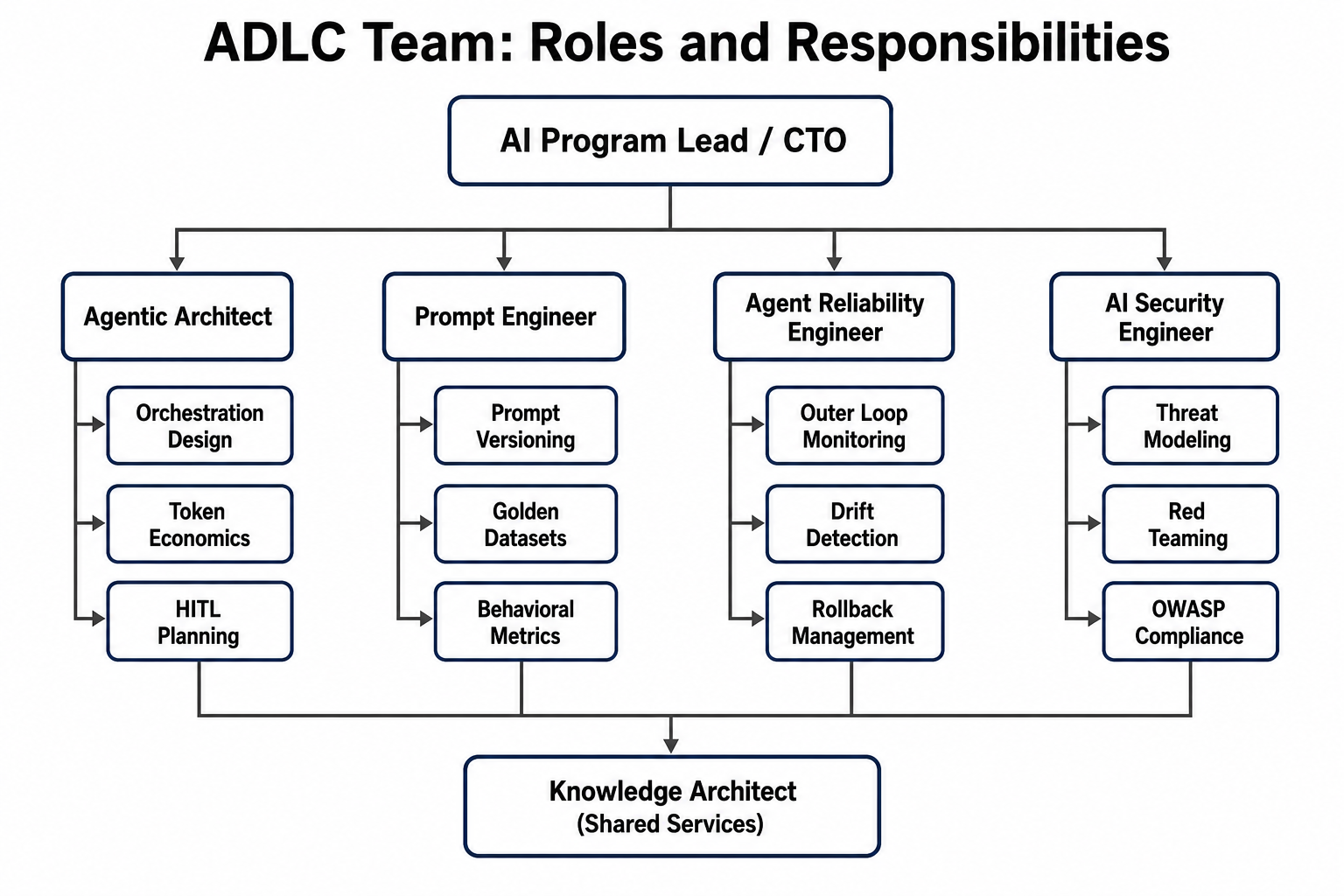
ADLC does not simply add AI tools to existing developer roles, it redefines the team structure. As Thoughtworks research on the agentic SDLC identifies, experienced engineers migrate toward architecture, orchestration, and governance roles, while new specialized roles emerge to build and maintain the agentic platform [8].
The Agentic Architect designs the overall agent architecture, selects orchestration patterns, models token economics, and defines the HITL integration points. The Prompt Engineer treats prompt development as a rigorous engineering discipline, versioning prompts, measuring their behavioral effects, and maintaining the golden datasets used for evaluation. The Agent Reliability Engineer (ARE) operates the outer loop: monitoring production agents for drift and degradation, managing escalation thresholds, and orchestrating rollbacks. The Knowledge Architect designs the data pipelines, retrieval-augmented generation (RAG) systems, and memory stores that give agents access to enterprise context. The AI Security Engineer maps the threat model to OWASP agentic frameworks, implements guardrails, and leads red teaming exercises.
3. Phase 1: Discovery and Intent Specification
Phase 1 is the most underestimated and most frequently skipped phase in agentic AI projects. Under pressure to demonstrate AI progress, teams often leap directly into prompt engineering or prototype construction, bypassing the structured problem definition work that separates sustainable production deployments from expensive pilots that never scale. Phase 1 exists to slow teams down just enough to prevent mistakes that become exponentially harder to fix later [9].
3.1 Framing the Business Problem as an Agent Opportunity
The first discipline of Discovery is translating a broad organizational problem into a precisely scoped, governable agent opportunity. This requires a full business process mapping exercise: documenting the end-to-end workflow, identifying the specific steps where AI agent intervention would create value, and quantifying what that value looks like in measurable terms.
Not every business problem is an agent problem. The team must assess whether the target workflow benefits from autonomous multi-step reasoning, or whether it is better served by a simpler approach, a static automation, a retrieval-augmented search, or a traditional ML model. Agents are appropriate when the workflow is too complex for fixed rules, when context must be gathered from multiple sources before a decision can be made, and when the cost of human execution justifies the engineering investment in agent deployment.
Constraint identification is a parallel discipline: defining hard limits on what the agent is permitted to do. These constraints include compliance requirements (which data can the agent access?), risk tolerance (what is the maximum acceptable error rate?), acceptable autonomy zones (which decisions require human approval?), and latency and cost budgets. Constraints defined in Phase 1 become the guardrails encoded in the agent's architecture in Phase 2 and verified in testing in Phase 4.
3.2 Human–Agent Responsibility Mapping
One of the most valuable artifacts produced in Phase 1 is the Human–Agent Responsibility Map (HARM), a document that explicitly divides every decision, action, and approval gate in the target workflow between human and agent responsibility. This is not a vague designation of 'AI-assisted' tasks. It is a precise specification: the agent handles X; a human approves Y; escalation is triggered by condition Z.
The HARM prevents the two most common failure modes in agentic deployment. The first is excessive agency, the agent is given authority over consequential decisions (financial transactions, production system modifications, regulatory submissions) without human review, and errors become costly before detection. The second is insufficient autonomy, the agent is so heavily supervised that it provides no productivity benefit over manual workflows. The HARM finds the calibrated boundary by mapping each decision to its reversibility, regulatory risk, and business consequence [10].
3.3 Data Readiness and Compliance Scoping
AI agents are only as reliable as the data they reason over. Phase 1 includes a Data Readiness Review that assesses the quality, accessibility, and governance status of every data source the agent will need. This review covers data quality (completeness, accuracy, freshness), access controls (does the agent have the right permissions without having excessive permissions?), data sovereignty requirements (where does the data reside? what regulations govern its use?), and the presence of sensitive or personally identifiable information (PII) that requires special handling.
Data pipeline failures are among the most common causes of AI agents producing incorrect or harmful outputs in production. An agent that reasons over stale inventory data may commit to out-of-stock orders. An agent that has access to more data than it requires may inadvertently expose sensitive records. Phase 1's data readiness work prevents both failure modes by establishing data governance boundaries before any agent logic is written.
Regulatory and compliance mapping in Phase 1 is equally critical. For agents operating in healthcare, financial services, or legal contexts, the applicable regulatory frameworks (HIPAA, GDPR, SOC 2, PCI DSS, the EU AI Act) must be identified and their requirements translated into agent design constraints. This mapping informs both the HITL requirements and the security architecture developed in Phase 2.
3.4 Defining KPIs and Evaluation Criteria Upfront
Phase 1 concludes with the definition of a comprehensive KPI framework, both business and technical, against which the agent will be evaluated throughout its lifecycle. Business KPIs typically include cycle time reduction, cost per resolved transaction, error rate, escalation rate, and customer or employee satisfaction scores. Technical KPIs include task completion accuracy, latency (end-to-end and per tool call), token consumption, hallucination rate, and first-contact resolution rate.
Setting these criteria before any code is written is not a bureaucratic exercise. It is the mechanism by which organizations avoid the most expensive form of pilot purgatory: deploying an agent, running it for six months, and then being unable to determine whether it delivered business value because no one defined what value would look like. The evaluation criteria defined in Phase 1 directly generate the golden datasets constructed in Phase 4 and the monitoring dashboards built in Phase 6.
4. Phase 2: Architecture and Agent Design
With a well-scoped problem definition and approved KPI framework from Phase 1, Phase 2 translates intent into engineering architecture. The decisions made here, about agent patterns, model selection, orchestration frameworks, tool integration, and cost structure, set the ceiling on what the production system can achieve and the floor below which its reliability cannot fall. Architectural mistakes at this phase are expensive to reverse; they compound through every subsequent phase.
4.1 Agentic Architecture Patterns: ReAct, Plan-and-Execute, Multi-Agent
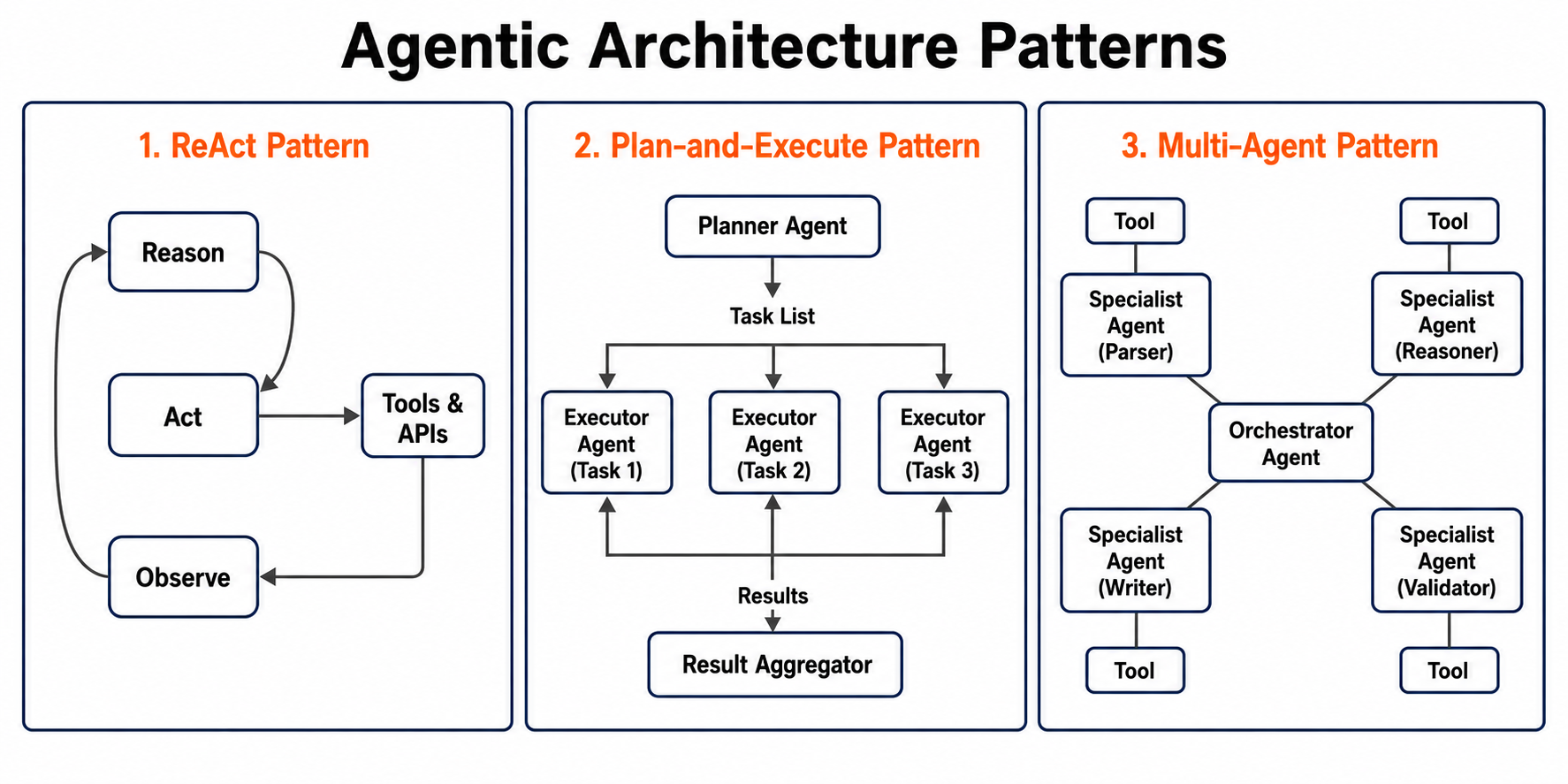
The choice of agent architecture pattern is the most consequential design decision in Phase 2. Three patterns dominate enterprise agentic deployments, each suited to different problem profiles.
The ReAct (Reasoning + Acting) pattern interleaves reasoning steps with tool actions in a tight loop. The agent reasons about what to do next, takes an action, observes the result, reasons about the observation, and continues iterating until the goal is reached or a stopping condition is met. ReAct is well-suited to tasks where the path to completion is uncertain and must be discovered through exploration, research tasks, debugging workflows, and open-ended retrieval pipelines.
The Plan-and-Execute pattern separates planning from execution: a planning agent first generates a complete task decomposition, and separate executor agents implement each step. This pattern provides higher predictability and easier auditability than ReAct, since the full plan is visible before execution begins. It is well-suited to structured workflows with known subtask sequences, financial report generation, multi-step data transformation, and compliance document assembly.
Multi-agent systems architecture applies the microservices principle to agent design: rather than a single generalist agent handling all aspects of a complex workflow, specialized agents each own a bounded domain and collaborate through structured communication. One agent handles document parsing, another handles entity extraction, a third handles decision logic, and an orchestrator coordinates the workflow. As Google's Agent Development Kit (ADK) documentation notes, 'monolithic applications don't scale', the same principle applies to agents: as complexity grows, a single agent's instruction adherence degrades and error rates compound [12].
4.2 Model Selection: LLMs, SLMs, and Fine-Tuning Decisions
Model selection in Phase 2 involves three axes: capability, cost, and governance. On the capability axis, the team evaluates whether the target tasks require frontier model reasoning (complex multi-step inference, long-context synthesis) or whether smaller, specialized models are sufficient. Small language models (SLMs), typically 3–8 billion parameters, offer dramatically lower inference costs and latency, and can be fine-tuned on domain-specific data to match frontier model performance on narrow task types. For cost-sensitive, high-volume agent deployments, SLMs frequently deliver better economics than frontier models.
Fine-tuning decisions are driven by the specificity of the domain, the volume of proprietary training data available, and the performance gap between a prompted frontier model and a fine-tuned SLM on the target tasks. Fine-tuning introduces a training and maintenance overhead, the fine-tuned model must be retrained when domain knowledge evolves, that must be weighed against the inference cost savings it provides. ADLC treats the fine-tuning decision as a Phase 2 architectural choice documented with explicit economic justification.
On the governance axis, model selection must account for data residency, vendor SLA requirements, model versioning policies (will the vendor deprecate this model version? on what timeline?), and the availability of audit trails for model outputs. In regulated industries, the ability to demonstrate that a specific model version produced a specific output at a specific time is not optional.
4.3 Orchestration Frameworks: LangChain, CrewAI, and Beyond
Orchestration frameworks provide the scaffolding within which agent logic runs: managing tool registries, handling context windows, routing between agents, and providing primitives for memory and state management. The dominant frameworks in enterprise deployments as of 2026 include LangChain and LangGraph for flexible, code-first orchestration; CrewAI for role-based multi-agent collaboration; Microsoft AutoGen for research-oriented multi-agent experimentation; and Google's Agent Development Kit (ADK) for cloud-native agentic deployments on Google Cloud infrastructure.
Framework selection is not purely a technical question. Enterprise considerations include the vendor's commitment to long-term maintenance, the availability of enterprise support contracts, the quality of observability integrations (can this framework emit the traces and logs needed for production monitoring?), and alignment with existing cloud platform investments. A framework that works beautifully in a proof-of-concept environment but lacks production observability support will become an operational liability at scale.
4.4 Model Context Protocol (MCP) and Tool Integration
Model Context Protocol integration strengthens tool integration, where connecting the agent to external services, APIs, databases, and data stores introduces both its greatest capability and its greatest risk. The Model Context Protocol (MCP), an emerging open standard initially developed by Anthropic and rapidly adopted across the industry, provides a standardized interface for exposing enterprise services as agent-callable tools. MCP enables any agent, regardless of the orchestration framework it runs on, to interact with any MCP-compatible tool server through a consistent protocol, reducing integration fragmentation and establishing a consistent security boundary for tool access [13].
In Phase 2, the tool integration design must specify: which tools the agent is permitted to call, under what conditions, with what data access scope; how tool authentication and authorization are enforced; how tool failures (timeouts, API errors, rate limits) are handled gracefully without cascading to agent failure; and how tool call logs are captured for auditability. The principle of least privilege applies to agent tool access with the same force it applies to human user permissions in traditional systems.
4.5 Cost Modeling: Token Economics and Infrastructure
Agentic systems introduce a category of operational cost that has no direct analog in traditional software: token economics. Every LLM call consumes input and output tokens at a per-token cost that scales with the model's capability tier. A multi-agent workflow that makes dozens of LLM calls per user request can accumulate costs that are invisible during development (where call volumes are low) but significant at production scale.
Phase 2 must produce a Cost Structure Calculation covering both capital expenditure (infrastructure build-out, fine-tuning compute, vector database provisioning) and operating expenditure (per-inference token costs, API call volumes, data pipeline processing costs). This calculation establishes cost guardrails that flow through to the monitoring and alerting infrastructure in Phase 6, where production AI monitoring tracks cost per transaction and total token consumption alongside latency and accuracy [9].
5. Phase 3: Development: The Inner Loop
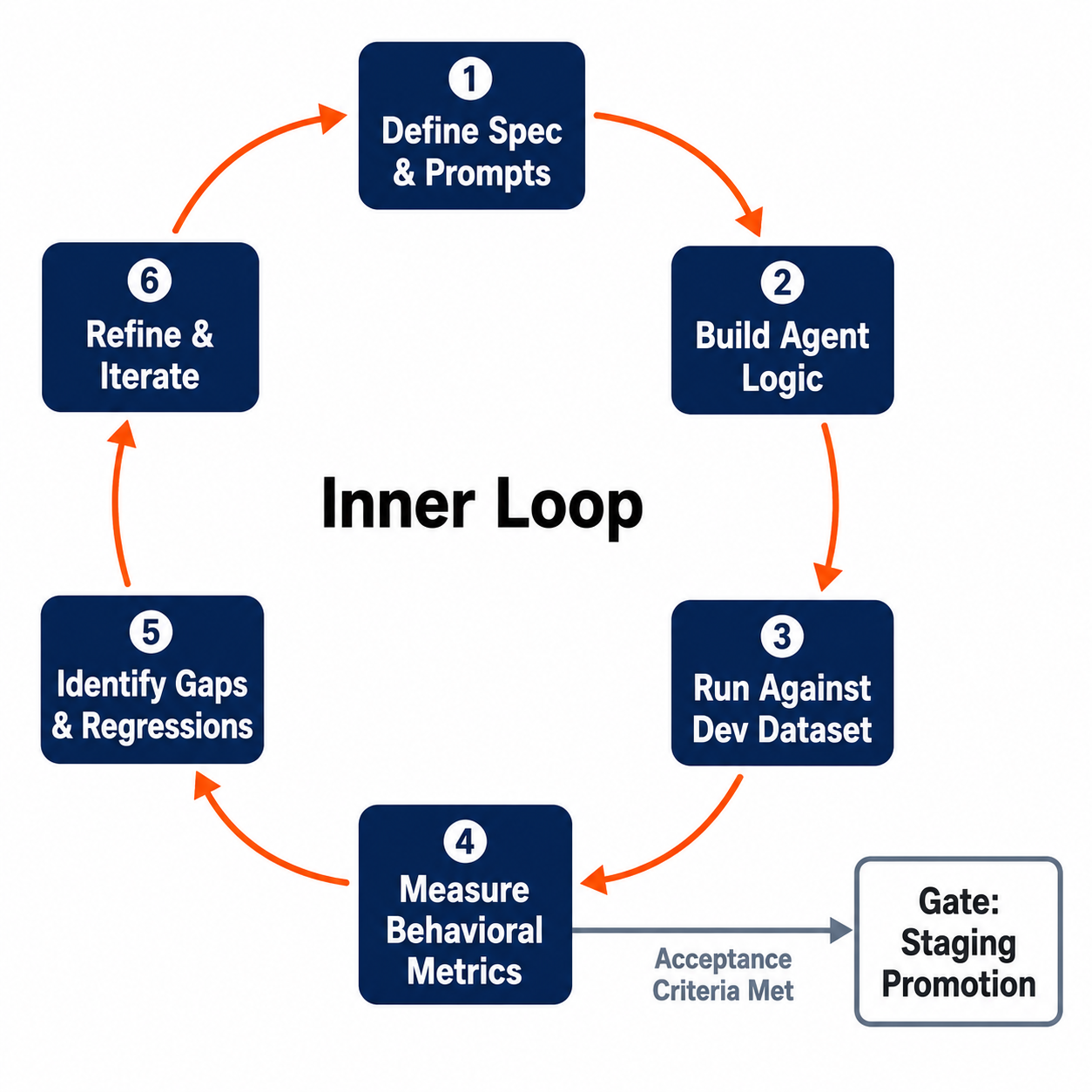
Phase 3 is where the agent comes to life as an engineering artifact. The Inner Loop of ADLC, so named because it involves rapid, high-frequency iteration within a controlled development environment, combines the disciplines of traditional software engineering with new practices specific to agentic systems: prompt engineering, behavioral validation, and agent trajectory testing. The Inner Loop is not a single pass; it is a continuous cycle of build, evaluate, refine, and AI behavioral testing that runs until behavioral acceptance criteria are met [9].
5.1 Prompt Engineering as a Core Engineering Discipline
Prompt engineering best practices involve designing, testing, and versioning the natural language instructions that govern agent behavior. In ADLC, it is treated with the same rigor as code engineering: prompts are version-controlled, changes are peer-reviewed, and behavioral effects are measured against the evaluation framework established in Phase 1. An undocumented prompt change is equivalent to an undocumented code change, it is a source of uncontrolled behavioral variance in production.
Effective prompt engineering involves several practices that are now well-documented across the industry. System prompt design establishes the agent's identity, its explicit permissions and prohibitions, its escalation criteria, and its output format requirements. Few-shot examples embedded in the context window can dramatically improve task-specific accuracy for structured outputs. Chain-of-thought prompting, asking the agent to reason step by step before producing an output, improves accuracy on complex tasks by externalizing reasoning that would otherwise be implicit in the model's sampling process.
The 90% of software development professionals who now use AI tools, spending a median of two hours per day with them (DORA 2025), are learning empirically what ADLC formalizes structurally: that the quality of AI-assisted output is inseparable from the quality of the prompt engineering discipline that shapes it [14].
5.2 Environment Separation: Dev, Staging, and Production
Software teams learned decades ago that testing in production is a governance failure, not a valid deployment strategy. The same principle applies to AI agents with even greater urgency, because the consequences of behavioral errors in agentic systems, incorrectly committed code, incorrectly sent communications, incorrectly executed financial transactions, are harder to reverse than a crashed service.
ADLC mandates three fully isolated environments. The Development environment is where builders create, experiment, and iterate. Prompt changes, tool additions, logic modifications, and model swaps all happen here, against synthetic or masked test data, with no connection to live enterprise systems. The Staging environment mirrors production configuration, using production-equivalent credentials, real data (subject to appropriate anonymization), and production-connected tool integrations, but serves only test traffic. Staging is where behavioral acceptance testing runs before any change is approved for promotion. Production is where approved agents serve real users and execute real workflows [7].
Promotion between environments requires explicit approval: a human sign-off that the behavioral evaluation results in staging meet the acceptance criteria established in Phase 1. This gate cannot be automated away. The human approval requirement is not bureaucratic overhead, it is the HITL integration point that keeps governance meaningful in the deployment pipeline.
5.3 Version Control for Agents: Prompts, Tools, and Logic
In traditional software engineering, version control covers source code and configuration. In ADLC, the version control surface is substantially wider: it must cover prompt versions, model versions (which LLM, which version, which fine-tune checkpoint), tool definitions and their schemas, evaluation datasets, and behavioral baselines. A complete version control record for an agent deployment specifies not just what code ran but what the agent was told to do, which model generated its outputs, and which tools it was authorized to call.
This completeness is essential for two operational scenarios. First, debugging: when a production agent produces an unexpected output, diagnosing the cause requires knowing the exact prompt, model, and tool state at the time of the incident. Second, compliance: regulated industries require the ability to reproduce and explain AI-generated decisions, which is only possible if the full agent state at decision time is captured in version control.
5.4 Spec-Driven Development for Agentic Systems
Spec-driven development (SDD) is emerging as a critical discipline for agentic systems, adapting an idea from traditional software engineering to the specific needs of AI agent development. In SDD, a structured specification, capturing the agent's goal, tool access, output format, escalation criteria, and behavioral constraints, serves as the authoritative source of truth for both human developers and the agent itself. GitHub's Spec Kit, released as open source in 2025, describes SDD as 'version control for your thinking': specifications are first-class artifacts that evolve with the project rather than becoming stale documentation buried in a knowledge repository.
For agentic systems, SDD provides the structured context that reduces hallucination (the agent has explicit, current specifications to reason against), enables automated consistency checking (does the agent's behavior match its specification?), and creates a clear basis for governance review (stakeholders approve the specification, not just the code).
5.5 Multi-Agent Orchestration in Practice
When the architecture from Phase 2 calls for multi-agent orchestration, the Inner Loop must manage the complexity of multiple agents developing and interacting simultaneously. Each specialist agent is developed independently against its own behavioral acceptance criteria, then integrated through the orchestrator. Integration testing for multi-agent systems must cover not just individual agent behavior but inter-agent communication: does Agent A pass context to Agent B in the format Agent B expects? Does a failure in Agent B cause Agent A to enter an infinite retry loop? Does the orchestrator handle partial failures gracefully?
The SequentialAgent, ParallelAgent, and Router patterns documented in frameworks like Google ADK provide structured primitives for common orchestration scenarios. Sequential orchestration chains agents for pipeline-style workflows. Parallel orchestration runs multiple agents concurrently and aggregates their results. Router orchestration uses a decision-making agent to select the appropriate specialist for each request [12]. Each pattern has distinct failure mode profiles that must be covered in the behavioral testing of Phase 4.
6. Phase 4: Behavioral Testing and Validation
Testing is the phase where the gap between ADLC and traditional SDLC is most stark. Pass/fail unit tests and integration tests are necessary but insufficient for autonomous agents. An agent can pass every deterministic test case while still producing plausible-sounding but factually incorrect outputs in production, misusing a tool in ways that pass schema validation but violate business logic, or behaving correctly on average while failing catastrophically on specific edge cases that appear only at scale.
ADLC Phase 4 defines a multi-layered behavioral evaluation framework that addresses both the deterministic and probabilistic dimensions of agent correctness, combining automated evaluation at scale with human judgment on high-stakes decisions.
6.1 Why Traditional QA Breaks in Non-Deterministic Systems
The fundamental challenge of AI agent testing is that the specification of correct behavior cannot be exhaustively encoded in test assertions. A test for a document summarization agent cannot enumerate every possible input document and its correct summary. A test for a customer service agent cannot cover every customer query and its ideal response. Traditional QA's strength, deriving complete test coverage from a complete specification, is unavailable when the agent's task domain is open-ended.
The appropriate response is not to abandon testing rigor but to shift the evaluation paradigm from assertion-based testing to distribution-based evaluation. Rather than asking 'does this specific input produce this specific output?', the question becomes 'across a representative distribution of inputs, what fraction of outputs meet our quality standards, how does that fraction change across prompt versions and model updates, and where do the failures cluster?'
6.2 Simulation-Based and Golden-Dataset Testing
Simulation-based testing exposes the agent to representative inputs, including edge cases and imperfect data, before production exposure. The emphasis on real-data representativeness is critical: agents tested only against curated, well-formed examples routinely fail against the messy, incomplete, and contradictory inputs that production environments supply. EPAM's ADLC research notes that this phase 'exposes failure early, if accuracy drops sharply or costs spike under real data, teams discover it here before scaling magnifies the damage' [9].
Golden datasets are curated collections of input-output pairs that represent the behavioral baseline for an agent. They are built from two sources: human-annotated examples that represent ideal agent behavior, and production samples captured over time (once the agent is in deployment). Golden datasets serve two functions: initial behavioral acceptance testing before deployment, and regression detection across agent updates. A prompt change, model upgrade, or tool modification should be tested against the full golden dataset before promotion to staging. A meaningful drop in performance against golden dataset cases is a regression, it must be diagnosed before the change proceeds.
6.3 LLM-as-Judge and Automated Evaluation Frameworks
For workflows where human annotation of every evaluation case is impractical, high-volume agents processing thousands of interactions per day, LLM-as-judge evaluation uses a separate, evaluation-focused model to assess the quality of agent outputs at scale. Purpose-built evaluation models, such as Galileo's Luna-2 (a 3B or 8B parameter model fine-tuned specifically for hallucination detection and output quality assessment), provide more reliable evaluation than using general-purpose frontier models as judges, because they are calibrated for deterministic single-token evaluation outputs rather than the multi-token, non-deterministic responses of general LLMs [15].
Automated evaluation frameworks such as RAGAS, Trulens, and Arize AI provide structured pipelines for computing evaluation metrics, faithfulness (does the output accurately reflect the source data?), answer relevance (does the output address the actual question?), context precision (is the retrieved context relevant to the query?), and hallucination rate, at scale, on a continuous basis. These frameworks are integrated into the CI/CD pipeline for agents, running evaluations automatically whenever a prompt version, model version, or tool configuration changes.
6.4 Red Teaming and Adversarial Testing
Red teaming for agentic systems is a structured adversarial testing discipline that asks: how does this agent behave when inputs are deliberately crafted to manipulate it? The OWASP Top 10 for Agentic Applications 2026, developed through extensive collaboration with over 100 industry experts, identifies prompt injection, an attacker embedding instructions in agent-processed content that redirect the agent's goals, as the leading security risk in agentic deployments [16].
Red teaming scenarios for agents include direct prompt injection (instructions embedded in user inputs), indirect prompt injection (instructions embedded in documents, web pages, or database records that the agent retrieves during task execution), tool misuse testing (does the agent call tools with parameters outside their intended scope?), goal hijacking (can the agent's task objective be redirected mid-execution?), and privilege escalation (can the agent access resources beyond its authorized scope?). Microsoft's AI Red Teaming Agent, integrated with Azure AI Foundry, automates the simulation of adversarial prompts across full multi-agent workflows, not just individual model responses, enabling systematic red teaming at scale [17].
6.5 Human Evaluation Gates Before Production
The final gate before staging-to-production promotion is a human evaluation review. A designated reviewer, typically the Agentic Architect or a senior domain expert, reviews a sample of agent interactions from the staging environment, with particular attention to edge cases identified in simulation testing, cases that automated evaluation flagged as borderline, and any scenarios involving the escalation and HITL integration points designed in Phase 2. This human review is not a rubber-stamp process; it is a structured evaluation against the acceptance criteria defined in Phase 1, documented and timestamped as a governance artifact.
| Evaluation Layer | Method | Frequency | Automated? |
|---|---|---|---|
| Unit behavioral testing | Golden dataset assertion | Every code/prompt commit | Yes |
| Distribution evaluation | LLM-as-judge, RAGAS metrics | Every staging deployment | Yes |
| Adversarial/red team | Prompt injection scenarios | Pre-release, quarterly | Partial |
| Human evaluation gate | Structured sample review | Pre-production promotion | No |
| Production monitoring | Real-time metric tracking | Continuous | Yes |
7. Phase 5: Deployment and Orchestration
Phase 5 transitions the agent from the controlled environments of development and staging into the open complexity of production. The central principle of ADLC deployment is progressive exposure: rather than switching traffic from zero to 100% in a single release event, agentic deployments incrementally increase their production footprint based on measured behavioral performance at each stage. This approach treats the production environment as a controlled observation window, not a leap of faith.
7.1 Progressive Rollout Strategies
Initial production deployment should target a limited user population, typically 5% of total traffic, enabling real-world performance data collection while containing the potential impact of unexpected behaviors. Teams track task completion success rates, user satisfaction scores, escalation rates, and cost per transaction against the KPI baselines established in Phase 1. Only when these metrics meet the pre-defined thresholds does the deployment expand to broader traffic segments [18].
A/B testing is the standard mechanism for comparing agent versions during progressive rollout. Equivalent traffic segments are exposed to the current production agent (the control) and the candidate new version (the treatment), with statistical analysis of completion rate, latency, accuracy, and user satisfaction differences. Testing windows of one to two weeks typically provide sufficient data to identify statistically meaningful trends before full rollout decisions are made [18].
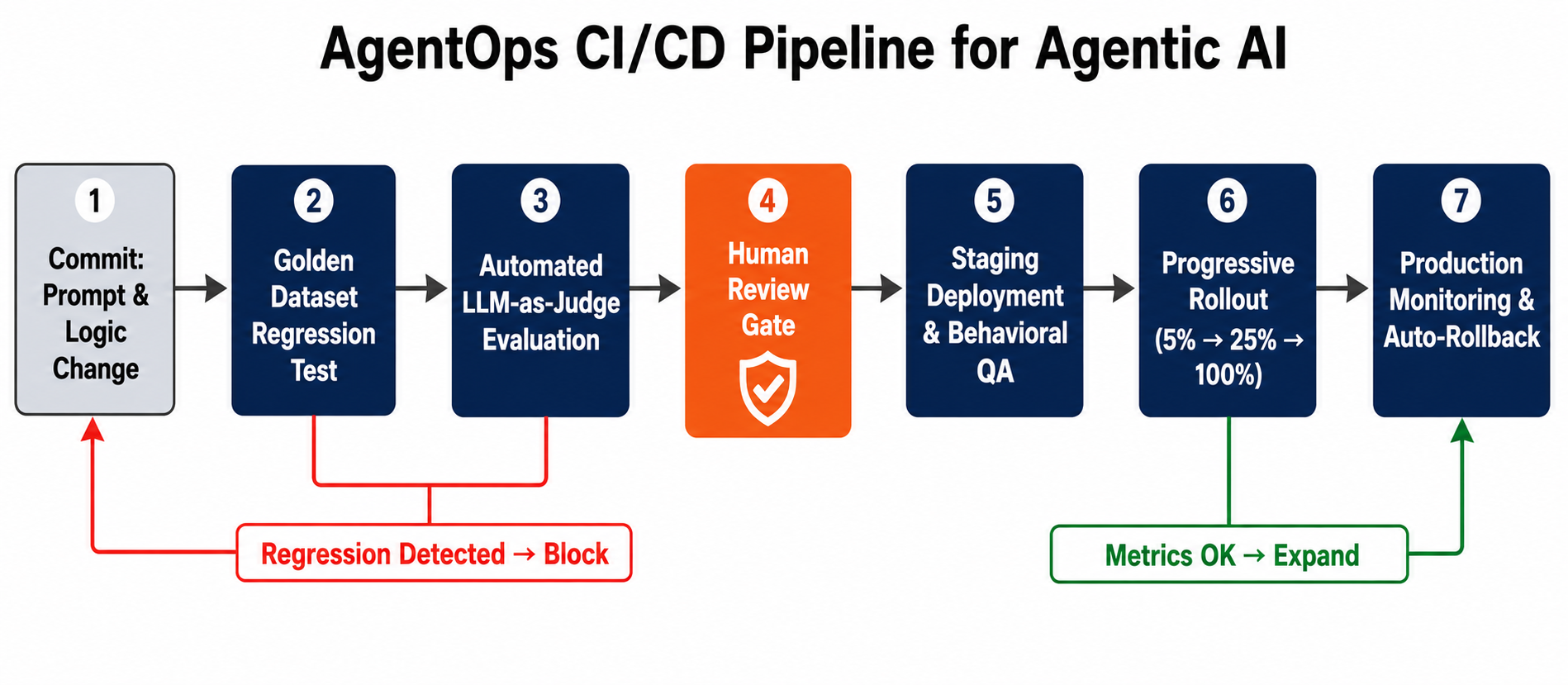
Progressive deployment also includes explicit rollback plans. Because agent state (prompts, model versions, tool configurations) is fully versioned in the ADLC version control system, rollback to the previous production configuration is a defined, tested procedure, not an emergency improvisation. Rollback triggers are pre-defined: specific metric thresholds (e.g., escalation rate exceeds X%, task completion drops below Y%) that automatically halt traffic expansion and alert the Agent Reliability Engineer.
7.2 CI/CD for Agents: AgentOps Practices
AgentOps, the discipline of applying continuous integration and continuous deployment practices to AI agent systems, is the operational backbone of Phase 5. The AgentOps pipeline extends the traditional CI/CD pipeline with agent-specific stages: prompt linting and validation, golden dataset regression testing, automated LLM-as-judge evaluation, cost estimation (does this change increase per-transaction token spend?), and security policy compliance checking.
A fully instrumented AgentOps pipeline for a production agent might include: automated golden dataset testing triggered on every commit to the agent's prompt or logic repository; staging environment deployment with automated behavioral evaluation on commit merge; human review gate with documented approval; progressive production rollout with automated metric monitoring; and automated rollback trigger if metrics deteriorate beyond defined thresholds. This pipeline transforms deployment from a high-stakes manual event into a repeatable, governed operational process.
The analogy to traditional DevOps is instructive: just as DevOps transformed software deployment from quarterly release events into daily deployable artifacts, AgentOps transforms agent updates from risky manual releases into routine governed operations. The discipline makes high deployment frequency safe, not by removing risk but by detecting it earlier and responding to it faster.
7.3 Infrastructure for Scalable Agent Deployment
Scalable agent infrastructure differs from traditional application infrastructure in several dimensions. Token throughput management, ensuring that LLM API rate limits do not create production bottlenecks during traffic spikes, requires queuing architectures that are not typical in request-response web services. Context window management, assembling the right information into the agent's context on each call, without exceeding the model's context limit or inflating token costs, requires purpose-built retrieval and assembly pipelines.
Cloud-native architectures that separate the agent orchestration layer from the underlying LLM inference infrastructure provide the best combination of scalability and cost control. Organizations typically see 15–25% reductions in cloud infrastructure spending by applying right-sizing and cost-optimized configurations to agentic AI platforms, compared to lifting traditional VM-based architectures into the cloud [19]. Modular agent architectures that enable component-level scaling, scaling the document retrieval agent independently from the reasoning agent, for example, provide finer-grained cost control than monolithic deployments.
7.4 Human-in-the-Loop (HITL) Integration Points
HITL integration in production is not a fallback for when the agent fails, it is a designed feature of every agentic workflow where the cost of an incorrect decision exceeds the benefit of full automation. The specific HITL integration points, designed in Phase 2 and tested in Phase 4, are activated in production whenever the agent's confidence in an action falls below a defined threshold, when the action involves an irreversible consequence (financial transactions, data deletions, regulatory submissions), or when the workflow touches a regulatory compliance boundary.
Effective HITL integration preserves full context for the human reviewer: the agent's reasoning trace, the tools it called and their responses, the specific decision point requiring human judgment, and the options available to the reviewer with their expected consequences. A human reviewer presented with a well-structured escalation context can make an informed decision in seconds; a reviewer presented with a raw agent output and no context must reconstruct the reasoning independently, defeating the efficiency purpose of the agentic system.
Gartner projects that by 2029, 70% of enterprises will deploy agentic AI as part of IT infrastructure operations, up from less than 5% in 2025. As deployment scale increases, the governance gap between autonomous agent actions and human-approved ones grows, making thoughtful HITL architecture not a transitional measure but a permanent governance pattern calibrated to each workflow's risk profile [20].
8. Phase 6: Monitoring, Observability, and the Outer Loop
Phase 6 is where ADLC departs most fundamentally from traditional SDLC operations. In a deterministic system, production monitoring is primarily about uptime: is the service responding? Are error rates within bounds? In an agentic system, the surface of what requires monitoring expands dramatically. A service can be fully operational, responding within SLA, producing outputs in the correct format, while simultaneously experiencing behavioral drift: its outputs are becoming less accurate, its reasoning is making systematic errors, or its tool usage patterns are shifting in ways that signal model degradation or data pipeline problems.
The Outer Loop of ADLC, the continuous cycle of monitoring, analysis, and improvement that operates throughout the agent's production life, is what separates ADLC from a one-time deployment exercise and makes it a true lifecycle framework.
8.1 Observability Architecture for Multi-Agent Systems
Production observability for agentic systems requires instrumentation at multiple granularity levels. Distributed tracing tracks requests through multi-agent workflows, revealing bottlenecks, failures, and performance degradation patterns across agent boundaries. Request-level logs capture user inputs, agent outputs, intermediate reasoning steps, tool invocations and their responses, and system metadata. Aggregate metrics track behavioral KPIs across all production interactions.
The observability infrastructure must be designed before deployment, not added reactively when production problems arise. Key components include a trace collection layer (capturing the full execution path of every agent request), a metrics aggregation layer (computing real-time KPIs across the production agent population), an alerting layer (triggering notifications when metrics breach defined thresholds), and a log analysis layer (enabling forensic investigation of specific incidents or behavioral anomalies) [21].
For multi-agent systems, the additional complexity of inter-agent communication must be traced. When a multi-step workflow fails, the distributed trace must identify which agent in the chain introduced the failure, what state it received from the upstream agent, and what state it passed to the downstream agent. Without this cross-agent traceability, debugging multi-agent failures is equivalent to debugging a distributed microservices system without distributed tracing, theoretically possible but operationally impractical.
8.2 Detecting Drift, Hallucination, and Behavioral Regression
Behavioral drift is the gradual divergence of an agent's production behavior from its established baseline, caused by changes in the distribution of production inputs, model updates by the LLM provider, shifts in the data in retrieval pipelines, or changes in the external tools the agent calls. Drift is insidious because it is gradual: no single incident triggers an alert, but the agent's average performance degrades over weeks or months to the point where its business value is materially reduced.
ADLC's Outer Loop detects drift through continuous evaluation against the golden dataset established in Phase 4. A subset of production interactions is periodically re-evaluated using the LLM-as-judge framework, and the resulting metrics are tracked against historical baselines. A statistically significant degradation in any key metric, accuracy, task completion rate, escalation rate, triggers an investigation cycle: is this a data drift issue, a model drift issue, a tool behavior change, or a shift in user intent patterns?
Hallucination detection in production agents requires specific instrumentation: grounding checks that verify whether agent outputs are supported by the retrieved context, factual consistency scoring against authoritative data sources, and human review sampling of outputs flagged as potentially hallucinated by automated evaluation. Amazon's published research on evaluating agentic systems at scale identifies hallucination monitoring as requiring a fundamental shift from single-model benchmarks to full-system evaluation, assessing not just individual outputs but the coherence of multi-step reasoning processes and the accuracy of tool selection decisions [22].
8.3 Key Metrics: Latency, Accuracy, Escalation Rate, Cost
The ADLC monitoring dashboard for a production agent tracks four categories of operational metrics, all mapped back to the KPI framework established in Phase 1.
Quality metrics assess whether the agent's outputs meet the behavioral standards defined in the acceptance criteria: task completion accuracy, hallucination rate, context faithfulness, answer relevance, and golden dataset regression scores. These metrics are the primary indicators of agent health from a business perspective.
Performance metrics assess the agent's operational efficiency: end-to-end latency (the time from user request to final agent output), per-tool-call latency (which tool calls are creating bottlenecks?), and throughput (how many concurrent agent workflows can the system handle within SLA?).
Governance metrics assess the agent's compliance with its designed operating boundaries: escalation rate (what fraction of requests are being routed to human reviewers, and is that fraction changing?), HITL override rate (how often are human reviewers changing the action recommended by the agent?), policy violation rate (how often is the agent attempting actions outside its authorized scope?), and audit log completeness.
Cost metrics track the economic efficiency of the agent: average token consumption per request, average cost per completed task, total API spend, and cost per escalated interaction. These metrics feed back into capacity planning and architecture decisions, if token costs are escalating, it may be time to evaluate an SLM fine-tuning approach for the high-volume task types.
| Metric Category | Key Metrics | Alert Threshold Example |
|---|---|---|
| Quality | Task accuracy, hallucination rate, golden dataset regression | Accuracy drop > 5% vs. baseline |
| Performance | End-to-end latency, per-tool latency, throughput | P95 latency > 8 seconds |
| Governance | Escalation rate, HITL override rate, policy violations | Escalation rate > 15% |
| Cost | Tokens per request, cost per task, total API spend | Cost per task > 2x baseline |
8.4 Feedback Loops and Continuous Improvement
The Outer Loop generates a continuous stream of improvement signals that feed back into the Inner Loop. High-quality production interactions, where the agent completed its task accurately and the user or human reviewer confirmed a positive outcome, are candidates for addition to the golden dataset, expanding its representativeness over time. Production failures and escalations are candidates for root cause analysis: was this a prompt engineering failure? A retrieval pipeline gap? A tool integration edge case? A model limitation on this task type?
ADLC formalizes this feedback mechanism through monthly or quarterly improvement sprints: structured reviews of production monitoring data, golden dataset updates, prompt refinements, and where warranted, model or tool changes. The improvement sprint produces a new agent version that goes through the full Inner Loop (Development, Testing, Validation) before being promoted back to production through the AgentOps pipeline. This cycle, monitor, analyze, improve, validate, deploy, is the operational rhythm that keeps a production agent's performance improving over time rather than degrading.
8.5 Agent Retirement and Lifecycle Closure
Every agent has a lifecycle that eventually ends. Deprecating and retiring an agent requires the same disciplined governance as deploying it. Abandoned agents, with live webhooks, active credentials, and orphaned access to enterprise systems, represent security risks that are easily overlooked when attention moves to the next initiative. ADLC treats decommissioning with the same discipline as deployment: a formal retirement checklist that revokes credentials, archives version history and audit logs, notifies downstream systems and users, documents the retirement rationale, and closes any open incidents or improvement items. Agent retirement is a lifecycle closure, not an abandonment.
9. Security and Governance in ADLC
Security in agentic AI systems is not a layer applied on top of a working architecture, it is a structural property of the architecture itself. Agents that act in the world, writing to databases, calling external APIs, sending communications, executing code, have a blast radius when compromised that is fundamentally larger than a passive software service. A compromised agent can corrupt data, exfiltrate information, trigger unauthorized transactions, or propagate malicious instructions through a multi-agent system before any human reviewer detects the anomaly. ADLC encodes security as a first-class concern at every phase.
9.1 The OWASP Top 10 for Agentic Applications 2026
The OWASP Top 10 for Agentic Applications 2026, developed through extensive collaboration with over 100 industry experts, researchers, and practitioners, provides the most comprehensive and operationally actionable framework for agentic AI security available as of this writing. Released in December 2025 at the Agentic AI Security Summit in London, it identifies the highest-impact risk categories observed in real agentic environments and provides practical guidance for addressing each [16].
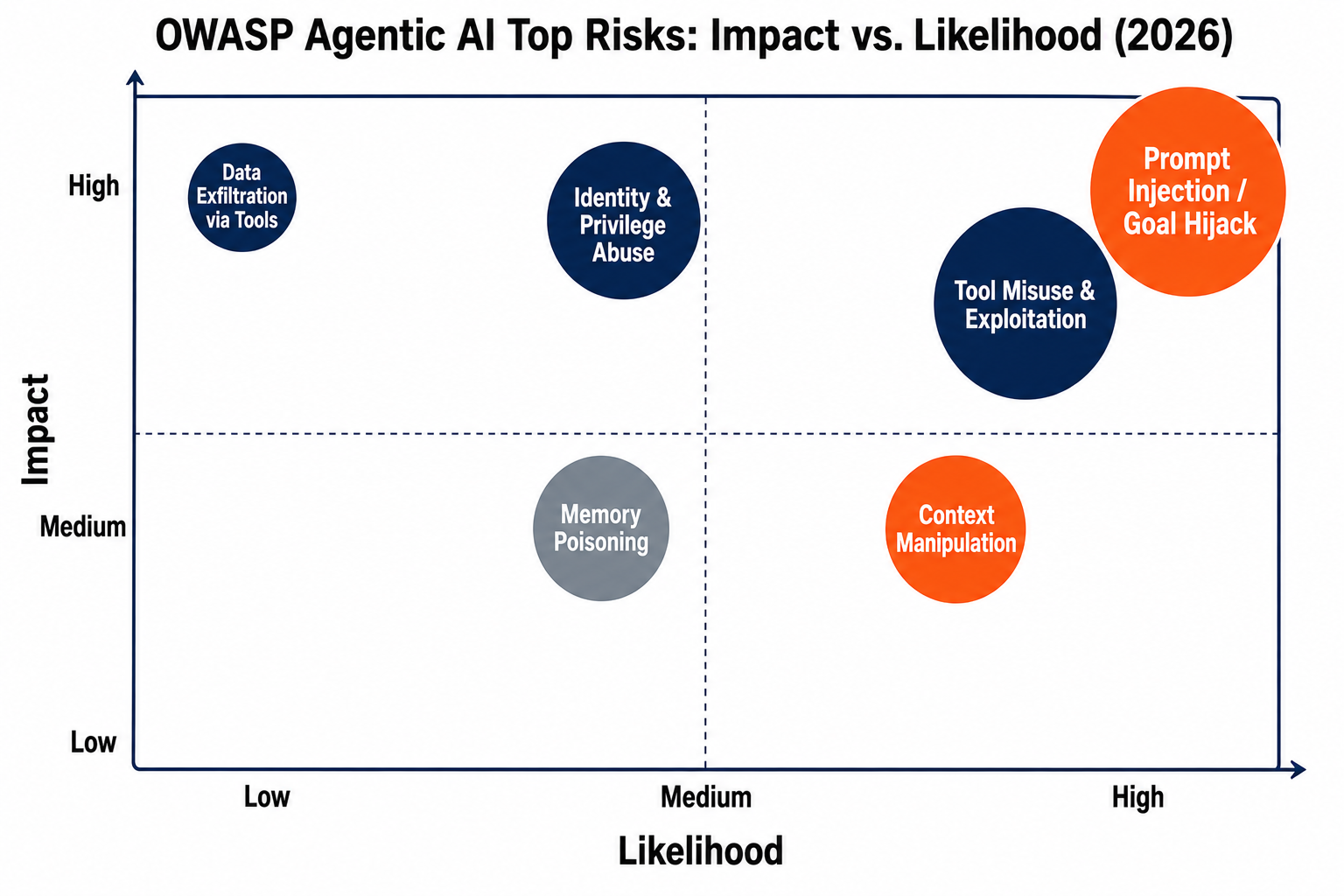
The top risks identified include Agent Goal Hijack (attackers redirecting the agent's objectives through injected instructions), Tool Misuse and Exploitation (agents calling tools with parameters outside authorized scope, or attackers manipulating tool responses), Identity and Privilege Abuse (agents being impersonated or agents inheriting excessive permissions from their execution context), Context Manipulation (poisoning the information in the agent's context window to manipulate its reasoning), and Memory Poisoning (corrupting the persistent memory stores that agents use to maintain state across sessions).
The OWASP framework notes that these risks mirror patterns observed across enterprises moving agents from pilots into production: identity gaps, uncontrolled tool actions, multi-step failures that cascade across workflows, and context-related issues that surface before traditional security controls can detect them. The implication is that traditional application security approaches, perimeter-based defenses, API rate limiting, input sanitization, are necessary but insufficient for agentic systems.
9.2 Prompt Injection, Tool Misuse, and Identity Risks
Prompt injection is the most prevalent and most dangerous attack vector in agentic systems. In direct prompt injection, an attacker embeds instructions in the user's input that override or supplement the agent's system prompt, redirecting its behavior, extracting sensitive information, or triggering unauthorized tool calls. In indirect prompt injection (sometimes called content injection), instructions are embedded in external content that the agent retrieves during task execution: a web page, a document, an email, a database record. The agent follows these instructions because it cannot reliably distinguish between authoritative instructions from its developers and injected instructions from malicious content.
Mitigations include input sanitization layers that detect and strip injection patterns before they reach the agent's context, structured output schemas that constrain the agent's response format and limit the range of actions it can take based on external content, and privilege separation between the agent's ability to read external content and its ability to take consequential actions. A critical architectural principle: agents that consume external content should operate in a restricted mode with reduced tool permissions until a human reviewer approves any consequential action triggered by that content.
Tool misuse mitigations center on the principle of least privilege. Each tool should be accessible to agents only through a permission scope that allows the minimum necessary operations for the agent's defined task. An agent that needs to read from a database should not have write permissions. An agent that needs to query an internal API should not have access to administrative endpoints. MCP's server architecture supports fine-grained tool permission scoping, making least-privilege tool access practically implementable in complex multi-tool environments [13].
9.3 Building a Governance Control Plane
Enterprise governance for agentic AI requires a dedicated control plane, a centralized management layer that provides visibility into and control over all agents deployed across the organization. The governance control plane answers the questions that compliance teams, executive stakeholders, and auditors will ask: Which agents are deployed in production? What are their authorized scopes? Who approved their deployment and when? What actions have they taken in the last 30 days? What is the status of their security review?
Key capabilities of an ADLC governance control plane include an agent registry (a catalog of all deployed agents with their version, scope, approved KPIs, and responsible owner), an audit log (an immutable record of all agent actions with timestamps and the identity of any human who approved or overrode agent decisions), a policy engine (automated enforcement of organizational AI policies, data access restrictions, output content policies, cost limits, applied to all agents at runtime), and a compliance reporting layer (aggregated reports for regulatory submissions and internal governance reviews).
IBM's ADLC e-book, one of the first vendor-published comprehensive treatments of the framework, identifies governance control plane capabilities, agent cataloging, MCP server lifecycle management, compliance certification workflows, as essential for enterprises moving beyond single-agent proofs of concept to multi-agent production environments at scale [23].
9.4 Regulatory and Compliance Considerations
The regulatory environment for AI agents is evolving rapidly. The EU AI Act, which came into full effect in 2025, classifies AI systems by risk level and imposes conformity assessment, transparency, and human oversight requirements that directly affect agentic deployments in high-risk domains including healthcare, financial services, employment, and critical infrastructure. Organizations deploying agents in these domains must maintain technical documentation demonstrating compliance, implement effective human oversight mechanisms, and conduct ongoing monitoring for accuracy and robustness [11].
In the United States, sector-specific regulations (HIPAA for healthcare, FINRA and SEC guidance for financial services, NIST AI Risk Management Framework for federal agencies) are supplemented by evolving state-level AI legislation. NIST's NCCoE published a concept paper on agent identity in February 2026, explicitly acknowledging that organizations must address how identity principles, identification, authentication, and authorization, apply specifically to AI agents, not just to the humans who deploy them [14].
ADLC's compliance integration approach treats regulatory requirements as architectural constraints that flow from Phase 1 (compliance scoping) through Phase 2 (architectural implementation), Phase 4 (compliance validation testing), and Phase 6 (continuous compliance monitoring). Rather than treating compliance as a checkbox exercise performed before audit, ADLC embeds compliance evidence generation into the operational lifecycle, making the governance artifacts created during normal agent operation the basis for regulatory reporting.
10. Citrusbug's ADLC Approach: From Concept to Production
Citrusbug has applied the ADLC framework across client engagements spanning healthcare technology, enterprise automation, financial services, and AI-powered voice agents. Our experience implementing agentic systems at production scale has yielded a set of practical engineering and governance principles that complement the theoretical ADLC framework with ground-level operational insight.
10.1 How Citrusbug Implements ADLC for Client Engagements
Every Citrusbug agentic engagement begins with a structured Discovery Sprint, a focused Phase 1 engagement that produces the Human–Agent Responsibility Map, KPI framework, data readiness assessment, and compliance scope document before any architecture or code is discussed. This disciplined upfront investment consistently reduces total project timelines by eliminating the expensive rework that follows premature agent construction on an unclear problem definition.
In the Architecture phase, Citrusbug's default starting point is the multi-agent pattern with a central orchestrator, not because multi-agent is always the right answer, but because the modularity it provides is consistently valuable as agent complexity grows. Monolithic agent designs that seem simpler at the prototype stage routinely require painful refactoring when production requirements reveal their limitations. Starting with a properly scoped modular architecture creates an expandable foundation.
Citrusbug uses a standardized evaluation harness, a combination of golden dataset management tooling, automated LLM-as-judge evaluation, and behavioral regression reporting, that is deployed identically across client engagements. This consistency means that evaluation infrastructure built for one engagement compounds in value across subsequent projects, and that behavioral metrics are comparable across different agent types and use cases.
10.2 Platform Engineering and Toolchain Selection
Citrusbug's agentic platform stack as of 2026 is anchored on LangGraph for stateful multi-agent orchestration (its graph-based execution model provides native support for the complex conditional routing and human interruption patterns that production agents require), MCP for tool integration (providing a standardized, security-conscious interface between agents and enterprise systems), and a vector database layer (Pinecone for cloud-native deployments, pgvector for PostgreSQL-integrated deployments) for RAG pipelines.
Observability is built on OpenTelemetry-compatible tracing, with Arize AI for behavioral evaluation dashboards and custom agent-specific metrics exported to client-preferred monitoring platforms (Datadog, Grafana, or Azure Monitor depending on existing client infrastructure). This platform-agnostic observability approach ensures that ADLC monitoring capabilities are available regardless of the client's cloud platform preference.
For governance, Citrusbug deploys a lightweight agent registry and audit log on every production engagement, even for clients who do not yet have a formal AI governance program. The reasoning is straightforward: the audit log that seems unnecessary during initial deployment becomes invaluable the first time a production incident requires forensic investigation or a compliance reviewer asks for an action history. Building it from day one is always cheaper than retrofitting it under pressure.
10.3 Lessons Learned and Common Failure Modes
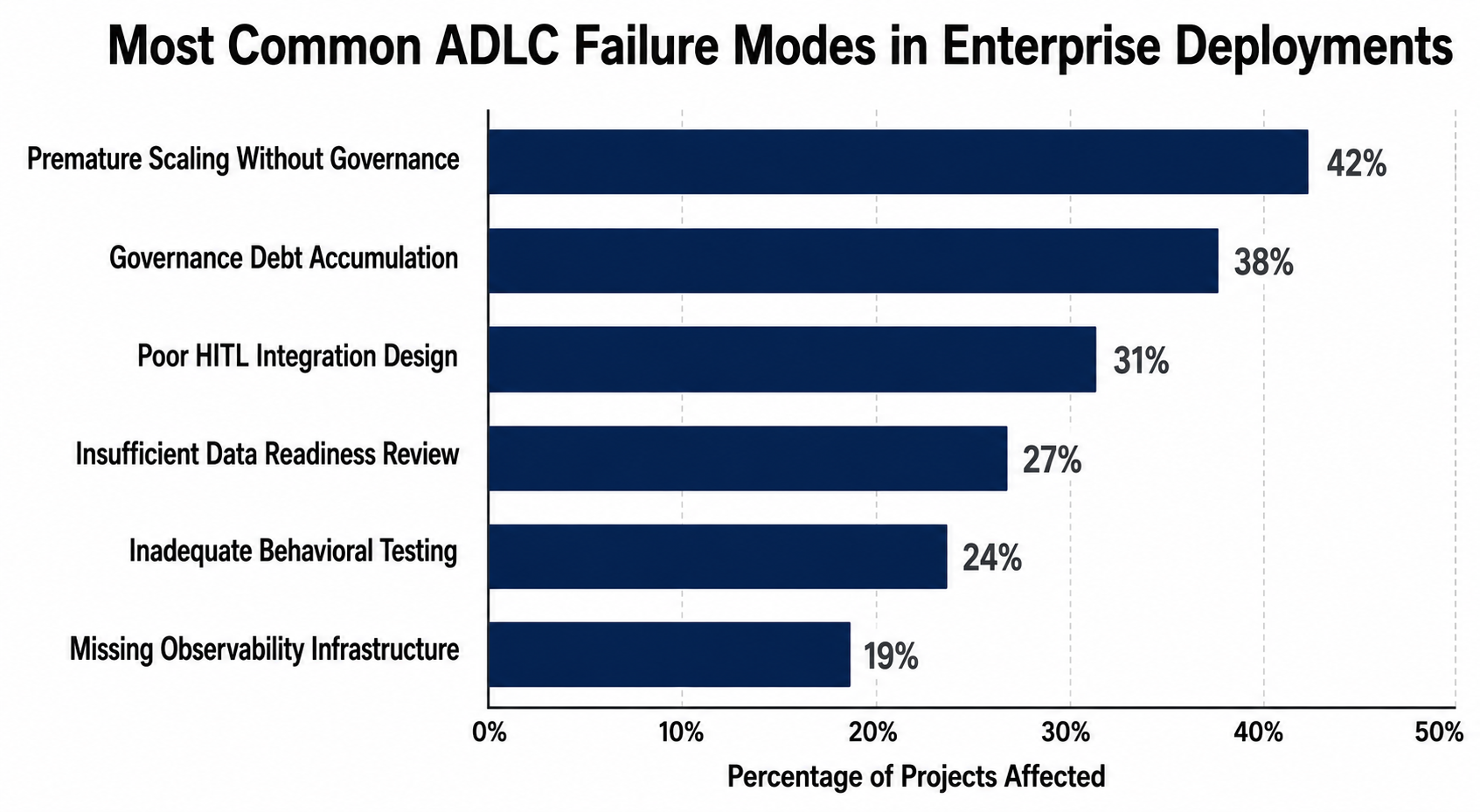
The most consistent pattern in failed or stalled agentic projects, across both Citrusbug's client experience and the broader industry data, is premature scaling. Teams build a working prototype, demonstrate it to stakeholders, receive approval to scale, and immediately discover that the prototype's prompt engineering, evaluation framework, and infrastructure assumptions all break at production volume. The ADLC inner loop disciplines, particularly the mandatory staging environment gate and the golden dataset evaluation requirement, exist specifically to prevent premature scaling by ensuring that production-readiness criteria are met before the production promotion decision is made.
A second consistent failure mode is governance debt accumulation. Teams defer the governance control plane, the audit logging, and the compliance documentation to a 'later phase' that never arrives because production operational demands consume all available engineering capacity. ADLC addresses this by treating governance artifacts as phase deliverables, required outputs of Phase 2 and Phase 5, not optional enhancements.
A third failure mode is underestimating the human side of HITL integration. Technically, inserting a human review gate into an agent workflow is straightforward. Operationally, it requires change management: the humans in the loop need training on what they are reviewing, what actions they can take, and what context the agent provides to support their decision. HITL systems where reviewers lack context or training become bottlenecks rather than governance assets, defeating the purpose of human oversight.
The organizations that Citrusbug has observed navigating these failure modes successfully share a common characteristic: they treat agentic AI deployment not as a technology project but as an organizational transformation. The technology, the models, the frameworks, the platforms, is the smaller challenge. The larger challenge is aligning teams, governance structures, and operational processes to the new realities of autonomous AI systems operating at enterprise scale.
Conclusion & Next Steps
The agentic AI era is not approaching, it is already underway. With the global agentic AI market growing at over 43% annually, Gartner forecasting that 40% of enterprise applications will include task-specific agents by the end of 2026, and Google Cloud reporting that 74% of executives achieving production deployments see ROI within the first year, the business case for agentic AI investment is established. The question for enterprise technology leaders is no longer whether to invest, it is how to invest in a way that converts the 79% of organizations experimenting with agents into the 11% running them in production at scale.
The Agentic Development Life Cycle answers that question with a structured, phase-gated framework that addresses the full spectrum of challenges in agentic AI deployment: from the disciplined problem scoping of Phase 1 through the architectural rigor of Phase 2, the behavioral evaluation disciplines of Phases 3 and 4, the progressive deployment governance of Phase 5, and the continuous observability and improvement cycle of Phase 6. ADLC does not make agentic AI simpler than it is, it makes the complexity manageable through discipline and systematic practice.
The security and governance dimensions of ADLC, anchored by the OWASP Top 10 for Agentic Applications 2026 and implemented through a dedicated governance control plan, are not compliance overhead. They are the operational foundation that makes enterprise stakeholders, compliance teams, and regulators confident that autonomous AI systems are operating within authorized boundaries and producing auditable outcomes. Without this foundation, agentic AI projects stall not because the technology failed but because organizational trust was never established.
For organizations at the beginning of their agentic AI journey, the practical next step is a structured ADLC Discovery Sprint: a focused engagement that produces a problem definition, Human–Agent Responsibility Map, KPI framework, and architectural recommendation before any agent is built. For organizations with existing agentic deployments, an ADLC audit, assessing the current state of behavioral evaluation, governance, and observability against the framework, identifies the gaps most likely to prevent scaling and provides a prioritized remediation roadmap.
Citrusbug is ready to partner on both. Our team of Agentic Architects, Prompt Engineers, and Agent Reliability Engineers brings the technical depth, operational experience, and organizational change management discipline needed to move from AI experimentation to production-grade agentic systems, systematically, reliably, and at pace.
To discuss how ADLC can accelerate your agentic AI journey, visit www.citrusbug.com or contact our team directly.
About Citrusbug
Citrusbug is a technology services and product engineering company specializing in AI, mobile, and web application development. With a team of experienced engineers, designers, and strategists, Citrusbug partners with startups and enterprises across the United States, United Kingdom, and beyond to build scalable, intelligent digital products.
Our expertise spans generative AI integration, full-stack development, healthcare technology, IoT solutions, and enterprise automation. We combine deep technical knowledge with a pragmatic, business-first approach, helping clients move from concept to production with speed and confidence.
From AI-powered voice agents to remote patient monitoring platforms, Citrusbug delivers solutions that create measurable business impact. Our work is guided by a commitment to quality, transparency, and long-term partnership.
To learn more or discuss your next project, visit www.citrusbug.com or reach out to our team directly.
References
- [1] Gartner. "Gartner Forecasts Enterprise Software Applications with Agentic AI." Gartner, 2024–2025. https://www.gartner.com
- [2] Mordor Intelligence. "Agentic AI Market Size & Share Report." Mordor Intelligence, 2026. https://www.mordorintelligence.com/industry-reports/agentic-ai-market
- [3] Grand View Research. "AI Agents Market Size, Share & Growth Report 2026." Grand View Research, 2026. https://www.grandviewresearch.com/industry-analysis/ai-agents-market-report
- [4] Digital Applied. "Agentic AI Statistics 2026: 150+ Data Points Collection." Digital Applied, March 2026. https://www.digitalapplied.com/blog/agentic-ai-statistics-2026-definitive-collection-150-data-points
- [5] Svitla Systems. "Explore Agentic AI Market Trends 2025-2026: 5 Shifts That Matter." Svitla, May 2026. https://svitla.com/blog/agentic-ai-market-trends-2026/
- [6] SumatoSoft. "What is ADLC? Agentic Development Lifecycle Guide 2026." SumatoSoft, May 2026. https://sumatosoft.com/blog/what-is-adlc-agentic-development
- [7] StackAI. "The Agentic Development Life Cycle: How to Manage AI Agents at Scale." StackAI Blog. https://www.stackai.com/blog/the-agentic-development-life-cycle-how-to-manage-ai-agents-at-scale
- [8] Thoughtworks. "Preparing your team for the agentic software development life cycle." Thoughtworks Insights, March 2026. https://www.thoughtworks.com/insights/articles/preparing-your-team-for-agentic-software-development-life-cycle
- [9] EPAM Systems. "Introducing Agentic Development Lifecycle (ADLC): Building and Operating AI Agents in Production." EPAM Insights, February 2026. https://www.epam.com/insights/ai/blogs/agentic-development-lifecycle-explained
- [10] IBM. "What is the agent development lifecycle (ADLC)?" IBM Think Topics, 2026. https://www.ibm.com/think/topics/agent-development-lifecycle-adlc
- [11] European Union. "EU AI Act." Official Journal of the European Union, 2024. https://eur-lex.europa.eu
- [12] Google Developers Blog. "Developer's guide to multi-agent patterns in ADK." Google, December 2025. https://developers.googleblog.com/developers-guide-to-multi-agent-patterns-in-adk/
- [13] Anthropic / MCP Community. "Model Context Protocol (MCP) Overview." 2025. https://modelcontextprotocol.io
- [14] Augment Code. "Agentic SDLC: What Changes When Agents Run Development." Augment Code, May 2026. https://www.augmentcode.com/guides/agentic-sdlc
- [15] Augment Code. "Best AI Agent Evaluation Tools for Production Teams (2026)." Augment Code, May 2026. https://www.augmentcode.com/tools/best-ai-agent-evaluation-tools
- [16] OWASP GenAI Security Project. "OWASP Top 10 for Agentic Applications 2026." OWASP, December 2025. https://genai.owasp.org/resource/owasp-top-10-for-agentic-applications-for-2026/
- [17] Microsoft Azure. "Agent Factory: Top 5 agent observability best practices for reliable AI." Microsoft Azure Blog, August 2025. https://azure.microsoft.com/en-us/blog/agent-factory-top-5-agent-observability-best-practices-for-reliable-ai/
- [18] Maxim AI. "The Ultimate Checklist for Rapidly Deploying AI Agents in Production." Maxim AI, November 2025. https://www.getmaxim.ai/articles/the-ultimate-checklist-for-rapidly-deploying-ai-agents-in-production/
- [19] TransOrg AI. "Agentic AI Transforming the SDLC for Enterprises." TransOrg AI Blog, February 2026. https://www.transorg.ai/blog/agentic-ai-powered-sdlc-platform/
- [20] Elementum AI. "Human-in-the-Loop Agentic AI: When You Need Both." Elementum AI Blog, March 2026. https://www.elementum.ai/blog/human-in-the-loop-agentic-ai
- [21] Maxim AI. "A Comprehensive Guide to Testing and Evaluating AI Agents in Production." Maxim AI, November 2025. https://www.getmaxim.ai/articles/a-comprehensive-guide-to-testing-and-evaluating-ai-agents-in-production/
- [22] Amazon Web Services. "Evaluating AI agents: Real-world lessons from building agentic systems at Amazon." AWS ML Blog, February 2026. https://aws.amazon.com/blogs/machine-learning/evaluating-ai-agents-real-world-lessons-from-building-agentic-systems-at-amazon/
- [23] IBM. "AI Agents Demand a New Development Lifecycle: Introducing the Agent Development Lifecycle (ADLC)." IBM, 2025. https://www.ibm.com/forms/mkt-whitepaper-f42e5