

 Back
Back Small Language Models (SLMs): How Compact, Efficient AI Is Reshaping Enterprise Software Strategy

Executive Summary
For most of the last five years, progress in artificial intelligence has been measured in a single dimension: parameter count. Each generation of large language models (LLMs) has been bigger than the last, and each jump in size has widened the gap between what frontier AI can do and what most enterprises can afford to run in production. That equation is now changing. A new class of compact, efficient, purpose-built models, Small Language Models, or SLMs, is reshaping enterprise AI by shifting the conversation from 'how large a model can we access' to 'how well-matched is this model to the task in front of us.'
SLMs are language models, typically in the range of a few hundred million to roughly 14 billion parameters, engineered to run efficiently on consumer hardware, edge devices, and modest on-premise servers rather than requiring sprawling GPU clusters [1][2]. What makes them strategically important is not that they are simply lightweight language models, but that a combination of better training data, knowledge distillation, pruning, and quantization has allowed them to close much of the capability gap with far larger systems on well-defined, narrow tasks [1]. Industry analysis suggests SLMs now retain 70 to 95 percent of large-model accuracy on domain-specific work while running at roughly one-tenth the inference cost and multiple times the speed [6].
The market is responding accordingly. Analysts at Gartner project that by 2027, organizations will run small, task-specific AI models at a volume at least three times greater than general-purpose LLMs, driven by lower compute costs, faster response times, and stronger domain accuracy [3]. Market sizing estimates from Grand View Research put the global SLM market at roughly USD 7.8 billion in 2023, growing at a 15.1 percent compound annual rate toward USD 20.7 billion by 2030 [1], and independent forecasts from Pragma Market Research describe a broadly similar trajectory extending past USD 26 billion by the early 2030s [2].
This shift is not simply about saving money, although the cost differential is significant: on-premise SLM deployments frequently reach economic break-even against commercial LLM APIs within months rather than years [17]. It is also about control. SLMs can run entirely inside a company's own infrastructure, making them a practical foundation for private AI initiatives, which matters enormously for healthcare providers bound by HIPAA, financial institutions navigating data-residency rules, and any enterprise that simply cannot send proprietary or regulated data to a third-party API [14][18]. And it is about architecture: NVIDIA Research has argued in a widely discussed 2025 position paper that SLMs, not LLMs, are the natural building block for agentic AI systems, because the great majority of tasks an agent performs are narrow, repetitive, and structured, exactly the profile SLMs are built for [10].
Key Takeaways
- SLMs deliver 70-95% of large-model accuracy on domain-specific tasks at roughly one-tenth the cost and multiple times the inference speed, making them the pragmatic default for high-volume, well-defined enterprise workloads [6][20].
- Gartner projects task-specific small models will see three times the usage volume of general-purpose LLMs by 2027, and the global SLM market is on a path from roughly $7.8B (2023) to $20.7B+ (2030) [3][1].
- The most durable enterprise architecture is not 'SLM instead of LLM' but a hybrid model: SLMs handle the routine 80-95% of requests locally or on-premise, while LLMs are reserved for genuinely complex, open-ended reasoning [23][10].
- Data privacy, regulatory compliance, and on-device/edge deployment are increasingly the deciding factors in SLM adoption, not just cost, particularly in healthcare, financial services, and manufacturing [14][18].
This whitepaper is written for CTOs, VPs of Engineering, and technical decision-makers evaluating how to allocate AI investment across their organization. It examines what SLMs are and how they differ from LLMs; the compression and training techniques used to build them; the current landscape of production-ready models; how enterprises are deploying them on-premise, at the edge, and inside agentic systems; the risks and governance considerations that come with adopting them; and a practical, phased roadmap for building an SLM strategy. Throughout, the guiding question is not whether small models will replace large ones, the evidence suggests they will not, but how the two are increasingly deployed together, and what that means for how software gets built.
1. Introduction: The Emergence of Small Language Models in the AI Ecosystem
1.1 The LLM Bottleneck: Size vs. Practicality
The generative AI boom of the past several years has been powered almost entirely by scale. Each new frontier model has arrived with more parameters, more training data, and more compute behind it, and each has pushed benchmark scores higher. That approach has produced remarkable systems, but it has also produced a widening gap between what these systems can do and what most organizations can practically deploy. Running a frontier-class model in production means depending on GPU-dense cloud infrastructure, absorbing per-token API costs that scale directly with usage, and accepting latency measured in hundreds of milliseconds per request, a real constraint for anything that needs to feel instantaneous [17][14].
The bottleneck is especially visible in three places. First, cost: enterprises that scaled up generative AI usage in 2025 and 2026 have in some cases seen token spending run several multiples over budget within a single fiscal year, prompting FinOps teams to scrutinize AI line items the way they once scrutinized cloud compute [14]. Second, latency: a model built for open-ended, general-purpose conversation carries computational overhead that a narrow, repetitive task simply does not need, and every millisecond of round-trip time compounds at scale. Third, and increasingly decisive, is data control: a frontier LLM API is, by definition, a third party, and for healthcare records, financial transactions, or attorney-client communications, sending that data off-premise is not merely a preference but frequently a compliance obstacle [14][18].
None of this means LLMs are no longer useful, for open-ended reasoning, broad general knowledge, and tasks that genuinely require a very large context window, they remain the better tool. But it does mean that treating a trillion-parameter generalist model as the default choice for every task in an enterprise workflow is, for a large share of real-world use cases, economically and operationally the wrong architecture [7].
1.2 The Paradigm Shift to Small Language Models
The response to this bottleneck has not been to abandon large models, but to right-size the model to the task. Small Language Models, generally defined as models in the range of a few hundred million to roughly 14 billion parameters that can run on consumer-grade or modest enterprise hardware, have moved from research curiosities to production infrastructure in a remarkably short window [7][8]. The shift is best understood as a change in default assumption: instead of asking 'which frontier model should handle this,' engineering teams are increasingly asking 'does this task actually require frontier-scale reasoning, or would a smaller, faster, cheaper, fine-tuned model do the job as well or better?'
Three converging developments made this shift possible. The first is data quality: research from Microsoft's Phi series demonstrated that training a small model on carefully curated, 'textbook-quality' data produces disproportionately strong reasoning and coding performance relative to parameter count, undercutting the assumption that scale is the only lever available [8][20]. The second is compression: knowledge distillation, pruning, and quantization now let teams derive a compact, deployable model from a much larger teacher model while retaining a large share of its capability [10][15]. The third is hardware: neural processing units (NPUs) are now standard in flagship and mid-range phones, laptops, and edge devices, delivering tens of trillions of operations per second locally, enough to run a multi-billion-parameter model at interactive speed without a network round trip [24][25].
The result is a model class that is not a diminished version of a chatbot, but a different tool built for a different job: fast, private, cost-effective, and among today's most efficient AI models for enterprise workloads, often better, at the narrow, repetitive, well-defined tasks that make up the majority of real enterprise AI workloads [17][7].
1.3 Market Drivers and Projections
The economics behind this shift are increasingly well documented. Grand View Research estimates the global small language model market at USD 7.8 billion in 2023, projecting growth to roughly USD 11.1 billion by 2026 and USD 20.7 billion by 2030, a compound annual growth rate of 15.1 percent [1]. Other market research houses describe a similarly steep trajectory: Pragma Market Research's analysis places 2024 market value near USD 7.46-7.8 billion with a path past USD 20-26 billion by the early 2030s, depending on methodology [2]. While individual estimates vary, as is typical across market research firms, the direction and order of magnitude are consistent.
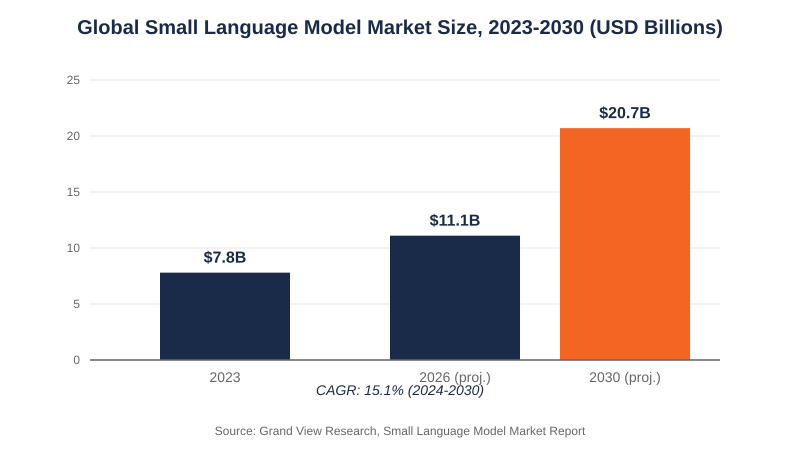
Figure 1. Global small language model market size, 2023–2030 (USD billions). Source: Grand View Research.
Perhaps the most cited forward-looking figure in this space comes from Gartner, which predicts that by 2027 organizations will deploy small, task-specific AI models at a usage volume at least three times greater than general-purpose LLMs [3]. Gartner's reasoning is instructive: general-purpose models lose accuracy as tasks become more specific to a business's own context, and the variety and volume of tasks inside real workflows increasingly favor models fine-tuned to a narrow function over a generalist model asked to do everything [3][7]. A parallel EY analysis of agentic AI adoption in 2026 describes SLMs becoming the practical backbone for multilingual, regulated, and cost-sensitive enterprise applications, combining local relevance with predictable compute spend [42].
Three demand drivers stand out consistently across this research. Cost predictability: SLM deployment can run 5 to 150 times cheaper than equivalent LLM API usage depending on the workload and hosting model [28][29]. Data sovereignty: the growing weight of regulations such as the EU AI Act and sector rules like HIPAA is pushing organizations toward architectures where sensitive data never leaves their own infrastructure [1][14]. And edge and IoT expansion: as more computation moves to smartphones, industrial equipment, and embedded systems, the demand for models that fit within tight memory and power budgets grows in lockstep [1].
1.4 Why This Matters for Custom Software Development
For software development teams and the organizations that commission their work, the rise of SLMs changes the default architecture question. Where a project might once have defaulted to 'call an LLM API for this feature,' the more disciplined question is now which of three patterns fits best: a general-purpose LLM API for open-ended, low-volume, high-complexity tasks; a fine-tuned SLM, self-hosted or lightly hosted, for high-volume, narrow, repetitive tasks; or a hybrid architecture that routes between the two based on task complexity, cost sensitivity, and data classification [23][7].
This matters concretely for build decisions. A development team building a customer support triage system, a document classification pipeline, an internal knowledge assistant, or an embedded feature inside a mobile or desktop application now has a credible, often superior alternative to routing every request through a costly, latency-heavy frontier API. It also changes the skill set a development partner needs: evaluating open-weight model families, fine-tuning with parameter-efficient methods like LoRA, setting up local inference runtimes, and designing routing layers are now as relevant to a custom software engagement as traditional backend and API integration work [30][31].
The remainder of this whitepaper works through that decision space in detail, from the technical foundations of how SLMs are built, to the production model landscape, to deployment patterns, applications, risks, and a practical roadmap for adoption.
2. Defining Small Language Models: Foundations and Key Characteristics
2.1 What Qualifies as 'Small'?
There is no single, industry-standardized parameter threshold that separates an SLM from an LLM, but a practical consensus has emerged. Most industry and research sources place SLMs in the range of roughly 1 million to 14 billion parameters, with the most commonly deployed enterprise models clustering between 1 billion and 10 billion [7][8]. NVIDIA Research proposes a more functional definition: an SLM is a language model that can run on common consumer devices while delivering responses fast enough to serve a single user interactively; anything that does not meet that bar is, by their working definition, an LLM regardless of its exact parameter count [4].
That functional framing is useful because parameter count alone is a moving target. A 7-billion-parameter dense model and a much larger mixture-of-experts model that only activates a fraction of its parameters per token can have similar practical deployment footprints despite very different total sizes [37]. What matters for the purposes of this whitepaper is deployability: can the model run on a single GPU, a laptop, a phone, or a modest on-premise server, at a cost and latency that make it viable for production use, as opposed to requiring a distributed, multi-GPU cluster reserved for frontier-scale inference.
2.2 Key Characteristics of SLMs
Across the current generation of production SLMs, several characteristics recur consistently. They are efficient by design, built to run on CPUs, single consumer GPUs, or NPUs rather than requiring data-center-scale infrastructure [8]. They are fast, frequently delivering 150-300 tokens per second on optimized hardware compared to 50-100 tokens per second for many hosted LLMs, which matters directly for real-time applications such as live chat or voice interfaces [18]. They are cost-efficient, both in absolute inference cost and in the lower cost of fine-tuning, many can be adapted on a single high-end GPU using parameter-efficient methods, rather than requiring the large training clusters LLM fine-tuning often demands [41][20].
They are also deployment-flexible in a way frontier models are not: the same SLM family can often run on a cloud server, an on-premise server, a laptop, or a phone with only quantization or format changes, making it ideal for edge AI deployment across diverse environments, which lets an organization standardize on a model family across very different deployment targets [26][30]. And they are increasingly specialization-friendly, making them well suited for domain-specific AI models tailored to enterprise use cases: because they are cheaper and faster to fine-tune, it becomes practical to maintain several narrow, purpose-built SLMs, one for document classification, one for intent routing, one for a specific domain's terminology, rather than asking a single generalist model to do all of it adequately [16][44].
The trade-off, and it is a real one, is breadth. SLMs generally have less world knowledge, weaker performance on genuinely novel or multi-step reasoning tasks, and shorter effective context windows than frontier LLMs. This is not a flaw so much as a design consequence of the specialization that makes them fast and cheap in the first place, and it is the central reason the most common enterprise pattern is hybrid rather than SLM-only, as discussed in Section 5.
2.3 SLMs vs. LLMs: A Detailed Comparison
The differences between the two model classes are best understood side by side, across the dimensions that matter most for a production deployment decision.
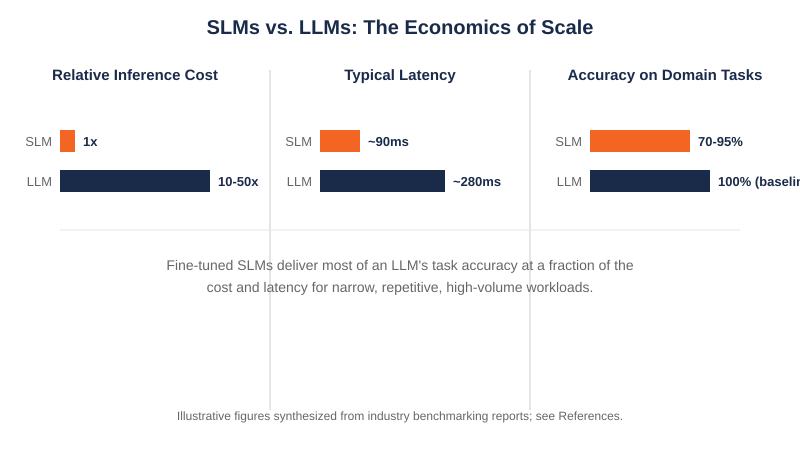
Figure 2. SLMs vs. LLMs: relative inference cost, latency, and accuracy retention on domain tasks.
| Dimension | Small Language Model (SLM) | Large Language Model (LLM) |
|---|---|---|
| Typical parameters | ~1M-14B | 70B to 1T+ (often mixture-of-experts) |
| Deployment footprint | Single GPU, CPU, NPU, edge device, phone | Multi-GPU cluster or hosted API |
| Inference cost | Roughly 1/10th to 1/50th of comparable LLM usage | Highest, scales directly with token volume |
| Typical latency | ~90ms and often lower on-device | ~280ms+ typical for hosted frontier APIs |
| Data privacy | Can run fully on-premise/on-device; data never leaves the org | Typically requires sending data to a third-party API |
| Best suited for | Narrow, repetitive, high-volume, well-defined tasks | Open-ended reasoning, broad knowledge, long-context tasks |
| Fine-tuning cost | Often single-GPU, hours to days, 200-5,000 examples | Substantial compute; often infeasible to fully fine-tune |
| Accuracy on domain tasks (fine-tuned) | 70-95%+ of comparable LLM accuracy, sometimes exceeding it | Baseline (100%), strong on general tasks |
The practical implication is that the choice between an SLM and an LLM is rarely about which model is 'better' in the abstract, it is about which model is better matched to a specific task's complexity, volume, latency requirement, and data sensitivity [7].
2.4 Representative Models in 2026
The production SLM landscape has matured considerably. Microsoft's Phi family, including Phi-4 and the smaller Phi-4-mini, has become a reference point for reasoning and coding performance relative to size, with Phi-4-mini reported to outperform models several times its parameter count on math and reasoning benchmarks [51]. Google's Gemma 3 family spans from a 270-million-parameter variant suited to narrow, embedded tasks up to a 4-billion-parameter model competitive on multilingual and multimodal benchmarks, with the Gemma 3n variant introducing memory-efficient architecture specifically for mobile deployment [10].
Meta's Llama 3.2 line, available from 1 billion to 11 billion parameters, targets edge and mobile use cases explicitly, while Alibaba's Qwen 2.5 and 3 series lead on multilingual coverage, particularly for Asia-Pacific languages [52]. Mistral's 7B family and a fast-growing set of community fine-tunes round out an ecosystem now rich enough that most enterprise use cases have at least two or three credible open-weight candidates to evaluate [23][51]. Section 4 examines this landscape in more depth, including how these families compare on benchmarks, memory footprint, and deployment target.
3. The Evolution of Small Language Models
3.1 Historical Milestones (2018–2023)
The lineage of today's SLMs traces back to the compression research that followed the release of BERT in 2018. As BERT and its successors demonstrated the power of the transformer architecture for language understanding, researchers quickly turned to the problem of making these models practical to deploy. DistilBERT, introduced by Hugging Face in 2019, used knowledge distillation to produce a model 40 percent smaller than BERT while retaining approximately 97 percent of its language-understanding performance and running 60 percent faster [4].
The following year brought further refinement. TinyBERT, from Huawei Noah's Ark Lab, extended distillation across the transformer layers, the embedding layer, and the prediction layer simultaneously, producing a model roughly 7.5 times smaller and 9.4 times faster than its BERT teacher while remaining competitive on standard NLU benchmarks [6]. MiniLM introduced deep self-attention distillation as an alternative compression strategy, and MobileBERT proposed a bottleneck architecture purpose-built for resource-constrained devices [2]. Collectively, this era established the three techniques, pruning, quantization, and knowledge distillation, that remain the technical foundation of SLM development today.
3.2 The Breakthrough Era (2023–2025)
The generative AI wave that began with GPT-3 and accelerated through 2022 and 2023 initially reinforced the assumption that scale was the only path to strong performance. Microsoft's Phi-1, released in 2023, complicated that assumption directly: trained on a comparatively small but extremely high-quality, 'textbook-like' dataset, it demonstrated that a compact model could achieve coding and reasoning performance disproportionate to its parameter count, shifting research attention toward data quality as a lever equal in importance to scale [8][20].
2024 saw this insight translate into a wave of production-ready releases. Microsoft's Phi-3 family, Google's Gemma models, and Meta's Llama 3.2 line all launched with explicit design targets around edge and mobile deployment rather than treating small size as a byproduct of research constraints [51]. This is also the period in which on-device AI moved from a niche feature to a headline capability: Apple Intelligence, Google's Gemini Nano, and Microsoft's Copilot+ PC initiative all launched SLM-powered, privacy-preserving local AI features during this window.
2025 marked a turning point for how SLMs are understood strategically rather than just technically. Microsoft's Phi-4 shipped with benchmark results that, in several reasoning and math categories, matched or exceeded much larger frontier models [51]. And in June 2025, NVIDIA Research published 'Small Language Models are the Future of Agentic AI,' a position paper arguing that the architecture of most AI agents, repeated, narrow, tool-calling tasks, is fundamentally better served by small, specialized models than by routing every call through a large generalist model [4]. That paper, discussed in depth in Section 6, reframed the SLM conversation from a cost-saving tactic to an architectural principle.
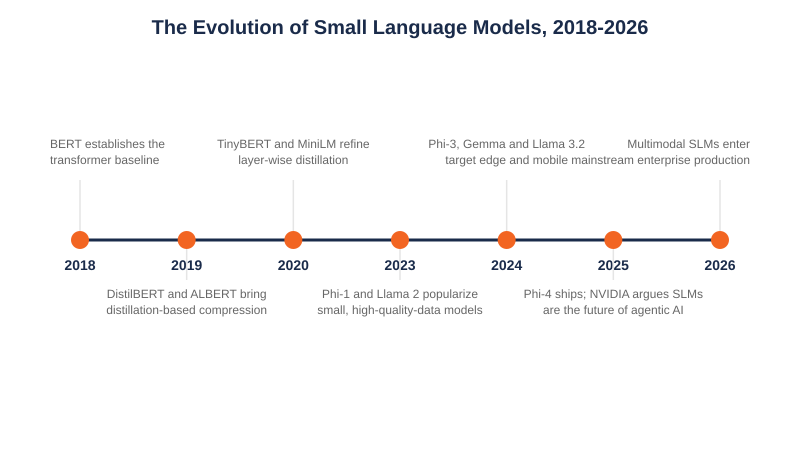
Figure 3. The evolution of small language models, 2018–2026.
3.3 2025–2026: Maturity and Specialization
The current period is defined less by individual breakthrough models and more by ecosystem maturity. Benchmarking has become far more rigorous, with dedicated small-model leaderboards tracking performance under 10 billion parameters across reasoning, coding, and multilingual tasks. Multimodal capability, once reserved for frontier models, is now standard in several SLM families: Gemma 3n and comparable models handle image and, increasingly, audio input at sub-10-billion-parameter scale [10]. Reasoning-specific variants, such as Phi-4-reasoning-plus, apply explicit chain-of-thought training to small models and post benchmark scores that rival distilled reasoning models several times their size [51].
Specialization has become the dominant theme. Rather than treating a single small model as a scaled-down generalist, organizations increasingly deploy several narrow SLMs, each fine-tuned for one function within a larger pipeline, a pattern examined in detail in Section 5's discussion of hybrid and multi-model architectures. This mirrors a broader shift in how the industry talks about model selection: less 'which model is smartest' and more 'which model is correctly matched to this specific job.'
3.4 Democratization of AI
A less-discussed but significant effect of the SLM era is the democratization of AI development itself. Training or meaningfully fine-tuning a frontier LLM remains the province of a small number of well-capitalized labs. Fine-tuning a small language model on a few hundred to a few thousand domain-specific examples is now realistic for a mid-sized engineering team on a single GPU, using well-documented open-source tooling [41]. This has lowered the barrier to building genuinely custom, proprietary AI capability for organizations that could never have justified training a frontier model from scratch.
The open-weight ecosystem has been central to this shift. Model families from Microsoft, Google, Meta, Alibaba, and Mistral are released under licenses that permit commercial fine-tuning and deployment, and a large community of derivative fine-tunes, quantized variants, and purpose-built adaptations has grown around them on platforms like Hugging Face [24]. For a custom software development company, this means the realistic build decision is rarely 'train a model from scratch,' it is 'select the right open-weight base model and fine-tune or adapt it for the client's specific domain,' a fundamentally more accessible and cost-effective engagement than frontier-model development ever was.
4. Techniques for Building and Enhancing SLMs
4.1 Training Strategies for Efficiency
Building an effective SLM starts well before compression, it starts with training strategy. The clearest lesson from the Phi research program is that data curation can substitute, to a meaningful degree, for raw parameter count: training on a smaller volume of high-quality, carefully filtered, textbook-like data produces stronger reasoning and coding performance per parameter than training on a much larger, noisier web-scraped corpus [8][20]. This 'quality over quantity' principle has become a standard part of SLM training pipelines across the industry, not just at Microsoft.
A second common strategy is starting from a strong base model and specializing in it, rather than training from scratch. Because pretraining a capable base model from zero requires resources few organizations have, most production SLM work today involves taking an open-weight base model, a Phi, Gemma, Llama, or Qwen checkpoint, and adapting it to a narrower task or domain through continued pretraining on domain text, followed by supervised fine-tuning on task-specific examples [30][41]. This two-stage approach, strong general base, then narrow specialization, consistently outperforms training a small model from scratch on a narrow dataset alone.
4.2 Compression Techniques
Three techniques, individually or in combination, form the technical backbone of AI model compression for SLM development: pruning, knowledge distillation, and quantization. Understanding how each works, and how they compose, is useful for any technical leader evaluating build-vs-buy decisions for a custom SLM.
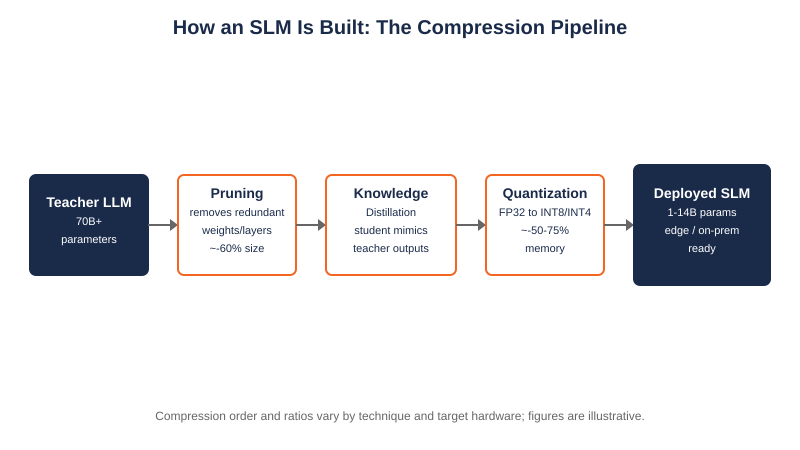
Figure 4. How an SLM is built: the compression pipeline from teacher model to deployed SLM.
Knowledge Distillation
Knowledge distillation trains a smaller 'student' model to reproduce the output behavior of a larger 'teacher' model, rather than training the student on raw labels alone. Because the teacher's output distribution carries a richer signal than a single correct answer, it reflects the teacher's relative confidence across many possible answers, a student trained this way often learns more efficiently than one trained from scratch on the same data volume [27][29]. DistilBERT's approach used a triple loss function combining the distillation objective with a standard language-modeling loss, achieving 97 percent of BERT's performance at 40 percent of the size [28]. TinyBERT extended this by distilling not just final outputs but intermediate transformer-layer representations and attention patterns, achieving even greater compression [29].
Pruning (Structured and Unstructured)
Pruning removes parameters, layers, or attention heads that contribute little to a model's output, on the theory that large models are substantially over-parameterized for most tasks. Unstructured pruning removes individual weights, producing a sparse network that can be hard to accelerate on standard hardware without specialized kernels. Structured pruning removes entire neurons, attention heads, or layers, producing a smaller dense network that runs efficiently on standard GPUs and CPUs without special support [15]. In mixture-of-experts architectures, a related technique, expert pruning, removes entire underused experts from the model, an approach that has become increasingly relevant as more SLM-adjacent models adopt sparse MoE designs [33][34].
Quantization
Quantization reduces the numerical precision used to store a model's weights, significantly improving AI inference efficiency on resource-constrained hardware, for example, converting 32-bit floating-point weights (FP32) to 8-bit or 4-bit integers (INT8, INT4), which shrinks memory footprint and speeds up inference with a comparatively small accuracy cost [27]. This is the technique most directly responsible for making SLMs runnable on consumer hardware: the GGUF quantization format, now the de facto standard for local model distribution on platforms like Hugging Face, supports quantization levels from 1.5-bit through 8-bit, letting a single model checkpoint be compressed to fit anything from a high-end workstation down to a modest laptop [19]. In practical terms, a model that would require 24 GB of memory at full precision can often run in roughly 6 GB after aggressive quantization, with a modest and usually acceptable accuracy trade-off [15].
4.3 Enhancement Methods
Beyond compressing an existing large model, SLMs are commonly enhanced after their base training through parameter-efficient fine-tuning. Low-Rank Adaptation (LoRA) and its quantized variant QLoRA have become the default methods: rather than updating all of a model's weights during fine-tuning, LoRA freezes the base model and trains a small number of additional low-rank matrices, dramatically reducing the memory and compute required to adapt a model to a new domain or task [41]. QLoRA extends this further by combining LoRA with 4-bit quantization of the frozen base model, making it possible to fine-tune a multi-billion-parameter model on a single consumer or prosumer GPU.
Retrieval-augmented generation (RAG) is a complementary enhancement, particularly relevant to SLMs because it offsets one of their core limitations, narrower world knowledge, without increasing model size. By retrieving relevant documents or records at inference time and providing them as context, a small model can answer questions about proprietary or rapidly changing information it was never trained on, closing much of the knowledge gap with much larger generalist models for domain-specific question answering [41].
4.4 Tools and Frameworks
The tooling ecosystem for building and deploying SLMs has matured substantially. For fine-tuning, Hugging Face's Transformers and PEFT (Parameter-Efficient Fine-Tuning) libraries remain the most widely used foundation, with PEFT providing production-ready LoRA and QLoRA implementations. For local inference, the landscape has diversified by use case: llama.cpp remains the reference C/C++ inference engine, running on essentially any hardware from Raspberry Pi to high-end workstations and supporting the GGUF quantization format that has become the standard distribution format on Hugging Face [19][24]. Ollama, built on top of llama.cpp, wraps this in a developer-friendly CLI and API layer that has become the default starting point for prototyping, it exceeded 172,000 GitHub stars in 2026 and tens of millions of monthly downloads [24].
For teams standardizing on Apple Silicon, Apple's MLX framework, purpose-built for the unified memory architecture of M-series chips, delivers meaningfully faster throughput than general-purpose runtimes on Mac hardware [25]. For production, multi-user serving at scale, vLLM has become the standard choice on NVIDIA and AMD GPU infrastructure, using PagedAttention and continuous batching to achieve roughly 16-20 times the concurrent throughput of a single-request tool like Ollama [23]. For edge and embedded deployment specifically, NVIDIA's TensorRT Edge-LLM SDK targets Jetson-class hardware, while PyTorch's ExecuTorch targets mobile and microcontroller deployment with a footprint as small as 50KB [26].
The practical guidance for a development team: prototype with Ollama, move to MLX if the target is Apple Silicon, and move to vLLM for production multi-tenant serving on GPU infrastructure, treating these as complementary tools for different stages of a project rather than competing choices [25][26].
4.5 Case Study: Building a Customer Service SLM
A representative pattern, drawn from patterns documented across multiple enterprise deployments, illustrates how these techniques combine in practice. A mid-sized company handling a high volume of routine customer service inquiries, order status, return policy questions, account changes, starts by selecting an open-weight base model in the 3-8 billion parameter range (a Phi-4-mini or Llama 3.2 8B, for example) rather than routing every inquiry through a frontier LLM API. The team assembles a fine-tuning dataset of a few thousand real historical support conversations, redacted for customer data, and applies QLoRA fine-tuning on a single GPU over the course of a few days [41].
The resulting model is quantized to INT8 or INT4 and deployed behind an internal API, often using vLLM for production serving. A lightweight classification step routes inquiries: the fine-tuned SLM handles the 80-90 percent of requests that match patterns seen in training, while genuinely novel or complex inquiries, a legal dispute, an unusual multi-order issue, are escalated to either a human agent or a general-purpose LLM [23]. Organizations following this pattern commonly report response times dropping from several seconds with a hosted LLM API to under 200 milliseconds locally, alongside meaningful reductions in per-conversation inference cost, since the bulk of volume now runs on owned infrastructure rather than metered API calls [17][18].
5. Applications and Use Cases
5.1 Edge AI and IoT Deployments
Edge deployment is where SLMs have the clearest, least-contested advantage over LLMs: a large model simply cannot run on a smartphone, a factory sensor, or an offline medical device, while a well-quantized SLM often can. Modern smartphone NPUs now deliver tens of trillions of operations per second, enabling on-device AI with multi-billion-parameter models running at interactive speed [24][25]. This has moved from a research demonstration to shipping consumer product: Apple Intelligence and Google's Gemini Nano both run core features locally on-device, and Microsoft's Copilot+ PC program requires a qualifying NPU specifically to support local SLM inference [66].
The practical benefits compound in edge contexts specifically. Latency drops because there is no network round trip. Reliability improves because the feature keeps working without connectivity, which matters for industrial equipment on a factory floor or medical devices in a rural clinic with unreliable internet. And privacy improves by default, because sensitive data, a photo, a voice recording, a health reading, never leaves the device [1][19]. A documented example: a European healthtech deployment used a compact model for offline medical query handling in rural clinics without reliable internet access, a use case that would simply be impossible with a cloud-only LLM.
5.2 Agentic AI Systems
The most influential recent argument for SLM adoption comes from agentic AI. In June 2025, NVIDIA Research published a position paper, 'Small Language Models are the Future of Agentic AI,' making a structural case rather than just a cost-based one. Their observation: an AI agent's work is overwhelmingly composed of narrow, repetitive subtasks, parsing a structured input, calling a specific tool, classifying an intent, formatting an output, and routing every one of these steps through a large, general-purpose model is both computationally wasteful and often no more accurate than a small model fine-tuned for that specific step [4].
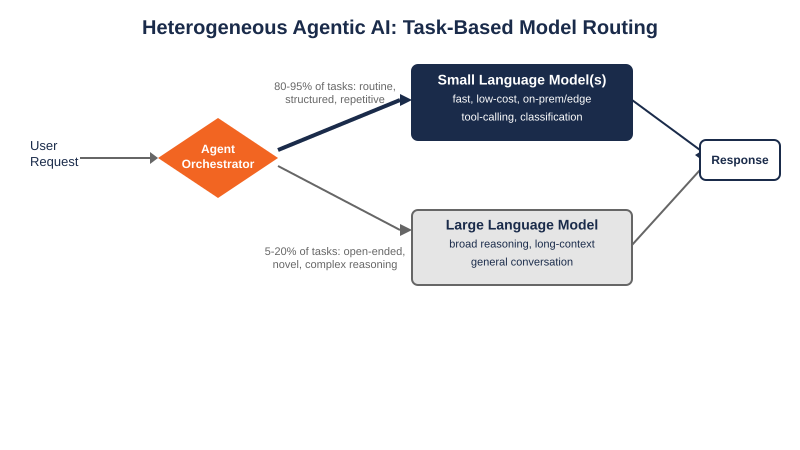
Figure 5. Heterogeneous agentic AI: task-based routing between small and large models.
This has given rise to heterogeneous agent architectures, in which an orchestration layer classifies each incoming task and routes it to the smallest model capable of handling it well, reserving large-model calls for the minority of tasks that genuinely require broad reasoning or novel judgment. In practice, this often means 80 to 95 percent of an agent's tool calls and subtasks run on one or more fine-tuned SLMs, with the remainder escalated to an LLM [4]. Beyond cost and speed, this pattern also improves reliability: a narrow, fine-tuned SLM is often more consistent and less prone to unexpected behavior on a task it was specifically trained for than a generalist model prompted to perform the same narrow task.
5.3 SLM–LLM Hybrid Architectures
Beyond agentic systems specifically, the hybrid pattern has become the default architecture for enterprise AI more broadly. Rather than treating SLM adoption as a wholesale replacement for LLM usage, most mature deployments implement a routing layer that directs each request based on complexity, latency requirement, cost sensitivity, and data classification.
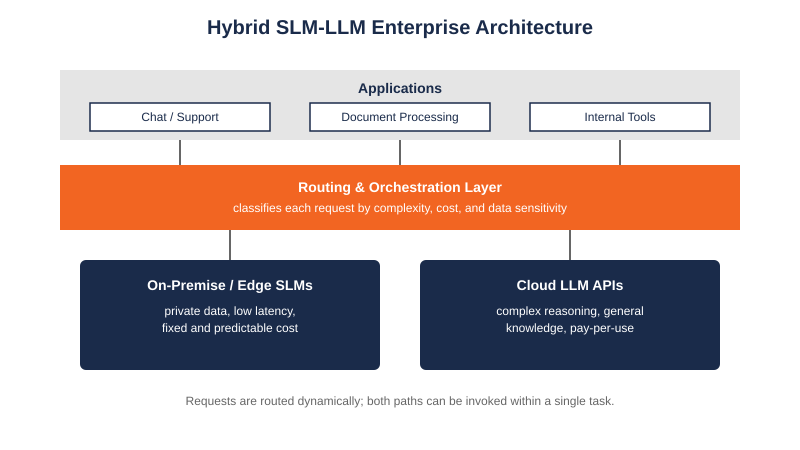
Figure 6. A representative hybrid SLM-LLM enterprise architecture.
In this architecture, applications sit at the top of the stack, a routing and orchestration layer classifies incoming requests, and two backing systems handle the actual inference: on-premise or edge SLMs for private, latency-sensitive, high-volume, or well-defined work, and cloud LLM APIs for complex reasoning, broad general knowledge, or genuinely novel requests [23]. Gartner's prediction that task-specific models will reach three times the usage volume of general-purpose LLMs by 2027 is best understood through this lens: it does not imply LLM usage declines, but that the overall volume of AI-handled tasks grows substantially, with the incremental volume increasingly served by small, purpose-built models rather than by routing everything through a generalist [3].
5.4 Custom Software Development Applications
For custom software development specifically, SLMs open up a set of features that were previously cost-prohibitive or latency-prohibitive to build on top of a hosted LLM API. Code completion and developer tooling is one clear example: IDE plugins for fill-in-the-middle code completion increasingly run small, specialized code models locally, since the latency requirement for interactive autocomplete, well under 100 milliseconds, is difficult to hit consistently with a network round trip to a hosted API [19].
Document processing pipelines, classification, extraction, redaction, routing, are another strong fit: these are high-volume, well-defined tasks where a fine-tuned SLM can match LLM accuracy at a fraction of the cost, and where processing sensitive documents on a client's own infrastructure is often a hard requirement rather than a preference. Embedded product features, such as an in-app writing assistant, a smart search function, or a classification step inside a larger workflow, similarly benefit from an SLM's ability to run without adding a network dependency or a large recurring API cost to a product's unit economics.
5.5 Industry-Specific Case Studies
Healthcare
Healthcare has emerged as one of the strongest-fit industries for SLM adoption, driven primarily by HIPAA and similar patient-data regulations that make sending records to third-party APIs legally fraught. On-premise SLMs can process clinical documentation, summarize patient notes, and support diagnostic coding entirely within a hospital's own infrastructure, without patient data ever leaving the building [14][18]. The rural-clinic offline medical query example cited in Section 5.1 illustrates a related, distinct value: in settings without reliable connectivity, an SLM may be the only form of AI assistance that works at all.
Financial Services
Financial institutions face a similar dynamic, layering data-residency and regulatory requirements on top of latency-sensitive use cases like fraud detection, where a decision often needs to be made in the time it takes a transaction to clear. Fine-tuned SLMs deployed on-premise or at the edge of a bank's own infrastructure can flag suspicious transaction patterns in real time without the latency and data-exposure risk of a round trip to an external API, while compliance-focused document review, parsing loan applications, regulatory filings, or KYC documentation, benefits from the same cost and privacy profile that makes SLMs attractive in healthcare [14].
Manufacturing and Retail
Manufacturing environments increasingly deploy SLMs directly on factory-floor edge hardware for quality inspection, predictive maintenance alerts, and equipment diagnostics, where connectivity to a central cloud may be unreliable and where the volume of routine sensor-driven inference makes per-token API pricing uneconomical at scale. Retail applications follow a similar edge-inference pattern for in-store systems, inventory queries, product lookup assistants, where many similar, structured queries recur constantly and a small, fast, locally hosted model outperforms a cloud round trip both on cost and on responsiveness [1].
5.6 Privacy-Preserving AI
Across every industry examined above, one theme recurs: the ability to keep data on-premise or on-device is frequently the deciding factor in SLM adoption, ahead of raw cost savings. This is not a minor technical detail, it is often the difference between a deployment being legally viable at all and not. As data privacy regulation continues to tighten globally, and as more organizations adopt formal AI governance frameworks (examined in Section 7), the ability to demonstrate that sensitive data never left a controlled environment is becoming a procurement requirement in its own right, not just a risk-mitigation nicety [14][18].
6. Challenges and Risks in SLM Adoption
6.1 Technical Limitations
The central technical limitation of SLMs is the reasoning and generalization gap relative to frontier LLMs. Small models, even well fine-tuned ones, tend to perform less reliably on tasks that require multi-step reasoning, handling genuinely novel situations outside their training distribution, or synthesizing broad world knowledge the way a much larger model can. This gap narrows every year but has not closed, and it is the single most important reason hybrid architectures, not SLM-only deployments, remain the dominant enterprise pattern.
A second limitation is context window size: many SLMs support shorter effective context windows than frontier models, which can constrain their usefulness for tasks involving very long documents or extended multi-turn conversations, though this gap has also been narrowing, with models like Phi-3.5 supporting context windows up to 128K tokens. A third is hallucination risk, which is not unique to SLMs but is not solved by smaller size either, a fine-tuned SLM can hallucinate confidently within its narrow domain just as an LLM can, which matters enormously in regulated contexts like healthcare and financial services.
6.2 Ethical and Trust Concerns
Deploying a fine-tuned SLM in a regulated or high-stakes context raises the same fairness, bias, and explainability questions that apply to any machine learning system, with one added wrinkle: because SLMs are frequently fine-tuned on an organization's own historical data, they can inherit and amplify biases present in that data more directly than a generalist frontier model trained on a broader, more heterogeneous corpus. A support-triage SLM trained on historical support tickets, for example, will reproduce whatever patterns, including problematic ones, existed in how those tickets were originally handled.
Trust and reliability in regulated contexts is a related concern: a hallucination or an incorrect classification from a customer-facing SLM handling insurance claims or loan applications carries the same real-world consequences as one from a larger model, and the fact that the model is smaller, cheaper, and faster does not reduce the need for rigorous evaluation before deployment.
6.3 Deployment and Integration Challenges
Beyond the model itself, deploying an SLM well requires MLOps capability that many organizations do not have in-house: managing quantized model artifacts across multiple formats (GGUF, safetensors, MLX), setting up inference servers, monitoring for model drift as production data diverges from training data, and building the routing and orchestration layer that hybrid architectures require. Model fragmentation is a related practical challenge, a team maintaining several narrow, purpose-built SLMs across a hybrid pipeline takes on more operational surface area than a team calling a single hosted LLM API, even though each individual SLM is simpler than the alternative.
Runtime selection itself has also become a genuine decision rather than a given: the 2026 local-inference landscape includes Ollama, llama.cpp, vLLM, MLX, TensorRT Edge-LLM, and ExecuTorch, each suited to different hardware and scale targets, and picking the wrong one for a given deployment context can leave significant performance on the table [26].
6.4 Systemic Risks
As agentic systems increasingly chain together multiple SLM calls with tool access, new systemic risks emerge that are less prominent in single-model deployments. Agents that inherit permissions and make tool calls at machine speed can compound a small error across a chain of actions before a human has a chance to intervene, a risk regulatory bodies have begun to study directly. NIST's 2026 request for information on agent security received 937 public comments, reflecting how quickly this has become a live governance concern, and existing frameworks such as ISO 27001, the NIST Cybersecurity Framework, and SOC 2 were not designed with autonomous, tool-calling agents in mind [24].
6.5 Mitigation Strategies
The organizations navigating these risks most successfully tend to apply a consistent set of practices. They evaluate a fine-tuned SLM against held-out, production-representative test data before deployment, not just against the training distribution. They maintain human-in-the-loop review for high-stakes decisions, particularly in healthcare and financial services, treating the SLM as a triage or first-pass tool rather than a fully autonomous decision-maker. They monitor production outputs continuously for drift, rather than treating evaluation as a one-time pre-launch gate. And they build explicit escalation paths, the same routing logic that sends complex tasks to an LLM should also flag low-confidence SLM outputs for human review, rather than allowing a confidently wrong answer to pass through unchecked. Section 7 develops these practices into a fuller governance framework.
7. Best Practices and Governance
7.1 Selecting the Right SLM
Choosing among the growing field of open-weight SLM families should start from the task, not the leaderboard. The most useful evaluation criteria, in practice, are: benchmark performance on tasks genuinely similar to the target use case (general leaderboard rank is a weak proxy); license terms, since not every open-weight model permits unrestricted commercial use; memory footprint at the target quantization level relative to available deployment hardware; multilingual coverage, if relevant, where Qwen's family currently leads; and the maturity of the surrounding fine-tuning and deployment tooling, since a slightly weaker base model with excellent tooling support is often the more productive choice for a team on a deadline [23][51].
As a general starting point: Microsoft's Phi-4 family suits reasoning- and math-heavy tasks; Google's Gemma 3 family suits multilingual and multimodal work, with Gemma 3n specifically for mobile; Meta's Llama 3.2 line suits edge and mobile deployment where its tooling ecosystem is especially mature; and Alibaba's Qwen family suits any use case with significant Asia-Pacific language coverage requirements [22][52]. In every case, running a short internal benchmark against representative production data before committing is worth more than any published leaderboard score.
7.2 Implementation Roadmap
A phased approach consistently outperforms a single large-bang deployment, both because it surfaces problems early and because it builds organizational confidence and internal expertise incrementally.
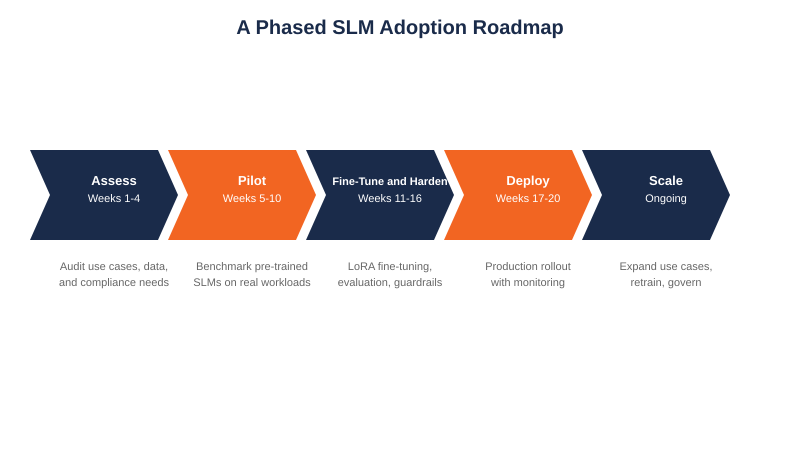
Figure 7. A phased SLM adoption roadmap.
The five phases shown above, Assess, Pilot, Fine-Tune and Harden, Deploy, and Scale, are elaborated in full as a standalone roadmap in Section 9. The core discipline that makes this work is treating each phase as a genuine gate rather than a formality: a pilot that shows a fine-tuned SLM does not meet accuracy requirements on real production data should lead to model reselection or scope adjustment, not a rushed deployment.
7.3 Governance and Compliance
SLM deployments should be governed under the same frameworks organizations are increasingly adopting for AI more broadly, rather than treated as a separate, lower-risk category simply because the model is smaller. The NIST AI Risk Management Framework, organized around four functions, Govern, Map, Measure, and Manage, provides a voluntary but increasingly influential structure for identifying and mitigating AI-specific risk, and its Generative AI Profile (NIST AI 600-1) extends this specifically to generative and agentic systems [22][23]. ISO/IEC 42001 offers a certifiable, audit-ready management-system standard that many enterprise buyers now expect as a trust signal, particularly for vendors handling regulated data [26][28].
For organizations with EU market exposure, the EU AI Act adds a binding legal layer on top of these voluntary frameworks, with risk-tiered obligations that are being phased in through 2027 [25]. The practical guidance emerging across governance literature is consistent: use NIST AI RMF as the internal operating model, ISO 42001 as the certifiable, customer-facing proof of governance maturity, and binding regulation such as the EU AI Act as the mandatory compliance layer for the specific markets an organization serves [27][29]. A fine-tuned SLM handling healthcare or financial data should be brought into this governance structure from the pilot phase onward, not retrofitted after production deployment.
7.4 Team Building and Skills Development
Successful SLM adoption requires a somewhat different skill mix than most organizations have built up around LLM API integration. Teams need working familiarity with parameter-efficient fine-tuning (LoRA/QLoRA), quantization trade-offs, and at least one local or self-hosted inference runtime, in addition to the prompt engineering and API integration skills that LLM-only development emphasizes [41][30]. For most organizations, the realistic path is not hiring an entirely new specialist team, but upskilling a subset of existing engineers and, where speed matters, partnering with a development firm that has already built this capability across multiple client engagements.
7.5 Essential Checklists
Pre-Deployment Checklist
- Task and data audit completed: candidate use cases identified, volume estimated, data sensitivity classified
- Base model selected and benchmarked against representative production data, not just public leaderboards
- Fine-tuning dataset assembled, reviewed for bias and sensitive data, and held-out test set separated
- Target deployment hardware and quantization level confirmed as sufficient for latency and memory requirements
- Escalation path defined for low-confidence outputs and out-of-scope requests
- Governance framework alignment reviewed (NIST AI RMF and/or ISO 42001, as applicable)
Post-Deployment Checklist
- Production monitoring in place for output quality, latency, and cost
- Drift detection process defined for when production data diverges from training distribution
- Human-in-the-loop review active for high-stakes or regulated decisions
- Retraining or re-fine-tuning cadence established
- Incident and audit logging in place, aligned to applicable compliance requirements
8. Future Outlook: 2026 and Beyond
8.1 Emerging Trends
Several trends visible in 2026 point toward where SLM development is headed next. Multimodality is moving down-market: models like Gemma 3n already bring image and audio understanding to sub-10-billion-parameter models, and this capability is likely to become a standard expectation rather than a differentiator within the next model generation [10][52]. Reasoning-specific small models, Phi-4-reasoning-plus and comparable variants that apply explicit chain-of-thought training at small scale, are narrowing the reasoning gap with frontier models faster than raw parameter scaling alone would predict [51].
On the runtime side, hardware-software co-design is accelerating: Apple's MLX framework saw M-series-specific speedups of up to 4x for time-to-first-token in the first half of 2026 alone, and AMD's Lemonade platform is bringing similar NPU-targeted efficiency to Windows laptops, suggesting the hardware substrate for on-device SLM inference will keep improving faster than the models themselves [21].
8.2 Research Frontiers
Mixture-of-experts architectures are increasingly blurring the line between SLMs and LLMs: a sparse MoE model may have a large total parameter count while activating only a small fraction of those parameters per token, giving it a deployment footprint closer to a dense SLM despite its larger nominal size [37][38]. Expect continued research into expert pruning and routing efficiency specifically aimed at bringing MoE-style capability into genuinely small, single-GPU-deployable footprints [33][34].
A second frontier is automated architecture search for efficient models, techniques like gradient-free proxy search for lightweight language model architectures aim to reduce the manual trial-and-error currently involved in designing a new compact model family [7]. A third is continued refinement of distillation itself: newer approaches distill not just final-layer outputs but attention patterns and intermediate representations across a full teacher-student pair, squeezing out compression ratios that would have been considered unrealistic even two years ago [29].
8.3 Market Predictions
The market signals reviewed throughout this whitepaper point in a consistent direction. Gartner's forecast of 3x task-volume dominance for small, task-specific models by 2027 remains the most cited industry benchmark for where enterprise usage is headed [3]. Market sizing projections from Grand View Research and Pragma Market Research both describe sustained double-digit compound annual growth through the early 2030s, driven by the combination of cost pressure, regulatory tightening, and edge-hardware proliferation examined throughout this paper [1][2].
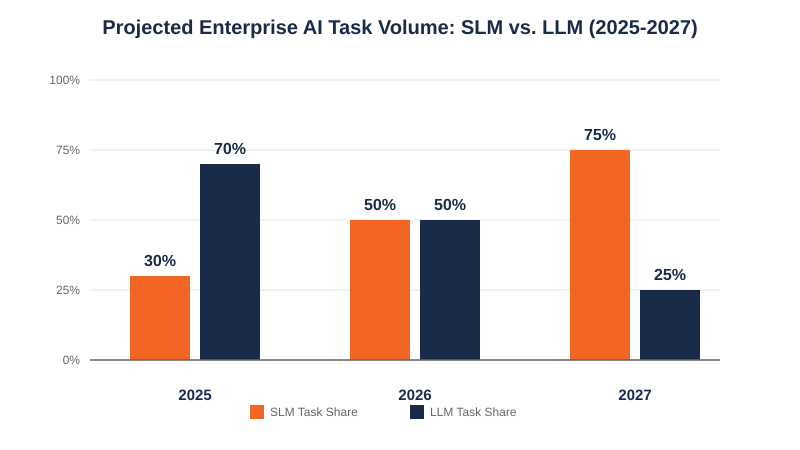
Figure 8. Projected enterprise AI task volume, SLM vs. LLM, 2025–2027 (illustrative, based on Gartner's usage-volume prediction).
8.4 Implications for Businesses
For technical leaders, the clearest implication is that AI infrastructure planning should assume a multi-model future rather than a single-vendor, single-model future. Budgeting, hiring, and architecture decisions made on the assumption that all AI workloads will route through one general-purpose API are likely to look increasingly conservative, and increasingly costly, over the next two to three years. Organizations that build hybrid-routing capability and SLM fine-tuning competency now are positioned to capture the cost, latency, and privacy advantages examined throughout this whitepaper as they compound, rather than retrofitting that capability under competitive pressure later.
9. Conclusion: Embracing the SLM Revolution
9.1 Key Takeaways
- SLMs are not a downgraded LLM, they are a distinct architectural tool, purpose-built for narrow, high-volume, latency- and privacy-sensitive tasks that make up the majority of real enterprise AI workloads.
- The technical foundation, pruning, knowledge distillation, and quantization, refined over more than five years of research since DistilBERT, is now mature, well-tooled, and accessible to teams without frontier-scale research budgets.
- The market is moving decisively in this direction: Gartner projects 3x the task volume for small, task-specific models over general-purpose LLMs by 2027, and the global SLM market is on a sustained double-digit growth trajectory.
- The winning enterprise architecture is hybrid, not exclusive: SLMs handle the routine majority of tasks, LLMs handle genuinely complex or novel reasoning, and a routing layer directs traffic between them based on complexity, cost, and data sensitivity.
- Governance cannot be an afterthought, SLM deployments handling regulated or sensitive data should be brought under the same NIST AI RMF and/or ISO 42001-aligned governance structure as any other production AI system, from the pilot phase onward.
9.2 Strategic Recommendations
For technical leaders evaluating where to start, three recommendations synthesize the analysis in this whitepaper. First, audit before building: identify the specific tasks in your organization's AI workload that are high-volume, well-defined, and repetitive, these are the tasks where an SLM will outperform a general-purpose LLM on cost, latency, and often accuracy, and they are usually more numerous than initial intuition suggests. Second, pilot narrowly before scaling broadly: a single well-chosen use case, benchmarked rigorously against production data, builds the organizational confidence and technical competency needed to expand SLM adoption credibly. Third, architect for hybrid from day one: even organizations planning an SLM-first strategy should build the routing and escalation logic that allows complex or novel requests to reach a larger model, rather than forcing every request through a small model regardless of fit.
9.3 Action Steps
- Convene a cross-functional review (engineering, compliance, and business stakeholders) to inventory current AI workloads and flag candidates for SLM migration.
- Select one well-defined, high-volume use case and run a time-boxed pilot comparing a fine-tuned SLM against current LLM-based or manual handling.
- Establish baseline governance documentation (risk classification, data handling, escalation paths) before the pilot reaches production traffic.
- Build or acquire the fine-tuning and local-inference competency needed to support the pilot, whether in-house or through an experienced development partner.
- Use pilot results to build the business case for a phased, multi-use-case rollout following the roadmap outlined in Section 7.
The organizations that treat this moment as an architectural shift, not merely a cost-cutting exercise, will be the ones best positioned as AI becomes further embedded into everyday software. The question is no longer whether small language models belong in a production AI deployment strategy; it is which tasks belong to them first.
About Citrusbug
Citrusbug is a technology services and product engineering company specializing in AI, mobile, and web application development. With a team of experienced engineers, designers, and strategists, Citrusbug partners with startups and enterprises across the United States, United Kingdom, and beyond to build scalable, intelligent digital products.
Our expertise spans generative AI integration, full-stack development, healthcare technology, IoT solutions, and enterprise automation. We combine deep technical knowledge with a pragmatic, business-first approach, helping clients move from concept to production with speed and confidence.
From AI-powered voice agents to remote patient monitoring platforms, Citrusbug delivers solutions that create measurable business impact. Our work is guided by a commitment to quality, transparency, and long-term partnership.
To learn more or discuss your next project, visit www.citrusbug.com or reach out to our team directly.
References
- [1] Grand View Research. "Small Language Model Market Size, Share & Trends Analysis Report."
- [2] Pragma Market Research. "Small Language Model Market Analysis and Forecast."
- [3] Gartner, Inc. "Gartner Predicts by 2027, Organizations Will Use Small, Task-Specific AI Models Three Times More Than General-Purpose Large Language Models." Press release.
- [4] NVIDIA Research. "Small Language Models are the Future of Agentic AI." Position paper, June 2025.
- [6] CogitX. "Small Language Models (SLMs): Comprehensive Guide 2026."
- [7] W-PCA: Gradient-Free Proxy for Efficient Search of Lightweight Language Models. https://arxiv.org/abs/2504.15983
- [8] Javaheripi, M., Bubeck, S., et al. "Phi-2: The Surprising Power of Small Language Models." Microsoft Research Blog.
- [10] Cluster-Driven Expert Pruning for Mixture-of-Experts Large Language Models. https://arxiv.org/abs/2504.07807
- [14] daily.dev. "Running LLMs Locally in 2026: Ollama, llama.cpp, and Self-Hosted AI for Developers."
- [15] Fast Vocabulary Transfer for Language Model Compression. https://arxiv.org/abs/2402.09977
- [16] W-PCA Based Gradient-Free Proxy for Efficient Search of Lightweight Language Models. https://arxiv.org/abs/2504.15983
- [17] XDA Developers. "Most People Use Ollama or llama.cpp for Local LLMs, but These Are the Tools I Switch to When It Gets Serious."
- [18] Codersera. "Ollama vs LM Studio vs vLLM vs llama.cpp vs MLX 2026."
- [19] GitHub. ggml-org/llama.cpp: LLM Inference in C/C++.
- [20] C-Sharp Corner. "DistilBERT, ALBERT, and Beyond: Comparing Top Small Language Models."
- [21] Codersera. "Local AI Runtime Update: What Shipped in Ollama, vLLM, llama.cpp, MLX, and LM Studio in May 2026."
- [22] NIST. "AI Risk Management Framework." nist.gov/itl/ai-risk-management-framework. https://www.nist.gov/itl/ai-risk-management-framework
- [23] GAICC. "NIST AI Risk Management Framework: A Complete Guide for US Organisations."
- [24] EdgeAIStack. "The Edge LLM Runtime Stack 2026: llama.cpp vs Ollama vs TensorRT Edge-LLM vs ExecuTorch vs vLLM vs MLX."
- [25] Contra Collective. "llama.cpp vs MLX vs Ollama vs vLLM: Local AI Inference for Apple Silicon in 2026."
- [26] AIIndigo. "The Local LLM Stack 2026: Ollama, MLX, and AMD Lemonade."
- [27] PMC. "On the Effectiveness of Compact Biomedical Transformers." PMC10027428.
- [28] Sanh, V., Debut, L., Chaumond, J., Wolf, T. "DistilBERT, a Distilled Version of BERT." https://arxiv.org/abs/1910.01108
- [29] Jiao, X. et al. "TinyBERT: Distilling BERT for Natural Language Understanding." https://arxiv.org/abs/1909.10351
- [30] Dasroot. "Running Local LLMs with Python: Ollama, llama.cpp, and Transformers."
- [33] Cluster-Driven Expert Pruning for Mixture-of-Experts Large Language Models. https://arxiv.org/abs/2504.07807
- [34] MoE-Inference-Bench: Performance Evaluation of Mixture of Expert Large Language and Vision Models. https://arxiv.org/abs/2508.17467
- [37] CogitX. "Small Language Models (SLMs): Comprehensive Guide 2026."
- [38] Mixture of Experts in Large Language Models. https://arxiv.org/abs/2507.11181
- [41] Hugging Face. PEFT (Parameter-Efficient Fine-Tuning) Documentation.
- [42] EY. "Agentic AI Adoption in the Enterprise, 2026."
- [44] Gartner, Inc. "Gartner Predicts by 2027, Organizations Will Use Small, Task-Specific AI Models Three Times More Than General-Purpose Large Language Models."
- [51] Microsoft. Phi-4 and Phi-4-mini Technical Reports.
- [52] Google. Gemma 3 and Gemma 3n Model Documentation.
- [66] Various. Apple Intelligence, Google Gemini Nano, and Microsoft Copilot+ PC Product Documentation.