
 Back
Back








Virtual care has moved from a temporary convenience into a permanent part of how people see doctors, manage chronic conditions, and get prescriptions filled. The telehealth software market sits at the center of that shift, powering the platforms that connect patients and providers without an in-person visit.
Hospitals, clinics, and independent practices are investing in these tools to cut wait times, reach patients in remote areas, and manage rising caseloads without expanding physical space. Software vendors have responded with platforms built for video visits, remote monitoring, and secure messaging.
The sections below break down current market size, adoption patterns, regional performance, market segments, and where this technology is headed through 2030.
What Is Telehealth Software?
Telehealth software is a digital platform that lets patients and healthcare providers connect remotely through video calls, messaging, and data sharing tools. It replaces or supplements in-person visits with virtual consultations and remote monitoring. The terms are often used interchangeably, but the telehealth vs telemedicine distinction matters for vendors deciding how broad a platform to build.
This technology matters because it gives patients in rural or underserved areas access to care they might otherwise skip, while helping providers manage more patients without adding physical clinic space or hiring additional staff.
Telehealth Software Market Overview
Current figures show a market moving in a clear upward direction, with valuations climbing steadily and providers investing heavily in software built specifically for virtual care delivery.
Global Market Valuation
- The global telehealth market reached USD 77.4 billion in 2025, reflecting sustained investment in virtual care platforms across hospitals and clinics as more health systems shift routine visits online.
- Market valuation is estimated at USD 175.48 billion in 2025, with the sector projected to expand at a 23.55% CAGR through 2030, a pace that points to sustained rather than short-term demand.
- By 2026, the broader market is projected to reach USD 244.30 billion, driven by continued digitization of routine and specialty care visits across both public and private health systems.
Software-Specific Market Value
- The telehealth software segment specifically was valued at USD 9.2 billion in 2025, covering the platforms, applications, and backend systems that power virtual consultations rather than the physical devices used alongside them.
- A separate 2024 estimate placed the wider telehealth market at USD 94.14 billion, underscoring how much of the broader industry’s value now runs through software rather than physical devices alone.
This growing weight of software within the overall market reflects a broader shift in how health systems approach virtual care.
Early telehealth programs often centered on hardware, such as monitoring devices and video conferencing equipment purchased as one-time capital expenses.
Today, ongoing software subscriptions and platform licensing represent a larger and steadily growing share of total spending across both large hospital networks and smaller independent practices.
What Is Driving This Growth
Provider shortages in rural and suburban regions are pushing health systems to extend their reach through virtual visits rather than opening new physical locations.
At the same time, insurers have expanded reimbursement for virtual visits, giving providers a stronger financial reason to invest in dedicated software rather than treating telehealth as a stopgap measure used only during unusual circumstances.
Chronic disease management is playing an equally significant role. As health systems look for ways to keep patients with conditions like diabetes and heart disease out of the hospital, telehealth software that pairs video visits with remote monitoring data has become a practical way to catch problems early without requiring a clinic visit for every single check-in.
Behavioral health has emerged as another strong growth driver within this market.
Demand for mental health services has consistently outpaced the supply of available providers in many regions, and telehealth software has made it possible for therapists and psychiatrists to serve patients across a much wider geographic area than a single physical office location ever could.
Telehealth Software Adoption and Usage Statistics
Adoption data shows telehealth software moving well past early pilot programs and into routine clinical use across hospitals, specialty care, and chronic disease management.
The numbers below reflect actual usage rather than projected demand, giving a clearer picture of how deeply these tools have already been integrated into daily care delivery.
Provider and Consultation Volume
- More than 1.5 billion virtual consultations are now conducted annually worldwide, spanning primary care, mental health, and specialty follow-ups.
- Telehealth adoption has exceeded 75% of hospitals in developed countries, showing the technology has moved from optional to standard infrastructure in major health systems.
This level of consultation volume means telehealth platforms are no longer handling occasional overflow appointments.
Many hospitals now route a meaningful share of their day-to-day scheduling through virtual visits by default, reserving in-person slots for cases that genuinely require a physical exam or hands-on procedure.
Patient-Side Usage Patterns
- In the United States, smartphone penetration reached 96%, representing roughly 310 million active users, giving telehealth platforms a broad built-in user base to reach.
- Nearly one in four Medicare beneficiaries with disabilities used telehealth services, highlighting how virtual care is closing access gaps for patients who face mobility or transportation barriers.
- Close to 50 million people in the United States now use remote patient monitoring devices, extending software-driven care management beyond the video visit itself.
Taken together, these figures show that telehealth software delivers the greatest value to patients who benefit from easier access to care.
This includes older adults, individuals with disabilities, and patients managing chronic conditions that require frequent monitoring and regular follow-up appointments.
Provider-side workflows are adapting alongside this patient demand. Scheduling systems, patient intake processes, and billing workflows that were once designed exclusively for in-person appointments are increasingly being rebuilt around a hybrid model of virtual and physical care.
As a result, many healthcare organizations now view telehealth software as core infrastructure rather than an optional extension of their existing electronic health record systems and technology stack.
Regional Telehealth Software Market Share and Growth Insights
Regional performance data currently points most clearly to North America, where the combination of insurance reimbursement and provider infrastructure has pushed adoption ahead of other markets, while China stands out as the fastest-growing single country in the software segment specifically.
North America
North America accounted for 54% of global market share in 2025, making it the largest single region for telehealth software deployment.
This lead reflects a combination of established provider networks and mature reimbursement policies for virtual visits.
United States
Within North America, the United States market alone was valued at USD 74.80 billion in 2025, representing the bulk of the region’s overall telehealth activity.
Strong provider adoption and consistent insurance coverage continue to anchor this figure.
China
China’s telehealth software segment is expanding at 16.3% annually, among the fastest growth rates recorded for any single country.
This pace is tied to government-backed digital health initiatives aimed at extending specialist access to lower-tier cities and rural provinces where specialist physicians have historically been in short supply.
Large domestic technology companies have also moved quickly into this space, building platforms tailored specifically to local insurance and hospital referral systems rather than adapting Western-designed software.
This regional concentration is likely to shift over time as reimbursement policies and broadband infrastructure mature in other parts of the world, but for now, North America remains the largest proving ground for telehealth software at scale, while China represents the clearest example of a fast-follower market closing the gap through targeted government investment.
Telehealth Software Market Segmentation
Telehealth software adoption looks different depending on how the platform is built, delivered, and used, with clear differences emerging across components, deployment models, and service types.
Understanding these distinctions matters for any organization deciding where to focus investment, since a hospital network’s priorities often look very different from those of a small specialty practice operating on a tighter budget.
Software and Platform Tools
The software component of the market is its fastest-growing segment, expanding at a 12.2% CAGR as providers move away from bundled hardware-software packages toward standalone platforms.
In the United States specifically, this segment was valued at USD 10.5 billion, reflecting strong domestic demand for dedicated virtual care applications.
Why Standalone Platforms Are Gaining Ground
Providers increasingly prefer software that can integrate with whatever monitoring devices or electronic health record systems they already use, rather than being locked into one vendor’s full hardware and software bundle.
This flexibility lets health systems upgrade their software without replacing physical equipment that may still have years of useful life left, which keeps overall technology budgets more predictable year over year.
Cloud-Based Delivery
Cloud-based delivery has become the default choice for most new telehealth deployments, holding roughly 70% of total delivery share.
Providers favor this model because it avoids the upfront infrastructure costs tied to on-premises systems while still meeting most compliance and data security requirements.
Why Providers Are Moving to the Cloud
Smaller practices in particular benefit from cloud delivery, since it removes the need for dedicated IT staff to maintain servers on-site.
Larger health systems are following the same path, often citing faster deployment timelines and simpler updates as reasons to migrate legacy on-premises telehealth tools to cloud infrastructure, especially when they operate across multiple locations that need consistent access to the same platform.
Consultation and Support Services
Services built around the software, including implementation, training, and ongoing technical support, generated USD 47.9 billion in revenue in 2024.
These services now account for 40% of total market share, reflecting how much value sits in helping providers actually deploy and maintain these platforms rather than in the software licenses alone.
The Growing Role of Implementation Support
Many health systems underestimate the work involved in rolling out a new telehealth platform across multiple departments, which has created steady demand for vendors that offer hands-on onboarding, staff training, and ongoing technical support rather than software alone.
This is especially true for larger hospital networks, where a single rollout may involve coordinating dozens of departments with very different workflows and technical comfort levels.
Key Trends Shaping the Telehealth Software Market
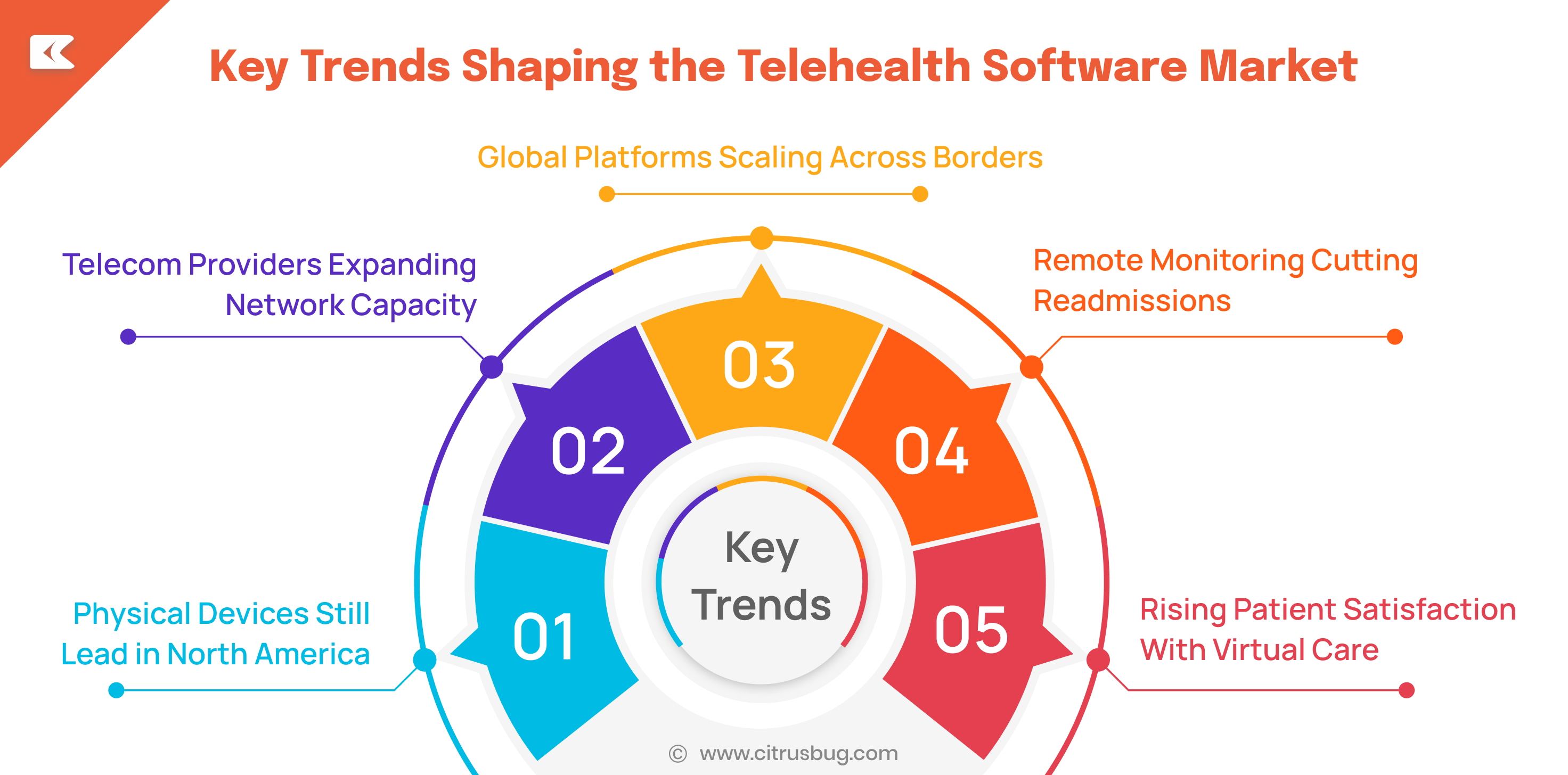
Several distinct patterns are shaping how telehealth software evolves, from device usage to the specific ways providers are putting these platforms to work in daily clinical practice.
Physical Devices Still Lead in North America
Even as software adoption accelerates, physical devices and products led the North America telemedicine market with a 55.6% share, showing that hardware and software continue to grow together rather than one fully replacing the other.
Connected devices like blood pressure cuffs and glucose monitors still generate meaningful revenue alongside the platforms that collect and display their data, and most vendors now design their software specifically to work with a wide range of third-party devices rather than a single proprietary hardware line.
Telecom Providers Expanding Network Capacity
Telecom infrastructure providers are responding directly to demand growth, with one major carrier increasing telehealth network installations by 29% to support the bandwidth virtual care platforms require.
This kind of infrastructure investment matters because video-based consultations depend on stable, high-bandwidth connections that many existing networks were not originally built to handle at scale, particularly in areas where multiple household members may be streaming or working remotely at the same time.
Global Platforms Scaling Across Borders
Established virtual-health systems are proving the model works well beyond a single country, with one platform facilitating over 63 million remote consultations across more than 60 countries.
That kind of cross-border scale shows telehealth software can adapt to different healthcare systems, languages, and regulatory environments without losing core functionality, which matters increasingly as vendors look to grow beyond their home markets and compete for contracts with multinational health insurers.
Remote Monitoring Cutting Readmissions
Remote patient monitoring tied into telehealth platforms is reducing hospital readmissions by up to 25%, giving hospitals a direct financial incentive to expand these programs beyond pilot status.
Fewer readmissions translate directly into lower costs for health systems operating under value-based care contracts, making this one of the clearer financial arguments for continued investment in connected monitoring tools rather than a purely patient-experience upgrade.
Rising Patient Satisfaction With Virtual Care
Patient satisfaction with virtual care platforms has reached 82%, a figure that continues to support provider confidence in expanding virtual services rather than treating them as a secondary option.
High satisfaction scores also make it easier for health systems to justify continued software investment to administrators focused on patient experience metrics, especially when those scores hold steady across different age groups and specialties.
What’s Limiting Telehealth Software Market Growth?
Despite strong momentum, telehealth software adoption still runs into practical obstacles that providers and vendors continue to work through.
- Connectivity gaps remain a real barrier, with 14.5 million rural Americans still lacking adequate internet infrastructure to reliably support video-based visits, which can leave the patients who might benefit most from remote care unable to access it consistently.
- Regulatory complexity continues to slow rollout in some regions, with 28% of providers reporting difficulty keeping pace with compliance requirements across different jurisdictions, particularly when serving patients who live across state or provincial lines.
- More vendors are responding by treating HIPAA-ready development as a starting point for new telehealth products rather than a compliance step bolted on after launch.
These barriers are being addressed rather than ignored, with vendors building stronger encryption into their platforms and providers pushing for clearer, more consistent telehealth regulations across state and national lines.
None of these challenges appear severe enough to reverse the market’s overall growth trajectory, but they do help explain why rollout speed still varies so much between well-resourced urban health systems and smaller, budget-constrained rural providers working with older network infrastructure.
Future Outlook for the Telehealth Software Market
Forecasts through the early 2030s point to continued expansion, with growth spread across several independent projections rather than concentrated in any single scenario.
Each estimate below comes from a distinct analysis, so the dollar figures naturally differ, but the underlying direction of sustained, multi-year growth stays consistent across all of them.
- The market is projected to reach USD 791.04 billion by 2032, growing at a 22.9% CAGR from 2025 as virtual care becomes further embedded in standard treatment pathways rather than reserved for occasional use.
- A separate projection places the market at USD 180.86 billion by 2030, reflecting continued expansion in both software licensing and connected service revenue as more providers move beyond single-department pilots.
- Longer-range estimates put the market at USD 505.07 billion by 2030, driven by expanding remote monitoring integration and specialty care expansion into areas like behavioral health and post-surgical follow-up.
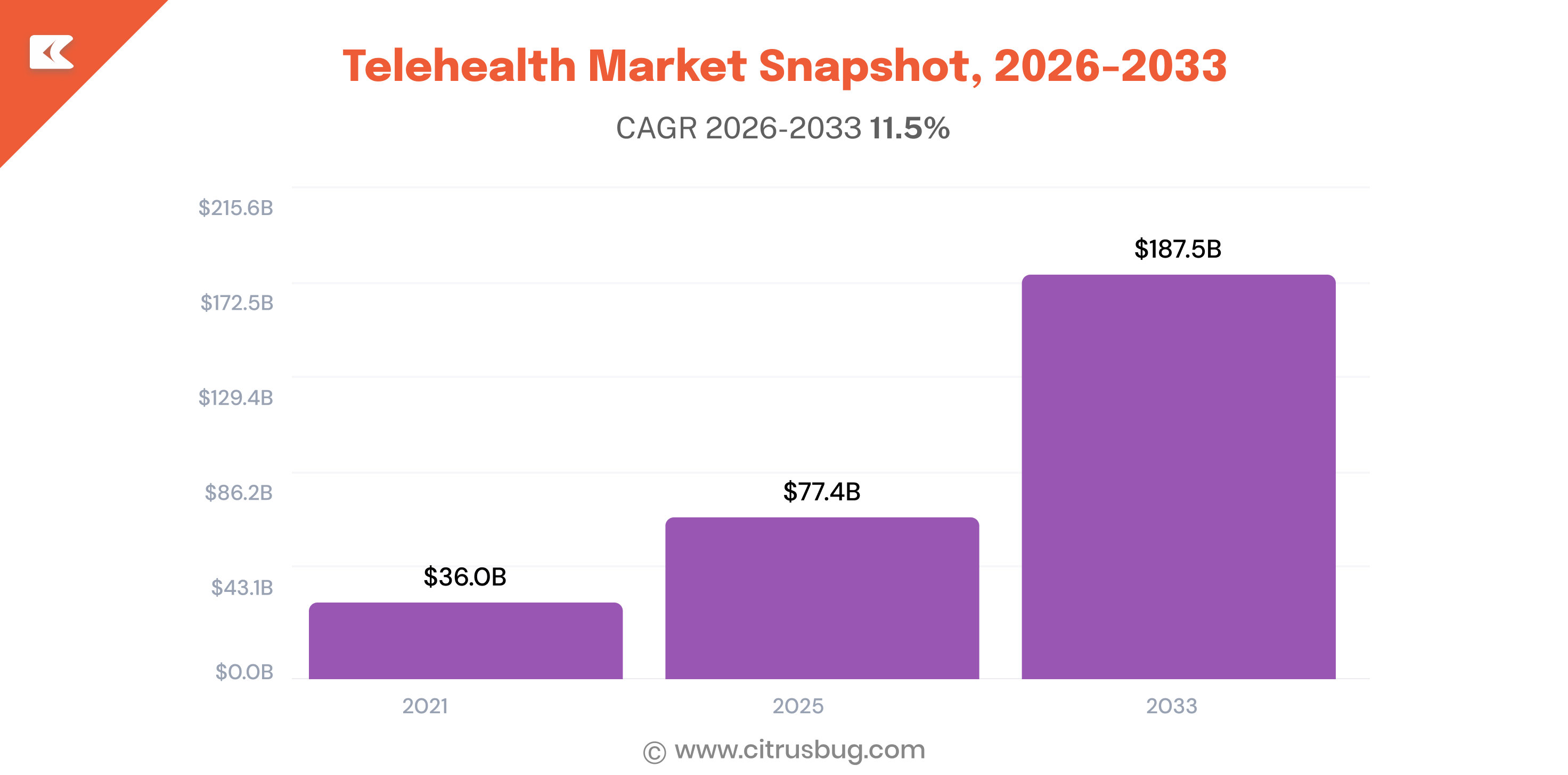
- One forecast projects the market reaching USD 1,126.03 billion by 2031, growing at a 33.09% CAGR from 2024 as adoption spreads well beyond early-adopter health systems into smaller regional providers.
- Another outlook places the market at USD 710.58 billion by 2032, pointing to sustained double-digit growth extending through the next decade as insurance coverage for virtual visits continues to broaden.
Across every one of these projections, the direction is the same even where the exact figures differ: telehealth software is expected to keep growing well past its current scale, supported by expanding remote monitoring use, broader insurance coverage, and continued provider investment in virtual-first care models.
Health systems that build flexible, scalable software foundations now are better positioned to absorb whichever growth trajectory actually plays out across their specific patient population, service lines, and regional regulatory environment.
Conclusion
The telehealth software market has moved firmly past its early, pandemic-driven phase into a period of steady, measurable growth across hospitals, clinics, and specialty providers.
Rising consultation volumes, expanding remote monitoring use, and strong patient satisfaction all point to virtual care becoming a permanent fixture of how healthcare gets delivered.
As providers work through remaining barriers like connectivity gaps and regulatory complexity, the telehealth software market is well positioned to keep expanding through 2030 and beyond, rewarding organizations that invest in reliable, secure virtual care platforms now. For health systems and vendors deciding what to build next, telehealth platform development remains the clearest lever for turning this growth into a system patients and providers actually use every day.