
 Back
Back







Key Takeaways
- AI in commercial real estate underwriting saves the most time on extraction and reconciliation, not on judgment calls.
- Screening and underwriting are different jobs with different accuracy bars; treating them as one causes process failures.
- High AI adoption has not produced matching time savings, because checking uncited AI output eats up the time it saves.
- Integration that writes directly into a firm's own model template saves more time than exporting files ever will.
- Structuring deal data before adding AI tools determines whether the investment pays off or has to be done twice.
Introduction
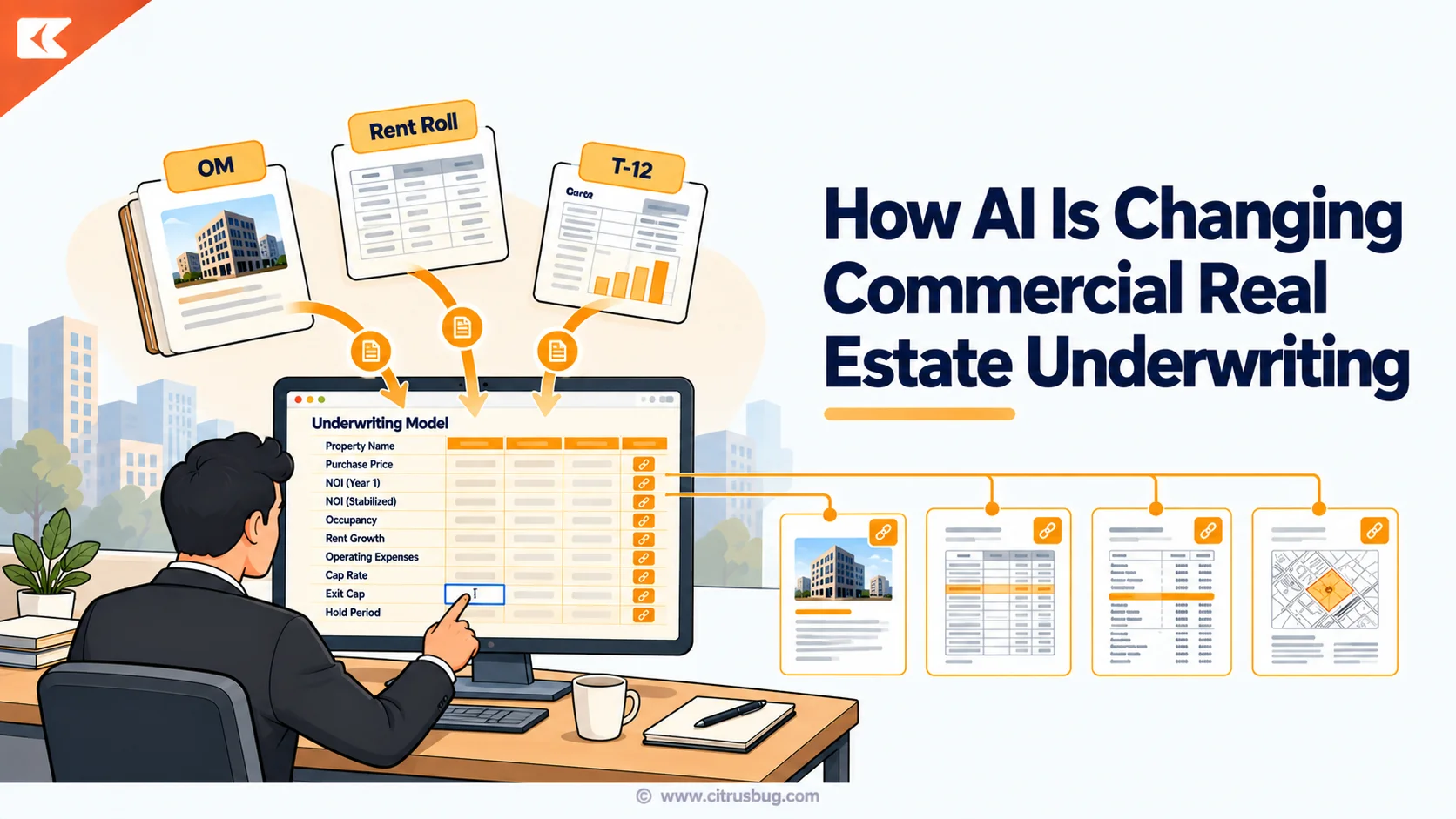
An analyst on a first-pass underwrite spends most of the day retyping numbers, not testing them: pulling a rent roll from a scanned PDF, reconciling it against a T-12 in a different chart of accounts, then rebuilding the model from scratch. Refinancing pressure is making that bottleneck worse.
The Mortgage Bankers Association counts $875 billion of commercial mortgages maturing in 2026, and every one needs to clear underwriting before a lender signs off. AI in commercial real estate underwriting is the use of large language models, document extraction, and machine learning to read deal documents, populate financial models, flag risk, and draft memos, while the underwriter still owns the assumptions and the final call.
This guide walks the workflow stage by stage, shows where AI earns its keep, and lays out how to choose between buying, pairing, or building.
What AI in Commercial Real Estate Underwriting Actually Means
Before looking at features, it helps to pin down what the term actually covers: AI in commercial real estate underwriting means using large language models and machine learning to extract data from deal documents, reconcile it across sources, populate a financial model, flag risk, and draft a first version of the credit or investment memo.
It does not mean the software decides whether to buy, lend, or pass. The underwriter still sets the exit assumptions, structures the deal, and makes the call.
Many guides on this topic treat screening, underwriting, and due diligence as the same job with different names. They are not. Screening is an attention problem: does this deal, out of the hundred that hit the inbox this week, deserve an underwriting model at all?
Underwriting is an accuracy problem: once a deal has a model, is the model right? Confusing the two is why some firms apply institutional-grade scrutiny to deals that should have been screened out in ninety seconds, and light-touch scrutiny to the one deal that actually needed the full workup.
Deal Screening vs. Underwriting vs. Due Diligence: Three Different Jobs
Three tasks often get grouped together under AI in commercial real estate underwriting, and treating them as one job is where most process design goes wrong.
- Screening scores inbound deals against a buy box and decides which ones get a model. It tolerates a lower accuracy bar because the cost of a false pass is a wasted look, not a bad investment.
- Underwriting builds and stress-tests the financial model on a deal that passed screening. Every number needs to be right, because the model drives the offer.
- Due diligence verifies the underwriting assumptions against the data room once a deal is under contract: leases against the rent roll, the PCA against the budget, the title report against the borrower’s ownership structure.
Each stage needs a different tool, a different review standard, and a different level of human sign-off. Building one AI workflow to do all three usually means over-engineering the easy stage and under-engineering the hard one.
Where Analyst Time Actually Goes in a Manual CRE Underwriting
AI in commercial real estate underwriting is usually sold on time savings. Ask any acquisitions team where the week actually goes on a manual underwrite, and the honest answer is rarely building the model. It is getting the deal package into a state where the model can be trusted, the same job real estate document management software is built to handle.
On a typical first-pass underwrite, the work breaks down roughly like this:
| Stage | What Happens | Where AI Helps Most |
|---|---|---|
| Screening | Inbound deal is scored against the buy box | Attention: flags fit, doesn’t decide |
| Document intake | OM, rent roll, T-12, leases are gathered | Sorting and routing documents |
| Extraction and reconciliation | Numbers are pulled and cross-checked | Highest-leverage automation target |
| Model population | Figures are entered into the underwriting model | Populating fixed cells and templates |
| Scenario and stress testing | Rate, vacancy, and exit assumptions are tested | Running more scenarios, faster |
| Risk review | Lease clauses, credit, rollover are checked | Reading everything, not skimming |
| IC memo and sign-off | Findings are written up for the decision-maker | First-draft summarization, not the decision |
Document intake, extraction, and reconciliation take up most of an analyst’s time, yet they are where the analyst adds the least judgment. The work that actually requires judgment (the exit cap, the capital stack, whether a lease clause is a dealbreaker) sits at the end of the process, after most of the hours have already gone to retyping.
This is the argument for AI in commercial real estate underwriting that actually holds up: not that software makes better judgment calls, but that it returns the hours currently lost to intake and reconciliation to the stages where judgment matters.
How AI Is Used in CRE Underwriting, Stage by Stage
The workflow above breaks into four stages of AI in commercial real estate underwriting that are actually earning their place today, each with a different job and a different bar for trust.
Deal Intake and Screening Against the Buy Box
AI-driven deal screening reads incoming OMs and broker emails, extracts basics like property type and price, and scores the deal against a firm’s written buy box. Dealpath (with AI Deal Screening) and Altrio (with Altrio Pro) both launched dedicated screening products in 2026, treating screening as a distinct job from underwriting rather than a feature bolted onto a pipeline tool.
The output is a ranked queue, not a decision. A deal that scores well still needs a human to open the file.
Document Extraction: OMs, Rent Rolls, T-12s, and Leases
This is where intelligent document automation tools do the heaviest lifting, reading a scanned rent roll, a T-12 in an unfamiliar chart of accounts, and a stack of lease amendments, and turning them into structured data the model can use. NAIOP, reporting on Dealpath’s 2026 survey, found that document analysis is the single most common AI use case in CRE, with 67% of firms already using AI for it.
That popularity is not surprising: extraction is repetitive, high-volume, and has a clear right answer, which makes it the easiest place to prove AI earns its keep before extending it to judgment-heavier work.
Model Population, Scenarios, and Stress Tests
Once numbers are extracted and reconciled, AI can populate the firm’s own Excel or ARGUS template, run base, upside, and downside scenarios, and stress-test debt service coverage against rate moves. The value here is speed on the mechanical part, not a better model. The assumptions, exit cap, rent growth, cap ex reserve still come from the underwriter.
Due Diligence and the IC Memo
The same approach extends into due diligence, where tools ingest the full data room and cross-check underwriting assumptions against what actually shows up: does every rent roll line have a matching lease, does the PCA flag anything the budget missed? The same extraction and reconciliation capability reused here runs against a larger, less forgiving document set.
AI can also draft the first version of the IC or credit memo from the verified model output, though the final narrative and recommendation stay with the underwriter.
What AI Automates and What Still Needs Human Judgment
A simple test shows where the automation line sits for AI in commercial real estate underwriting. Ask one question about any task: if the output is wrong, does the underwriter notice before it reaches a decision? Tasks checked against a source document are safe to automate. Tasks that are judgment calls with no external source to check against are not.
AI reliably automates:
- Document extraction and field-level data capture
- Cross-document reconciliation and conflict flagging
- Model population against a fixed template
- Scenario and sensitivity generation
- Lease-clause flagging for defined risk categories
- First-draft memo writing from verified inputs
AI does not replace:
- Setting the exit cap and hold-period assumptions
- Structuring the capital stack
- Judging whether a lease clause is a genuine dealbreaker or a manageable risk
- Weighing sponsor track record and reputation
- Making the final pass or pursue call
Firms drawing this line for themselves typically pair extraction tools with decision intelligence and forecasting software, which keeps the scenario math easy to trace and audit. Deloitte’s 2026 Commercial Real Estate Outlook found that 27% of CRE firms are experiencing real implementation challenges with AI, including technical issues, lack of expertise, and resistance to change, while another 19% describe themselves as still early in the AI journey.
In underwriting, most of that friction traces back to this same line being drawn in the wrong place: firms automating judgment calls that need a person, or leaving mechanical extraction work in human hands because nobody mapped where the boundary actually sits.
AI-Powered Risk Assessment in Commercial Real Estate
Risk assessment is where AI in commercial real estate underwriting earns its document-reading advantage fastest, because risk is mostly buried in places nobody has time to read closely under a deadline.
AI improves risk assessment in three specific ways:
- It reads every clause. Termination rights in a fourth amendment, co-tenancy triggers, and exclusive-use clauses often get skimmed or missed when an analyst works against a bid deadline.
- It catches inconsistency across documents. A unit’s rent in the rent roll that does not match the executed lease is exactly the kind of discrepancy that AI-based reconciliation surfaces automatically instead of by chance. Many systems use retrieval-augmented generation (RAG) to retrieve the relevant information directly from deal documents.
- It makes stress testing cheap enough to actually run. Instead of one base-case scenario, a rate-and-vacancy stress test across a range of assumptions becomes a default step rather than an extra one.
On the debt side, this matters more than usual right now. MBA forecasts total commercial mortgage originations of $805.5 billion in 2026, up sharply from the prior year. That volume makes consistent underwriting against credit policy critical, rather than leaving quality to vary by analyst.
Machine learning helps lenders apply the same policy checks and flag the same exceptions across every deal in the pipeline, which is a consistency gain more than an intelligence gain. It flags; the credit officer still decides.
Why AI Adoption Is High but Impact Still Lags
The adoption statistics on AI in commercial real estate underwriting look almost uniform. Dealpath’s 2026 State of AI in CRE Investing, a vendor survey of more than 100 institutional investment and technology professionals, found that 97% of respondents have AI integrated into their investment process. JLL’s 2025 Global Real Estate Technology Survey, which surveyed more than 1,500 decision-makers, found that 88% of investors, owners, and landlords had started piloting AI, while 92% of occupiers were doing the same.
Adoption Is Not the Same as Impact
What most people assume, seeing numbers like that, is that adoption this high means the payoff has already arrived. The details of these same surveys show something more complicated.
Only 5% of firms in JLL’s survey report having achieved all their AI program goals. In Dealpath’s survey, only 51% of respondents say AI actually saves them time once someone accounts for checking the output, while 41% say AI-assisted work takes longer than doing it manually.
The Verification Tax
Call this the verification tax. If an AI tool’s output lands in a chat window with no citation back to the source document, somebody has to re-read the original to confirm the number is right. That can erase the time the tool was supposed to save.
Fragmented deal data makes it worse. In the same Dealpath survey, 43% of respondents named fragmented data as the top reason AI falls short, ahead of hallucinated output or limitations of the underlying model.
The Problem Is Usually the Data Layer
The point where this consistently breaks in the field is not the model. It is the firm’s own deal data. Teams that bolt an AI layer onto data still scattered across inboxes, shared drives, and personal spreadsheets can get inconsistent answers and then blame the tool.
The fix is design, not simply a better model: output that lands inside the firm’s own template, per-field citations back to the source page, conflict detection when the OM and rent roll disagree, and a central deal record that AI can retrieve from instead of reconstructing information from scratch.
Firms exploring agentic workflows, where a system chains these steps together automatically, need those citations and conflict checks in place before AI agent development can deliver meaningful value.
Getting those fundamentals right first mirrors how digital transformation in real estate has generally progressed: establish the underlying data and workflows before automating them. That verification work is a major reason AI in commercial real estate underwriting has not yet delivered all the time savings its adoption numbers might suggest.
AI Tools and CRE Underwriting Software, Grouped by Job
When comparing AI tools for commercial real estate underwriting, it helps to remember that screening, extraction, modeling, and lender credit work are different jobs, each with tools built for it. The market reflects that split: Mordor Intelligence sizes the real estate investment software market at roughly $5.6 billion in 2025, growing to about $9.8 billion by 2030, a pace consistent with a category still specializing rather than consolidating.
Grouped by the job they actually do:
| Job | Example Platforms | What They’re Built For |
|---|---|---|
| Deal screening and pipeline | Dealpath, Altrio | Scoring inbound deals against a buy box |
| Document extraction, first-pass underwrite | Kolena, Cactus, Archer, Primer | Turning OMs and rent rolls into structured data |
| Lender-side credit and spreading | Blooma, LenderBox | Credit policy checks, spreading, memos |
| Modeling and scenario work | ARGUS Enterprise, Excel | Where the numbers actually get analyzed |
| Drafting, summarizing, general use | General-purpose LLMs (ChatGPT, Claude) | Cheap for memo drafting, wrong tool for batch extraction |
None of these tools is a universal answer. Firms increasingly need to choose technology based on how it fits their investment management software development strategy rather than evaluating point solutions in isolation.
Can AI Underwriting Software Integrate With Your Existing CRE Systems
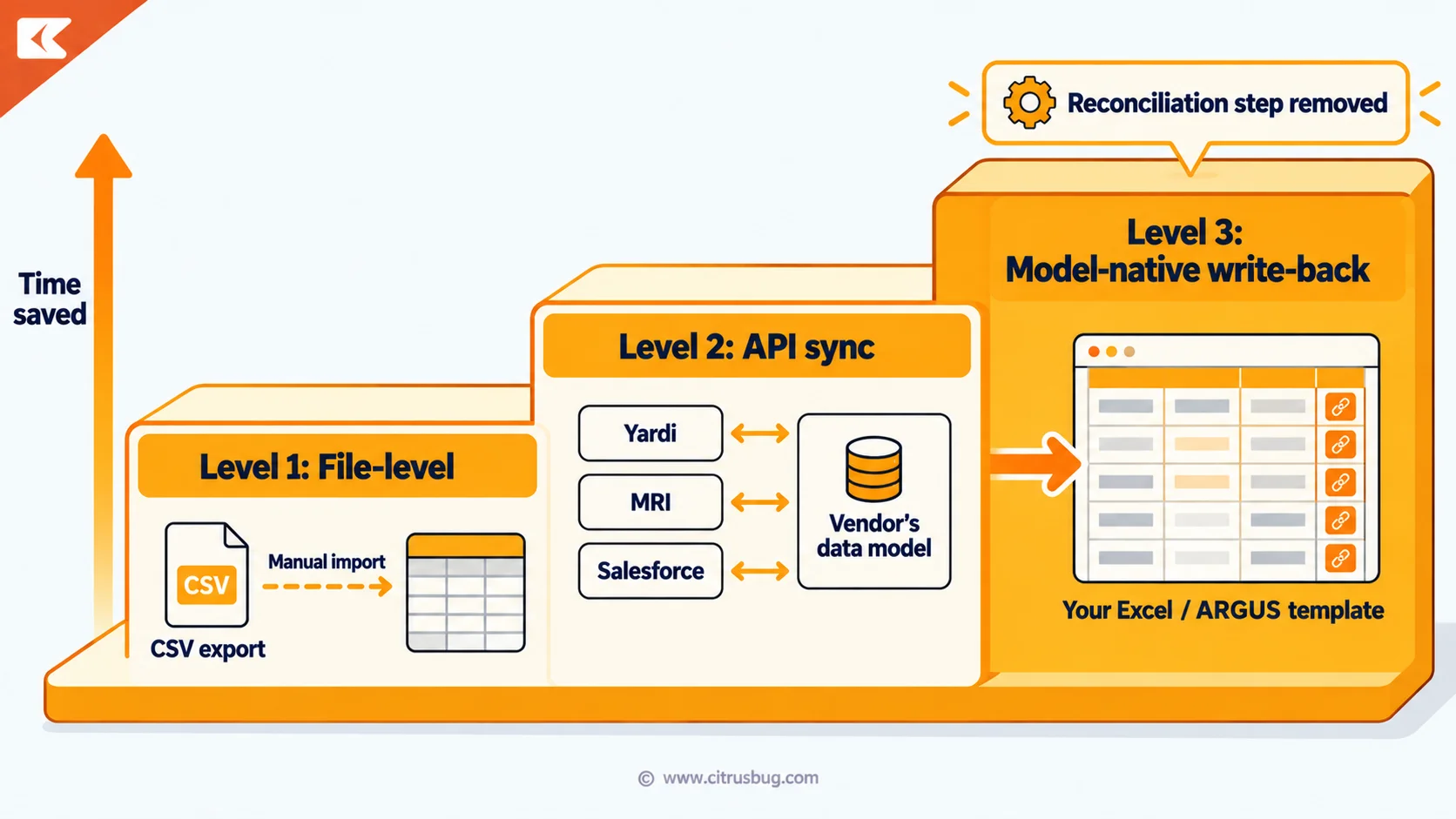
Most underwriting platforms list Yardi, MRI, ARGUS, Excel, and Salesforce as integrations. What matters is how deep each real estate software integration actually goes, because the depth determines whether the tool saves time or creates a new silo.
There are three levels:
- File-level: the tool exports a CSV or spreadsheet you import into your own template by hand. This is barely an integration; it still requires a human step to move data across systems.
- API sync: the tool reads from and writes to Yardi, MRI, or Salesforce through an API, keeping data current without manual export, but usually into the vendor’s own data model rather than yours.
- Model-native write-back: the tool writes directly into your firm’s own Excel or ARGUS template, in your cell structure, preserving citations back to source documents.
The third level is where time is actually saved, because it removes the reconciliation step entirely rather than moving it somewhere else. In a vendor demo, bring your own messy deal package and your own template, and watch which level the output actually lands at.
Real-time data integration, a common selling point for AI in commercial real estate underwriting, deserves the same scrutiny. Not every input needs to be live. Rate curves driving DSCR and loan sizing should move with the market, and comps and rent data should refresh as new transactions close, but a PCA or an appraisal does not change daily and does not need a live feed.
Gartner predicts that through 2026, organizations will abandon 60% of AI projects that lack AI-ready data, and integration is exactly where that risk concentrates: an AI layer wired into disorganized systems will surface the same fragmented-data problem the tool was supposed to fix. Firms serious about closing that gap typically pair the underwriting layer with dedicated data integration services, rather than treating data cleanup as something the AI tool will handle on its own.
This is where the decision to build starts to look different from buying off the shelf, since a commercial real estate software build can write directly into whatever system of record a firm already runs, rather than asking the firm to adapt to the vendor’s structure.
Build, Buy, or Pair: Choosing a CRE Underwriting Software Platform
Choosing how to bring AI in commercial real estate underwriting into a firm is the decision every CRE technology leader eventually has to make. Platform vendors naturally make the case for buying and development partners make the case for building, which is why the decision deserves clear criteria rather than a pitch.
Buy a platform when the workflow looks close to the vendor’s template and speed matters more than customization. Pair tools with your existing model when extraction is the bottleneck and your systems are already solid, the most common right answer in practice. Build custom when the buy box or model is genuinely proprietary, when three or more systems of record need to talk to each other, or when per-seat pricing gets painful at scale.
Whichever path a firm chooses, sequencing matters more than the choice itself. Start with the deal record, not the model. Get deal data structured first, even a simple version, before adding AI on top. Every tool added after that point gets more reliable, because it reads from one source of truth instead of guessing across inboxes.
Firms that reverse this order, buying or building the AI layer first and structuring the data later, end up doing the integration work twice. Morgan Stanley Research estimates AI could unlock up to $34 billion in efficiency gains for the real estate industry by 2030, and firms structuring their data foundation now are the ones positioned to capture it.
For debt-side teams, the same build-versus-buy logic applies to lending software development as it does to acquisitions workflows. The systems of record differ, but the sequencing principle, data before AI, does not change.
For firms leaning toward a build, a custom commercial real estate software platform can be designed around the firm’s existing underwriting workflow, data model, and systems.
Choosing Your Approach at a Glance
| Criterion | Buy a Platform | Pair Tools with Existing Model | Build Custom |
|---|---|---|---|
| Deal volume needed to justify | Works at almost any volume | Mid-to-high volume, where extraction time is the real cost | High volume, where per-seat platform pricing becomes expensive |
| Buy-box specificity | Fits a standard, well-documented buy box | Fits a specific buy box layered onto a generic extraction tool | Fits a highly proprietary or unusual buy box |
| Systems of record involved | One or two, matching the vendor’s supported list | Two to three, connected through APIs | Three or more, needing custom integration |
| In-house engineering needed | None | Light, mostly configuration | Dedicated engineering or a development partner |
| Time to first value | Weeks | Weeks to a couple of months | Several months |
| Who owns the deal data | Largely the vendor’s data model | Split between the vendor and the firm’s own systems | Entirely the firm |
| Best for you if… | Your workflow already looks like the vendor’s template and speed matters most | Extraction is your real bottleneck and your model and pipeline are already solid | Your buy box, ownership structure, or model is genuinely proprietary |
Conclusion
AI in commercial real estate underwriting earns its place by returning hours to the people doing judgment work, not by making judgment calls itself. The firms seeing real value structured their deal data first and let every tool read from one source of truth. Everything else- which platform, which integration depth, build or buy- gets easier once that foundation exists.
Citrusbug builds custom underwriting and deal-screening software for CRE investors, lenders, and asset managers, including document extraction pipelines that read OMs and rent rolls, model-native integrations that write into a firm’s own Yardi, MRI, or ARGUS templates rather than a generic export, and data foundations built to support AI without creating a new silo. Firms evaluating whether to buy a platform, pair tools, or build a custom capability can see the full scope of that work on the custom commercial real estate software development page.
Frequently Asked Questions
Can AI be used for real estate underwriting?
⇒ Yes, AI in commercial real estate underwriting handles extraction, reconciliation, model population, first-pass risk flags, and drafting the initial memo. The underwriter still owns the exit assumptions, the deal structure, and the final pass or pursue call, none of which AI makes for them. Think of AI as removing the retyping so the underwriter spends more time actually testing whether the deal works.
How can AI be used in underwriting?
⇒ AI works through five stages: screening deals against a buy box, extracting data from documents, populating the model, flagging risk, and drafting the memo. Each stage runs through a different tool with a different accuracy bar. Screening tolerates more error than model population does, because the cost of a mistake differs at each step.
Will AI replace CRE underwriting analysts?
⇒ No, it changes what analysts spend their time on. The retyping and reconciliation that used to eat most of a first pass gets automated, freeing analysts for judgment calls software cannot make. Firms still need people who can read a lease clause and know whether it actually threatens the deal.
What AI tools are commonly used for commercial real estate underwriting?
⇒ Tools for AI in commercial real estate underwriting split by job: Dealpath and Altrio for screening, Kolena, Cactus, Archer, and Primer for extraction, Blooma and LenderBox for lender credit work, and ARGUS or Excel for the model itself. General-purpose LLMs handle memo drafting but are not built to process a full rent roll in batches. Matching the tool to the job matters more than picking a single platform.
How accurate is AI data extraction for rent rolls and T-12s?
⇒ Accuracy depends on whether the tool cites every extracted number back to its source page. A tool that shows its work is fast to verify against the original rent roll or T-12. One that outputs a number without a citation has to be checked line by line, whatever its headline accuracy figure.
Can I use ChatGPT for CRE underwriting?
⇒ For drafting a memo section or summarizing a market report, yes, and it costs nothing to try. For extracting a 150-tenant rent roll or keeping amendments in order, no, because general assistants cannot process deal packages in batches or cite every figure. Use general AI as one tool inside the workflow, not the whole workflow.
How can AI be used in commercial real estate?
⇒ Beyond underwriting, AI supports leasing, asset management, and property operations across a portfolio. Underwriting and deal screening are the highest-leverage starting point because they are the most document-heavy, repetitive work in the business. Firms that get the underwriting workflow right typically extend the same extraction and reconciliation approach to lease management next.