
 Back







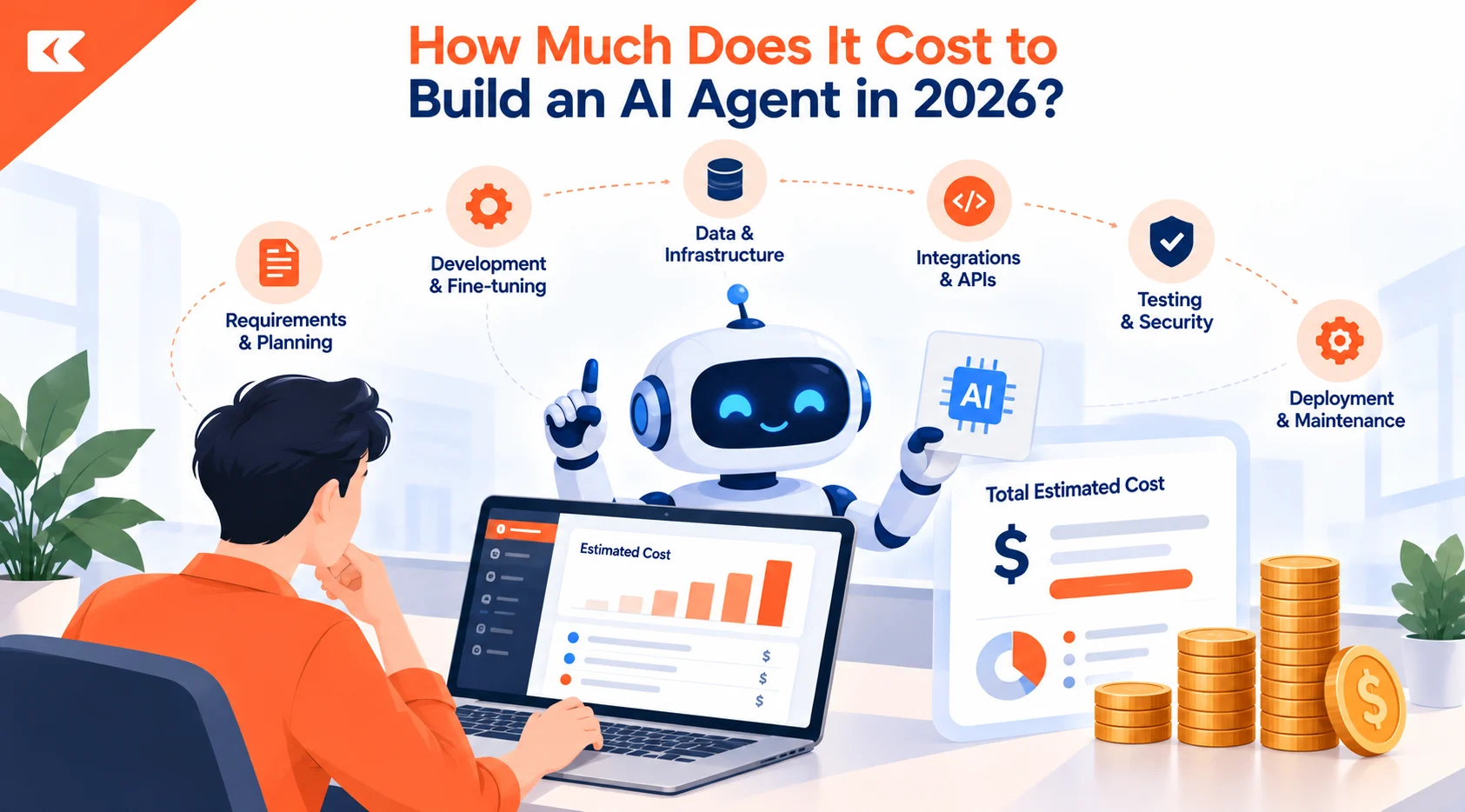
To build an AI agent for an operational system involving many other agents, you might want to consider spending around $10,000 on a small test. However, expect to pay at least $500,000 to implement such a solution. Most AI development companies quote $60,000 to $150,000 for an agent ready to work with real clients.
Why such a wide range?
The price depends on:
- what the agent does,
- which tools it connects to,
- what data it uses, and
- how much it can decide on its own.
An illustration created using your laptop is entirely different from an agent processing customer requests on a continuous basis.
In this guide, we will discover the financial aspect connected to creating an AI agent, the price of its usage on a monthly basis after its launch and the time it takes to develop and maintain it.
How Much Does It Cost to Build an AI Agent in 2026?
Below is a general view of things like expenses for team projects.
| Type of AI agent | Estimated development cost | Present Time Frame |
| Proof of concept (PoC) | 10,000–35,000 | 2–6 weeks |
| Basic AI agent MVP | 25,000–60,000 | 6–10 weeks |
| Production-ready AI agent | 60,000–150,000 | 3–6 months |
| Complex enterprise AI agent | 150,000–300,000+ | 4–9+ months |
| Multi-agent system | 300,000–500,000+ | 6–12+ months |
Consider these figures to be planning figures and not quotes. The variation in the figures is understandable because of the various sizes of every project.
What Do You Get at Each Price Point?
A proof of concept checks one thing: can an agent do this specific task at all? It’s a test, so real users usually never see it.
An MVP involves everything necessary to handle one use case of an agent’s operation and its connection to all necessary instruments with a small number of users involved.
A production-ready agent is where the budget grows. You’re paying for reliability testing, monitoring, access controls, error handling, and a proper launch setup.
Enterprise and multi-agent systems sit at the top. They run complex workflows across many systems and need stricter rules for who can do what.
What Factors Make AI Agent Development More Expensive?
Two companies can ask for nearly the same thing and get very different quotes. Four factors usually explain why.
How Complex Is the Agent’s Work?
Think about an agent that answers questions using a set of approved documents. Now think about one that plans a task, calls other software, makes choices, and deals with things going wrong. The second one takes far more engineering.
The more freedom you give an agent, the more you have to test it. Each decision it can make alone is a decision someone has to check.
Is Custom Data or Model Training Necessary for the Agent?
Usually, business agents don’t require a custom model to be trained. You may utilize a pre-trained language model and an API for its functioning in combination with RAG functionalities, which allow language models to search documents and get reliable and accurate answers.
Your data still needs to be processed properly, as documents must be scanned, separated, and indexed to enable looking up the right documents fast. The need for retention or the use of customized language models is inefficient unless there are severe privacy concerns or the task is beyond the capabilities of standard models.
Investing in customized model training is useless if the problem isn’t compatible with the model, so the type of model should be selected depending on the problem.
How Many Business Systems Should It Be Integrated With?
Every interconnection created with a payment infrastructure system, database, ERP system or CRM creates a new workload. These require managing logins, different ways of doing things, permissions, API restrictions, data and connection failures.
A service that only has to receive data from a single system is relatively easy to create. However, the process of developing such a service becomes more complicated when there are multiple sending systems, as each connection may fail at any point in time.
What Protection and Reliability Are Needed?
An agent that behaves on your behalf requires boundaries. That means having privacy measures, access control according to role, manual approvals of the precarious moves as well as audit logs indicating what exactly the agent had done and for what reason.
Also, tests need to be performed to be able to find incorrect answers and mistakes the agent is likely to make. The NIST AI Risk Management Framework provides a good guide for implementing this control system.
Low price offers from some AI development companies often disregard this aspect. However, if you are looking for a team to provide services from creating a project, Citrusbug’s AI agent development perfectly covers design, integrations, and testing in one.
What’s included in the budget for developing an AI agent?
What does the quoted price represent when a company offers it? Here’s a general summary:
| Development component | Work involved |
| Planning and architecture | Define use cases, requirements, processes and system architecture |
| AI engineering | Model integration, tool calling, prompts, and agent orchestration |
| Data and knowledge setup | Data getting ready, processing of documents, retrieval and authorization |
| Backend and frontend development | APIs, databases, application logic, and user interface |
| Integration with third-party | Integrating business systems and external services |
| Testing and security | Output and testing of failure cases |
| Implementation & supervision | Infrastructure, logging, and alerts required for release |
Not all projects require everything at full scale. A simple internal agent may not need an interface of its own. An agent that is part of a customer-facing SaaS service will probably need user accounts, a billing system and lots of testing.
Always check what is not included in the quotation. A good quotation includes what is included, what isn’t and whether there are extra expenses such as the use of cloud computing, paid APIs, licenses and post-launch support.
Compare at least three quotes. Then check each vendor’s client feedback on a B2B review platform before you shortlist.
What is the Average Monthly Expense of Employing an AI Agent?
Once the AI agent is developed, additional costs will emerge, making for two costs in total.
What Are the Recurring Costs of an AI Agent?
- LLM API consumption: Tokens are paid for with reference to their use in the persistence of the system. The more functions required to carry out and the more tokens consumed in unit functions, the higher will be the total expenditure. The latest data on token consumption is available on the OpenAI API rates page and the rates of other suppliers.
- Cloud services: the cost of storage, networks, servers, and databases used.
- Third-party services: costs of other types of external apps used for processing.
- Operational costs: the cost of fixing bugs, ensuring quality assurance, changing the landed configuration upon arrival of the upgraded version of the model.
- Support and scaling: handling incidents and increasing capacity of the system.
How Can You Estimate Monthly AI Agent Costs?
It is easy to use this simple formula:
Monthly expenses = usage of the model + infrastructure + the cost of third-party services + maintenance and support.
Usage is more important than one might think.
There may be two agents whose building costs are equal, but the one that will have 100,000 requests each month will cost much more to operate in comparison to the one generating 1,000 requests.
Additional factors such as the selected model, prompt size, retry volume, and number of calls to third-party services may raise the bill even more.
Costs rise drastically if a long prompt is sent the necessary number of times.
Be sure to think of three options:
- How many requests you plan to generate,
- Which peak days you expect, and
- Whether the request load will be much higher than planned.
If the last figure exceeds your budget, better learn that immediately.
How Much Does It Cost to Build Different Types of AI Agents?
The use case changes the price a lot. These examples show what pushes the cost up.
| Use case of AI agent | Factors influencing the price |
| Support agent | Knowledge base, ticket system integrations, escalation processes, and response monitoring |
| Sales and lead generation agent | CRM system, lead scoring, data enrichment, and follow-up workflows |
| Research and document analysis agent | Volume of documents, retrieval quality, citation quality, and access to sources of information |
| Internal operations AI agent | Access to ERP or internal systems, permissions, and multi-stage processes |
| AI agent in a SaaS product | Multi-user access, product APIs, tenant isolation, usage tracking, and scalability |
These factors affect the price and not the price itself. Support agents that are just answering the FAQs may be very simple ones. However, those who issue refunds or change customer accounts would require additional permissions, verification, and protection solutions. The case is the same but the performance is quite different.
If you want to have some agents added to the SaaS product, you should consider tenant isolation at the beginning.
Should You Build a Custom AI Agent or Use an Existing Tool?
Ask this before you spend on development.
| Consideration | Existing AI platforms | Custom AI agents |
| Initial costs | Usually lower | Usually higher |
| Time to release | Usually shorter | Depends on project scope |
| Customization | Limited by platform capabilities | Greater flexibility |
| Integrations | Available connectors and platform limits | Can be fully customized |
| Maintenance | Vendor handles most of it | In-house or with a partner |
| Long-term costs | Usually involves subscriptions and usage costs | Infrastructure, models, support, and maintenance costs |
When Should You Choose Each Option?
While platforms from established AI companies are suitable for standard workflows and offer fast delivery, custom agents should be developed if a client has specific workflows, integrations, and rules about data. Hybrid variants are possible as well.
Custom solutions do not guarantee low overall costs in the long run. Calculating total cost of ownership (TCO), including all costs of entering the market, subscription costs, and maintenance costs is important. Teams building a SaaS product often forget that last one.
How Can You Reduce AI Agent Development Costs?
You can save money without sacrificing quality. Here are a few methods.
Start With a Simple MVP
Focus on just one measurable issue. For example, the time it takes for a request for support to be resolved. Don’t try to automate the entire department in one go.
Use Available Models and Components
Use widely used LLM APIs, frameworks, and retrieval tools first. Only spend money developing a custom model if these don’t work.
Prioritize Essential Integrations
Connect only the systems your first release needs. Once the use case proves itself, add the rest.
Control Model Usage and Agent Actions
For simpler functions, apply a more economical, smaller model if quality permits. Prevent agents from doing excessive iterations of the same job and impose usage limitations. Validate every modification before it goes live.
It is easy to make the mistake of considering the wrong aspects of the implementation of AI-based models.
Gartner indicates that over 40% of AI initiatives will be scrapped by the end of 2027 because of the increasing costs, unclear economic utility, and insufficient risk management.
How Can You Tell If The Expense of Creating an AI Agent Is Justified?
Make financial forecasts of the efforts. You should consider the following indicators:
- The number of hours saved in standard operations
- The price of each completed operation before and after
- The level of mistakes and the number of cases that require human intervention
- The time needed to respond to customers
- The extra income created through the work of the agent
The best way to start is to sum up similar operations and then subtract the agent’s annual expenses and running costs from the total. Compare the benefits of implementing the agent with the money spent on its creation.
Don’t be certain that you will get your investment back. The benefit depends on how effectively you use the agent, whether the task can be automated, and how well your AI development company has built the agent.
FAQs
- How much does it cost to create an AI agent?
An elementary proof of concept goes for about $10,000. The real minimum depends on the nature of the agent, the systems that it gets connected to, and the quality that is needed.
- How long does it take to create an AI agent?
Creating a proof of concept may take approximately 2-6 weeks; developing an MVP takes 6-10 weeks; creating an agent that can be launched in live operation takes 3-6 months. If there is slow data access, complex integrability of systems, and extra testing, it can take longer.
- Is an AI agent more expensive than an AI chatbot?
Usually, yes. An agent needs all the tools for launching it, actions have to be done step by step, there should be a state of the agent, etc. However, there are advanced chatbots with many integrations that can also contribute to increasing the price.
- What are the costs for creating an AI agent?
It is required to pay for the way the model is being used, for hosting in the cloud, monitoring, and support. The final amount can increase due to the level of usage and the urgency of the issues that need to be resolved.