

 Back
PageIndex: A Vectorless Tree-Based Retrieval Architecture for Accurate RAG Systems

Executive Summary
Retrieval-Augmented Generation transformed how we build AI systems that need factual grounding. But there's a problem nobody talks about: vector search doesn't actually understand documents.
Here's what happens in most RAG systems today. You take a 200-page financial report, chop it into chunks, convert each chunk to a vector, throw everything into a database, then hope semantic similarity finds the right context. It usually doesn't. Not for the questions that matter.
Ask about deferred tax liabilities in a 10-K filing. Vector search might return chunks from the executive summary, risk factors, and footnote 17 because they're all 'semantically similar' to tax discussions. But the actual answer is in section 8, subsection C, page 142. The structure tells you exactly where to look. Vector search ignores structure completely.
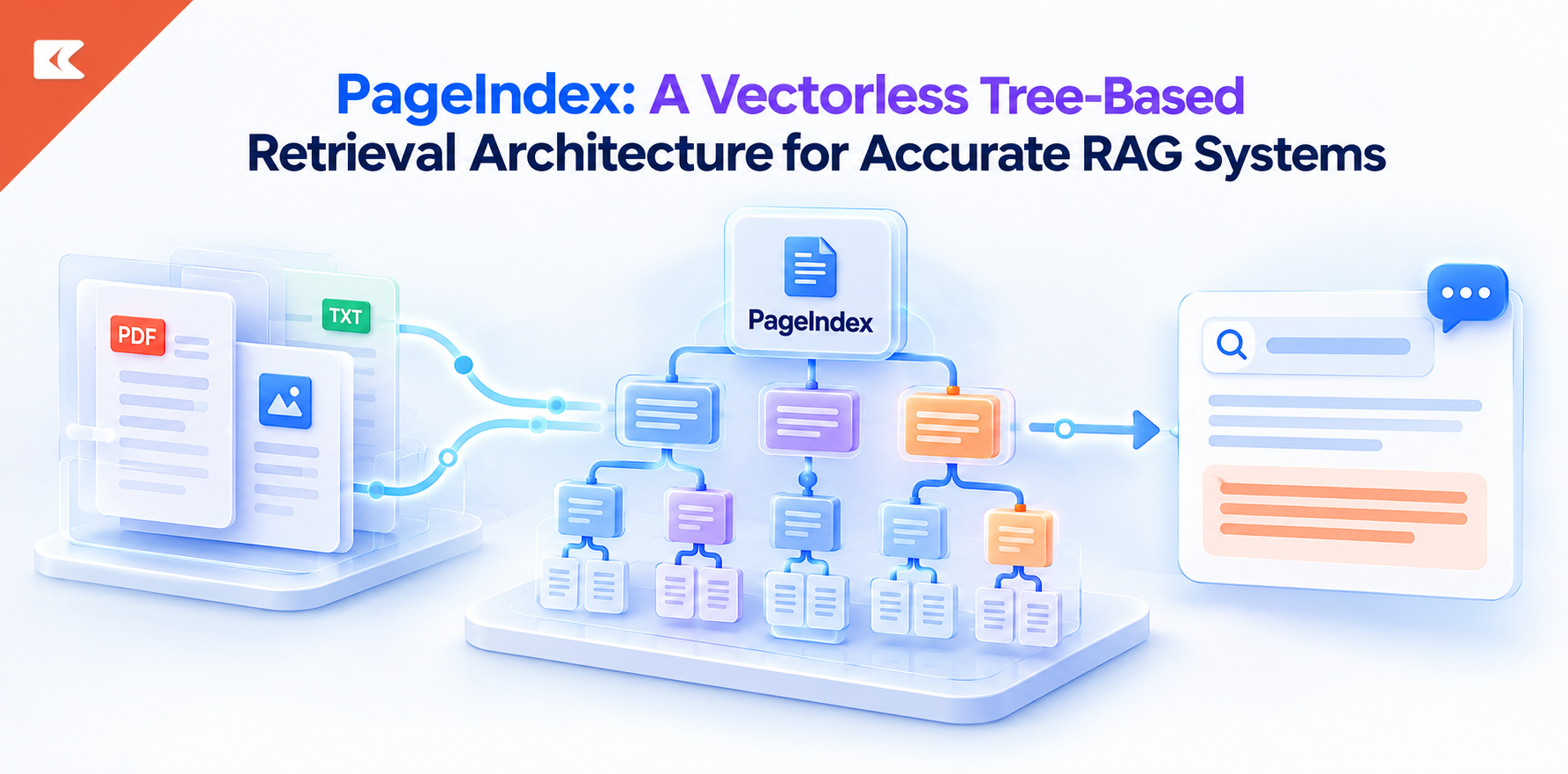
PageIndex takes a different approach with vectorless RAG. Instead of converting documents to vectors and searching for similarity, it builds a hierarchical tree that preserves document structure, then uses reasoning to navigate that tree. Think of it as the difference between searching for keywords in a book versus actually reading the table of contents and turning to the right chapter.
The Core Insight
Documents have structure for a reason. Authors organize information hierarchically because that's how humans understand complex topics. Financial reports follow standardized formats. Legal contracts have predictable sections. Technical manuals use nested hierarchies. This structure contains valuable information that vector embeddings discard.
PageIndex preserves and exploits this structure. When you ask a question, the system:
- Understands what you're looking for
- Identifies the relevant top-level section
- Traverses down the document tree following structural cues
- Retrieves specific pages that contain the answer
No vector database. No chunking. No semantic similarity search. Just structural reasoning about where information lives in the document.
Key Benefits
Accuracy for structured documents. When documents follow predictable structures (financial reports, legal contracts, technical specifications), PageIndex consistently outperforms vector search. You get the right section, the right page, the right context.
No infrastructure complexity. Vector RAG requires embedding models, vector databases, chunking strategies, and similarity thresholds. PageIndex needs document parsing and an LLM. The stack simplifies dramatically.
Explainable retrieval. You can trace exactly how the system found information. 'I looked in the Balance Sheet section, then Liabilities subsection, then found deferred taxes on page 142.' This transparency matters for regulated industries where you need to justify AI decisions.
Better handling of long documents. Vector search struggles with 100+ page documents because you end up with thousands of chunks. PageIndex provides better long document retrieval by navigating structure rather than searching embeddings.
Trade-offs
Nothing is perfect. PageIndex has clear limitations:
Reasoning cost. Tree traversal requires LLM reasoning at each step. This uses more tokens than simple vector similarity. For very large document collections, this adds up.
Document structure dependency. Works brilliantly for well-structured documents. Struggles with unstructured text where semantic search actually helps.
Parsing complexity. Building accurate hierarchical indexes requires sophisticated document parsing. PDFs with inconsistent formatting can be challenging.
Use Cases
PageIndex excels in specific scenarios:
- Financial analysis: Annual reports, 10-Ks, earnings transcripts
- Legal document review: Contracts, compliance documents, case law
- Technical documentation: Manuals, specifications, API docs
- Research paper analysis: Academic papers with clear section structures
- Healthcare documentation: Clinical guidelines, research studies
What This Paper Covers
We'll walk through PageIndex in detail:
- Why traditional RAG architectures fail for long documents
- How PageIndex builds hierarchical document indexes
- The reasoning-based retrieval process step-by-step
- Detailed comparison with vector-based approaches
- Performance considerations and trade-offs
- Implementation guidance for production systems
- Real-world use cases and results
Whether you're building financial analysis tools, legal document systems, or enterprise knowledge platforms, understanding when to use structural retrieval versus vector search matters. This paper gives you the technical depth to make that decision.
1. Introduction
The promise of large language models was simple: systems that understand and generate human language at unprecedented levels. The reality proved more complicated. LLMs hallucinate. They confidently state incorrect facts. They can't access information beyond their training cutoff. These limitations make them unreliable for applications requiring factual accuracy.
Retrieval-Augmented Generation emerged as the solution. Instead of relying solely on the model's parametric knowledge, RAG systems retrieve relevant information from external sources and include it in the prompt. The model then generates answers grounded in retrieved facts rather than hallucinating from training data.
This approach works. RAG powers countless production systems: customer support chatbots that query documentation, financial analysis tools that parse earnings reports, legal research assistants that search case law, and enterprise knowledge systems that make internal documents accessible.
But there's a fundamental problem with how most RAG systems retrieve information using semantic similarity search. They rely on vector embeddings and semantic similarity, which work poorly for the documents that matter most: long, structured documents where information location follows hierarchical patterns rather than semantic clustering.
1.1 The Rise of RAG Systems
RAG adoption accelerated rapidly in 2023-2024 for clear reasons:
Hallucination reduction. When you ground LLM responses in retrieved context, accuracy improves dramatically. Instead of generating plausible-sounding fiction, the model references actual source material.
Knowledge freshness. Training data has cutoff dates. GPT-4's knowledge ends in April 2023. RAG systems access current information by retrieving from up-to-date sources. Your financial analysis bot can answer questions about last quarter's earnings because it retrieves the latest documents.
Domain specialization. LLMs know a lot about many topics but lack deep expertise. RAG enables specialization by retrieving from domain-specific knowledge bases. A medical diagnosis assistant retrieves from clinical databases. A legal research tool queries case law repositories.
Privacy and control. Enterprise data can't be included in model training. RAG keeps sensitive information in controlled databases that the model queries at runtime. The data never leaves your infrastructure.
Cost efficiency. Fine-tuning large models is expensive. RAG provides similar benefits through retrieval without requiring model updates. When information changes, you update your knowledge base, not your model.
These advantages explain why RAG became the default architecture for production LLM applications. Nearly every enterprise AI deployment uses some form of retrieval augmentation.
1.2 The Long Document Retrieval Problem
RAG works well for certain types of documents. Knowledge base articles, documentation pages, and short-form content are retrieved reliably. But long documents create serious problems:
Financial reports average 150-300 pages. A typical 10-K filing contains comprehensive business descriptions, financial statements, risk factors, management discussion, legal proceedings, and extensive footnotes. Information is organized hierarchically following SEC regulations. Ask about a specific line item in the balance sheet, and you need the exact section, not semantically similar text from elsewhere.
Legal documents like merger agreements run 200+ pages with deeply nested section hierarchies. Definitions in Section 1.1 matter for understanding obligations in Section 7.3(b)(ii). Vector search might retrieve the obligation text but miss the critical definition located 100 pages earlier.
Research papers follow Introduction, Methods, Results, Discussion structures. Questions about methodology require the Methods section, not semantically similar content from Results. Structure signals location more reliably than semantic similarity.
Technical manuals organize troubleshooting procedures hierarchically. System problems follow diagnostic trees: check power, check connections, check configuration. The right solution appears at a specific node in the diagnostic tree, not wherever the symptoms are mentioned.
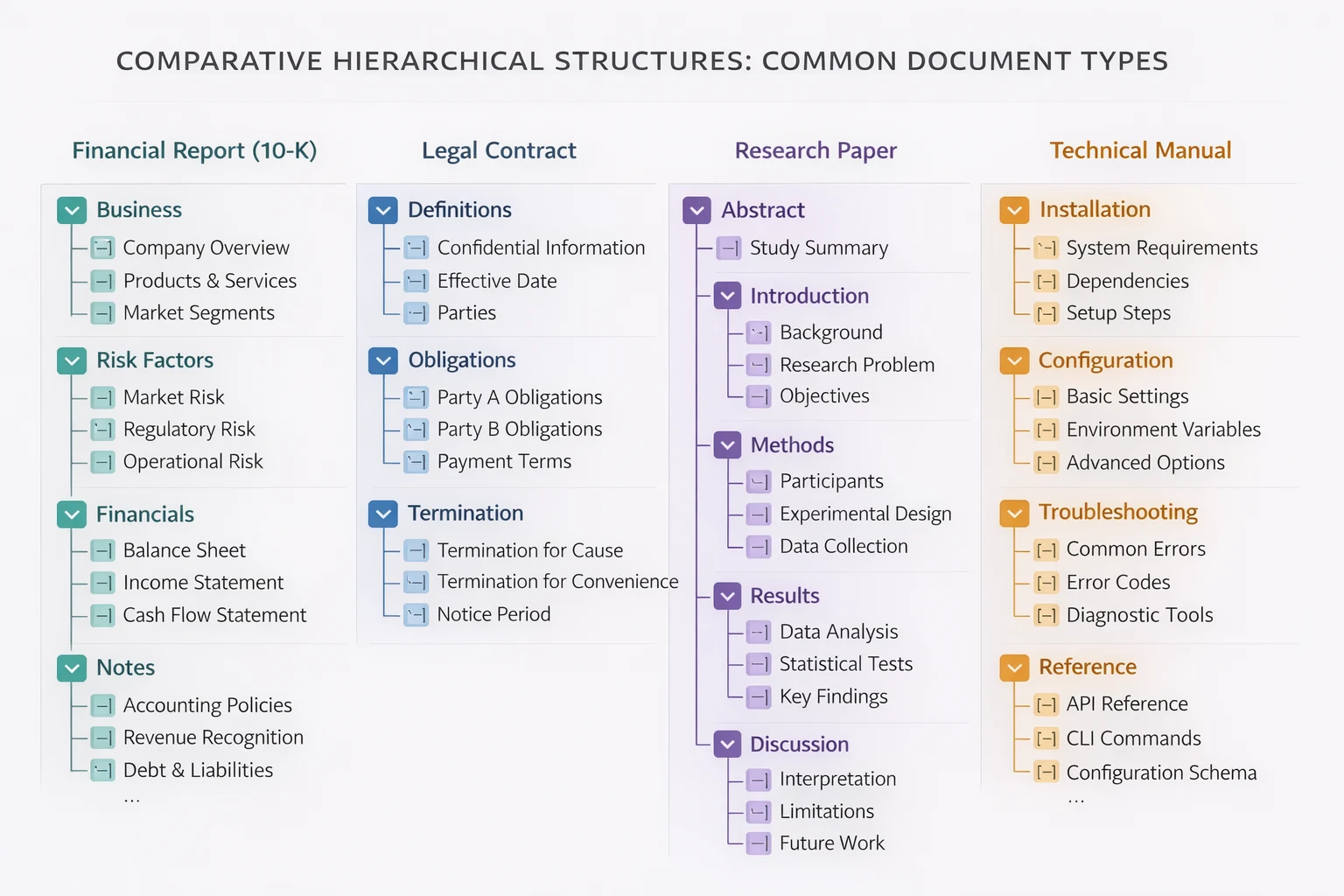
Figure 1. Long document structure examples across financial, legal, research, and technical documents.
The problem is simple: these documents have structure that matters. The standard RAG approach throws away this structure completely.
Why Chunking Fails
Here's what happens in traditional RAG:
- Take a 200-page financial report
- Split it into chunks (usually 500-1000 tokens each)
- Convert each chunk to a vector embedding
- Store vectors in a database
- At query time, embed the question and search for similar vectors
- Return the top-k most similar chunks
This process destroys critical information:
Section boundaries disappear. Chunk 47 might contain the end of the Risk Factors section and the beginning of Management Discussion. The chunk boundary is arbitrary and meaningless.
Hierarchical relationships vanish. Subsection 3.2.1 relates to Section 3 and Subsection 3.2. These relationships tell you context. Chunks have no such relationships.
Page numbers become meaningless. The answer might be on page 142, but chunks don't preserve page information. You get floating text snippets with no location context.
Document flow breaks. Authors structure documents so later sections build on earlier ones. Chunking makes every piece independent, losing this careful organization.
The result: you get semantically similar text that may or may not answer the actual question. For unstructured content, this works acceptably. For structured documents, it's frustratingly unreliable.
2. Limitations of Traditional RAG Architectures
Let's examine exactly why vector-based retrieval struggles with long structured documents. Understanding these limitations clarifies when alternative approaches like PageIndex make sense.
2.1 Context Fragmentation
Chunking creates artificial boundaries that destroy meaning.
Consider a balance sheet section from a financial report. The complete section includes:
- Section heading: 'Consolidated Balance Sheets'
- Column headers defining time periods
- Line items for assets
- Line items for liabilities
- Line items for equity
- Subtotals and totals
- Footnote references
Chunking might split this into:
Chunk 1: Header and first half of assets
Chunk 2: Second half of assets and first half of liabilities
Chunk 3: Second half of liabilities and equity
Now ask: 'What were deferred tax liabilities in Q3 2024?'
If deferred taxes appear in Chunk 2, that chunk lacks the header explaining which balance sheet (consolidated vs. subsidiary) and might lack the column header identifying the time period. The retrieved context is fragmentary and potentially misleading.
Worse, the chunk boundary is arbitrary. Different chunking strategies produce different fragments. Change chunk size from 500 to 1000 tokens and you get completely different retrieval results for the same query.
2.2 Embedding Similarity ≠ True Relevance
Vector embeddings capture semantic similarity. But semantic similarity and question relevance are different things.
Example query: 'What percentage of revenue came from international markets?'
The answer appears in the financial statements, typically in a revenue breakdown table. But vector search might retrieve:
- Risk factors discussing international market exposure
- Management commentary about international strategy
- Forward-looking statements about global expansion
- Legal proceedings in international jurisdictions
All these chunks are semantically similar to 'international markets.' None contain the actual revenue percentage.
The problem intensifies with technical terminology. Medical documents use 'myocardial infarction' and 'heart attack' interchangeably. Legal documents reference 'Section 7.3' or 'the termination provisions.' Financial reports abbreviate 'deferred tax liabilities' as 'DTL' after first mention.
Embedding models handle some of this through training on domain-specific text. But they fundamentally match semantic patterns, not structural location. When the right answer is in Section 7, Subsection B, Table 2, Row 4, semantic similarity won't reliably get you there.
2.3 Inefficient Retrieval for Large Documents
Search complexity grows with document size in problematic ways.
A 200-page document at 500 tokens per chunk creates roughly 800-1000 chunks. Each query searches across all chunks. The search itself is fast (vector databases excel at similarity search), but the quality degrades:
- More chunks mean more false positives (similar but irrelevant content)
- Ranking becomes harder (which of 50 similar chunks is actually relevant?)
- Context limits force trade-offs (retrieve top-5 and risk missing the answer, or top-20 and exceed context windows)
The standard solution is metadata filtering. Tag chunks with section names, page numbers, or document types, then filter before similarity search. This helps but creates new problems:
- Metadata extraction requires sophisticated parsing
- You need to know which section to filter for (circular problem)
- Metadata schemas become complex for deeply nested documents
Essentially, you're trying to add back the structure that chunking destroyed. PageIndex keeps the structure from the beginning.
2.4 Loss of Document Hierarchy
Documents are not flat collections of text; their document structure conveys important information. They have a hierarchical structure that conveys important information.
Consider these structural patterns:
Parent-child relationships: Section 3 contains Subsections 3.1, 3.2, and 3.3. Understanding that these relate to Section 3 provides context.
Definitional dependencies: Legal contracts define terms in Section 1 that appear throughout later sections. Missing the definition makes later sections incomprehensible.
Sequential flow: Research papers present background before methods before results. This sequence matters. Results don't make sense without method context.
Cross-references: 'See Section 7.3 for details' points to specific locations. Vector search can't follow explicit references.
Nested specificity: Higher-level sections provide general context. Lower-level subsections provide specific details. The hierarchy signals information granularity.
Chunking flattens all of this. Every chunk becomes independent. The structural information that authors carefully created disappears.
This is why traditional RAG works well for knowledge bases (flat, independent articles) but struggles with formal documents (hierarchical, interdependent sections). The use case dictates whether structure preservation matters.
3. Introducing PageIndex
PageIndex takes a fundamentally different approach to retrieval. Instead of converting documents to vectors and searching for similarity, it preserves document structure and uses reasoning-based retrieval to navigate that structure.
The Core Concept
Think about how you find information in a long document manually. You don't read every page. You look at the table of contents, identify the relevant section, flip to that section, scan the headings, and zero in on the specific subsection that should contain your answer.
This process uses structural reasoning for tree-based retrieval:
- What am I looking for? (query understanding)
- Which major section would contain this information? (top-level selection)
- Which subsection within that section? (tree traversal)
- Which specific pages? (content retrieval)
PageIndex automates exactly this process. It builds a hierarchical tree representing document structure, then uses LLM reasoning to traverse that tree intelligently.
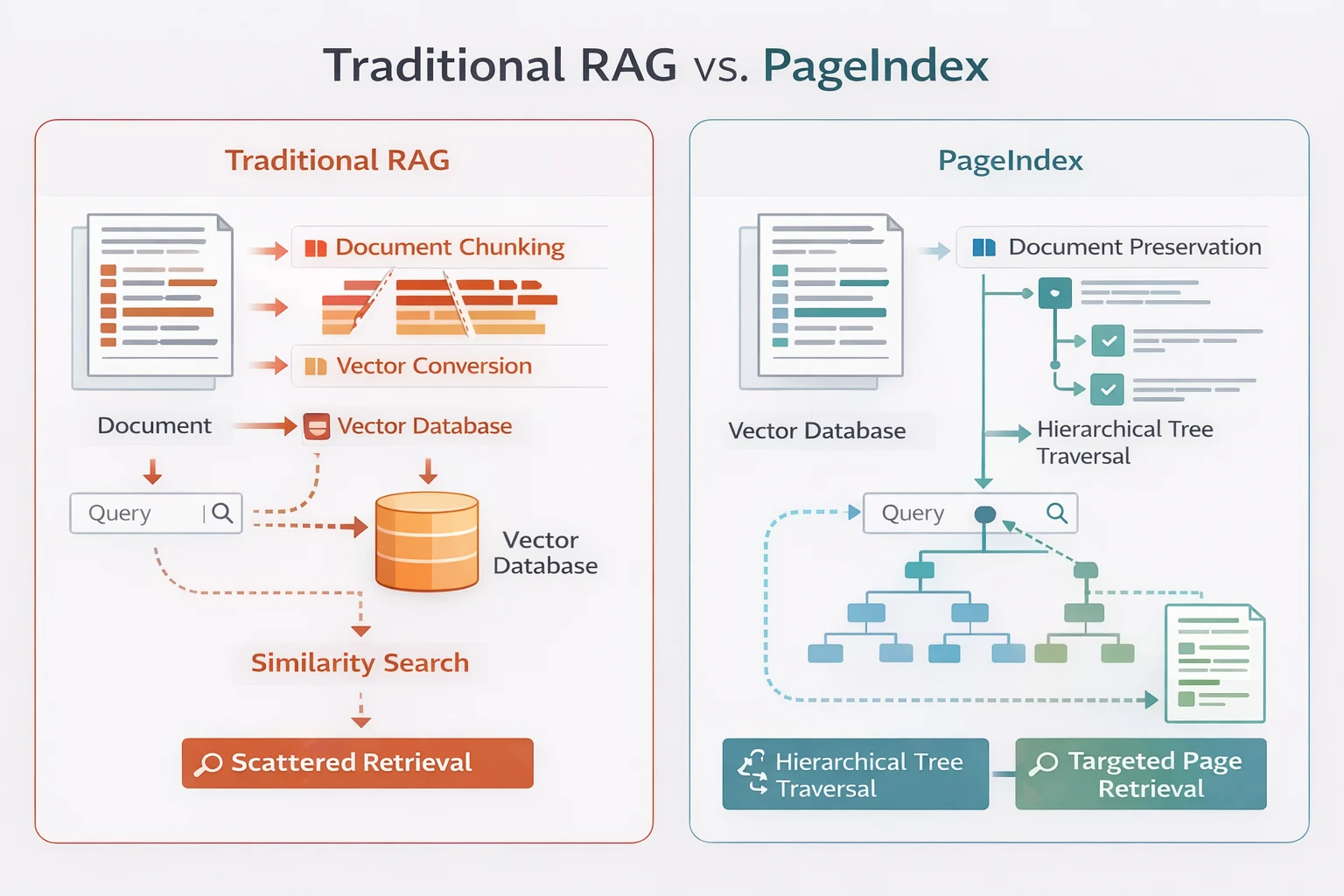
Figure 2. PageIndex concept: tree-based vs. vector-based retrieval.
Definition
PageIndex is a vectorless retrieval framework that indexes documents using hierarchical structure and retrieves information through reasoning-based tree traversal.
Let's break down what this means:
Vectorless: No embedding models. No vector databases. No similarity calculations. Retrieval happens through logical navigation of document structure.
Hierarchical structure: Documents are parsed into trees that reflect their actual organization. Sections contain subsections which contain pages which contain content.
Reasoning-based: An LLM analyzes the query, understands what information is needed, and determines which path through the document tree leads to that information.
Tree traversal: Starting from the root (entire document), the system iteratively selects branches (sections/subsections) until reaching leaves (specific pages/content).
How It Differs from Vector RAG
The distinction is fundamental, not incremental:
| Dimension | Traditional Vector RAG | PageIndex |
|---|---|---|
| Document processing | Chunking into fixed-size pieces | Parsing into structural hierarchy |
| Index representation | Vector embeddings in database | Tree structure with metadata |
| Retrieval method | Cosine similarity search | Reasoning-based navigation |
| Context selection | Top-k similar chunks | Specific pages from tree nodes |
| Structure preservation | Lost during chunking | Maintained in tree |
| Infrastructure | Embedding model + vector DB | Document parser + LLM |
| Explainability | Similarity scores only | Full traversal path |
| Best for | Unstructured content | Structured documents |
When PageIndex Makes Sense
PageIndex isn't universally better. It excels in specific scenarios:
- Documents follow predictable structures (financial reports, legal contracts, technical specs)
- Information location correlates with structure more than semantics
- Documents are long enough that chunking creates hundreds of fragments
- Accuracy matters more than speed (financial analysis, legal review, compliance)
- Explainability is required (regulatory environments, auditing)
For collections of short, independent articles (knowledge bases, wikis), vector search works fine. For formal documents with careful structural organization, PageIndex provides superior accuracy.
4. PageIndex Architecture
Let's examine how PageIndex actually works, component by component.
4.1 Document Parsing Layer
Everything starts with converting documents into structured representations.
Document ingestion handles various formats: PDFs (the most common), DOCX, HTML, and even scanned documents through OCR. The goal is extracting text while preserving formatting cues like headings, lists, and tables.
Page extraction identifies page boundaries and numbers. This matters because page references are often the most specific way to cite information. 'See page 142' is more precise than 'see the liabilities section.'
Section detection finds structural boundaries using multiple signals:
- Font size and styling (headings are typically larger and bold)
- Numbering patterns (1, 1.1, 1.1.1 or I, A, 1)
- Whitespace and layout (sections often start on new pages)
- Table of contents cross-referencing
Heading recognition extracts heading text and hierarchy level. 'Section 3: Financial Statements' is level 1. 'Balance Sheet' underneath is level 2. 'Current Assets' below that is level 3. The hierarchy matters.
The parsing layer's accuracy determines everything downstream. Poor parsing creates incorrect trees. Incorrect trees cause wrong retrievals. Investment in robust parsing pays dividends.
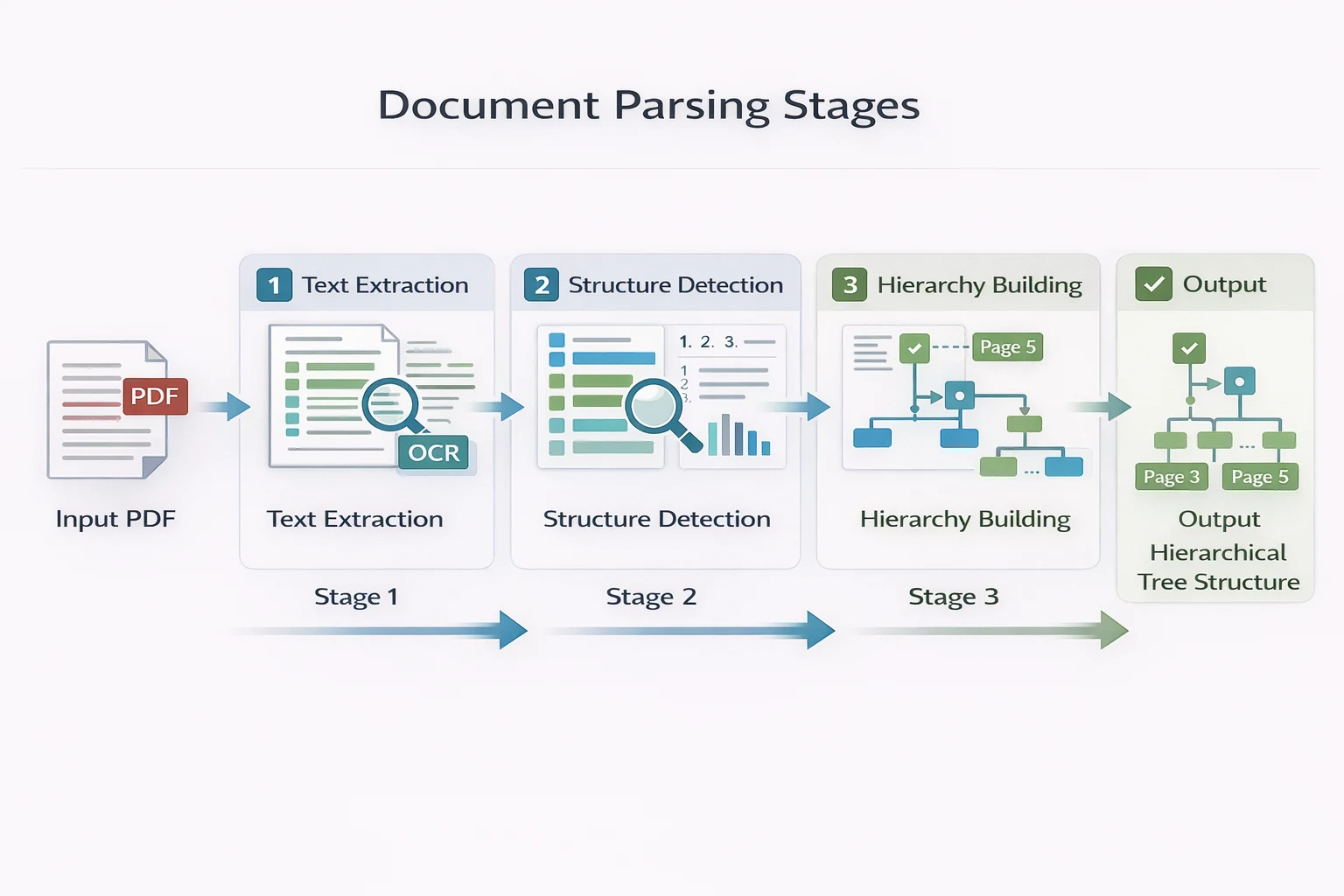
Figure 3. Document parsing pipeline.
4.2 Hierarchical Index Construction
The parsed document becomes a tree structure:
Document Root
├── Section 1: Business Overview
│   ├── Page 1-5
│   ├── Subsection 1.1: Company Description
│   │   └── Page 6-8
│   └── Subsection 1.2: Market Position
│       └── Page 9-12
├── Section 2: Risk Factors
│   ├── Page 13-25
│   ├── Subsection 2.1: Market Risks
│   │   └── Page 13-18
│   └── Subsection 2.2: Operational Risks
│       └── Page 19-25
└── Section 3: Financial Statements
    ├── Subsection 3.1: Balance Sheet
    │   └── Page 26-28
    ├── Subsection 3.2: Income Statement
    │   └── Page 29-31
    └── Subsection 3.3: Cash Flow
        └── Page 32-34
Each node in the tree contains:
- Node ID (unique identifier)
- Title/heading text
- Hierarchy level (1, 2, 3...)
- Page range
- Child nodes (subsections)
- Summary text (optional, for large sections)
The tree can be stored as JSON, a graph database, or even a simple nested dictionary. The representation matters less than preserving the hierarchical relationships.
For very large documents, section summaries help. Instead of passing entire sections to the LLM during traversal, you can pass titles and summaries. This reduces token usage while maintaining navigation accuracy.
4.3 Reasoning-Based Retrieval Engine
This is where PageIndex gets interesting. Instead of similarity calculations, retrieval uses iterative reasoning.
The process:
Step 1: Query understanding. The LLM analyzes the query to understand what information is needed. 'What were deferred tax liabilities in Q3 2024?' requires finding a specific line item in a balance sheet for a particular time period.
Step 2: Top-level section selection. Given the document's top-level sections (Business, Risks, Financials, etc.), which would contain the answer? For tax liabilities, obviously Financials.
Step 3: Tree traversal. Within Financials, which subsection? Balance Sheet vs. Income Statement vs. Cash Flow. Tax liabilities appear on balance sheets.
Step 4: Page identification. The Balance Sheet node indicates pages 26-28. Retrieve these specific pages.
Step 5: Answer extraction. Pass the retrieved pages to the LLM with the original query. Extract the specific value.
This multi-step reasoning process mimics how humans navigate documents. You don't read every page. You navigate structure intelligently.
4.4 Context Assembly
Once the system identifies relevant pages, it assembles context for the final LLM call.
Context includes:
- Retrieved page content
- Structural context (section path: Financial Statements > Balance Sheet)
- Page numbers for citation
- Related sections if needed (definitions, cross-references)
The assembled context gives the LLM everything needed for accurate, context-aware retrieval while maintaining traceability. You can point users to exact locations: 'The answer is in Section 3.1, Balance Sheet, page 27, line item Deferred Tax Liabilities.'
5. Retrieval Workflow
Let's walk through a complete retrieval example step-by-step.
Example Scenario
Document: Company X 2024 Annual Report (10-K filing), 247 pages
Query: 'What percentage of total revenue came from Product Line A in fiscal year 2024?'
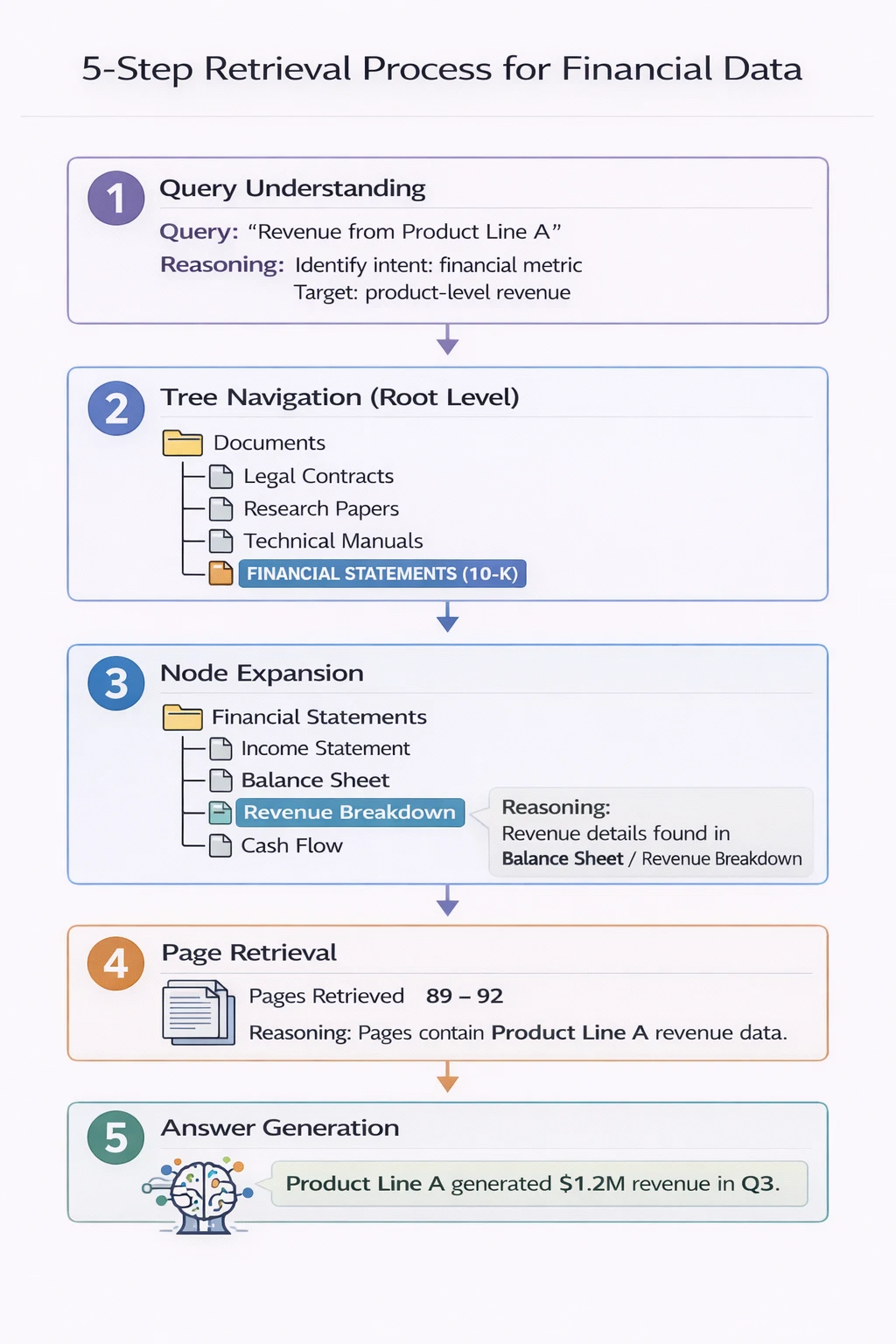
Figure 4. PageIndex retrieval workflow.
Step 1: Query Understanding
The LLM analyzes the query to extract key requirements:
- Information type: Revenue breakdown by product line
- Time period: Fiscal year 2024
- Specific entity: Product Line A
- Expected location: Financial statements, likely in revenue disclosures
This understanding guides navigation. The system knows it needs financial data, not business description or risk factors.
Step 2: Tree Navigation - Root Level
The system examines top-level sections:
Available sections:
1. Business Overview
2. Risk Factors
3. Legal Proceedings
4. Management Discussion & Analysis
5. Financial Statements
6. Notes to Financial Statements
Reasoning: 'Revenue breakdown by product would be in Financial Statements or possibly Notes. Start with Financial Statements.'
Selection: Financial Statements (Section 5)
Step 3: Node Expansion
Expand the Financial Statements section:
Section 5: Financial Statements
├── 5.1 Balance Sheet
├── 5.2 Income Statement
├── 5.3 Statement of Cash Flows
├── 5.4 Statement of Shareholders' Equity
└── 5.5 Revenue Recognition Note
Reasoning: 'Revenue breakdowns typically appear in Income Statement or Revenue Recognition notes. Check Revenue Recognition Note first as it would have detailed breakdowns.'
Selection: Section 5.5 – Revenue Recognition Note
Step 4: Page Retrieval
The Revenue Recognition Note node metadata shows:
- Section: 5.5
- Title: Revenue Recognition and Product Line Breakdown
- Pages: 89-92
Retrieve pages 89-92 from the document.
Step 5: Answer Generation
Pass retrieved content to the LLM with original query:
Context:
Section: Financial Statements > Revenue Recognition Note
Pages: 89-92
[Page content shows table:]
Revenue by Product Line (FY 2024)
Product Line A: $456M (34%)
Product Line B: $398M (29%)
Product Line C: $492M (37%)
Total Revenue: $1,346M (100%)

Query: What percentage of total revenue came from Product Line A?
LLM response: 'Product Line A accounted for 34% of total revenue in fiscal year 2024, generating $456 million out of total revenue of $1,346 million. This information is found in Section 5.5 (Revenue Recognition Note) on page 90.'
Why This Works Better
Compare this to vector search:
Vector RAG would:
- Embed the query
- Search 2,000+ chunks for similarity
- Potentially retrieve chunks from product descriptions, strategy discussions, and footnotes
- Hope the actual revenue table appears in top-k results
PageIndex:
- Reasoned about document structure
- Navigated directly to financial statements
- Found the specific revenue note
- Retrieved exactly the right pages
The structural approach eliminates false positives and goes straight to the answer.
6. Detailed Comparison with Traditional RAG
Let's examine specific dimensions where PageIndex and vector RAG differ.
Accuracy on Structured Documents
For financial reports, legal contracts, and technical manuals, PageIndex consistently outperforms. The structure signals exactly where information lives. Vector similarity often retrieves related but incorrect content.
Example: Finding a specific clause in a 200-page merger agreement. PageIndex navigates to Section 7 (Termination), Subsection 7.3 (Termination for Cause), page 143. Vector search might return any mention of termination from various contexts.
Infrastructure Simplicity
PageIndex requires fewer components: document parser, tree storage, LLM API. No embedding model, no vector database, no chunking pipeline. The stack simplifies significantly.
Cost Structure
Trade-offs exist. Vector RAG has upfront costs (embeddings, database) but cheap queries. PageIndex has minimal infrastructure but uses more LLM tokens per query for reasoning. For high-volume queries on static documents, vectors win. For complex queries on frequently-updated documents, PageIndex becomes cost-effective.
Latency Comparison
Vector search is fast (milliseconds). Tree traversal requires multiple LLM calls (seconds). For applications where sub-second response matters, vectors win. For applications where accuracy trumps speed, PageIndex makes sense.
7. Advantages of PageIndex
7.1 Improved Retrieval Accuracy
Structure-aware navigation finds the right section, not just similar text. For documents following standard formats, this dramatically improves precision.
7.2 Excellent Long Document Handling
Works particularly well for 100-500 page documents. The tree structure scales better than flat chunk arrays. Navigation complexity grows logarithmically with document size, not linearly.
7.3 Reduced Infrastructure Complexity
No vector database to maintain. No embedding models to update. No chunking strategies to tune. The simplicity matters for small teams and rapid prototyping.
7.4 Explainable Retrieval
The traversal path shows exactly how the system found information, supporting explainable AI retrieval. This transparency is valuable for regulatory compliance, auditing, and user trust. Example path: Financial Statements → Balance Sheet → Current Liabilities → Deferred Taxes → Page 142.
8. Performance Considerations
Retrieval latency depends on tree depth and reasoning steps. Typical queries require 3-5 LLM calls (section selection, subsection selection, page retrieval). At 1-2 seconds per call, total latency runs 5-10 seconds. This is slower than vector search but acceptable for accuracy-critical applications.
Token usage scales with document complexity. Large trees with deep hierarchies use more tokens for navigation. Optimize by using section summaries instead of full content during traversal.
Scalability to thousands of documents requires efficient tree storage and caching strategies. Graph databases work well for large collections.
9. Use Cases
9.1 Financial Document Analysis
Annual reports, 10-Ks, and earnings transcripts follow standardized structures. PageIndex excels here. Analysts can query specific line items, ratios, and disclosures with confidence the system finds the exact location.
9.2 Legal Document Retrieval
Contracts, compliance documents, and regulatory filings use hierarchical organization. Finding specific clauses, obligations, or definitions requires structural navigation that PageIndex provides.
9.3 Technical Documentation
Product manuals, API documentation, and technical specifications organize information by functionality and component. Users need specific sections, not semantically similar content.
10. Implementation Considerations
Practical deployment requires addressing several technical challenges:
Document parsing: Invest in robust PDF parsing. Tools like PyMuPDF, pdfplumber, and Apache Tika work well. For complex layouts, consider commercial solutions like Adobe PDF Services.
Tree storage: JSON files work for prototypes. Production systems benefit from graph databases (Neo4j) or document stores (MongoDB) with hierarchical query support.
LLM selection: Reasoning quality matters more than speed. GPT-4, Claude, or similar high-capability models work best. Smaller models struggle with complex navigation decisions.
11. Limitations and Challenges
Reasoning cost: Multiple LLM calls per query increase costs. For high-volume applications, this adds up. Hybrid approaches help: use PageIndex for complex queries, vectors for simple ones.
Parsing accuracy: Poor document parsing creates incorrect trees. Garbage in, garbage out. Investment in parsing quality is essential.
Unstructured content: PageIndex assumes structure exists. For truly unstructured text (chat logs, social media, email dumps), vector search works better.
12. Future Directions
Hybrid retrieval: Combine structural navigation with semantic search. Use PageIndex to navigate to relevant sections, then vector search within those sections for specific content.
Graph-based indexing: Extend beyond trees to graphs that capture cross-references, citations, and relationships between sections.
Multimodal documents: Index charts, tables, and images alongside text. Navigate to relevant visualizations structurally.
13. Conclusion
PageIndex represents a fundamental rethinking of document retrieval. Instead of discarding structure through chunking and relying on semantic similarity, it preserves structure and navigates intelligently.
The approach works brilliantly for structured documents where information location follows hierarchical patterns: financial reports, legal contracts, technical specifications, research papers. For these use cases, PageIndex delivers superior accuracy compared to vector search.
Trade-offs exist. Reasoning requires more LLM calls than simple vector lookup. Latency increases. Token costs rise. But for applications where accuracy matters more than speed, these trade-offs make sense.
The future likely involves hybrid retrieval approaches. Use PageIndex for structural navigation to relevant sections. Use vector search within those sections for semantic matching. Combine the strengths of both methods.
For AI architects building document analysis systems, PageIndex offers a proven alternative to vector RAG that works particularly well for long, structured documents. The technique is production-ready and the benefits are substantial for the right use cases.
About Citrusbug
Citrusbug is a technology services and product engineering company specializing in AI, mobile, and web application development. With a team of experienced engineers, designers, and strategists, Citrusbug partners with startups and enterprises across the United States, United Kingdom, and beyond to build scalable, intelligent digital products.
Our expertise spans generative AI integration, full-stack development, healthcare technology, IoT solutions, and enterprise automation. We combine deep technical knowledge with a pragmatic, business-first approach, helping clients move from concept to production with speed and confidence.
From AI-powered voice agents to remote patient monitoring platforms, Citrusbug delivers solutions that create measurable business impact. Our work is guided by a commitment to quality, transparency, and long-term partnership.
To learn more or discuss your next project, visit www.citrusbug.com or reach out to our team directly.
14. References
- 1. PageIndex GitHub Repository: https://github.com/VectifyAI/PageIndex
- 2. Lewis, P., et al. (2020). Retrieval-Augmented Generation for Knowledge-Intensive NLP Tasks. NeurIPS.
- 3. Guu, K., et al. (2020). REALM: Retrieval-Augmented Language Model Pre-Training. ICML.
- 4. Karpukhin, V., et al. (2020). Dense Passage Retrieval for Open-Domain Question Answering. EMNLP.
- 5. Anthropic. (2024). Constitutional AI and Advanced Reasoning Techniques.
- 6. OpenAI. (2023). GPT-4 Technical Report.
- 7. Izacard, G., & Grave, E. (2021). Leveraging Passage Retrieval with Generative Models. EACL.
- 8. Ram, O., et al. (2023). In-Context Retrieval-Augmented Language Models. arXiv.
- 9. Shi, F., et al. (2023). Large Language Models Can Be Easily Distracted by Irrelevant Context. ICML.
- 10. Zhao, W., et al. (2024). Retrieval-Augmented Generation for Large Language Models: A Survey. arXiv.