
 Back
Back







Key Takeaways
- Custom CRE platforms are built around specific workflows and integrations (accounting, mapping, payments), unlike off-the-shelf property management tools.
- Companies were ranked on PropTech experience, client reviews, delivery standards, and long-term maintenance support.
- A focused CRE MVP takes 4-6 months, while full-featured platforms with analytics and integrations often take 8-12 months.
- Legacy system integration is a common challenge, often requiring custom middleware to bridge old CRM or accounting tools with new platforms.
- Custom CRE software typically costs $30,000 to $250,000+, and makes the most sense once workflows outgrow generic, off-the-shelf platforms.
Finding the right commercial real estate software development partner can be the difference between a platform that streamlines your team’s daily work and one that adds friction to it.
With so many software development companies claiming real estate expertise, cloud engineering skills, and CRM specialization, comparing portfolios, pricing, and delivery track records can quickly get overwhelming.
This guide breaks down seven leading commercial real estate software development companies in USA, comparing their ratings, experience, and pricing so you can shortlist a partner suited to your lease management, tenant portal, or investment tracking project with confidence.
What is Commercial Real Estate Software Development?
Commercial real estate software development is the process of designing and building custom digital platforms such as lease management systems, tenant and vendor portals, CRM tools, and investment or portfolio management dashboards tailored to how brokers, property managers, and investors actually work.
Unlike off-the-shelf property management software, custom CRE platforms are built around a company’s specific workflows, integrations (accounting, mapping, payment gateways), and compliance requirements, making them easier to scale as a portfolio grows.
How We Selected the Top Commercial Real Estate Software Development Companies in USA
Every company on this list was evaluated using practical business factors instead of marketing claims alone. Six criteria mattered most:
- Industry & Technical Expertise: Experience with developing PropTech solutions for lease administration, tenant management, and investment workflows, paired with modern skills in cloud computing, AI-powered automation, and secure architecture.
- Client Reviews & Recognition: Independent feedback on Clutch and Google, along with awards and certifications that reflect consistent delivery quality.
- Development Process & Delivery Standards: Structured delivery, maintainable code, and scalable platforms that hold up as portfolios grow.
- Team Structure & Engagement Flexibility: Availability of dedicated teams, project-based models, and the ability to scale resources as project needs shift.
- Communication & Transparency: Regular demonstrations, structured reporting, and clear timelines that make progress easy to track.
- Value & Long-Term Support: Transparent pricing matched to project complexity, plus reliable post-launch maintenance and enhancements.
Quick Comparison: Top CRE Software Development Companies
Here’s how the best 7 commercial real estate software development companies in United States stack up at a glance before you dive into the full profiles below.
| Sr No. | Company | Clutch Rating | Founded | Location |
|---|---|---|---|---|
| 1 | EffectiveSoft | 4.9 | 2012 | San Diego, CA, USA |
| 2 | Leobit | 4.9 | 2014 | L’viv, Ukraine. USA |
| 3 | Citrusbug Technolabs | 4.7 | 2013 | USA, India |
| 4 | Fingent | 4.9 | 2003 | New York, NY, USA |
| 5 | Itransition | 4.9 | 2015 | Decatur, GA, USA |
| 6 | Inoxoft | 5.0 | 2014 | Philadelphia, PA, USA |
| 7 | Ascendix Technologies | 4.9 | 1996 | Dallas, TX, USA |
Top 7 Commercial Real Estate Software Development Companies in USA
Each CRE company below brings unique strengths to commercial property technology projects, covering different budgets, specializations, and engagement models.
1. EffectiveSoft
EffectiveSoft delivers custom enterprise software for organizations operating across multiple industries, including real estate and financial services.
The company develops secure, data-driven applications that support complex operational requirements while maintaining high performance across expanding business environments.
Its cross-industry background in fintech and enterprise systems translates well to CRE platforms that need strong data security, audit trails, and integrations with accounting or payment infrastructure.
Key Highlights:
- Delivers enterprise-grade software for real estate, fintech, and other regulated industries
- Strong focus on secure, data-driven, cloud-based application architecture
- Experienced in building applications that handle complex compliance and reporting needs
- Works with mid-size to large organizations needing long-term technical partnerships
- Recognized with consecutive Clutch Global Champion and Global Leader honors
Google Rating: N/A
Clutch Rating: 4.9
Awards: Clutch Global Champion 2023, Clutch Global Leader (Spring 2024)
Hourly Rate: $50 – $99
2. Leobit
Leobit develops custom business applications for organizations seeking dependable software engineering and modern digital transformation services.
Its development teams deliver secure solutions that help businesses manage operational processes, business data, and customer interactions more effectively.
Its ISO certifications and Microsoft partnership signal a strong quality-assurance and information-security discipline that CRE clients handling sensitive tenant and financial data tend to prioritize.
Key Highlights:
- Specializes in custom business applications and digital transformation projects
- ISO 9001 and ISO 27001 certified engineering processes
- Microsoft Solutions Partner, well-suited for teams on the Microsoft stack
- Stevie Award-winning delivery team with a strong quality assurance discipline
- Handles both new builds and modernization of existing enterprise systems
Google Rating: 4.5
Clutch Rating: 4.9
Awards: Stevie Award 2024, Microsoft Solutions Partner, ISO 9001 / ISO 27001 certifications
Hourly Rate: $25 – $49
3. Citrusbug Technolabs
Citrusbug Technolabs develops commercial real estate software solutions that help organizations simplify property operations, automate business workflows, and manage growing portfolios efficiently.
The company combines modern engineering practices with dependable delivery standards, enabling businesses to build secure, cloud-based, and scalable digital products tailored to commercial real estate requirements.
Its teams work closely with clients from initial discovery through post-launch support, covering everything from lease administration tools and tenant communication portals to investment dashboards and reporting systems.
Key Highlights:
- Full-cycle CRE software development, from lease management to portfolio dashboards
- Offices in the USA and India support distributed, cost-effective delivery
- Recognized as a Clutch Top Developer and Top Rated Plus on Upwork
- Works with both early-stage PropTech startups and established CRE firms
- Flexible, dedicated team engagement models tailored to the project scope
Google Rating: 4.5
Clutch Rating: 4.7
Awards: Clutch, Upwork, ISO
Hourly Rate: $25 – $49

4. Fingent
Fingent builds custom enterprise software that helps organizations modernize operations through reliable digital solutions.
Its development teams have experience delivering applications that simplify property management workflows, automate repetitive tasks, and improve visibility across commercial real estate portfolios without sacrificing scalability.
Two decades of enterprise software delivery have given the company a broad base of process-automation experience that carries over well to CRE-specific challenges.
Key Highlights:
- Focus on workflow automation and operational visibility for property teams
- Experience simplifying maintenance scheduling, vendor coordination, and multi-property reporting
- Broad client base spanning smaller engagements to large enterprise contracts
- Dedicated teams for organizations modernizing legacy property management systems
Google Rating: 4.5
Clutch Rating: 4.9
Awards: ISO, Clutch
Hourly Rate: $25 – $49
5. Itransition
Itransition develops enterprise software that supports organizations managing complex business processes across multiple industries.
Its engineering teams design secure and scalable applications that improve operational efficiency while integrating smoothly with existing business systems and third-party platforms.
The company’s experience with large-scale enterprise deployments makes it a reasonable option for CRE organizations with sizable user bases or heavy integration needs.
Key Highlights:
- Enterprise-scale delivery experience across large, complex user bases
- Strong integration capability across CRM, accounting, and document management systems
- Flexible engagement models that scale development teams up or down
- Works with organizations managing complex, multi-departmental business processes
- Track record supporting enterprise clients through long development cycles
Google Rating: N/A
Clutch Rating: 4.9
Awards: Clutch
Hourly Rate: $25 – $49
6. Inoxoft
Inoxoft delivers custom software solutions that help businesses digitize operations through modern web, mobile, and cloud technologies. The company emphasizes dependable engineering, business collaboration, and scalable development practices while creating applications tailored to industry-specific operational requirements. Its certifications and partner status point to a strong track record on both delivery quality and data security.
Key Highlights:
- ISO 27001 certified with a strong focus on data security
- Microsoft Gold Partner status supporting Microsoft-based infrastructure builds
- Coverage across web, mobile, and cloud development for industry-specific needs
- Supports both new builds and modernization of legacy property systems
- Emphasizes dependable engineering and close business collaboration throughout delivery
Google Rating: 4.8
Clutch Rating: 5.0
Awards: ISO 27001 certification, Microsoft Gold Partner
Hourly Rate: $25 – $49
7. Ascendix Technologies
Ascendix Technologies specializes in software development for the commercial real estate sector, delivering digital products that support brokerage operations, property management, investment activities, and CRM-driven customer relationship management.
Its industry focus enables solutions that closely reflect day-to-day CRE business requirements. Being one of the few companies on this list built exclusively around commercial real estate, Ascendix brings nearly 30 years of accumulated domain knowledge to every engagement.
Key Highlights:
- Deep specialization exclusively in the commercial real estate sector
- Nearly 30 years of accumulated CRE domain knowledge and workflow expertise
- Builds CRM-driven solutions for brokerage, property management, and investment teams
- Shorter discovery phases thanks to built-in CRE process knowledge
- Reputation built specifically within the CRE and brokerage community
Google Rating: 5.0
Clutch Rating: 4.9
Awards: N/A
Hourly Rate: $50 – $99
Website: https://ascendix.com
How to Choose the Best USA-based Commercial Real Estate Software Development Company
Choosing the right development partner affects far more than the initial launch. You need a team that understands commercial property operations while building software that remains reliable as your portfolio and business processes grow.
- Look for relevant industry experience
A company familiar with lease administration, tenant portals, maintenance workflows, and investment management can reduce discovery time and lead to more practical recommendations.
- Review previous projects carefully
Ask for examples involving commercial properties, asset management, or property operations for better insight into your specific requirements.
- Evaluate the technology stack
Your platform should integrate smoothly with accounting software, CRM systems, mapping services, payment gateways, and reporting tools, with scalability built in from the start.
- Understand communication practices
Regular demonstrations, transparent timelines, and structured progress updates make development easier to monitor and reduce misunderstandings.
- Confirm long-term maintenance services
Ongoing security updates, performance improvements, and feature enhancements after launch protect your investment over time.
- Balance cost with long-term value
Lower pricing should never outweigh software quality, maintainability, or technical expertise — well-designed platforms reduce operational costs long after deployment.
Common Challenges When Building Commercial Real Estate Software
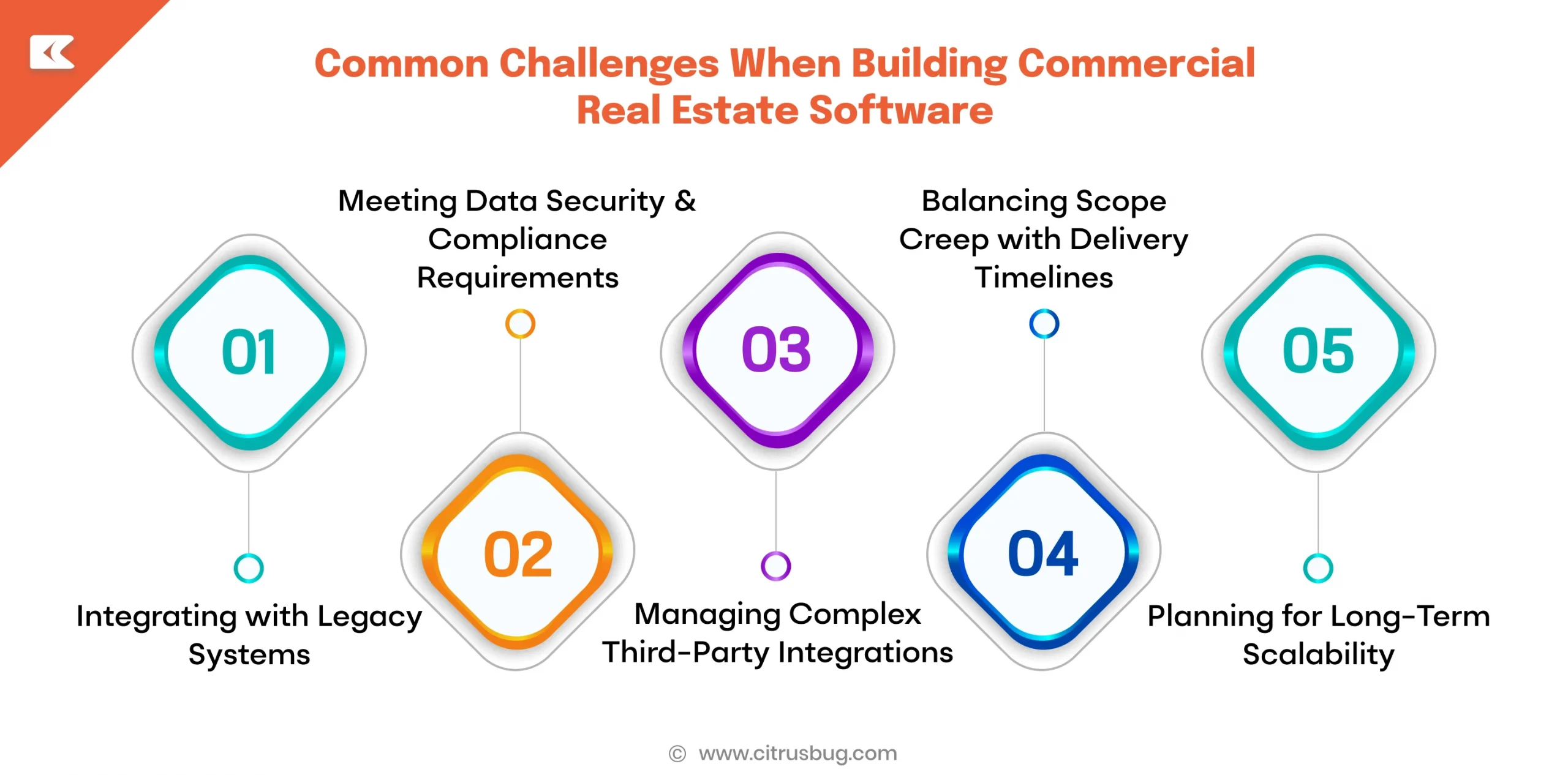
Even with the right development partner, CRE software projects tend to run into a similar set of obstacles. Knowing these in advance helps you plan scope, budget, and timelines more realistically.
- Integrating with Legacy Systems
- Older CRM, accounting, or property management tools often lack modern APIs
- Data migration carries the risk of duplicate, missing, or corrupted records
- Cutover phases can cause temporary downtime for daily operations
- Custom middleware is often required to bridge old and new systems
- Vendor lock-in with legacy providers can limit integration options
- Extra QA cycles are needed to confirm legacy compatibility
- Meeting Data Security & Compliance Requirements
- Lease agreements and tenant records contain sensitive personal and financial data
- Regional compliance requirements can vary significantly across markets
- Role-based access control is needed across brokers, managers, and investors
- Encryption at rest and in transit adds architectural complexity
- Regular security audits extend both timeline and budget
- Financial workflows may require SOC 2 or similar security standards
- Managing Complex Third-Party Integrations
- Accounting platform integrations often require custom API work
- CRM syncing must stay reliable as both systems release updates
- Mapping and GIS services add complexity to property data handling
- Payment gateway integration is needed for rent and lease collection
- Third-party API rate limits can affect real-time data syncing
- Ongoing maintenance is required as integrated tools evolve
- Balancing Scope Creep with Delivery Timelines
- Brokers, managers, and investors often request different, competing features
- Mid-sprint feature requests can delay MVP delivery significantly
- Unplanned functionality frequently leads to budget overruns
- Prioritization becomes difficult without a clear product roadmap
- Communication gaps between technical and business teams slow down decisions
- Formal change-request processes are needed to manage scope responsibly
- Planning for Long-Term Scalability
- Portfolio growth increases data volume and reporting complexity fast
- Multi-property reporting tools must handle growing datasets reliably
- Infrastructure choices, cloud versus on-premise, affect ease of scaling
- Growing user bases require role-based interfaces that scale cleanly
- Performance testing is essential before onboarding larger portfolios
- Early architecture decisions are costly and difficult to reverse later
Final Thoughts
Selecting the right commercial real estate software development service provider influences how efficiently your commercial property operations perform over time. Technical expertise, industry understanding, and dependable execution often deliver greater value than pricing alone.
This list provides a practical starting point for your evaluation. Compare each organization against your business goals, integration needs, and long-term product roadmap before making a final decision.
CRE Software Development FAQs
How much does commercial real estate software development cost?
Rates typically range from $25 to $150+ per hour, with most custom CRE platforms costing $30,000 to $250,000+ depending on scope.
How long does it take to build a commercial real estate platform?
A focused MVP takes 4 to 6 months, while full-featured platforms with analytics and integrations often take 8 to 12 months.
What features should commercial real estate software include?
Core features include lease administration, tenant and vendor portals, maintenance tracking, investment reporting, and CRM or accounting integrations.
Should I hire a CRE-specialized developer or a general enterprise software company?
Specialized partners reduce discovery time, while generalist firms often offer broader technical flexibility for complex integrations.
Is custom CRE software worth it compared to off-the-shelf platforms?
Custom software makes sense once your workflows or reporting needs outgrow generic platforms and you want full ownership of the roadmap.
What is PropTech, and how does it relate to commercial real estate software?
PropTech is the broader category of real estate technology; CRE software development is its custom-built, firm-specific side.