
 Back
Back







Key Takeaways
- The regulatory compliance consulting market grew to $15.71 billion in 2025, while the broader eGRC market reached $72.42 billion.
- 58% of businesses increased their compliance budgets in 2025, signaling regulatory alignment is now a long-term strategic priority.
- Large enterprises hold 67.2% of the compliance consulting market, driven by multi-jurisdiction operations and complex regulatory exposure.
- Cloud-based compliance infrastructure now holds 69.23% of the compliance software market, favored for scalability and centralized monitoring.
- High costs and expertise gaps continue to limit adoption among SMEs, with the core advisory segment growing at a slower 4.80% CAGR.
The compliance and regulatory consulting services market has become a core component of enterprise risk strategy across industries. As legal frameworks expand in financial services, healthcare, data privacy, and environmental governance, demand for expert compliance guidance has grown steadily at both the organizational and regulatory levels.
Regulatory complexity is no longer limited to large multinational firms. Mid-sized businesses, financial institutions, and healthcare providers now face layered mandates that require specialized advisory services to interpret, implement, and sustain. The distance between regulatory intent and operational readiness continues to drive demand for consultants who bridge that gap with structured, evidence-based programs.
Behind this demand lies a significant and measurable market, shaped by digital transformation, cross-border enforcement activity, and the mounting financial cost of non-compliance.
What Is Compliance and Regulatory Consulting?
Compliance and regulatory consulting is a professional advisory service that helps organizations navigate evolving legal requirements, industry regulations, and governance frameworks. Consultants assess compliance gaps, design internal controls, interpret mandates, and build programs that align business operations with applicable regulatory standards.
As regulations multiply and enforcement intensifies across industries, organizations depend on these services to reduce legal exposure, avoid financial penalties, and maintain stakeholder trust. For sectors like banking, healthcare, and data technology, compliance consulting provides the strategic clarity needed to operate responsibly in regulated environments. In healthcare, this often includes meeting privacy and security requirements outlined in a HIPAA compliance checklist.
Compliance Consulting Market Size and Momentum
The compliance and regulatory consulting services market reflects consistent demand from regulated industries seeking to close the gap between evolving mandates and internal readiness. Market data across multiple segments reveals a broad and growing investment in compliance infrastructure, underpinned by stricter enforcement, data governance requirements, and the increasing complexity of cross-jurisdictional regulation.
Market Valuation and Growth
Multiple market definitions capture the compliance consulting space from distinct angles, each confirming an expanding advisory sector with strong growth trajectories across both pure advisory and technology-integrated delivery models. Each segment reflects different scope boundaries, from dedicated consulting services to broader compliance management platforms.
- The regulatory compliance consulting services market grew from USD 15.0 billion in 2024 to USD 15.71 billion in 2025 at a CAGR of 4.75%, with sustained demand from healthcare, financial services, and technology sectors that require ongoing regulatory advisory support providing a reliable growth foundation.
- The regulatory and compliance management consulting segment, which combines advisory expertise with digital platform deployment and managed services, was valued at USD 25.6 billion in 2024 at a CAGR of 17.4%, with the substantially higher rate reflecting the value generated when technology delivery and advisory services are integrated into a unified compliance program.
Enterprise GRC and Compliance Technology
Enterprise-scale governance, risk, and compliance programs are generating the fastest growth within the overall compliance market. Organizations are committing capital to centralized frameworks that span multiple business units, regulatory domains, and jurisdictional requirements, and these investments create a structural uplift for advisory providers that support GRC architecture and ongoing program governance.
- The global enterprise governance, risk, and compliance (eGRC) market was estimated at USD 72.42 billion in 2025 at a CAGR of 13.7%, with rising regulatory complexity and growing enterprise demand for integrated risk governance architecture as the primary growth catalysts.
- The enterprise compliance management (ECM) market reached USD 3.66 billion in 2025 at a CAGR of 14.2%, with digital transformation initiatives and stricter enforcement activity across BFSI, healthcare, and energy verticals sustaining strong and consistent demand for compliance management solutions.
- The consulting segment held over 38% of global eGRC market revenue in 2024, which confirms the enduring preference for strategic advisory engagement alongside technology platforms as organizations build and scale their compliance programs across regulated industries.
Compliance Advisory Adoption Across Enterprises
Adoption of compliance and regulatory advisory is accelerating as organizations at every scale recognize the financial and reputational risks of inadequate regulatory readiness. The shift from reactive, audit-driven engagement toward proactive, program-level governance is reshaping how compliance services are structured, budgeted, and deployed across the market.
Enterprise Demand and Scale
Large enterprises generate the majority of compliance consulting demand globally, particularly those managing regulatory obligations across multiple jurisdictions and complex organizational structures with wide-ranging compliance exposure across multiple sectors and regulatory frameworks.
- Large enterprises held a 67.2% share of the regulatory and compliance management consulting market in 2024, with multi-jurisdiction operations and the need for scalable compliance frameworks across diverse regulatory environments driving consistent high-value engagement with specialist advisory providers.
- Enterprise demand is concentrated in programs that span data privacy obligations, financial reporting standards, ESG disclosure mandates, and sector-specific requirements where the financial and legal consequences of non-compliance justify sustained investment in third-party advisory over multi-year periods.
Cloud Deployment and Digital Adoption
Cloud-based compliance infrastructure has become the dominant delivery model for organizations seeking scalable and cost-efficient regulatory programs that adapt to changing mandates without proportional increases in internal staff, compliance headcount, or legacy infrastructure costs.
As more organizations migrate compliance workloads to the cloud, many also rely on AWS consulting services to design secure, scalable environments that support regulatory requirements and simplify ongoing infrastructure management.
- Cloud-based solutions held a 69.23% share of the compliance software market in 2025, with sovereign-cloud data residency frameworks, AI-powered audit automation, and the ability to centralize regulatory monitoring across distributed enterprise environments collectively accelerating adoption among regulated organizations.
- The integration services segment within the global eGRC market is projected to grow at a CAGR of 12.8%, which reflects the technical complexity of deploying compliance systems across enterprise environments that span multiple regulatory jurisdictions, legacy system architectures, and diverse internal data governance frameworks.
Compliance Budget Growth
Investment in compliance programs is expanding steadily as organizations reclassify regulatory spending from an administrative overhead category to a core risk management and governance priority, and this reclassification creates strong and durable revenue growth for consulting providers across all major regulated verticals.
- 58% of businesses increased their compliance budgets in 2025, a clear organizational signal that regulatory alignment is now treated as a long-term strategic investment rather than a discretionary line item to minimize during budget cycles.
- Budget increases are concentrated in third-party risk management, data privacy compliance programs, and automated monitoring tools, with financial services, healthcare, and technology sectors leading overall advisory spend growth and sustaining strong commercial demand for the market.
Market Segmentation and Industry Vertical Demand
The compliance and regulatory consulting services market is shaped by distinct industry verticals, service delivery models, and organizational profiles. Segmentation by application area, technology type, and end-user category reveals where advisory demand is most concentrated and where structural expansion is taking place at the highest rate.
Financial Services and Insurance
Banking, financial services, and insurance is the largest end-user segment for compliance consulting globally and generates the highest concentration of regulatory advisory spend. BFSI accounted for 22.12% of the global eGRC market share in 2026, with demand for governance solutions tied to AML enforcement, Basel III requirements, capital adequacy mandates, and evolving sanctions screening obligations that require continuous specialist support.
Healthcare is the fastest-growing application segment within the broader compliance advisory landscape, where expanding patient privacy requirements, data security regulations, and quality-of-care standards are creating sustained advisory demand that continues to grow at rates exceeding other verticals.
Compliance Technology and Software
Automated compliance platforms now represent a structurally significant component of the overall market, and their growth is expanding the addressable opportunity for the advisory layer built around them. Software held 35.41% of the compliance software market share in 2025, as organizations transition from manual, advisory-only compliance cycles toward automated platforms that deliver continuous monitoring, real-time audit trail generation, and policy tracking at scale.
Consulting firms that position themselves as implementation, customization, and program management partners for these platforms are capturing a growing share of total compliance advisory revenue.
Enterprise Governance and Consulting Services
Integrated compliance consulting remains the dominant service model across the market, with organizations increasingly preferring programs that combine regulatory expertise with technology deployment rather than standalone advisory engagements.
The enterprise governance, risk, and compliance market reached USD 24.42 billion in 2026 at a CAGR of 12.54%, with the consulting segment maintaining its position as the leading service type across all industry verticals. Organizations are committing to multi-year eGRC consulting programs as regulatory frameworks evolve faster than internal compliance teams can adapt without sustained external advisory support.
Key Trends Reshaping Compliance Services
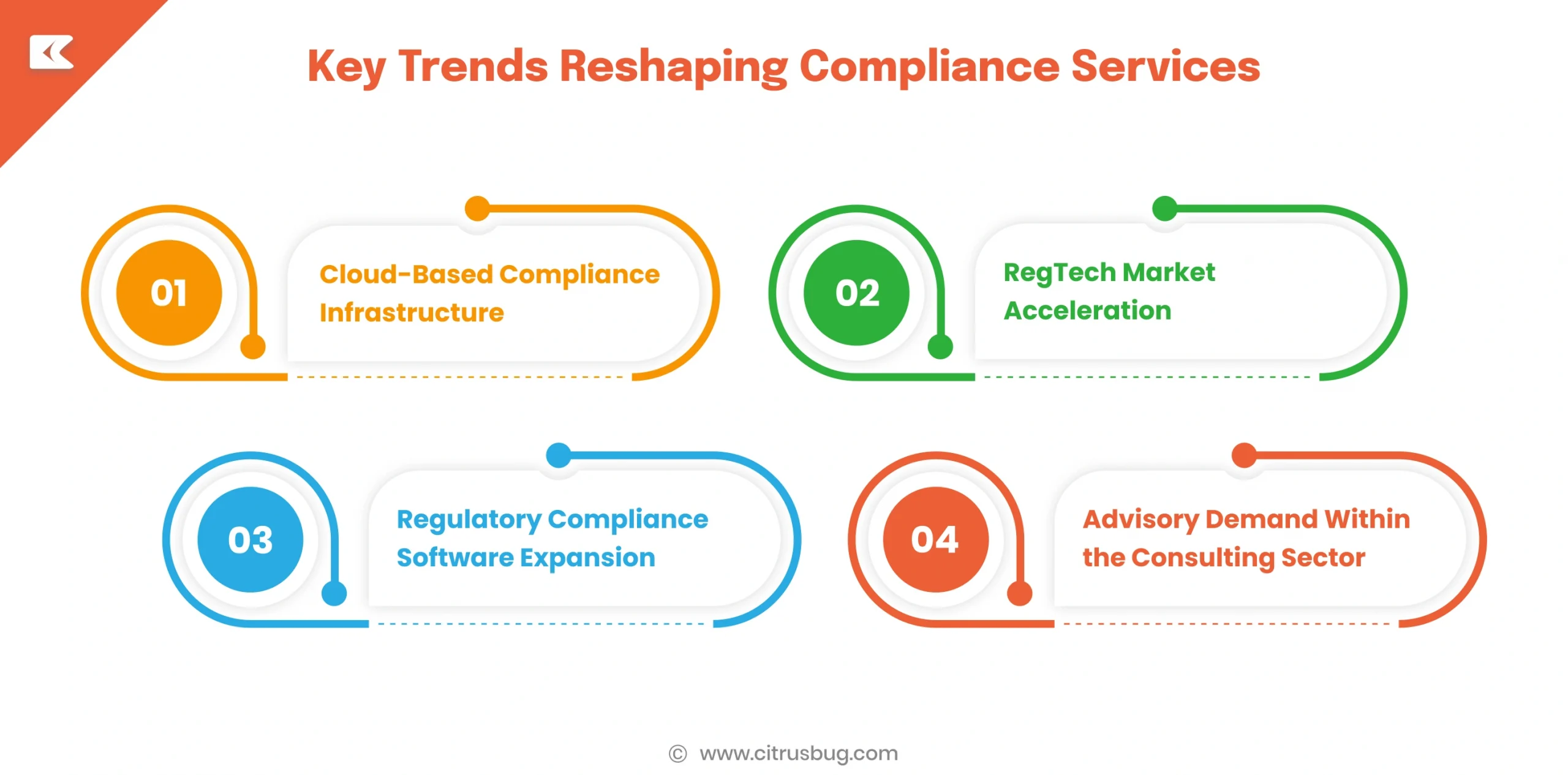
Several forces are changing the scope, speed, and economics of compliance advisory delivery. These developments are creating new demand patterns within the compliance and regulatory consulting services market while also redefining what effective, scalable governance looks like in practice across regulated industries globally.
Cloud-Based Compliance Infrastructure
Cloud deployment is fundamentally reshaping how compliance programs are built, delivered, and maintained at scale. Cloud-based compliance tools are set to expand at a CAGR of 13.19% through 2031, with sovereign-cloud data residency acceptance and AI-powered audit automation engines providing the primary growth drivers.
Organizations managing multi-jurisdictional regulatory obligations are finding cloud platforms especially effective for centralizing regulatory oversight without requiring proportional increases in internal headcount. The scalability and configurability of cloud-based compliance delivery are also making enterprise-grade programs accessible to a broader range of mid-market organizations that previously relied on periodic advisory engagements.
RegTech Market Acceleration
Regulatory technology has become the operational backbone for modern compliance programs and is changing the economics of advisory delivery across financial services, healthcare, and data-intensive industries. The global RegTech market grew from USD 19.21 billion in 2025 to USD 22.30 billion in 2026 at a CAGR of 16.10%, which has accelerated demand for technology-enabled compliance consulting and automated audit capabilities.
As RegTech platforms mature, they are creating a new class of hybrid consulting engagement where regulatory advisory expertise is integrated directly with platform implementation. These engagements generate longer and more complex consulting relationships in financial services and healthcare where regulatory change is most frequent.
Regulatory Compliance Software Expansion
The software layer supporting compliance management is scaling rapidly and generating parallel growth for advisory services built around it. The regulatory compliance management software market is expanding from USD 27,800 million in 2024 at a CAGR of 12%, with regulatory pressure across healthcare, finance, and manufacturing and rising data privacy obligations including GDPR and CCPA serving as the primary demand catalysts.
Consulting firms are positioning themselves as ongoing implementation and program management partners for these platforms, extending the scope and duration of advisory relationships beyond initial deployment into sustained operational governance roles.
Advisory Demand Within the Consulting Sector
Compliance advisory is generating measurable and growing demand within the broader professional services landscape. This growth reflects the transition from a specialized compliance niche to a mainstream strategic service category. The global business management consulting market was valued at USD 161.2 billion in 2024 at a CAGR of 5%, with regulatory compliance advisory identified as a key growth driver, particularly in BFSI and healthcare.
The advisory and consulting segment within global auditing services is also expanding at a CAGR of 9.4%, which reflects the rising organizational reliance on proactive compliance advisory for audit readiness, governance design, and long-term regulatory risk management.
Challenges in Market Accessibility and Reach
Despite consistent overall growth, structural barriers continue to limit adoption in specific market segments and geographies. These challenges are most apparent among smaller organizations and businesses in emerging economies that lack sustained access to formal compliance advisory frameworks.
- High Costs and Expertise Gaps for SMEs: The risk and compliance consulting market grows at a relatively modest CAGR of 4.80% within its core advisory segment, constrained by elevated consulting fees and a significant shortage of in-house compliance expertise that limits sustained engagement among small and medium-sized businesses without dedicated compliance budgets or internal legal and regulatory teams.
- Limited Market Penetration in Emerging Economies: Developing markets continue to see low formal compliance consulting adoption due to fragmented regulatory environments, limited awareness of structured advisory services, and significant affordability barriers that restrict market access. Latin America, for example, holds only approximately 5% of the global regulatory compliance market at USD 901.21 million in 2024. This figure illustrates the substantial gap between regulatory intent and accessible, cost-effective compliance advisory across emerging-economy markets.
Regional Market Share and Growth Patterns
The compliance and regulatory consulting services market is distributed unevenly across global regions, with established regulatory environments generating the largest revenue shares and rapidly developing economies expanding their market presence as domestic governance frameworks continue to formalize and intensify across key industries.
North America
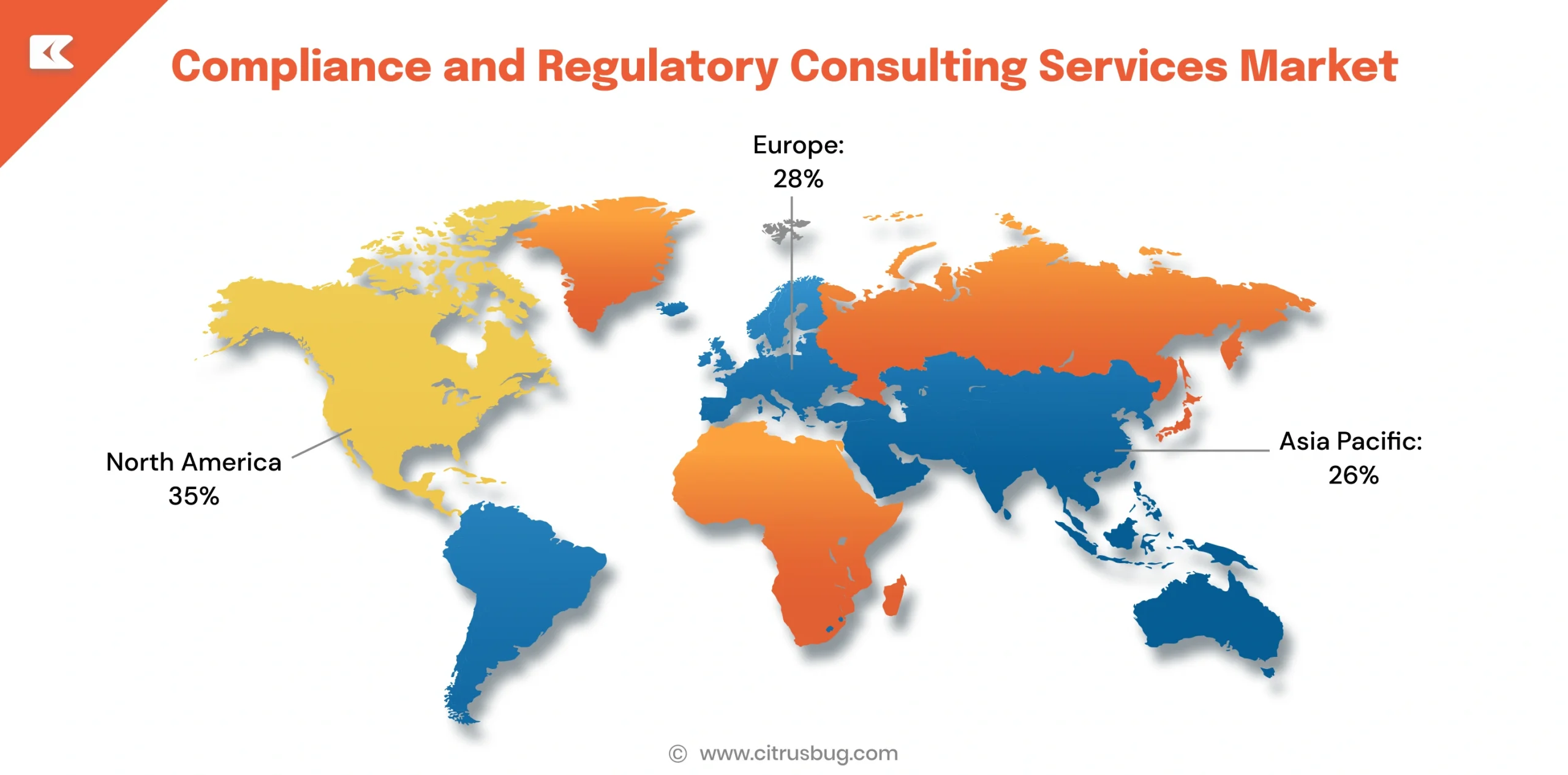
- North America accounts for approximately 35% of the global risk management and compliance consulting market in 2025, with intense enforcement activity in financial services, healthcare, and data-sensitive industries driving demand, and the United States alone generating approximately 27.4% of global compliance advisory spend; the US enterprise GRC market reached USD 4.92 billion in 2024 at a CAGR of 12.5%, supported by broad financial services, technology sector, and healthcare compliance mandates that continue to expand in scope and enforcement frequency.
Europe
- Europe holds approximately 28% of the global compliance consulting market share in 2025, with GDPR, MiFID II, DORA, and ESG disclosure requirements creating sustained advisory demand across the region; the consulting segment captured 45.3% of the European GRC services market in 2024, which reflects the technical and interpretive complexity of regional privacy, financial conduct, and sustainability mandates that require continuous specialist advisory to implement and maintain.
Asia-Pacific
- Asia-Pacific accounts for approximately 26% of the global compliance consulting market share in 2025, with rapid digitalization, maturing domestic regulatory frameworks, and growing cross-border compliance requirements generating consistent advisory uptake across financial services, technology, and manufacturing verticals in India, China, and Southeast Asia, where compliance infrastructure is developing in step with broader economic and regulatory maturation.
Middle East and Africa
- South Africa leads compliance advisory activity within the Middle East and Africa region at USD 501.82 million with a CAGR of 5.0%, with mining, finance, and energy sectors generating the primary advisory demand; Nigeria contributes USD 341.55 million at a CAGR of 4.9%, and Egypt stands at USD 251.67 million at a CAGR of 4.8%, with banking, energy, and public sector governance driving compliance engagement across the broader regional market.
Future Market Forecast and Growth Projections
The compliance and regulatory consulting services market is entering a multi-year expansion phase as regulatory volumes increase, digital compliance infrastructure scales globally, and organizations at every level treat proactive governance as a structural operational requirement. Multiple forward-looking projections through 2030 reflect strong growth across both advisory-focused consulting services and the technology-integrated compliance programs that support them.
- Risk and Compliance Consulting Through 2032: The risk and compliance consulting services market is projected to reach USD 14.08 billion by 2032, with BFSI, healthcare, and technology verticals sustaining advisory demand as cross-jurisdictional regulatory obligations grow in scope, specificity, and enforcement intensity across all major economic regions.
- Enterprise eGRC Market Expansion: The global eGRC market is forecast to grow to USD 39.99 billion by 2030 at a CAGR of 14.2%, with escalating regulatory complexity, expanding third-party risk exposure, and rising enterprise investment in integrated governance platforms and advisory programs that provide multi-layered and sustained growth catalysts across the market.
- Finance and Risk Management Consulting Growth: The finance and risk management consulting services market is projected to grow from USD 27.1 billion in 2025 to USD 37.1 billion by 2030, a USD 10 billion increase over five years as evolving capital requirements, digital finance adoption, and heightened supervisory expectations generate new and increasingly complex advisory demand across banking institutions globally.
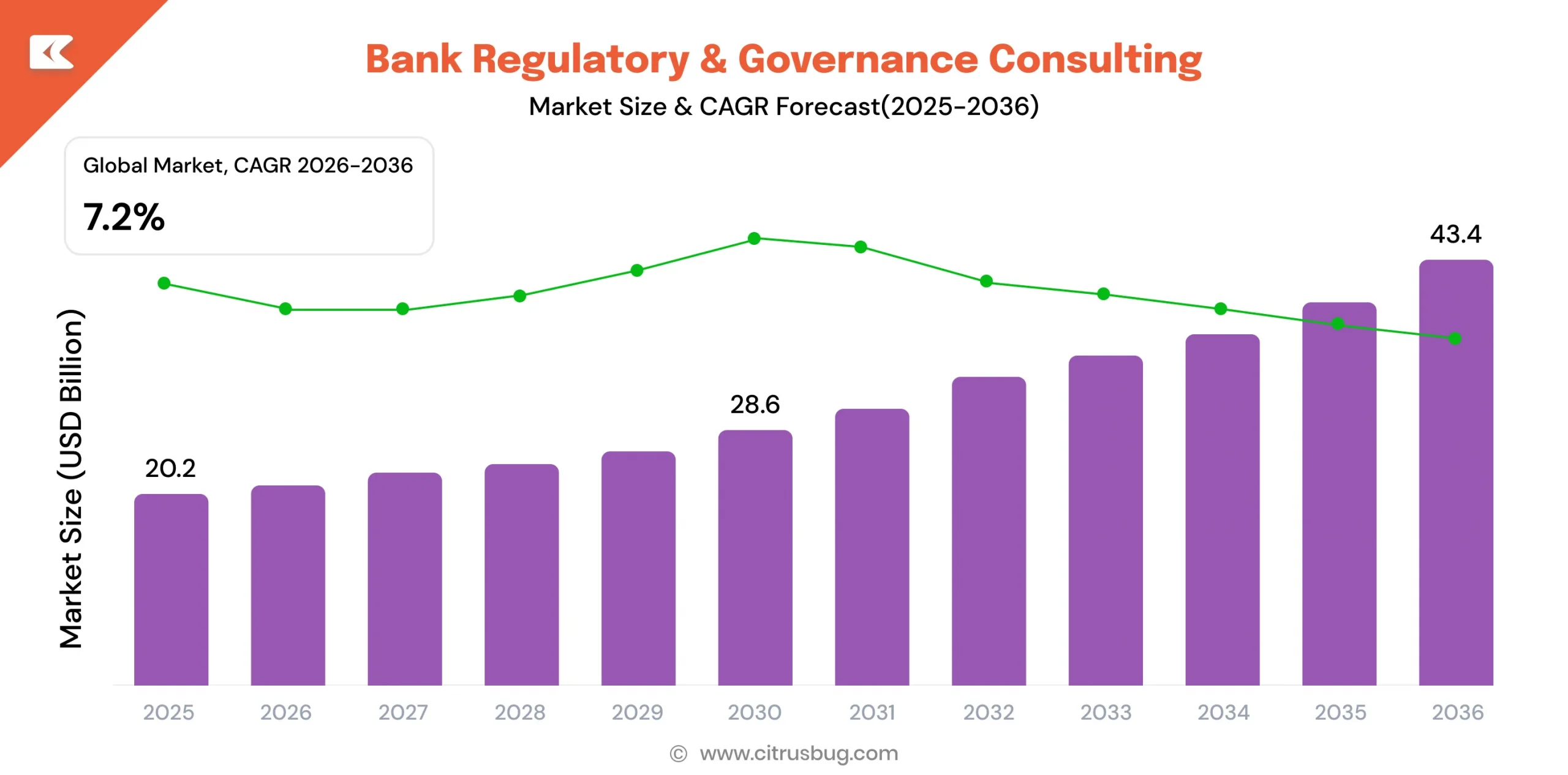
- Bank Regulatory and Governance Consulting: The bank regulatory and governance consulting segment is expected to expand from USD 20.2 billion in 2025 to USD 28.6 billion by 2030, with rising compliance workload in AML enforcement, prudential reporting obligations, and increasing regulatory examination cycles providing the structural demand for specialist advisory engagement from financial institutions of every scale.
- Long-Term Enterprise GRC Investment Trajectory: The global enterprise governance, risk, and compliance market is projected to reach USD 134.86 billion by 2030 at a CAGR of 13.2%, with technology-led compliance programs, expanding third-party risk management requirements, and evolving global regulatory frameworks collectively accelerating enterprise investment in both compliance infrastructure and advisory services through the next decade.
Conclusion
The compliance and regulatory consulting services market is expanding across multiple dimensions simultaneously, from dedicated advisory programs and enterprise GRC platforms to technology-integrated compliance tools and growing regional adoption. Data across segments and geographies confirms a consistent industry shift from episodic, audit-driven compliance toward continuous, program-level governance backed by both advisory expertise and scalable digital infrastructure.
Organizations building compliance capabilities today are investing in long-term regulatory resilience, not just short-term risk mitigation. As AI trends continue to influence compliance automation, risk monitoring, and governance, compliance software development and integrated advisory services offer a structured path toward that objective. This positions regulatory compliance not as a cost center but as a measurable strategic capability that delivers lasting and compounding business value.