
 Back
Back







Key Takeaways
- The digital mortgage software market was valued near $7 billion in 2024 and could reach $8.7 billion by 2026.
- Long-range forecasts project a 23.16% CAGR through 2035, one of the steepest rates in lending technology.
- 62% of lenders plan to adopt eNotes within two years, showing rapid near-term acceleration in digital closings.
- 71% of borrowers want clear disclosure when AI is used, so transparency matters as much as processing speed.
- Cloud deployment, AI underwriting, and compliance automation are the top drivers reshaping lender adoption in 2026.
Home lending has moved far past paper stacks and courier envelopes. The digital mortgage software market now touches nearly every step of getting a loan, from the first application to the final signature.
Lenders, credit unions, and independent mortgage banks are replacing manual paperwork with connected platforms that pull data, verify documents, and route approvals automatically.
This shift did not happen overnight. Years of rising application volumes, tighter compliance rules, and growing borrower expectations pushed the industry toward automation.
In this blog, we walk through where adoption stands, which regions are moving fastest, how different types of lenders are approaching the shift, and what challenges and opportunities lie ahead for the digital mortgage software market.
What Is Digital Mortgage Software?
Digital mortgage software refers to the platforms and tools lenders use to manage a home loan electronically, from application intake through closing. It replaces paper forms, manual data entry, and in-person signings with automated workflows, electronic documents, and digital verification.
These systems matter because they cut processing time, reduce manual errors, and give borrowers a faster, more transparent path to closing. For lenders, they also lower operating costs and make it easier to meet regulatory documentation standards.
Digital Mortgage Software Market Overview
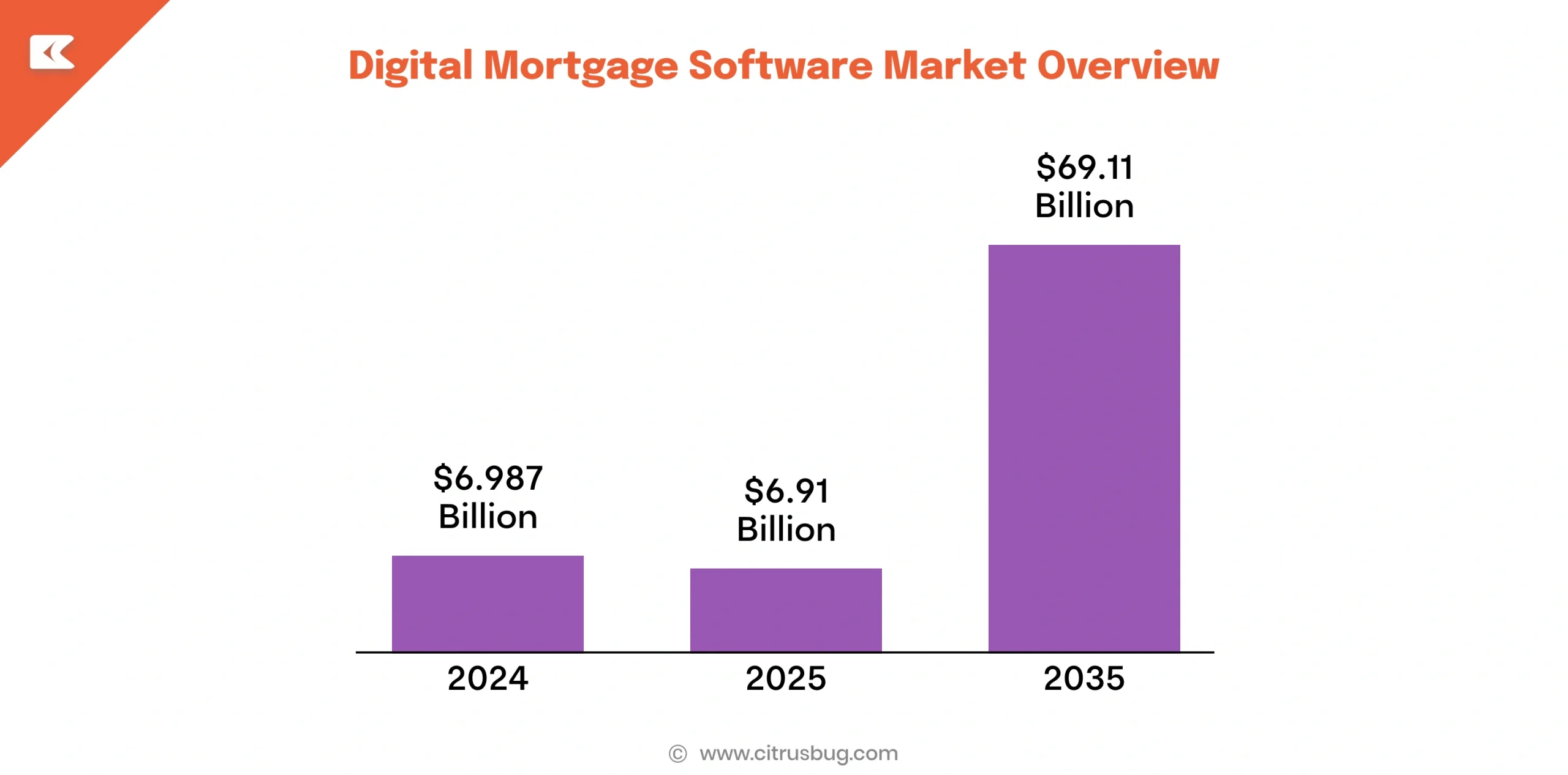
Lenders are registering more electronic notes, automating more of the underwriting process, and investing more in artificial intelligence than they were even two years ago.
Global Market Valuation, 2024 to 2026
Baseline figures from the past two years show a market moving from early digitization projects into recurring technology budget commitments across banks and independent lenders.
- The digital mortgage software market was valued at USD 6.987 billion in 2024, reflecting steady lender investment in origination and underwriting automation.
- By 2025, valuation had grown further, supporting a 2026 estimate of USD 6.91 billion from a separate assessment covering the same global category.
- A parallel 2026 estimate places the market at USD 8.7 billion, pointing to continued acceleration in lender technology spending across the category.
- This trajectory reflects a market where technology budgets for mortgage origination have become a fixed, recurring line item rather than a one-time modernization project many lenders complete and then move on from.
This scale of spending reflects how mortgage technology has moved from a competitive nice-to-have into a baseline requirement, as lenders that cannot offer a fully digital application process increasingly lose borrowers to competitors that can.
Community banks and credit unions in particular have been ramping up spending after years of relying on legacy systems built for paper-based workflows, a shift that shows no signs of slowing as borrower expectations continue to climb.
Compound Annual Growth Rate Outlook
Longer growth-rate estimates help frame how fast this category is compounding relative to broader financial services technology spending.
One long-range projection places growth at a 23.16% CAGR between 2025 and 2035, among the steeper rates tracked across lending technology categories.
A growth rate above 20% sustained across a decade-long window signals that current market size likely understates how large this category becomes as more mid-sized lenders and credit unions complete their digital transformation projects.
What Is Driving This Momentum
Rising application volumes after years of rate volatility have forced lenders to look for ways to process more loans without adding headcount.
Regulatory bodies have also opened the door wider for electronic closings, giving lenders more legal room to go fully digital. Together, these forces are pushing the digital mortgage software market past pilot programs and into everyday production use.
Competitive pressure adds another layer to this shift. Borrowers who have grown used to instant approvals in other parts of their financial lives now expect the same pace from a mortgage application.
Lenders that still rely on manual document collection and phone-based status updates risk losing business to competitors offering a faster, more transparent path from application to closing.
Digital Mortgage Software Adoption and Usage Statistics
Adoption patterns show a industry that is moving quickly on some fronts and cautiously on others. Automation tools are becoming routine, while full AI deployment still trails lender intent.
Lender-Side Adoption
- 62% of lenders say they plan to use eNotes within the next two years, a sign that near-term adoption should accelerate well beyond current levels.
- Robotic process automation, often used for ordering appraisals and credit pulls, is now used by 48% of lenders, up from 30% in 2020.
- Fannie Mae’s own lender outlook projected AI adoption climbing to 55% by the end of 2025, continuing the sharp upward trend seen through 2024.
Borrower-Side Comfort With Digital Tools
- Slightly more than half of borrowers, 54%, say they are completely comfortable with lenders using AI during the origination process, with another 31% saying they are partially comfortable.
- However, 71% of borrowers say it is very important that lenders clearly disclose when AI is being used, showing that transparency still matters as much as speed.
This gap between comfort and disclosure expectations is shaping how lenders roll out new tools.
Rather than quietly automating decisions behind the scenes, many lenders are building borrower-facing explanations into their platforms, showing applicants exactly which parts of their file were reviewed by automated systems and which were handled by a person.
That kind of visibility is becoming a selling point rather than a compliance afterthought.
Regional Market Share and Growth Insights
Digital mortgage adoption looks different depending on where lenders operate, shaped by local regulation, broker culture, and banking infrastructure.
United States
The United States has built one of the clearest legal foundations for digital closings anywhere in the world. Remote online notarization is now permitted for real estate transactions in 45 states and the District of Columbia, giving lenders a consistent legal path to fully remote closings across most of the country.
United Kingdom
The UK’s open data infrastructure is increasingly feeding directly into mortgage income verification.
Active open banking users in the UK reached 13.3 million as of March 2025, up 40% year over year, giving lenders a growing pool of borrowers whose financial data can be verified digitally rather than through submitted documents.
Cloud-based deployment now holds a 75% share of the broader UK open banking technology stack that mortgage lenders increasingly plug into for verification.
Canada
Canadian mortgage brokerages are seeing measurable gains in platform usage.
Broker adoption of one national franchise’s end-to-end digital mortgage platform rose to 85% in the third quarter of 2025, up from 73% in the same quarter a year earlier, reflecting how quickly broker networks can shift once a digital workflow proves reliable.
That jump matters because Canadian brokers historically split their business across several lenders at once, so a single platform earning near-universal adoption within a broker network signals real trust in the underlying technology rather than a single lender pushing its own tool.
Across all three regions, the pattern looks similar even where the specific driver differs.
Clear legal frameworks, growing data-sharing infrastructure, and proven broker-facing platforms are each removing a different obstacle to digital adoption, and lenders that operate across borders are watching all three closely.
Factors Accelerating Digital Mortgage Software Adoption
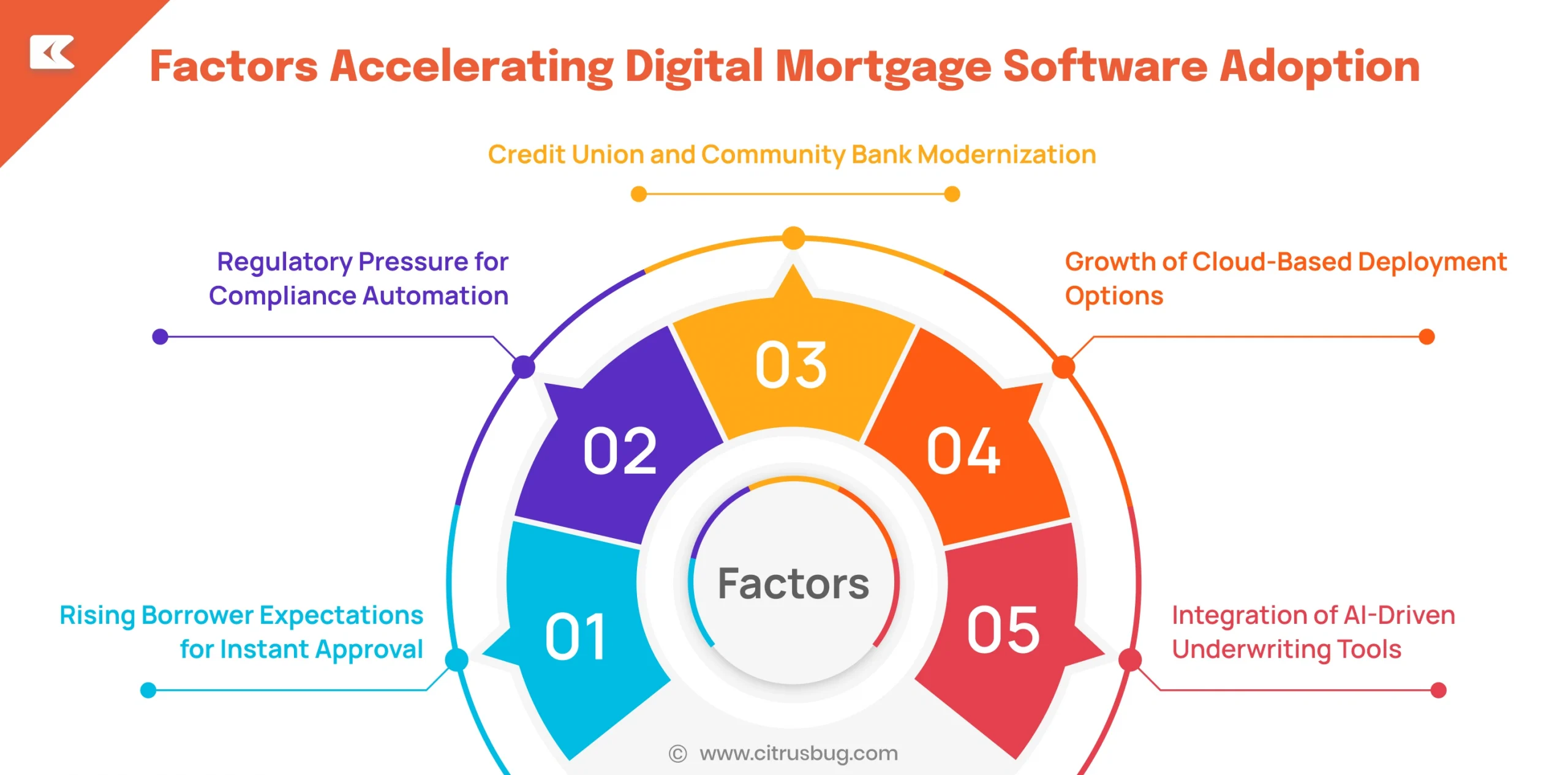
Several forces are pushing lenders toward digital platforms at the same time, rather than any single driver acting alone.
1. Rising Borrower Expectations for Instant Approval
- Borrowers increasingly expect mortgage applications to work like other digital financial services, with fast responses and minimal paperwork.
- Digital mortgage software allows applicants to upload documents, complete forms, and track application progress online.
- Automated verification can reduce the time lenders spend collecting and reviewing borrower information manually.
- Faster prequalification and approval processes can help lenders respond to borrowers before they approach competing lenders.
- Mobile-friendly applications make it easier for borrowers to apply and communicate with lenders from anywhere.
- Automated notifications keep borrowers informed about missing documents, application status, and next steps.
- A smoother digital experience can improve customer satisfaction and reduce application abandonment.
2. Regulatory Pressure for Compliance Automation
- Mortgage lenders must manage extensive requirements related to lending practices, data protection, disclosures, and record keeping.
- Digital mortgage platforms can automate compliance checks throughout different stages of the lending process.
- Automated workflows built with modern lending software development help ensure required documents, disclosures, and approvals are completed before an application moves forward.
- Built-in audit trails make it easier for lenders to track decisions, user actions, and changes made during the loan lifecycle.
- Compliance automation can reduce the risk of errors caused by manually entering or reviewing large amounts of information.
- Software can also help lenders apply consistent rules across applications, supporting more standardized processes.
- As regulations and reporting requirements evolve, configurable digital systems can make compliance updates easier to manage.
3. Credit Union and Community Bank Modernization
- Credit unions and community banks are modernizing their lending operations to compete with larger financial institutions and digital-first lenders.
- Legacy mortgage systems can make it difficult to provide the fast, convenient experiences borrowers now expect.
- Digital mortgage software helps smaller lenders automate repetitive tasks without completely rebuilding their lending operations.
- Modern platforms can connect loan origination, document management, customer communication, and other processes in one environment.
- Cloud-based solutions can also reduce the need for large upfront investments in on-premises infrastructure.
- Better access to borrower data can help lenders make faster decisions while maintaining their relationship-focused approach.
- Modern technology allows smaller institutions to improve efficiency while continuing to offer personalized service.
4. Growth of Cloud-Based Deployment Options
- Cloud deployment makes digital mortgage software more accessible to lenders that do not want to maintain extensive in-house IT infrastructure.
- Lenders can scale computing and storage resources as application volumes change, which is useful during periods of high demand.
- Cloud platforms can support remote access, allowing loan officers and other teams to work efficiently across different locations.
- Software updates and maintenance can often be managed centrally, reducing the operational burden on internal IT teams.
- Cloud environments also make it easier to connect mortgage platforms with APIs, third-party services, and financial data providers.
- Modern cloud architectures can support stronger backup, monitoring, and disaster recovery capabilities when configured properly.
- Flexible deployment options allow lenders to adopt digital mortgage capabilities gradually instead of replacing every system at once.
5. Integration of AI-Driven Underwriting Tools
- AI in the mortgage industry is helping lenders process large volumes of borrower and financial data more efficiently during underwriting.
- AI-powered tools can identify patterns across income, credit history, assets, liabilities, and other relevant information.
- Automated risk assessment can help underwriters prioritize applications that require closer human review.
- AI can also identify missing information or inconsistencies that may otherwise slow down the application process.
- When integrated with mortgage software, AI tools can reduce repetitive analysis and give underwriters more time to focus on complex cases.
- AI-supported decisioning can contribute to faster turnaround times when combined with appropriate human oversight and validation.
- Lenders still need strong governance, explainability, data quality controls, and regulatory review when using AI in lending decisions.
Future Outlook for the Digital Mortgage Software Market
Momentum in the digital mortgage software market looks set to build further as adoption barriers gradually ease and distribution channels widen.
- Friction between fintech vendors and credit unions is fading quickly. The share of fintech companies reporting no obstacles at all when selling to credit unions jumped from just 6% to 29% in a single year, opening the door to faster rollout of lending tools through smaller institutions.
- Consumer readiness for data sharing continues to build the foundation for automated verification. Roughly 80% of US consumers already link their financial accounts to digital tools, a habit that directly supports faster, document-free income and asset verification during underwriting.
- On the services side of open banking infrastructure that underpins digital verification, banking and capital markets already account for 40% of activity in mature markets like the UK, a signal of how central financial data-sharing has become to modern underwriting.
- Broker-facing platforms are proving that adoption can move fast once trust is established, with one national platform’s usage among brokers climbing from 73% to 85% in a single year.
Taken together, these trends point toward a digital mortgage software market where remote closings, AI-assisted underwriting, and automated verification stop being differentiators and simply become the standard way loans get done.
Benefits of Digital Mortgage Software
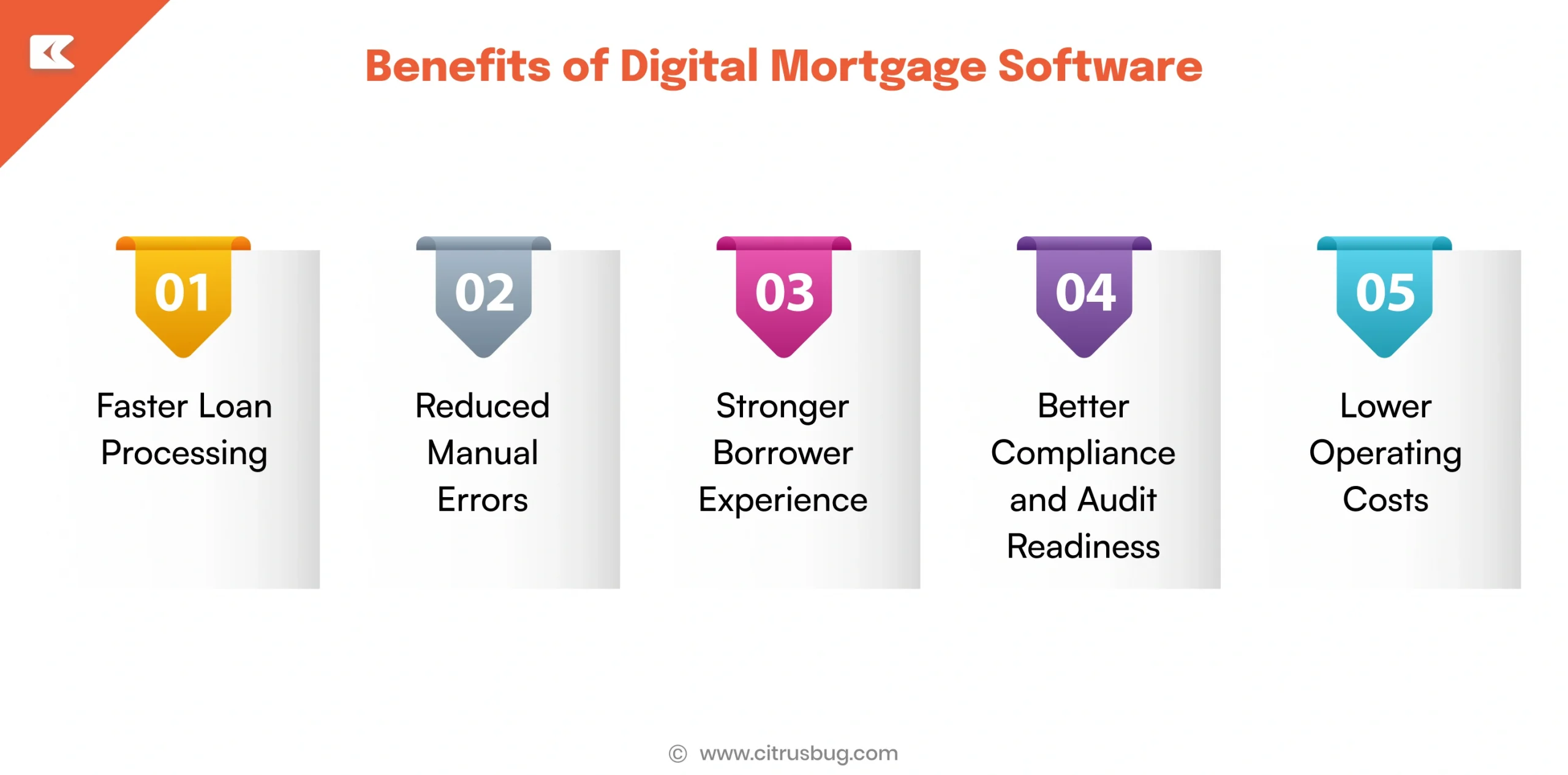
Lenders adopting these platforms see gains that touch nearly every part of the loan process, from the borrower’s first click to the final signature.
Faster Loan Processing
- Cuts the time between application and initial decision from days to hours in many cases
- Reduces back-and-forth document requests by pulling verified data automatically
- Speeds up appraisal and credit ordering through automated workflows
- Shortens the path from conditional approval to clear-to-close
- Allows lenders to handle volume spikes without adding staff
- Frees loan officers to spend more time advising borrowers instead of chasing paperwork
Reduced Manual Errors
- Pulls data directly from verified sources instead of manual re-entry
- Flags missing or inconsistent information before it reaches underwriting
- Applies consistent compliance checks across every file
- Cuts down on rework caused by typos or mismatched figures
- Creates a clean digital audit trail for every decision made
- Lowers the risk of costly compliance violations tied to human error
Stronger Borrower Experience
- Gives borrowers real-time visibility into where their loan stands
- Allows document uploads and signatures from any device, at any time
- Removes the need to take time off work for in-person closings
- Builds borrower confidence through clear, consistent communication
- Shortens the overall time to close, reducing borrower anxiety
- Creates a smoother handoff between loan officers, processors, and underwriters
Better Compliance and Audit Readiness
- Automatically timestamps and logs every document interaction
- Applies the same disclosure and documentation rules to every file
- Makes audits faster by keeping records organized and searchable
- Reduces reliance on manual checklists that can be skipped or missed
- Helps lenders respond quickly to regulator requests for file history
- Supports consistent recordkeeping across multiple branches or channels
Lower Operating Costs
- Cuts paper, printing, and courier costs tied to physical documents
- Reduces the staff hours needed for manual data entry and file prep
- Lowers the cost of correcting errors caught later in the process
- Allows smaller teams to manage higher loan volumes
- Reduces office space and storage needs for physical files
- Frees budget that can be redirected toward growth or borrower service
Conclusion
The digital mortgage software market is no longer defined by pilot programs or cautious experiments. Electronic notes, remote closings, and AI-assisted underwriting have become working parts of how loans get originated and closed across banks, credit unions, and independent lenders alike.
What comes next depends less on whether the technology works and more on how quickly trust, compliance clarity, and vendor readiness catch up with lender ambition.
Institutions that close that gap early and communicate clearly with borrowers along the way stand to gain the most as digital-first lending becomes the default rather than the exception.